
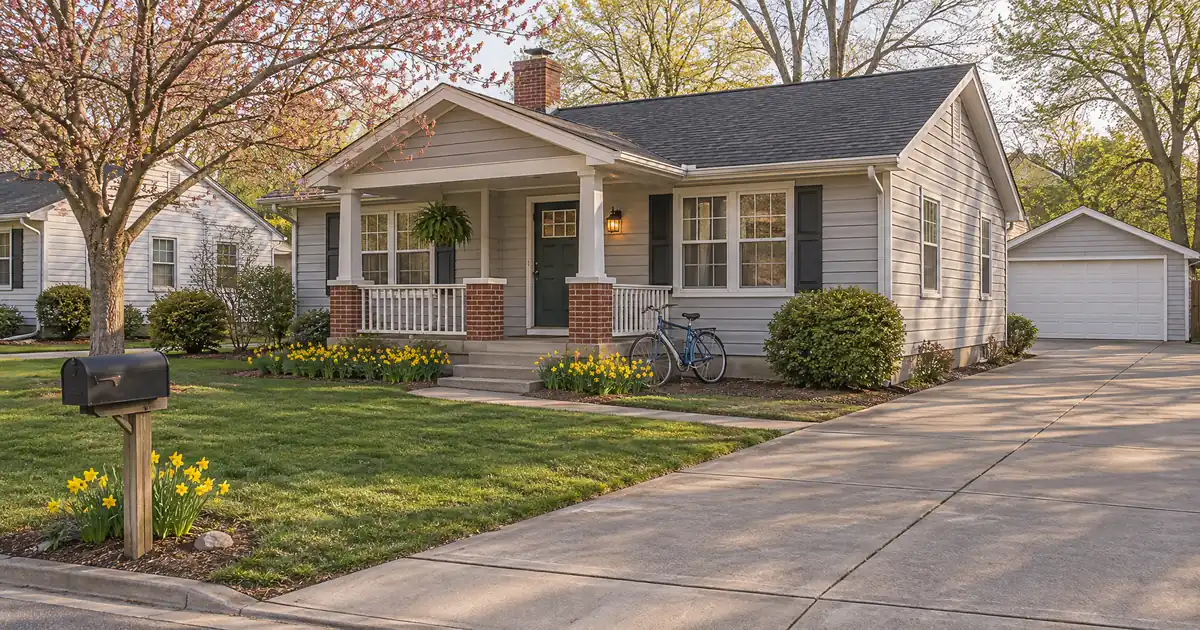
The Quick Read: The exception lets an heir skip the usual 12-month wait to live in a home before taking cash out with an FHA loan. It only holds if the heir has never treated the home as an investment property since inheriting it. Everything else still applies: the 80% loan-to-value cap, credit, income, the appraisal, and the heir’s use of the home as a primary residence.
What Is the Standard FHA Cash-Out Rule?
FHA cash-out normally requires you to have owned the home and lived in it as your principal residence for the 12 months before the FHA case number is assigned. A case number is the identifier the lender requests from FHA when your file starts. That date anchors the test.
FHA cash-out estimate
Seeded with an example value, a balance to match, and a round cash request; change any field.
Editable benchmark: 7.18% as of November 5, 2026 · Freddie Mac 30-year average via FRED®. A conventional market reference, not an FHA cash-out refinance quote.
Illustrative starting assumptions: a $350,000 home value, a $193,000 current balance, the FHA cap on a principal residence with the upfront premium financed, a thirty-year term at the current Freddie Mac benchmark, and property taxes and insurance estimated at typical national rates. Every field is editable.
An illustration, not a Loan Estimate, an approval, a quote, or a commitment to lend. The rate shown is the weekly Freddie Mac thirty-year conventional benchmark, used as a market reference; an FHA cash-out is priced by the lender at lock, and this is not an FHA cash-out refinance quote. HUD’s cap limits the base loan; the upfront premium is financed on top of the capped base loan; the monthly premium for the first year follows the snapshot’s schedule. Cash available means the base loan the cap permits less the balances retired, before closing costs, which this calculator leaves out. The line figure applies the line program’s combined loan-to-value ceiling to the same value and balance. Taxes and insurance are estimates you can edit. Licensed in sixteen states for consumer mortgages.
Across the wholesale programs Lendmire places FHA files with, the cash-out is capped at a maximum loan-to-value (LTV) ratio on a home owned and occupied for those 12 months, and the exact cap depends on the lender’s guidelines and your file. LTV is the new loan balance divided by the home’s appraised value. All figures are subject to lender guidelines and full file review.
The rule makes sense for a buyer. For someone who just received a house through a will, it can feel like a roadblock. The inheritance exception exists for that gap.
What Does the Inheritance Exception Actually Waive?
It waives the waiting period. That is all. FHA’s policy source, Handbook 4000.1, says an heir does not have to occupy the inherited property for a minimum time before a cash-out refinance. HUD publishes the handbook through its Housing Handbooks index. Check the current wording there, because HUD updates it regularly.
The exception comes with one condition. You cannot have treated the home as an investment property at any point since you inherited it. If you meet that condition, you can apply without first serving 12 months of occupancy.
There is a limit to what the exception does. It removes a timing test. It does not turn FHA into a loan for a house you will never live in. FHA is an owner-occupant program, and the home still has to be your principal residence.
Key Terms Defined
Heir: the person who receives the property through a will, trust, or state inheritance rules, and who holds title.
Investment use: renting the home or otherwise treating it as income property after you inherited it.
Case number: the FHA identifier assigned to your file, which sets the date the occupancy test is measured against.
Principal residence: the home where you actually live most of the year.
Adjusted value: the value FHA uses for the loan-to-value test, driven here by the appraisal.
Cash-out refinance: a new, larger loan that pays off the old one (if any) and puts the difference in your hands as cash.
How Is the Loan Underwritten, Step by Step?
The loan follows the same path as any FHA cash-out, minus the occupancy waiting period. Here is the sequence.
1. Confirm title and occupancy. You hold title and you live in the home. An heir who never moved in is not a fit for FHA cash-out.
2. Establish no investment use. The lender asks about rental history and occupancy since you inherited. Expect to answer plainly and back it up. Leases or rental income on your records would end the conversation.
3. Handle any existing mortgage. A free-and-clear home can still be refinanced as FHA cash-out. If the home carries a mortgage, FHA’s payment-history rules come into play, and the lender will tell you what it needs to see.
4. Order the appraisal. An inherited home has no purchase price, so the appraisal sets the value. The lender works from that appraised value when sizing the loan.
5. Size the loan. The new loan, including any liens that stay, must fit under 80% of adjusted value. County loan limits also apply.
6. Run standard underwriting. Credit, income, debt ratios, and the appraisal all decide the outcome.
On ratios: the base pair across the programs we place is 31/43, housing to total debt, with no compensating factors. Documented compensating factors can reach 40/50 at the top tier. Credit decisions start from a 580 decision score on the wholesale programs Lendmire works with.
How Much Cash Can You Actually Take?
Your cash will be less than 80% of the home’s value. The 80% cap covers the whole new loan. Payoffs, remaining liens, and costs come out of it first. Your cash is whatever is left.
HUD set the 80% cap in Mortgagee Letter 2019-11, which lowered the limit for cash-out refinances. HUD said the change aligned FHA with the maximum cash-out LTV the government-sponsored enterprises allow. The letter has since been folded into the handbook, so confirm the current figure there. Reserves and final terms vary by lender and program and follow the full file review.
Picture an heir whose inherited home has no mortgage. The entire 80% cap is available as a new loan, less costs. Now picture an heir who inherited a home with a loan on it. The payoff comes first, and cash to the borrower shrinks accordingly.
FHA cash-out also carries mortgage insurance. Across the programs we place, there is an upfront premium of 1.75% of the base loan, usually financed into the balance. There is also an annual premium between 0.15% and 0.75% of the balance, depending on term, loan amount, and LTV. Because the cash-out cap is 80%, a thirty-year cash-out loan sits in the lower-LTV group, where the annual premium ends after eleven years.
Standard Rule vs. Inheritance Exception
| Factor | Standard FHA Cash-Out | Inheritance Exception |
|---|---|---|
| Occupancy wait | 12 months before case number | Waived |
| Investment use | Not the test | Disqualifies you |
| Principal residence | Required | Still required |
| Max LTV | 80% | 80% |
| Credit and income | Full review | Full review |
Where Does the Exception Break Down?
Several situations fall outside the exception. Here are the common ones, and what to do about each.
| Situation | Exception Status | What to Do Next |
|---|---|---|
| Sole heir lives in the home, never rented | Applies | Gather documents and apply |
| Heir rented the home after inheriting | Lost | Live in it 12 months as a primary residence, then apply |
| Heir does not live in the home | Does not fit | Consider another loan type or structure |
| Home was gifted, not inherited | Not covered | The 12-month rule controls |
| Co-heirs, only one lives there | Depends | Occupying heir may fit; others generally cannot |
| 2-4 unit, heir lives in one unit | Described as available | Confirm with the lender |
Rented after inheriting. The exception requires that the home was never treated as an investment property after you inherited it, so a rental after you hold title puts it at risk. Whether a short rental voids the exception is a question for the lender, and an heir who rented should plan on the 12-month occupancy wait as the safe path. Rent collected earlier, such as by an estate, is not clearly addressed, so raise it with the lender up front.
Gifts are not inheritances. A relative who deeds you a house while alive has not created an inheritance. The 12-month rule controls.
Free-and-clear homes get no shortcut. Owning the house outright does not shorten anything beyond the exception itself. It does not block FHA cash-out either.
Co-heirs and buyouts. Heirs who do not live in the home generally cannot meet FHA’s occupancy test. Whether a sibling buyout fits a different refinance type depends on the program and the file.
FHA Streamline is a different product. It refinances an existing FHA loan with no appraisal and a limited credit review, but it offers no cash out. An inherited home with no FHA loan on it cannot use it.
Special cases. Other lenders’ programs, including conventional cash-out, carry their own seasoning rules and their own inheritance carve-outs. Some set stricter terms than FHA does.
What Documents Prove Your Case?
Plan to show how the home came to you and how you have used it. A practical checklist:
- Death certificate and the will, trust, or probate papers that name you.
- The recorded deed or other proof that title is in your name.
- Proof you live there, such as utility bills and a driver’s license showing the address.
- A statement that the home has never been rented, with no leases or rental income on your records.
- Mortgage statements, if a loan exists, showing payment history.
HUD’s exact document list is not something to guess at. Ask your loan officer what the lender requires. Probate timing matters too. If the estate still holds title, the transfer to you may need to finish before the file can move forward. An heir who has moved in but is not yet on title is generally not ready to apply.
Inheritance itself is not income on the loan file. The lender still looks at your regular income and debts.
Is FHA the Right Move for You?
It depends on what you need and how you use the home. Walk through these questions.
- Do you live there? If yes, FHA is on the table. If no, look elsewhere.
- Have you rented it, even once? If yes, the exception is gone. Occupy for 12 months first, or pick a different path.
- Do you need cash soon? The exception can save you up to a year of waiting. That matters for repairs, probate-related payoffs, or debt.
- Are you comfortable with mortgage insurance? FHA cash-out carries it regardless of how much equity you have.
The CFPB notes that a cash-out refinance can stretch out your payoff time and raise your monthly payment, because a larger loan replaces the current one. It also resets your interest rate and loan terms. Because the home is collateral, missed payments could put you at risk of foreclosure. Think carefully before using home equity to pay off other debts.
Myths vs. Facts
“I must wait 12 months after inheriting.” Not if the home was never rented or used as an investment.
“The exception waives everything.” It waives only the occupancy period. The 80% cap, the payment history, credit, and the appraisal all still apply.
“A paid-off house can’t be refinanced.” A free-and-clear home can be refinanced as FHA cash-out.
“Renting it briefly doesn’t matter.” Any investment use since inheritance voids the exception.
“A gift works like an inheritance.” It does not.
“I can borrow 80% as cash.” The 80% cap covers the whole new loan. Payoffs, liens, and costs come out first.
Frequently Asked Questions
Do I have to live in the inherited house to use the exception?
Yes. The exception waives the waiting period, not the principal-residence requirement. FHA is an owner-occupant program. If you do not live in the home, FHA cash-out is generally not the right fit.
What if the estate rented the house before I took title?
It is a gray area, and you should raise it with your loan officer immediately. The exception turns on whether you treated the property as an investment since inheriting it. Rent collected by an estate before transfer is a different fact pattern, and the lender decides how to read it from the documents.
Can I use the exception if the house has no mortgage?
Yes. The new loan still has to fit under 80% of the appraised value, and county loan limits apply.
How is FHA different from conventional for an heir?
Conventional cash-out has its own seasoning rules and its own inheritance carve-out, and the terms differ by program. FHA may suit borrowers with lower credit scores, though it adds mortgage insurance. Compare both on a Loan Estimate before choosing.
If I lose the exception, when can I apply?
After you have lived in the home as your principal residence for 12 months. The 12 months run before the FHA case number is assigned. Standard underwriting applies from there.
If you are weighing a cash-out refinance against keeping the loan you have, Lendmire can help you compare the programs and the equity each one reaches. Reach the team at 828-256-2183 or request a quote.
For current guidelines and terms, see Lendmire’s FHA loan programs page.
About Lendmire
As a mortgage broker (NMLS# 2371349), Lendmire helps homeowners and home buyers in 16 states with FHA, VA, conventional and jumbo purchase and refinance loans arranged through wholesale lenders. Lendmire is never the lender; program terms are set by the lender and the agency guidelines. Scotsman Guide named Lendmire a Top Mortgage Workplace in both 2025 and 2026.
Get Started
Ready to find the right loan for you?
See your offer in seconds. No credit pull, no obligation.
Informational only. Not a Loan Estimate, approval, or commitment to lend. Program availability and eligibility are subject to lender guidelines, credit approval, property review, and underwriting.
References
1. HUD Housing Handbooks (Handbook 4000.1 index)
2. HUD Mortgagee Letter 2019-11
4. CFPB Older Americans Housing Guide (using home equity)
This article is part of Lendmire’s FHA cash-out refinance program — full qualification details, guidelines, and scenarios live on the program page.
Related reading: FHA Cash-Out vs Conventional Cash-Out for a Homeowner on a Deadline · How FHA Cash-Out Underwriting Works After a Conventional Denial · How to Switch From an FHA Streamline to an FHA Cash-Out
Brandon Miller
Founder & CEO, Mortgage Loan Originator, Lendmire LLC
- Mortgage Loan Originator · NMLS# 1129696 · Verify on NMLS Consumer Access
- North Carolina Real Estate Broker · License# 343312 · Verify on NCREC
- North Carolina Insurance Producer · License# 19053198 · Property, Casualty, Life, Health · Verify on NAIC SBS
- Lendmire LLC · Firm NMLS# 2371349 · Verify firm licensure
Compliance and disclosures. Lendmire (NMLS# 2371349) is a licensed mortgage broker and is not a direct lender, depository institution, financial advisor, or tax professional. Content in this article is general market analysis and educational information — not financial, legal, or tax advice for any specific situation. Lendmire does not guarantee loan approval; every transaction is subject to underwriting by the funding lender. Mortgage pricing and loan program guidelines are subject to change at any time without notice and vary by borrower characteristics, property type, and state regulations. Lendmire complies with Equal Housing Opportunity. Licensure verification: NMLS Consumer Access.