
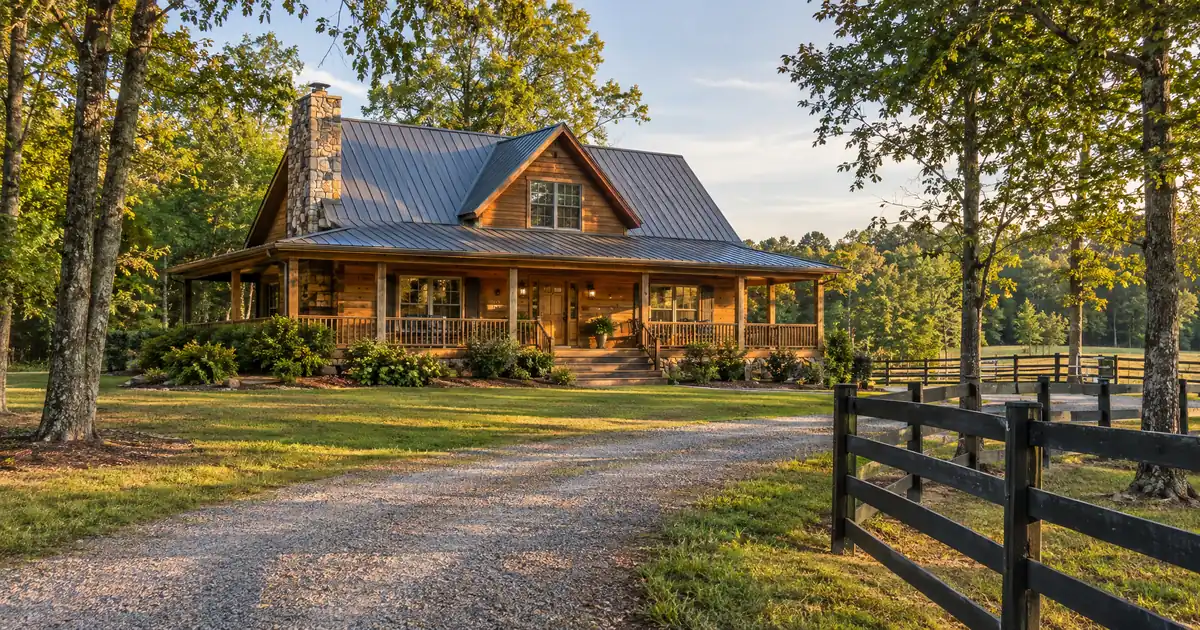
The Quick Read: Usually yes, because acreage alone does not disqualify a home. Three things decide the outcome. You must have owned and lived in the home for 12 months. The property must read as a residence, not a farm. And the appraiser must credit the land. Your cash-out tops out at 80% of the value the appraiser assigns.
That last point is where most rural borrowers get surprised. The loan is built on the appraiser’s number, not on the number you carry in your head for the whole parcel.
Lendmire’s FHA cash-out refinance program works through wholesale lenders. A cash-out refinance replaces your current mortgage with a new, larger one, and you take the difference as cash. Every figure below is subject to lender guidelines and a full file review, and none of it is a commitment to lend.
Key Terms Defined
A few terms come up again and again on rural files. Here they are in plain words.
- Cash-out refinance: a new mortgage that pays off your old one and hands you part of your equity as cash.
- Equity: the part of the home’s value you own, meaning value minus what you owe.
- LTV (loan-to-value): the new loan as a percentage of the appraised value.
- Excess land: land the home does not need, which could be sold off separately.
- Surplus land: extra land the home does not need but that cannot be separated and sold off.
- Outbuilding: a barn, shop, shed or garage separate from the house.
- Residential character: whether the property looks and works like a home first, not a business.
- Adjusted value: the value the lender uses to apply the LTV cap, which for FHA cash-out is the appraiser’s figure for the home and the land the appraiser credits.
Does Acreage Disqualify You?
No. Acreage by itself does not disqualify a home, and FHA policy does not set a fixed acre limit. Be wary of anyone quoting a flat “FHA counts only the first so many acres” rule as if it were official. That is a rule of thumb at best.
What FHA does control is how land is valued. The appraiser has to decide how much land supports the home and how much is extra. That decision flows straight into your loan amount.
Think of it as a residence-first test. Does the property look like a house on a lot that happens to be large? Or does it look like a working operation with a house attached? The first reads as a home. The second raises questions, and lenders will ask how you use the land.
Zoning matters too. FHA’s single-family programs are generally for one- to four-unit owner-occupied principal residences, and the property should comply with applicable zoning. A lot zoned agricultural is not an automatic problem, but the lender will want to know the home is a legal residence.
What Do You Need to Qualify First?
Before anyone talks about land, the borrower has to clear the cash-out gates. These are the ones I see on nearly every file.
Ownership and occupancy. The FHA cash-out reaches 80% LTV on a home you have owned and occupied for the 12 months before the case number is assigned. A case number is FHA’s tracking number for your loan. The lender documents occupancy with things like utility bills or employment records. A second home or a rental does not qualify on this path, because FHA is for the home you live in. Leverage, reserves, and pricing vary by lender and program; the final terms follow the full file review.
Payment history. Lenders look at your mortgage payments over the prior year. Late payments on the existing loan can stop a cash-out cold.
Ratios and credit. Underwriters compare your housing and total monthly obligations to your income. The base pair is 31/43 with no compensating factors. Documented factors can stretch it toward 40/50 at the top tier, and the automated underwriting finding governs most files. Nothing about rural land changes those standards.
County loan limits apply. The new loan must fit inside the FHA limit for your county. Those limits change every year, so ask your loan officer for the current one rather than trusting an old article.
One more point on occupancy. The hobby-farm owner who also rents out a second house on the parcel is the borrower who needs a conversation first. Lenders treat a rental unit very differently from a guest cottage.
How Much Can You Borrow?
The cap is 80% of the adjusted value. HUD cut the maximum cash-out LTV from 85% to 80% to align with the conventional market, according to HUD’s announcement. Older articles still quote 85%, so treat those as outdated. Terms vary by lender guidelines, property type, leverage, credit profile, and full file review.
The 80% also applies to your combined loans. If a second lien stays in place, it counts toward the ratio. In plain terms, you must keep at least 20% equity in the home after closing.
Cash-out is also not the same as a rate-and-term refinance. The FHA rate-and-term with an appraisal reaches 97.75% on a principal residence occupied for the previous twelve months, but it gives you no cash. If your goal is only to restructure the loan, that route leaves more room. Cash-out trades leverage for access to equity.
FHA mortgage insurance comes with any of these loans. There is an upfront premium of 1.75% of the base loan, which can be financed. There is also an annual premium between 0.15% and 0.75% of the balance, depending on term, loan amount and LTV. On a thirty-year loan at or below 90% LTV, the annual premium ends after eleven years. These are program mechanics, not a quote. Your Loan Estimate shows the real numbers.
How Does the Appraiser Treat Your Land?
The appraiser is the person who decides how much of your acreage counts. For FHA, the appraiser must be on the FHA Roster, and the value they set is the starting point for everything. In its handbook glossary, HUD defines excess land as land not needed to support the existing improvement, which may be sellable separately.
Here is how the pieces typically play out. The appraiser makes the final call on each one.
| Feature | Typical treatment | What to do |
|---|---|---|
| House and home site | Counted in value | Keep the home well maintained |
| Land supporting the home | Usually counted | Document how you use it |
| Excess land (divisible) | Value excluded | Expect a lower base for the 80% cap |
| Surplus land (not divisible) | May be included | Ask the lender how it was treated |
| Personal-use barn or shop | Often counted as part of the property | Show it is for personal use |
| Commercial farm structures | May draw extra review | Be ready to explain the use |
The line between excess and surplus is the heart of it. Excess land can be split off and sold. When it can, the appraiser describes it, supports that finding, and leaves its value out. The whole parcel still secures the mortgage. But the value that sets your cash-out ceiling shrinks.
Surplus land cannot be split off, so the appraiser generally includes it. Still, land that cannot be sold off may not add much value in practice. Appraisal is partly judgment, and rural comparables are thin. Expect some range.
A Worked Example
Say your whole parcel feels like it is worth 100 in your head. These are illustrative figures, not a market fact. The appraiser could land in three places.
| Appraisal outcome | Share of your estimate the appraiser credits | Loan cap at 80% |
|---|---|---|
| Land fully credited | 100% | 80% of your estimate |
| Some excess land excluded | 80% | 64% of your estimate |
| Large divisible acreage excluded | 60% | 48% of your estimate |
Same house. Same land. Three very different ceilings.
Now subtract what you owe. Your existing mortgage gets paid off first, and only the remainder comes to you as cash. If the ceiling falls to 48% of your own estimate and your current balance is already near that, there may be little or no cash left. The closing costs and the financed upfront premium come out of the same pool.
That is why I tell rural borrowers to focus on equity, not acreage. A big parcel does not create cash on its own. The appraised value of what the lender can count does.
Here is the honest bottom line. The cash-out often works well for a home with a modest lot and a few extra acres. It gets harder when most of the value sits in land that can be divided off.
Rural Complications That Come Up
Working farms and income land. The lender will ask how you use the land. A home with a pasture, a few animals and a garden is not automatically a farm. A property used mainly to produce income is a different file.
Conventional guidelines are clearer on this point. Freddie Mac’s guide says residential use with agricultural-type outbuildings is eligible, and properties used primarily for farming or ranching are not. That tells you how the whole market thinks about it: use matters more than acreage.
Wells and septic. Rural homes usually have both, and lenders check them. HUD has put out guidance on well-distance requirements for existing homes. Ask your lender how it applies to your property rather than assuming either way.
Manufactured homes on land. These carry their own FHA requirements on top of the cash-out rules. Raise this on the first call.
Multiple parcels. If your land is one tract, the appraiser may value it as a single site. If it is several platted lots under one ownership, one or more may be excluded. Check your deed and survey before the appraisal, not after.
Inherited homes. Occupancy timing can work differently when you inherited the property. Ask the lender how the 12-month clock applies to you.
Free-and-clear homes. Yes, you can do a cash-out on a home with no mortgage. The loan then simply creates your first mortgage.
Texas and other states. Some states put extra rules on cash-out against a homestead. Texas is the best-known example.
If FHA Doesn’t Fit
Sometimes the land is too much for FHA to credit. That does not leave you without options. Each one trades something.
| Option | Cash back? | How land is treated | Best fit |
|---|---|---|---|
| FHA cash-out | Yes, to 80% LTV | Excess land excluded | Primary home, modest acreage |
| Conventional cash-out | Yes | Residential use test | Stronger credit, more equity |
| Home equity loan or HELOC | Yes | Depends on lender | Keeping a low-cost first mortgage |
| USDA programs | Generally not designed for cash-out | Excludes income-producing land | Rural purchases |
| Farm or hobby-farm lending | Varies | Land and use both count | Properties with real farm use |
A home equity loan or line of credit leaves your original first mortgage in place. A cash-out replaces it. That is the real decision for many people. If your current first mortgage has terms you like, replacing it just to reach equity may cost more than a second lien. If you want to restructure the whole loan, cash-out can make more sense.
Lenders vary here. Some set higher credit floors or tighter rural rules than others, and a file that stalls with one wholesale lender can fit another. That is part of why a broker exists.
How to Prepare for a Rural Appraisal
A little preparation goes a long way on land-heavy files.
1. Pull your deed, survey and legal description. Know whether you have one parcel or several.
2. Write down how you use the land. Garden, pasture, timber, a few animals. Be specific and honest.
3. List every outbuilding and its purpose. Make clear which are personal-use.
4. Gather proof of occupancy. Utility bills and similar records help show the 12 months.
5. Check your mortgage payment record. Fix anything odd before you apply.
6. Know your well and septic status. Records and recent inspections help.
7. Ask the lender to use an appraiser familiar with rural sales. Comparable sales are what carry the value.
If the appraisal comes in low, ask what comparables and land adjustments drove it. Sometimes a missed detail, like an outbuilding or a recent improvement, can be corrected. Sometimes the number simply stands. You can then decide whether the smaller cash-out still makes sense.
What to Weigh Before You Take the Cash
Cash-out is a tool, not free money. You are replacing your mortgage with a bigger one, so the balance and the monthly obligation both rise. Closing costs and the FHA mortgage insurance flow into that new loan.
Why do people do it? In CFPB survey research, paying off other bills or debts was the most common reason, followed by home repairs or new construction. Both are sensible uses. Both also mean you are turning short-term costs into a long-term loan against your home.
That is the risk worth saying out loud. If you convert unsecured debt into mortgage debt and then cannot keep up the payments, the home itself is on the line. Run your monthly budget honestly before you commit.
Tax treatment can depend on your situation; borrowers should speak with a qualified tax professional before relying on any deduction or credit.
One more practical note: the handbook that governs all this gets updated. HUD lists the current version on its Housing Handbooks page, and your lender works from that version, not from an old summary.
Where to Go From Here
If you are weighing a cash-out refinance against keeping the loan you have, Lendmire can help you compare the programs and the equity each one reaches. Bring your deed, a rough list of your outbuildings, and the balance on your current mortgage. That is enough to start a useful conversation about how much of your land the appraiser is likely to credit.
Frequently Asked Questions
Is there an acreage limit for an FHA cash-out?
FHA policy does not set a fixed acre limit. The practical limit is how much land the appraiser can support as part of the home’s value. Large parcels often get part of the land excluded, which lowers the base for the 80% cap. A lender may also have its own overlays, so ask early.
Do barns and outbuildings count toward the value?
Often yes, when they are for personal use and fit the property. A garage, shop or small barn that serves the household usually reads as part of a residence. Buildings built for commercial farming may draw extra review. Document what each one is used for before the appraiser visits.
What if my land is zoned agricultural?
It can still work. The key question is whether the home is a legal residence under local zoning. Agricultural zoning raises questions, so the lender will ask for clarity on the home’s status. Bring any zoning letter or permit records you have.
Can I cash out if I rent out or farm part of the land?
It gets harder. FHA is for your principal residence, so a property used mainly to produce income is a different file. A home with some personal-use land may be fine. A rented second dwelling or income-producing farmland needs a direct conversation with the lender before you apply.
Does the new loan cover the whole parcel?
The whole parcel generally secures the mortgage, even if some excess land was left out of the value. Only the value the appraiser credits counts toward the loan amount. So you pledge all of the land but can borrow against only part of it.
For your own numbers, request a scenario review with Lendmire.
About Lendmire
Lendmire (NMLS# 2371349) is a mortgage brokerage serving homeowners and home buyers in 16 states. FHA, VA, conventional and jumbo purchase and refinance loans are arranged through wholesale lending channels; Lendmire brokers the financing and the lender underwrites each application. Scotsman Guide named Lendmire a Top Mortgage Workplace in both 2025 and 2026.
For the program’s current guidelines, see FHA loan programs.
Get Started
Ready to find the right loan for you?
In about 30 seconds you can review financing options available for your home or investment property. No commitment required.
Informational only. Not a Loan Estimate, approval, or commitment to lend. Program availability and eligibility are subject to lender guidelines, credit approval, property review, and underwriting.
References
1. HUD press release on the FHA cash-out LTV change
2. HUD Handbook 4000.1 glossary (excess land and property value)
3. Freddie Mac Guide, rural properties FAQ
5. HUD Housing Handbooks (Handbook 4000.1 listing)
This article is part of Lendmire’s FHA Loan series — every loan program’s qualification details, guidelines, and scenarios live on the loan options page.
Related reading: How to Do an FHA Cash-Out on a Texas Second Home · FHA Cash-Out vs FHA 203k for a Home Worth More After Repairs · Can a Texas Acreage Homestead Be Refinanced After an FHA Cash-Out?
Brandon Miller
Founder & CEO, Mortgage Loan Originator, Lendmire LLC
- Mortgage Loan Originator · NMLS# 1129696 · Verify on NMLS Consumer Access
- North Carolina Real Estate Broker · License# 343312 · Verify on NCREC
- North Carolina Insurance Producer · License# 19053198 · Property, Casualty, Life, Health · Verify on NAIC SBS
- Lendmire LLC · Firm NMLS# 2371349 · Verify firm licensure
Disclosures. The information presented in this article is general market commentary, not financial, legal, or tax advice. Lendmire is a mortgage brokerage (NMLS# 2371349) — not a direct lender or depository institution — and loan placement is subject to lender underwriting. Nothing in this content represents a commitment to lend. Loan terms, pricing, and program availability vary based on borrower qualifications, property characteristics, and state of subject property, and are subject to change at any time. Lendmire complies with Equal Housing Opportunity requirements. Consumer access: nmlsconsumeraccess.org.