
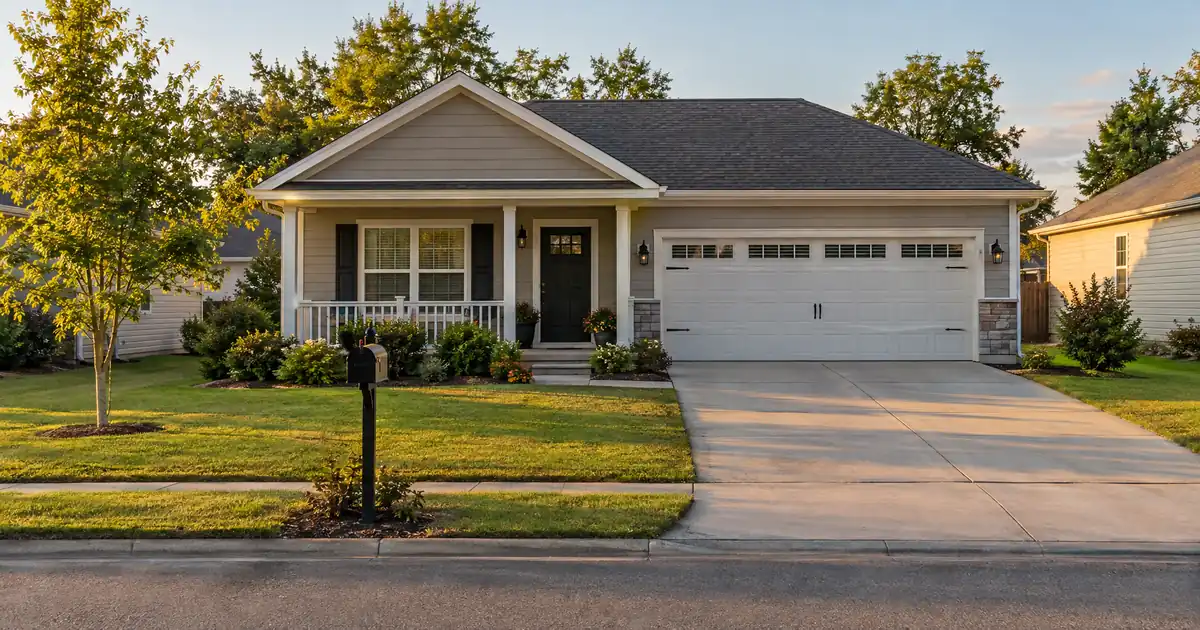
The Quick Read: An FHA cash-out refinance swaps your current mortgage for a larger one and hands you the difference in cash. The new loan can reach 80% of your home’s appraised value. The checklist below has three parts: confirm you qualify, gather your documents, and line up offers on equal terms.
Key Takeaways
- The cash-out ceiling is 80% of appraised value. The appraisal, not your pay-down history, sets the number.
- The home must be your principal residence. It also must have been owned and occupied for 12 months before the case number is assigned.
- FHA mortgage insurance applies: an upfront premium of 1.75% (financed) and an annual premium.
- Two offers can differ a lot for the same borrower, so request the same loan type from each lender and compare them line by line.
- Cash-out turns home equity into a larger loan secured by the home. Weigh it against the other ways to borrow.
What Is an FHA Cash-Out Refinance (and What Isn’t It)?
It is a new FHA-insured first mortgage that pays off your old one and sends the leftover equity to you. The old loan can be FHA or non-FHA. The funds can go to almost any purpose, such as repairs, debt payoff, or tuition.
Here is how the FHA refinance options differ:
| Refinance type | What it does | Cash to you? |
|---|---|---|
| Cash-out | New loan up to 80% LTV | Yes |
| Rate-and-term | Changes the term or loan structure; reaches 97.75% | No (costs only) |
| Streamline | Refinances an existing FHA loan, no appraisal | No |
LTV means loan-to-value: the loan balance divided by the home’s appraised value. The cash-out figure is much lower than the rate-and-term figure because you are borrowing against equity, not just restructuring debt. Lenders treat that as higher risk.
The streamline is not a cash tool. It needs an existing FHA loan, a limited credit review, and a net tangible benefit. Across the wholesale programs where these files are placed, the FHA cash-out is a separate track with its own appraisal and underwriting.
Lendmire’s FHA cash-out refinance program page lays out how Lendmire, as a mortgage broker, arranges these loans through wholesale lenders. The rest of this article works as a checklist you can run before you apply.
One more point on scope. FHA single-family programs cover owner-occupied homes. If you are hoping to pull cash from a second home or a rental, this program does not reach it. Occupancy decides the leverage.
Phase 1: Your FHA Cash-Out Refinance Program Checklist for Eligibility
Work through these in order. If you can’t tick one, fix it before you apply.
☐ Principal residence. You live there for most of the year. It is a one- to four-unit property, and you occupy one unit.
☐ Owned and occupied for 12 months. The program reaches 80% LTV on a home you owned and occupied for 12 months before the case number. (A case number is the FHA file identifier assigned when the lender starts your loan.) Some situations, such as an inherited home, may be treated differently. Ask the lender how it documents them.
☐ Clean recent payment history. Lenders read your mortgage payment history closely. Recent late payments on the current loan are among the fastest ways to stall a cash-out file.
☐ Credit that fits the lender’s floor. Credit minimums for cash-out vary by lender, and many lenders set a higher floor than the FHA baseline. Ask each lender for its floor in writing.
☐ Debt ratios inside the range. The base pair is 31/43. That means housing costs up to 31% of gross income and total debts up to 43%. Documented compensating factors can stretch that to 40/50 at the top tier. Compensating factors include things like cash reserves or a strong payment record. The automated underwriting finding governs most files.
☐ Enough equity. The new first mortgage plus any liens that stay in place must fit under 80% of adjusted value. Liens that remain can include a second mortgage or a home equity line.
☐ A property that appraises and meets condition standards. Three- and four-unit homes may face added tests, such as reserves. Lenders differ here, so ask early.
Every figure in this section is subject to lender guidelines and full file review. None of it is a commitment to lend.
Why Is the Cap 80%? (The Old Numbers Are Out of Date)
You will still see pages that say FHA allows 85% or even 95% cash-out. They are stale. HUD Mortgagee Letter 2019-11 cut the maximum LTV and combined LTV on FHA cash-out refinances to 80% of adjusted value. It applies to case numbers assigned on or after September 1, 2019. Loans on Section 247 Hawaiian Home Lands are excluded. Leverage, reserves, and pricing vary by lender and program; the final terms follow the full file review.
HUD explained the change as a way to reduce risk to the FHA insurance fund while still letting homeowners turn equity into cash. It also lined FHA up with the cash-out limit at Fannie Mae and Freddie Mac. HUD moved the cap from 95% to 85% in 2009 and then to 80%.
So if a lender quotes you a number that implies more than 80%, ask what program it is. It may not be an FHA cash-out.
Phase 2: Documents to Gather
Lenders ask for documents that match how you earn. Pulling them together before you apply keeps your file from stalling on a missing page.
| Document | Why it is needed | Who needs it |
|---|---|---|
| Recent pay stubs and W-2s | Verify income | Employees |
| Traditional personal-income documentation and a year-to-date profit sheet | Verify business income | Self-employed |
| Award letters and statements | Verify retirement income | Retirees |
| Current mortgage statement | Confirm payoff and history | Everyone |
| Proof of residence | Confirm occupancy | Everyone |
| Bank statements | Confirm assets and reserves | Everyone |
| Same set of income documents | Add the second borrower’s file | Co-borrowers |
Two habits help. First, explain any large recent deposit in writing before the underwriter asks. Second, disclose every debt, including small ones. An undisclosed account that shows up on a credit report can reset your approval.
Self-employed owners sometimes find that their traditional personal-income documentation shows less income than they actually earn. Lendmire’s piece FHA Cash-Out Refinance for Homeowners Whose Tax Returns Understate Income covers that situation.
How Much Cash Will You Actually Get?
The check is smaller than 80% of your value. The payoff, closing costs, and mortgage insurance all come out of the ceiling first. Here is the math in percentages of value, with no dollars.
Say your home appraises at 100% of its value, and your current mortgage payoff equals 52% of that value.
- Ceiling: 80% of value.
- Room under the ceiling: 28 points of value (80 minus 52).
- Costs and mortgage insurance: these come out of that room.
- Cash to you: whatever remains after costs.
Mortgage insurance has two parts. The upfront premium is 1.75% of the base loan and is usually financed into the loan. The annual premium runs between 0.15% and 0.75% of the balance, depending on term, loan amount, and LTV. HUD’s schedule sets the upfront premium as a percentage of the base loan amount. On a thirty-year loan above 90% LTV, the annual premium lasts for the term. At or below 90%, it ends after eleven years. Cash-out loans at 80% sit in the second group.
The appraisal can change everything. A low value shrinks the ceiling and the cash. It can also trigger a revised Loan Estimate. Ask each lender how the financed premium sits against the 80% test. The worksheet will show it.
Now run your own numbers. Write down your value estimate, your payoff, and 80% of value. Subtract the payoff. Then subtract the costs the lender shows you. What is left is your realistic check.
How Do You Compare Offers Side by Side?
Request the same loan type from each lender. The CFPB’s guidance on shopping for a mortgage suggests comparing at least three offers. Several mortgage inquiries in a short window should have no major effect on your credit score.
Use the Loan Estimate, the standard form every lender must give you. It is not an approval. You are not committed to anyone until you sign the final closing documents.
Build a worksheet with a column for each lender. Fill in these rows:
| Line to compare | What to look for |
|---|---|
| Loan type and amount | Same FHA cash-out, same ceiling |
| Origination charges | Itemized, not bundled |
| Services you cannot shop for | Compare lender to lender |
| Services you can shop for | You may choose your own provider |
| Lender credits | Check what they cost you elsewhere |
| Tax and insurance estimates | Same assumptions each time |
| Estimated cash to close | Your real check |
The CFPB’s Loan Estimate explainer tells you to compare origination charges across lenders and to look at the “Services You Cannot Shop For” section. You can shop separately for the “Services You Can Shop For” items.
Watch the lender credit line. A credit is not free money. The cost moves into the loan terms or the balance. Likewise, a “no-cost” refinance still has costs. They are built into the loan somewhere. Whatever shows up in the pricing line, the useful question is what you pay in total over the years you keep the loan.
Questions to ask every lender:
1. What credit floor and payment-history standard do you apply to FHA cash-out?
2. Do you add rules beyond FHA’s base guidelines, such as minimum loan size or extra waiting periods?
3. How does the financed premium count against the 80% test?
4. What do you need for my income type?
5. When would you issue a revised Loan Estimate? Terms vary by lender guidelines, property type, leverage, credit profile, and full file review.
Lenders can add rules on top of FHA’s base guidelines. That is why the same borrower can get different answers. Comparing like for like exposes the difference.
Phase 3: Appraisal, Underwriting, and Closing
This stage runs in a set order. Each step has its own checkpoint.
1. Apply and receive the Loan Estimate. Confirm the loan type reads FHA cash-out.
2. Appraisal. The appraiser sets adjusted value, and that value caps your loan. Be home when scheduled and note any recent upgrades.
3. Underwriting. The lender reviews your payment history, credit, income, and the appraisal together.
4. Closing. The new loan pays off the old mortgage and costs. The remainder goes to you or directly to creditors if you are paying off debts.
Common delay triggers:
- Occupancy proof that does not match your application, such as a different mailing address on key accounts.
- Recent late payments on the current mortgage.
- A debt that shows up late in the process.
- Large deposits with no paper trail.
- An appraisal that comes in below your estimate.
A low appraisal does not always end the deal. It does shrink the check, so run the math again before you commit.
After Closing: Where the Money Goes
Two things change right away. Your balance is larger, and your payment schedule starts over on the new loan. You also carry the annual mortgage insurance in the monthly payment.
Cash-out funds can go to any purpose. Use them with care. Paying off unsecured debt, such as credit cards, turns that debt into debt secured by your home. That swap can lower the monthly strain, but a missed payment now puts the house at risk.
Closing costs are also a common use of cash-out funds. The CFPB’s research on cash-out refinances notes that costs can be substantial, including origination fees, appraisal, title insurance, and other taxes and fees. A new lender usually requires its own title insurance policy, because your existing owner’s policy does not carry over to a new lender.
Tax treatment can depend on your situation; borrowers should speak with a qualified tax professional before relying on any deduction or credit.
Is It Worth It?
Costs, Trade-Offs, and Break-Even
A cash-out refinance replaces your first mortgage. That has consequences you should weigh.
| Upside | Trade-off |
|---|---|
| One loan, one payment | Larger balance |
| Access to equity in one lump sum | Home is collateral |
| FHA underwriting can fit modest credit | Mortgage insurance applies |
| Funds usable for many purposes | Costs reduce the check |
Think about break-even. Count the one-time costs and the mortgage insurance you will pay over the years you keep the loan. Then ask whether the cash does enough for you to justify that total. A repair that protects your home’s value may pass the test. A discretionary purchase may not.
Also consider what you give up. If your current first mortgage has a structure you value, replacing it means starting over. That matters if you plan to move soon, since you may not hold the new loan long enough to recover the costs.
When Another Option Fits Better
FHA cash-out is one tool among several. Here is a quick screen:
| Your situation | Option to consider |
|---|---|
| Need a small sum, keep your current first loan | Home equity loan or line |
| Strong credit and plenty of equity | Conventional cash-out |
| Want a lower payment, no cash needed | Rate-and-term or streamline |
| Existing FHA loan, no cash needed | FHA streamline |
Conventional cash-out has its own rules and mortgage insurance structure, and FHA’s 80% cap lines up with it. If your credit is strong, a conventional loan may deserve a quote. If your credit is thinner or your debt ratios run high, FHA’s flexibility can be the better route.
Lendmire’s piece on choosing between refinance programs walks through that decision in more detail.
Red Flags and Common Mistakes
- Treating a Loan Estimate as an approval. It is a quote, not a commitment.
- Assuming 80% means that much cash. The appraisal, costs, premium, and underwriting all affect the outcome.
- Comparing different loan types. An FHA cash-out and a conventional cash-out are not the same product.
- Trusting nicknames. Marketing labels for refinances are not official programs. If an ad uses a catchy name, ask what loan it is and who insures it. Scammers also exploit these labels.
- Ignoring the closing costs. They come out of your cash.
- Skipping the 12-month check. The seasoning requirement trips up buyers who bought recently.
Key Terms Defined
Adjusted value: The appraised value FHA uses to set the maximum loan. It is the base for the 80% limit.
LTV (loan-to-value): The loan balance divided by the home’s value. An 80% LTV means the loan equals 80% of value. Exact terms depend on the lender’s guidelines, property type, leverage, and a full review of the borrower’s file.
Upfront mortgage insurance premium: A one-time FHA insurance charge, 1.75% of the base loan, usually financed into the loan.
Annual mortgage insurance premium: A yearly FHA insurance charge built into the monthly payment. It runs between 0.15% and 0.75% of the balance.
Loan Estimate: A standard form each lender gives you so you can compare offers. It is not an approval.
Principal residence: The home where you live for most of the year. FHA cash-out is limited to this kind of home.
Next Steps
If you are weighing a cash-out refinance against keeping the loan you have, Lendmire can help you compare the programs and the equity each one reaches. Lendmire is a mortgage broker, so it shops wholesale lenders for you rather than lending itself. Bring your payoff statement, a rough value estimate, and your income documents, and the comparison gets sharper from the first conversation.
Frequently Asked Questions
Can I do an FHA cash-out refinance if my current loan isn’t FHA?
Yes. The new loan is an FHA loan, and it pays off whatever mortgage you have now. The old loan can be conventional or another type. The home must still meet the owner-occupancy and 12-month ownership requirements, and the 80% ceiling applies.
Does an inherited home have to meet the ownership period?
It may not. FHA treats inheritance differently from a purchase, and a lender may waive the standard occupancy period if the property was not treated as an investment after you inherited it. Lenders document this differently, so ask yours what it needs before you apply.
Will shopping for offers hurt my credit score?
Several mortgage inquiries in a short window should have no major effect on your score, according to the CFPB. Comparing at least three offers is the CFPB’s own suggestion. Keep the shopping within a tight stretch rather than spreading it across months.
Can I use FHA cash-out on a rental or second home?
No. FHA single-family programs are for owner-occupied principal residences, so second homes and rentals are outside this program. Occupancy decides what leverage you can reach.
Why do two lenders give me different answers on the same FHA cash-out?
Lenders can add rules on top of FHA’s base guidelines, such as a higher credit floor or a minimum loan size. Each one also prices and structures its offer differently. Request the same loan type from each, and compare the Loan Estimates line by line. Every figure here varies by lender and program — guidelines, property type, leverage, and credit profile all apply.
For your own numbers, request a scenario review with Lendmire.
About Lendmire
Lendmire, NMLS# 2371349, is a mortgage brokerage with consumer lending licenses in 16 states. FHA, VA, conventional and jumbo purchase and refinance loans are arranged through wholesale lending partners, and each application is reviewed individually by the lender. Scotsman Guide named Lendmire a Top Mortgage Workplace in both 2025 and 2026.
Get Started
Ready to find the right loan for you?
In about 30 seconds you can review financing options available for your home or investment property. No commitment required.
Informational only. Not a Loan Estimate, approval, or commitment to lend. Program availability and eligibility are subject to lender guidelines, credit approval, property review, and underwriting.
References
1. HUD Mortgagee Letter 2019-11
2. HUD press release on cash-out limits
3. HUD Mortgagee Letter 2023-05
4. CFPB: Shopping for a Mortgage
5. CFPB: Loan Estimate Explainer
6. CFPB Cash-out refinance research
This article is part of Lendmire’s FHA Loan series — every loan program’s qualification details, guidelines, and scenarios live on the loan options page.
Related reading: Can a Homeowner Consolidate Debt With an FHA Cash-Out Refinance? · Why an FHA Cash-Out Still Beats a Second Lien for Some Homeowners · FHA Cash-Out Refinance for Homeowners Choosing Between Programs
Brandon Miller
Founder & CEO, Mortgage Loan Originator, Lendmire LLC
- Mortgage Loan Originator · NMLS# 1129696 · Verify on NMLS Consumer Access
- North Carolina Real Estate Broker · License# 343312 · Verify on NCREC
- North Carolina Insurance Producer · License# 19053198 · Property, Casualty, Life, Health · Verify on NAIC SBS
- Lendmire LLC · Firm NMLS# 2371349 · Verify firm licensure
Legal disclosures. Lendmire (NMLS# 2371349) is a state-licensed mortgage brokerage that arranges financing through wholesale lender relationships. Lendmire is not a direct lender, depository institution, or registered financial advisor. The discussion above is general informational content about real estate financing — it is not financial, legal, or tax advice, and readers should consult licensed professionals for guidance on their individual circumstances. Loan inquiries are subject to lender underwriting; this article does not represent a commitment to lend. Loan terms, rates, and qualification standards vary by borrower, property, and state, and are subject to change at any time. Equal Housing Opportunity. NMLS Consumer Access: nmlsconsumeraccess.org.