
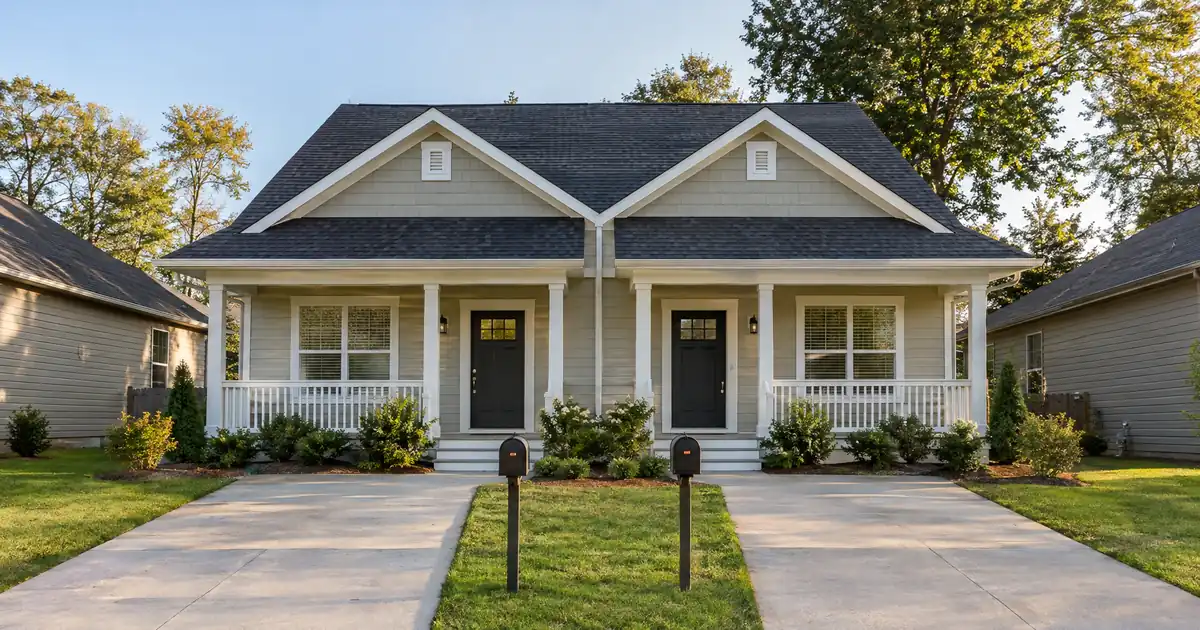
The Quick Read: FHA lets you pull cash out of a two-unit home you live in. It does so by replacing your current mortgage with a larger one, capped at 80% of the home’s appraised value. You must have owned the duplex and lived in it as your main home for 12 months before the case number is assigned. Rent from the other unit helps in limited, documented ways. It does not replace the occupancy test.
Key Takeaways
- Cash-out is for a primary residence only. Living in one unit of a duplex counts. Renting out the other unit does not disqualify you.
- The maximum loan is 80% of appraised value. The county loan limit for two-unit homes also applies, and the lower ceiling controls.
- Mortgage insurance applies to the whole new loan, not only the cash you take out.
- A first-time equity borrower with no prior mortgage is still processed as a cash-out refinance.
- Rent from your tenant is not a shortcut around the 12-month history, and a non-occupant co-borrower cannot help you qualify.
FHA cash-out estimate
Seeded with an example value, a balance to match, and a round cash request; change any field.
Editable benchmark: 7.40% as of October 15, 2026 · Freddie Mac 30-year average via FRED®. A conventional market reference, not an FHA cash-out refinance quote.
Illustrative starting assumptions: a $350,000 home value, a $193,000 current balance, the FHA cap on a principal residence with the upfront premium financed, a thirty-year term at the current Freddie Mac benchmark, and property taxes and insurance estimated at typical national rates. Every field is editable.
An illustration, not a Loan Estimate, an approval, a quote, or a commitment to lend. The rate shown is the weekly Freddie Mac thirty-year conventional benchmark, used as a market reference; an FHA cash-out is priced by the lender at lock, and this is not an FHA cash-out refinance quote. HUD’s cap limits the base loan; the upfront premium is financed on top of the capped base loan; the monthly premium for the first year follows the snapshot’s schedule. Cash available means the base loan the cap permits less the balances retired, before closing costs, which this calculator leaves out. The line figure applies the line program’s combined loan-to-value ceiling to the same value and balance. Taxes and insurance are estimates you can edit. Licensed in sixteen states for consumer mortgages.
Can I Take Cash Out of a Duplex I Live In?
Yes, when the duplex is your principal residence. FHA treats a two-unit home you occupy as an owner-occupied property. The tenant next door does not change that.
Across the wholesale programs Lendmire places FHA files with, the cash-out reaches 80% loan-to-value (LTV). LTV is the new loan divided by the appraised value. The home must have been owned and occupied for 12 months before the case number. The case number is the file ID the lender orders from FHA at the start of the refinance.
Notice what is missing: a separate, lower leverage number for duplexes. The 80% figure is the same whether the home has one unit or two. Some competing pages say otherwise, but those are describing conventional loans, which are a different product.
You can read the program overview on Lendmire’s FHA cash-out refinance program page. Everything here is subject to lender guidelines and full file review, and none of it is a commitment to lend.
What “Live-In” Actually Means to FHA
Live-in means you hold title and use the duplex as your main home. The test is about both ownership and occupancy, and the look-back is 12 months before the case number date.
Lenders verify it with paper. Common proof includes employment records, utility bills, and the address on your tax and bank documents. The lender reads those against the date the case number is assigned. If you moved in eight months ago, you are not there yet.
Think of it as two separate gates:
1. Ownership and occupancy. Did you own it and live in it for the full period?
2. Qualifying. Do your credit, income, and debts fit the program?
Passing the second gate does not open the first. A tenant’s rent can help with qualifying. It cannot make up for a short stay in the home.
A few situations bend the usual picture:
- You bought the duplex recently. The 12 months must be met before the case number. Waiting is the fix, not paperwork.
- You rented both units before moving in. The clock starts when you made it your principal residence, not when you bought it.
- You inherited the duplex. Inherited homes can be treated differently on the occupancy period, as long as the home was never treated as an investment property. If you rent it out after inheriting, expect the 12 months to apply first. Confirm this with the lender before you plan around it.
- You own it free and clear. A home with no mortgage is still eligible. The new loan is processed as a cash-out refinance.
That last point matters if you are a first-time equity borrower. You do not need an existing FHA loan, or any loan, to start.
How Much Cash Can You Actually Take Out?
Take 80% of the appraised value. Subtract what you owe on the current mortgage, and subtract any other lien that stays in place. Then subtract closing costs and any financed insurance premium, and confirm the exact amounts with a qualified local professional. What remains is your cash.
The cap itself is not new. Older, higher figures you see online are out of date.
Here is a modeled example, with every number expressed as a share of the appraised value. The payoff figure is an assumption, not market data.
| Step | Share of appraised value |
|---|---|
| Appraised value | 100% |
| Maximum new loan at 80% LTV | 80% |
| Payoff of current mortgage (assumed) | 50% |
| Closing costs and financed premium | Subtracted next |
| Cash to you | What remains |
In this model, the gap between 80% and the payoff is the room you have before costs. Your Loan Estimate shows the real subtraction. If costs run high, the cash shrinks.
Two caps apply at once:
- The 80% LTV test on the appraised value.
- The FHA county loan limit for two-unit homes.
Whichever is lower controls. HUD ties the limits to the FHFA conforming limit and sets different ceilings by unit count, as it explains in its annual loan limit announcement. County loan limits apply, and they change each year. A higher-priced duplex in a pricey county can hit the limit before it hits 80%.
Lendmire’s piece How CLTV Tiers Size an FHA Cash-Out for a First-Time Equity Borrower walks through what happens when a second lien stays in place. A second mortgage or HELOC that remains counts toward the combined number.
One more point on the appraisal. The appraised value is the base for everything. A low number shrinks the loan, the cash, and your options at the same time. Lendmire has a separate piece Can a First-Time Equity Borrower Challenge a Low FHA Cash-Out Appraisal? if that happens.
How Does the Other Unit’s Rent Count?
Rent from your tenant is a documentation question, not an automatic credit. On a two-unit home, the appraiser completes a small-income-property report, which includes an opinion of market rent. HUD’s Mortgagee Letter 2023-17 says that when a borrower has no rental history on the property since the last tax filing, the lender documents the proposed rent with an appraisal showing fair market rent.
That is the general shape. How much of the rent counts toward qualifying, and whether a lease is needed, depends on the lender’s reading of the guidelines and the automated finding on your file. Many duplex files qualify on the borrower’s own income without leaning on rent at all. Ask early, because it changes how you prepare.
Two related questions come up often:
- Does your own unit’s rent count? No. You live there. Nobody pays you rent for it.
- Does the three- and four-unit self-sufficiency test apply? That test, which checks whether a building’s rent can carry its payment on its own, is aimed at three- and four-unit homes. On the duplex files Lendmire’s lender network sees, it does not come up. Some older web pages blur this, so ask your loan officer to confirm which test applies to your file.
Rent can also cut the other way. A bigger payment that depends partly on tenant income is a real risk if the unit sits empty. Run a vacant-unit scenario before you borrow, not after.
What Does the Lender Check?
The lender checks the usual FHA things, plus the duplex-specific pieces above. In order:
1. Occupancy and ownership history, as covered earlier.
2. Mortgage payment history. Recent late payments matter more on a cash-out than on a rate-and-term.
3. Credit. The wholesale programs Lendmire places FHA purchase loans with start at a 580 decision score. Cash-out minimums are set lender by lender, and they can sit higher. Do not assume the purchase floor carries over.
4. Debt ratios. The base pair is 31/43. The first number is housing cost to income and the second is all monthly debt to income. Documented compensating factors can stretch that to 40/50 at the top tier, and the automated finding governs most files.
5. Property standards for both units. Appraisal and minimum property requirements cover the whole building, not only the half you live in.
6. Income from occupants only. On a cash-out, HUD says a non-occupant co-borrower’s income cannot be used to qualify, per the same Mortgagee Letter 2023-17. A parent who co-signs can help on a purchase. On this loan, not so.
Forbearance deserves its own note. HUD’s Handbook 4000.1 update clarified how late payments and forbearance affect cash-out eligibility. A borrower with fewer than three consecutive monthly payments since finishing a forbearance plan must be manually underwritten for a cash-out. Manual underwriting is slower to review and tighter on ratios. If you recently came out of forbearance, plan around that.
What Does It Cost?
Costs show up in two places: the monthly budget and the closing table.
Mortgage insurance is the big one. Across the programs Lendmire places, FHA charges an upfront premium of 1.75% of the base loan, which is normally financed into the balance. It also charges an annual premium between 0.15% and 0.75% of the balance, depending on term, loan amount, and LTV. Both are program facts, not prices. Your Loan Estimate shows what applies to you.
Here is the detail first-timers miss. The premium applies to the entire new loan, not only the cash portion. On a thirty-year loan above 90% LTV, the annual premium lasts the full term. At or below 90%, it ends after eleven years. An 80% cash-out sits in that second group. The exact numbers vary by lender and program and follow a full review of property, leverage, and credit.
Closing costs also come with the loan. They include the appraisal, title work, and origination charges. They get paid from the new loan or from your pocket, and either way they reduce your net cash. A “no-cost” refinance offer simply builds those costs into the balance or the interest. They do not disappear.
The monthly budget changes because the new balance replaces the old one in full. You are not adding a second payment. You are swapping one bigger loan for the one you had, with insurance attached. Whether that swap makes sense depends on what you do with the cash and what your old loan looked like.
Tax treatment can depend on your situation; borrowers should speak with a qualified tax professional before relying on any deduction or credit.
Where Do First-Time Equity Borrowers Trip Up?
Most trouble comes from timing, not math. These are the recurring edge cases on live-in duplex files:
| Situation | What it means for you |
|---|---|
| Moved in under 12 months ago | Not eligible yet; wait for the look-back |
| Rented both units before moving in | Clock starts at principal-residence date |
| Inherited the duplex | Period may be waived unless it was rented |
| Unit sitting vacant | Rent is harder to document; budget without it |
| Tenant in the other unit | Appraiser needs access; lease may be asked |
| Non-occupant co-borrower | Their income cannot be used |
| Recent forbearance exit | Manual underwriting if under three payments |
A few more habits cause trouble:
- Assuming rent fixes a short occupancy history. It does not.
- Skipping the vacancy test. If one empty unit sinks the budget, the loan is too big.
- Ignoring county loan limits. The lower ceiling controls, and a pricey duplex can hit it first.
- Forgetting a second lien. A HELOC that stays counts toward combined LTV.
- Treating cash as free money. You are borrowing it against the home you live in.
FHA Cash-Out vs. the Other Options
FHA cash-out is one path, and a good fit for a borrower whose credit or ratios don’t suit other products. It is not the only one. Here is how the main duplex options compare in general terms.
| Option | Cash available | Occupancy rule | Mortgage insurance |
|---|---|---|---|
| FHA cash-out | Up to 80% LTV | Owned and lived in 12 months | Upfront plus annual |
| Conventional cash-out | Varies by lender and unit count | Primary home | Not charged as FHA does |
| Second lien or HELOC | Depends on remaining equity | Primary home | Not charged as FHA does |
| FHA streamline or rate-and-term | Little or none | Previous 12 months for rate-and-term | Premium continues |
The streamline and rate-and-term are different animals. The FHA Streamline refinances an existing FHA loan with no appraisal and a limited credit review, but you need a net tangible benefit, and no cash comes out. The FHA rate-and-term with an appraisal reaches 97.75% on a principal residence occupied for the previous twelve months. Neither gives you equity in your hand.
A conventional cash-out may handle duplexes differently from single-family homes, and some lenders cut allowed leverage on two units. That is a conventional rule, not an FHA one. If your credit or ratios keep you out of one, the other may still work.
Key Terms Defined
- Cash-out refinance: A new, larger mortgage that pays off the old one and hands you the difference in cash.
- LTV (loan-to-value): The loan amount divided by the home’s appraised value, shown as a percentage.
- CLTV (combined loan-to-value): All loans against the home, including any second lien, divided by appraised value.
- Case number: The FHA file ID the lender orders at the start of the loan. Occupancy is measured back from its date.
- Mortgage insurance premium (MIP): FHA’s insurance charge, paid once upfront and then yearly in monthly installments.
- Non-occupant co-borrower: A co-signer who does not live in the home. Their income cannot be used on an FHA cash-out.
Step by Step, With a Document Checklist
A cash-out on a live-in duplex runs in a set order:
1. Screen yourself. Check the 12-month history, payment record, and who will be on the loan.
2. Apply and get the case number. The lender orders it and sets the date your history is measured against.
3. Order the appraisal. On a duplex, it includes a rent opinion for the other unit.
4. Run underwriting. Credit, income, and ratios go through the automated system or a manual review.
5. Review disclosures. Your Loan Estimate and Closing Disclosure show the real costs.
6. Close. The new loan pays off the old one, then costs, then any cash to you.
7. Use your right to cancel if needed. On a refinance of your home, you may have a right to cancel after closing, and timing varies by file and lender. The CFPB explains that cancellation must be in writing, and a phone call is not enough.
Gather these early:
- Proof of ownership and occupancy, such as utility bills and employment records.
- Recent pay documents and tax filings.
- Your current mortgage statement and a list of any other liens.
- Lease and tenant contact details for the other unit.
- Insurance information for the whole building.
- Any forbearance or hardship paperwork, if it applies.
Where to Go From Here
If you are weighing a cash-out refinance against keeping the loan you have, Lendmire can help you compare the programs and the equity each one reaches. A mortgage broker arranges the loan through wholesale lenders, so the comparison can run across several programs instead of one.
Frequently Asked Questions
Does the tenant in my other unit hurt my chances?
No. A tenant does not disqualify a live-in duplex. The appraiser needs access, and the lender may ask for a lease or other rent evidence. What can hurt is a budget that only works if the tenant stays and pays.
Can I use the cash to fix up the other unit?
Lenders generally don’t restrict what you do with cash-out proceeds on a primary-residence loan. The practical limit is risk. Spending borrowed equity on a rental unit makes your payment depend on that unit’s income, so test the plan with the unit empty.
Does my existing loan have to be FHA?
No. A conventional first mortgage can be paid off by an FHA cash-out. And a homeowner with no mortgage at all is still processed as a cash-out refinance.
Can a co-signer who lives elsewhere help me qualify?
Not on a cash-out. HUD bars a non-occupant co-borrower’s income from qualifying on this loan type. A co-signer can help on an FHA purchase, which is why the two get confused.
What if I’m not eligible yet?
Wait out the 12 months, or look at other paths: a conventional duplex cash-out, a second lien, or a rate-and-term refinance if you don’t need cash. Each has its own occupancy and credit rules. A broker can run those side by side with your numbers.
For your own numbers, request a scenario review with Lendmire.
About Lendmire
Lendmire is a mortgage brokerage (NMLS# 2371349) licensed for consumer mortgage lending in 16 states, arranging FHA, VA, conventional and jumbo purchase and refinance loans through a wholesale lending network. Eligibility is determined by the lender on each file. Scotsman Guide named Lendmire a Top Mortgage Workplace in both 2025 and 2026.
Get Started
Ready to find the right loan for you?
In about 30 seconds you can review financing options available for your home or investment property. No commitment required.
Informational only. Not a Loan Estimate, approval, or commitment to lend. Program availability and eligibility are subject to lender guidelines, credit approval, property review, and underwriting.
References
1. HUD – 2026 FHA Loan Limits announcement
2. HUD – Mortgagee Letter 2023-17
3. HUD – Handbook 4000.1 Update 15 transmittal
This article is part of Lendmire’s FHA Loan series — every loan program’s qualification details, guidelines, and scenarios live on the loan options page.
Related reading: FHA Cash-Out Rules for a First Mortgage With a Prepayment Penalty · How Much Equity an FHA Condo Needs for a Conventional Cash-Out · Conventional Cash-Out vs FHA Cash-Out on a Condo
Brandon Miller
Founder & CEO, Mortgage Loan Originator, Lendmire LLC
- Mortgage Loan Originator · NMLS# 1129696 · Verify on NMLS Consumer Access
- North Carolina Real Estate Broker · License# 343312 · Verify on NCREC
- North Carolina Insurance Producer · License# 19053198 · Property, Casualty, Life, Health · Verify on NAIC SBS
- Lendmire LLC · Firm NMLS# 2371349 · Verify firm licensure
Disclosure information. Lendmire is a state-licensed mortgage brokerage under NMLS# 2371349. Lendmire is not a depository institution, direct lender, or financial advisor — all loans referenced are placed through wholesale lender partners and are subject to each lender's underwriting standards. This article is provided for general informational purposes and is not a commitment to lend, nor does it constitute financial, legal, or tax advice. Loan programs, terms, rates, and qualification standards change without notice and depend on borrower profile, property type, and the state in which the subject property is located. Equal Housing Opportunity provider. NMLS Consumer Access: nmlsconsumeraccess.org.