
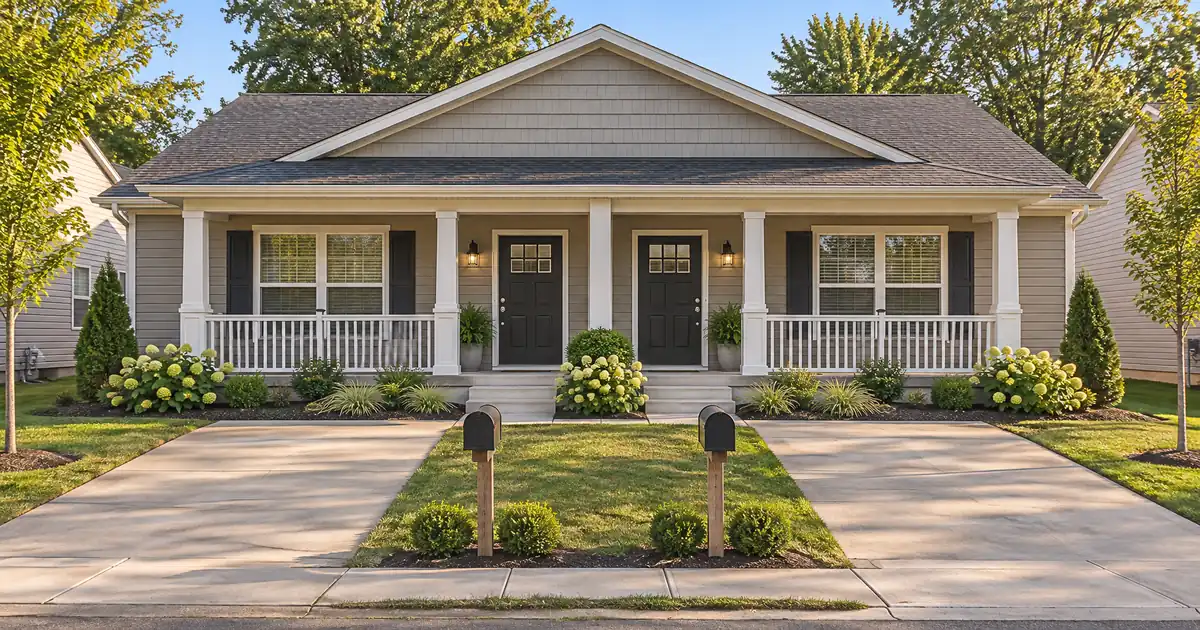
The Quick Read: An FHA cash-out refinance on a duplex works only when you live in one of the two units as your main home. The new loan can reach up to 80% of the home’s appraised value, and it must pay off your current mortgage first. Whatever is left after payoffs and closing costs comes to you as cash. Rent from the other unit may help you qualify, but only as the lender documents it.
What Is an FHA Cash-Out on a Duplex?
A cash-out refinance replaces your current mortgage with a bigger one. The difference, after paying off the old loan and closing costs, lands in your pocket. On a duplex you live in, the FHA version treats the building as an owner-occupied home. That matters because owner-occupied financing is the only kind FHA cash-out allows.
FHA cash-out estimate
Seeded with an example value, a balance to match, and a round cash request; change any field.
Editable benchmark: 7.18% as of November 5, 2026 · Freddie Mac 30-year average via FRED®. A conventional market reference, not an FHA cash-out refinance quote.
Illustrative starting assumptions: a $350,000 home value, a $193,000 current balance, the FHA cap on a principal residence with the upfront premium financed, a thirty-year term at the current Freddie Mac benchmark, and property taxes and insurance estimated at typical national rates. Every field is editable.
An illustration, not a Loan Estimate, an approval, a quote, or a commitment to lend. The rate shown is the weekly Freddie Mac thirty-year conventional benchmark, used as a market reference; an FHA cash-out is priced by the lender at lock, and this is not an FHA cash-out refinance quote. HUD’s cap limits the base loan; the upfront premium is financed on top of the capped base loan; the monthly premium for the first year follows the snapshot’s schedule. Cash available means the base loan the cap permits less the balances retired, before closing costs, which this calculator leaves out. The line figure applies the line program’s combined loan-to-value ceiling to the same value and balance. Taxes and insurance are estimates you can edit. Licensed in sixteen states for consumer mortgages.
Think of it as two things at once: your residence and a small rental. FHA cares most about the first part. The second part can help your income on paper.
Loan-to-value (LTV) is the new loan divided by the home’s appraised value. The home must be one you’ve owned and lived in for 12 months before the FHA case number is assigned. A case number is the file ID FHA gives your loan at the start.
This article goes deeper on the duplex version.
Key Terms Defined
- Adjusted Value: The appraised value after FHA’s adjustments. The 80% limit applies to this number.
- Base loan amount: The loan before the financed upfront mortgage insurance premium is added.
- Case number: The FHA file ID assigned to your loan before the appraisal.
- Owner-occupied: You live in the property as your principal residence. In a duplex, that means one unit.
- Rescission: Your right to cancel certain refinances after signing. It covers cash-out loans on your home.
- Net rental income: Rent from the other unit after the lender applies its documentation rules.
Key Takeaways
- You must live in one unit and have owned and occupied the duplex for 12 months.
- The cap is 80% of Adjusted Value, covering the whole new loan.
- County loan limits also apply, and they change every year.
- Mortgage insurance applies: 1.75% upfront, plus an annual premium.
- Rent may count toward qualifying, but it never guarantees cash flow.
Who Qualifies? The Eligibility Checklist
Occupancy comes first. A duplex qualifies only if you live in one unit. A duplex you rent to two tenants does not. Neither does a second home.
| Requirement | What FHA looks for |
|---|---|
| Occupancy | One unit is your principal residence |
| Ownership and occupancy | 12 months before the case number |
| Payment history | Existing mortgage reviewed, no recent lates |
| Leverage | Up to 80% of Adjusted Value |
| Credit | Decision score of 580 or higher at our network |
The 12-month rule is why a recent purchase blocks this loan. It is also why a duplex you used to rent out, then moved into, makes you wait.
Payment history matters too. Lenders review how you’ve paid your current mortgage, and a recent late payment can block the file or force a wait. The exact lookback depends on the loan’s age and lender review.
Your existing loan does not have to be FHA. A conventional loan can be paid off with an FHA cash-out.
On credit: HUD’s rules reach lower, but the wholesale programs Lendmire places FHA loans with start at a 580 decision score. Some lenders set higher floors than that. All of it is subject to lender guidelines and full file review.
How the Loan Is Underwritten, Step by Step
Here is the path from first call to cash in hand.
1. Eligibility screen. The lender confirms you live in one unit, checks your ownership and occupancy timeline, and reviews your mortgage history.
2. Application and Loan Estimate. The lender sends a Loan Estimate within three business days of your application, per the CFPB. Compare it line by line with what you expect.
3. Case number and appraisal. The appraiser inspects both units. For a 2–4 unit property, the report is the Small Residential Income Property form, which documents market rent for the units.
4. Sizing the loan. The lowest of three limits governs: 80% of Adjusted Value, the county FHA limit for a two-unit home, and the amount you can qualify for.
5. Income and debt review. The file runs through FHA’s automated underwriting or a manual review. More on this below.
6. Conditions and final approval. The lender asks for missing documents and clears the file.
7. Closing Disclosure. You get it at least three business days before closing, per the CFPB.
8. Signing and rescission. You sign, then the right to cancel runs. Funds are generally disbursed after it ends.
How Is the Maximum Loan Calculated?
Start with the appraisal. Multiply the Adjusted Value by 80%. That is the ceiling for the entire new loan.
HUD cut the cash-out cap from 85% to 80% and said the change aligned FHA with what the government-sponsored enterprises allow. The change was folded into Handbook 4000.1.
The base loan must cover your current mortgage payoff, closing costs and prepaids, and any required payoffs of other liens. Your cash is what remains. The 1.75% upfront mortgage insurance premium is calculated on the base loan and is typically financed on top of it.
A common mistake: reading 80% as 80% of your equity. It is 80% of the home’s value, and it covers the whole loan. If you owe a lot already, the cash left over can be small.
Here is an example using ratios instead of dollars. If you owe 60% of the duplex’s value today, the 80% cap leaves a gap of about 20% of value before costs. Closing costs, prepaids and the financed premium come out of that gap. What’s left is yours.
Subordinate liens count too. A home equity line or second mortgage on the duplex is part of the combined loan-to-value picture, so it is paid off or counted in the total. The combined first mortgage and other liens cannot exceed FHA’s limits.
Then there are county loan limits. HUD sets them by county and updates them every year. Each county has its own two-unit number, and it can cap the loan even when you have plenty of equity. Look yours up on HUD’s FHA mortgage limits lookup. Don’t rely on a number a friend heard.
How Does the Rent From the Other Unit Count?
It can help, but only if documented. FHA lets lenders count net rental income from the unit you don’t live in. How they calculate it depends on your rental history.
HUD’s policy letter on subject-property rental income, Mortgagee Letter 2023-17, sets the rules, including the appraisal form that documents market rent on 2–4 unit homes. With a rental track record, lenders typically work from your tax return’s rental schedule. A shorter history is treated differently. Your loan officer will tell you which applies.
Here is the honest part: the rent never counts in full. The lender haircuts it, and your real cash flow still absorbs vacancies, repairs and turnover. Treat the rent as a qualifying aid, not as a payment plan.
What About Mortgage Insurance?
Every FHA loan carries two kinds. The upfront premium is 1.75% of the base loan, and it is usually financed. The annual premium runs between 0.15% and 0.75% of the balance, depending on the term, loan amount and LTV.
How long it lasts matters. On a 30-year loan above 90% LTV, the annual premium lasts for the full term. At or below 90% LTV, it ends after eleven years. A cash-out at 80% falls in the second group, though the loan’s exact structure decides. Premiums are program mechanics, not advertised prices. Terms depend on the lender’s guidelines, the property type, the leverage, and a full review of the credit profile.
Mortgage insurance feeds into your debt-to-income ratio, so it affects how much you can borrow.
What Income and Debt Ratios Apply?
Lenders compare your housing cost and total debts to your income. The base pair is 31/43: housing at 31% of income, total debt at 43%. With documented compensating factors, such as savings or a strong payment record, ratios can stretch to 40/50 at the top tier.
Those are program figures. Individual lenders may set stricter credit, ratio and reserve requirements than HUD. Think of it as program rules versus lender rules: the lender’s rules can be tighter, never looser.
Where the General Rule Breaks
A few situations don’t fit the standard pattern.
Paid-off duplex. Pulling equity from a home with no mortgage still counts as cash-out. The same 80% cap and occupancy rules apply.
Inherited property. HUD has a narrow exception to the ownership and occupancy timeline for inherited homes. If this is your situation, ask the loan officer to check it against the handbook before you plan around it.
Your own unit gets rented. If you move out and rent both units, you no longer meet the occupancy rule. The loan was written as financing for your residence, so it no longer fits once you leave.
Triplexes and fourplexes. FHA also covers three- and four-unit homes you live in. Those carry extra tests, including a self-sufficiency requirement, where the property’s rent must support itself. That test is aimed at three- and four-unit homes rather than duplexes, which is one reason a duplex is often simpler. Confirm it against the handbook on your file.
Boarders. HUD issued a policy letter on rental income from boarders of the subject property. If a roommate or boarder is part of your income picture, ask the lender how it applies. Don’t assume.
Hawaiian Home Lands. The 80% change did not apply to Section 247 loans, a narrow program.
Second homes and investment properties. They do not qualify for standard FHA cash-out. Occupancy decides it.
FHA Cash-Out vs. Other Refinance Options
| Option | Cash to you? | Appraisal? | Leverage |
|---|---|---|---|
| FHA cash-out | Yes | Yes | Up to 80% |
| FHA rate-and-term | No | Yes | Up to 97.75% |
| FHA Streamline | No | Typically none | Existing FHA loan only |
| Conventional cash-out | Yes | Yes | Varies by lender |
The rate-and-term reaches 97.75% on a principal residence you’ve occupied for the previous twelve months. The Streamline refinances an existing FHA loan with no appraisal, a limited credit review and a net tangible benefit, and the premium continues. Any cash kept beyond small amounts moves the file into cash-out.
Which fits? If you only need to change the loan, the no-cash options leave more equity untouched. If you need cash for repairs, a second unit’s renovation or debt payoff, cash-out is the tool. And a conventional loan can be a stronger fit when your equity is large and your credit is high, since FHA’s mortgage insurance applies to the whole term in some cases. It’s a real tradeoff, and a broker can compare both against your equity.
What the Decision Looks Like in Practice
Picture a homeowner who has lived in one side of a duplex for several years, with the other side rented. The roof needs work, and a credit card balance is growing.
First check: has she owned and lived there for 12 months, and are her payments clean? Yes. Next, the appraisal comes in and the 80% ceiling is set. Her current mortgage payoff takes most of that room. After closing costs and the financed premium, the cash left is smaller than she hoped.
That is the moment to decide. She can proceed, trim the cash she asks for, or keep her current loan. The new loan is larger, restarts the term and carries mortgage insurance. Those are costs, not just features.
Two other things to plan around:
- Equity: At least 20% of the home’s value must remain after closing. Changes in value between the case number and closing can matter.
- Rescission: You generally have three business days to cancel a cash-out refinance on your home. Saturdays count; Sundays and legal holidays don’t. If you cancel, you still owe your original loan. And if the lender gave you defective disclosures, that right can extend for up to three years.
Tax treatment can depend on your situation; borrowers should speak with a qualified tax professional before relying on any deduction or credit.
Common Mistakes and Denials
- Assuming a rented-out duplex qualifies. One unit must be your home.
- Reading 80% as 80% of equity.
- Skipping the county limit check.
- Counting all the rent as income.
- Applying right after buying, before the 12 months are up.
- Overlooking a late payment on the current mortgage.
Frequently Asked Questions
Can I do an FHA cash-out on a duplex if I rent both units?
No. One unit must be your principal residence, with 12 months of ownership and occupancy before the case number. An investment duplex doesn’t fit this program, and occupancy is what decides it.
Does the whole rent count as my income?
No. FHA allows documented net rental income from the other unit, and the lender applies HUD’s rules to it. Your history of renting and your tax return documentation shape the result. It helps you qualify, but it doesn’t guarantee positive cash flow.
Do I need an existing FHA loan?
No. The loan you’re paying off can be FHA or non-FHA. What matters is your occupancy, ownership timeline, payment history and equity.
Can I cash out a duplex I own free and clear?
Yes, if you meet the occupancy and ownership rules. FHA still treats it as cash-out, so the 80% cap and county limit apply. With no payoff, more of the 80% comes to you, less costs and the financed premium.
How is this different from a Streamline?
A Streamline refinances an existing FHA loan without an appraisal and without paying you cash. A cash-out requires an appraisal, caps at 80% and puts money in your hands. They are different products for different goals.
The Bottom Line
If you are weighing a cash-out refinance against keeping the loan you have, Lendmire can help you compare the programs and the equity each one reaches. Everything here is subject to lender guidelines and full file review, and nothing is a commitment to lend.
For your own numbers, request a scenario review with Lendmire.
About Lendmire
As a mortgage broker (NMLS# 2371349), Lendmire helps homeowners and home buyers in 16 states with FHA, VA, conventional and jumbo purchase and refinance loans arranged through wholesale lenders. Lendmire is never the lender; program terms are set by the lender and the agency guidelines. Scotsman Guide named Lendmire a Top Mortgage Workplace in both 2025 and 2026.
Get Started
Ready to find the right loan for you?
See your offer in seconds. No credit pull, no obligation.
Informational only. Not a Loan Estimate, approval, or commitment to lend. Program availability and eligibility are subject to lender guidelines, credit approval, property review, and underwriting.
References
1. CFPB
2. CFPB
3. HUD press release on the FHA cash-out LTV reduction
4. HUD Handbook 4000.1 update transmittal
5. HUD FHA mortgage limits lookup
6. HUD Mortgagee Letter 2023-17 (rental income)
This article is part of Lendmire’s FHA cash-out refinance program — full qualification details, guidelines, and scenarios live on the program page.
Related reading: How an FHA Cash-Out Works on an Inherited Home for a Retiree · How an FHA Cash-Out Works on a Condo in a High-Cost State · How an FHA Cash-Out Works When Heirs Refuse to Sell
Brandon Miller
Founder & CEO, Mortgage Loan Originator, Lendmire LLC
- Mortgage Loan Originator · NMLS# 1129696 · Verify on NMLS Consumer Access
- North Carolina Real Estate Broker · License# 343312 · Verify on NCREC
- North Carolina Insurance Producer · License# 19053198 · Property, Casualty, Life, Health · Verify on NAIC SBS
- Lendmire LLC · Firm NMLS# 2371349 · Verify firm licensure
Legal disclosures. Lendmire (NMLS# 2371349) is a state-licensed mortgage brokerage that arranges financing through wholesale lender relationships. Lendmire is not a direct lender, depository institution, or registered financial advisor. The discussion above is general informational content about real estate financing — it is not financial, legal, or tax advice, and readers should consult licensed professionals for guidance on their individual circumstances. Loan inquiries are subject to lender underwriting; this article does not represent a commitment to lend. Loan terms, rates, and qualification standards vary by borrower, property, and state, and are subject to change at any time. Equal Housing Opportunity. NMLS Consumer Access: nmlsconsumeraccess.org.