
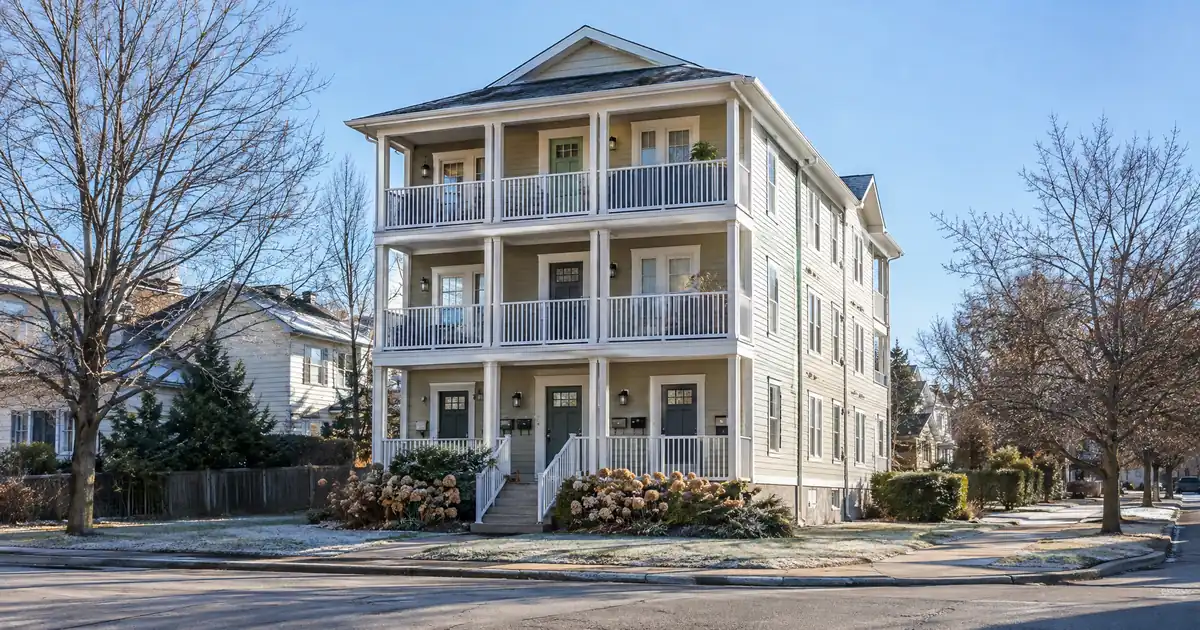
The Quick Read: On a three- or four-unit home, the building’s rent has to carry the whole payment on paper before the loan can go forward. The test counts rent from every unit, including the one you will live in, then trims it for vacancy and upkeep. The full monthly housing payment divided by that trimmed rent cannot top 100 percent. A plain duplex skips the test altogether.
Key Takeaways
- The test applies to three- and four-unit homes. One- and two-unit homes are exempt.
- Appraiser-estimated market rent drives the result, not the leases in place.
- Your own unit’s rent counts for this test, even though you will never collect it.
- The test sits on top of your own income and debt-ratio checks. It does not replace them.
- Three- and four-unit loans also call for more cash left in the bank after closing.
What Is the FHA Self-Sufficiency Test?
It is a property-level screen. It asks one question: could this building’s rent cover its own payment if you were not there to help pay it?
FHA payment estimate
Starting assumptions reflect an example price and the FHA minimum investment. Replace them with your own figures.
Editable benchmark: 7.32% as of October 22, 2026 · Freddie Mac 30-year average via FRED®. A conventional market reference, not an FHA loan quote.
Illustrative starting assumptions: a $350,000 price, the FHA minimum investment as the down payment, a thirty-year term at the current Freddie Mac benchmark, and property taxes and insurance estimated at typical national rates. Every field is editable.
Illustrative estimate only — not a Loan Estimate, approval, quote, or commitment to lend. The rate field carries the weekly Freddie Mac thirty-year conventional benchmark, a market reference and not an FHA loan quote; your rate is set by the lender at lock. FHA mortgage insurance follows HUD’s published schedule for the term, leverage and loan size entered; taxes, insurance and dues are editable estimates; closing costs are not included; county loan limits are not checked here. Licensed in sixteen states for consumer mortgages. Lendmire is not affiliated with or acting on behalf of FHA, HUD, or the federal government.
Think of it as a second approval. You qualify as a borrower, and the building qualifies as a property. A strong paycheck does not rescue a building whose appraised rent falls short.
Lendmire is a mortgage broker licensed for consumer lending in 16 states. It arranges FHA loan programs through wholesale lenders, and this test comes up on nearly every three- and four-unit file. The program itself is built for owner-occupants. The usual leverage, premium and ratio figures are covered in the sections that follow.
Who Has to Pass It?
Only three- and four-unit properties are tested. If you are buying a duplex, the test never enters the file.
| Units | Self-sufficiency test? | Post-closing reserves |
|---|---|---|
| 1 | No | 1 month of PITI |
| 2 | No | 1 month of PITI |
| 3 | Yes | 3 months of PITI |
| 4 | Yes | 3 months of PITI |
PITI means principal, interest, taxes and insurance. A triplex and a fourplex face the same test. The formula does not get harder at four units. What changes is the rent and the payment.
How Is the Test Calculated, Step by Step?
The math runs in five steps. Each one uses an appraiser’s opinion or a lender’s calculation.
1. Occupancy. You live in one unit as your primary home. The lender confirms you intend to stay and move in on a reasonable schedule.
2. Market rent. The appraiser estimates fair market rent for every unit, including yours.
3. The haircut. The lender subtracts the larger of two numbers: the appraiser’s vacancy-and-maintenance estimate, or 25 percent of the market rent.
4. Net rent. What remains is the Net Self-Sufficiency Rental Income, or NSSRI.
5. The ratio. The lender divides the full proposed payment by NSSRI. The answer must be 100 percent or less.
Here is the shortcut. When the appraiser’s vacancy estimate sits at or below the 25 percent floor, total market rent must be at least the full payment divided by 0.75. Put another way, the building’s gross rent needs to be about one-third larger than the payment.
Where Does the Rent Number Come From?
It comes from the appraisal, not from you. The appraiser pulls comparable rents and reports a market figure for each unit.
Existing leases do not drive the test. A tenant paying above market does not help you. A tenant paying below market does not hurt you. The appraiser’s opinion is what counts, which is why the appraisal is the moment of truth on a multi-unit file.
If the rent comes in low, ask what comparables the appraiser used. Some buyers and agents supply their own rental comps for the appraiser to consider. Sending them is reasonable, though the appraiser makes the final call.
What Goes Into the Payment Side?
The numerator is the whole housing payment, not just principal and interest. Property taxes and homeowners insurance are in it. So is the monthly FHA mortgage insurance premium, and any association dues. This is one reason a modest-looking loan amount can still fail the test.
The mortgage insurance is a program fact. On the wholesale programs Lendmire places files with, FHA carries an upfront premium of 1.75 percent of the base loan, which is financed. It also carries an annual premium between 0.15 and 0.75 percent of the balance. The exact annual figure depends on term, loan amount and LTV. On a thirty-year loan above 90 percent LTV, the annual premium lasts for the full term. At or below 90 percent it ends after eleven years. Subject to lender guidelines and full file review.
A Worked Example: One Building, Two Outcomes
Run the numbers on a modeled fourplex. These are index figures, not market data. Set the full monthly payment at 100 units so the percentages are easy to follow.
| Scenario | Gross rent | Haircut | Net rent | Ratio | Result |
|---|---|---|---|---|---|
| A: strong rents | 150 | 25% | 112.5 | 88.9% | Passes |
| B: weak rents | 125 | 25% | 93.75 | 106.7% | Fails |
| C: higher vacancy | 140 | 30% | 98.0 | 102.0% | Fails |
Same building, same payment, three different results. Scenario B misses because the gross rent is under the 133.3 threshold. Scenario C is the quiet one. The rent looks healthy, but the appraiser’s 30 percent vacancy estimate replaces the 25 percent floor and pulls the net rent below the payment.
How Do You Fix a Failing Property?
Every lever works through either the payment or the rent. Here is how each one moves the result.
| Lever | Effect on the test | Tradeoff |
|---|---|---|
| Lower price | Smaller loan, smaller payment | Seller must agree |
| Larger down payment | Smaller loan, less insurance | More cash up front |
| Higher appraised rent | Raises net rent | Out of your control |
| Different building | New rent-to-payment balance | Starting over |
| Move to a duplex | Test and higher reserves drop away | Fewer units, less income |
Price and down payment are the levers you control. Rent is the appraiser’s call. Note that the program’s maximum financing of 96.5 percent, with 3.5 percent minimum investment at a decision score of 580 or higher, is a ceiling and not a target. Putting more down shrinks the payment, which can turn a fail into a pass.
Sometimes the honest answer is a different building. A property that misses by a wide margin rarely gets rescued by tweaks.
The Two Calculations People Confuse
Borrowers often mix up the self-sufficiency test and the income used to qualify them. They are separate, and they treat your unit differently.
| Item | Self-sufficiency test | Qualifying income |
|---|---|---|
| Question | Can the building carry itself? | Can you carry the loan? |
| Your unit’s rent | Counted | Generally not counted |
| Rent source | Appraiser’s estimate | Lender’s rental-income rules |
| Pass condition | Payment ÷ net rent ≤ 100% | Ratios, 31/43 base |
On the ratios, the base pair is 31/43 (housing over total) with no compensating factors. Documented compensating factors can reach 40/50 at the top tier, and the automated finding governs most files. You have to clear both tests.
What Does the Handbook Say?
FHA’s rules live in HUD’s Single Family Housing Policy Handbook 4000.1. It is the consolidated source for FHA single-family policy. The self-sufficiency standard says the payment divided by net rental income may not exceed 100 percent for three- and four-unit properties. Handbook sections are renumbered from time to time, so confirm the current wording in the live document before relying on any citation.
Reserves come from Mortgagee Letter 2023-17. Three- and four-unit loans require reserves in the form of PITI verified after closing, and one- and two-unit loans require a smaller amount. That cash comes on top of your down payment and closing costs, so budget for it early.
Edge Cases Where the General Rule Bends
- Duplex with an accessory dwelling unit. Some secondary explanations treat two units plus an ADU as a three-unit property for this test. That reading is not confirmed on a HUD page, so verify it in the handbook before counting on it.
- One unit with an ADU. The same Mortgagee Letter sets a separate reserve of two months’ PITI when rental income is used to qualify.
- Higher vacancy estimate. The 25 percent haircut is a floor. When the appraiser’s number is higher, it wins.
- Loan limits. FHA limits are set by county and change every year. County loan limits apply, and they matter more on larger buildings.
- Refinancing. FHA cash-out reaches 80 percent LTV on a home you have owned and occupied for 12 months. Lendmire’s piece FHA Cash-Out Self-Sufficiency Requirements on a 2-4 Unit Primary Home covers how the test applies there.
How Should You Screen a Property Before Making an Offer?
Back-solve before you fall in love with the building. Start with the estimated full payment. Divide it by 0.75. That is the minimum gross market rent the building needs, assuming the appraiser stays at or under the 25 percent floor.
Then compare that number to realistic rents for similar units nearby. If you are close, leave a cushion. A building that passes by a hair on paper can fail when the appraiser sees higher vacancy in the area. Ask your lender to run the test with a higher haircut too, so you see the downside before you commit.
Common Misconceptions
- “Only principal and interest are tested.” The full payment is the numerator.
- “My unit’s rent is excluded.” Not for this test.
- “Duplexes must pass it.” They do not.
- “25 percent is always the vacancy factor.” It is a floor.
- “A fourplex is harder than a triplex.” The rule is the same. The rents and payment differ.
- “Passing means it’s a good deal.” It is only an FHA eligibility screen.
Key Terms Defined
NSSRI: Net Self-Sufficiency Rental Income, which is market rent from all units after the vacancy-and-maintenance haircut.
PITI: Principal, interest, taxes and insurance, the core of the monthly housing payment.
Haircut: The deduction from gross rent, using the larger of the appraiser’s estimate or the 25 percent floor.
Reserves: Cash you must still have after closing, counted in months of PITI.
Compensating factors: Documented strengths, such as savings or a strong credit profile, that can support higher debt ratios.
Frequently Asked Questions
Does the test apply to a duplex?
No. The test applies only to three- and four-unit properties. A duplex still needs the borrower to qualify on income and debt ratios, and it carries a lower reserve requirement of one month of PITI. Exact terms depend on the lender’s guidelines, property type, leverage, and a full review of the borrower’s file.
Does my own unit’s rent count?
Yes, for this test. The appraiser reports market rent for every unit, including the one you will occupy. That same rent is generally not counted as income when you qualify, which is why the two calculations differ.
Who decides the rent and the vacancy factor?
The appraiser supplies the rent opinion and the vacancy-and-maintenance estimate. The lender applies whichever deduction is larger, that estimate or the 25 percent floor. You can share rental comparables, but the appraiser makes the call.
Do the leases in place matter?
Not for the test. The appraiser’s market estimate drives the result, not what tenants pay today. Leases still matter for your own planning and for understanding the property.
What if the property fails?
Look at price, down payment and the building itself. A lower price or more down shrinks the payment. A different building or a duplex may fit better. Every option is subject to lender guidelines and full file review.
Next Step
If you are buying a home and want to see whether an FHA loan fits your file, Lendmire can help you compare the options and what each one asks of the file. Reach the team at 828-256-2183, or request a quote. Tax treatment can depend on your situation; borrowers should speak with a qualified tax professional before relying on any deduction or credit.
About Lendmire
Lendmire, NMLS# 2371349, is a mortgage brokerage with consumer lending licenses in 16 states. FHA, VA, conventional and jumbo purchase and refinance loans are arranged through wholesale lending partners, and each application is reviewed individually by the lender. Scotsman Guide named Lendmire a Top Mortgage Workplace in both 2025 and 2026.
Get Started
Ready to find the right loan for you?
In about 30 seconds you can review financing options available for your home or investment property. No commitment required.
Informational only. Not a Loan Estimate, approval, or commitment to lend. Program availability and eligibility are subject to lender guidelines, credit approval, property review, and underwriting.
References
1. HUD Single Family Housing Policy Handbook 4000.1
2. HUD Mortgagee Letter 2023-17
3. HUD FHA loan limits announcement
This article is part of Lendmire’s FHA loan program — full qualification details, guidelines, and scenarios live on the program page.
Related reading: FHA Cash-Out Payment History Requirements After a Late Payment · Conventional vs FHA Cash-Out Requirements on a 2–4 Unit Primary Home · Can a Homeowner With an FHA Loan Use an FHA Cash-Out for Any Purpose?
Brandon Miller
Founder & CEO, Mortgage Loan Originator, Lendmire LLC
- Mortgage Loan Originator · NMLS# 1129696 · Verify on NMLS Consumer Access
- North Carolina Real Estate Broker · License# 343312 · Verify on NCREC
- North Carolina Insurance Producer · License# 19053198 · Property, Casualty, Life, Health · Verify on NAIC SBS
- Lendmire LLC · Firm NMLS# 2371349 · Verify firm licensure
Compliance and disclosures. Lendmire (NMLS# 2371349) is a licensed mortgage broker and is not a direct lender, depository institution, financial advisor, or tax professional. Content in this article is general market analysis and educational information — not financial, legal, or tax advice for any specific situation. Lendmire does not guarantee loan approval; every transaction is subject to underwriting by the funding lender. Mortgage pricing and loan program guidelines are subject to change at any time without notice and vary by borrower characteristics, property type, and state regulations. Lendmire complies with Equal Housing Opportunity. Licensure verification: NMLS Consumer Access.