
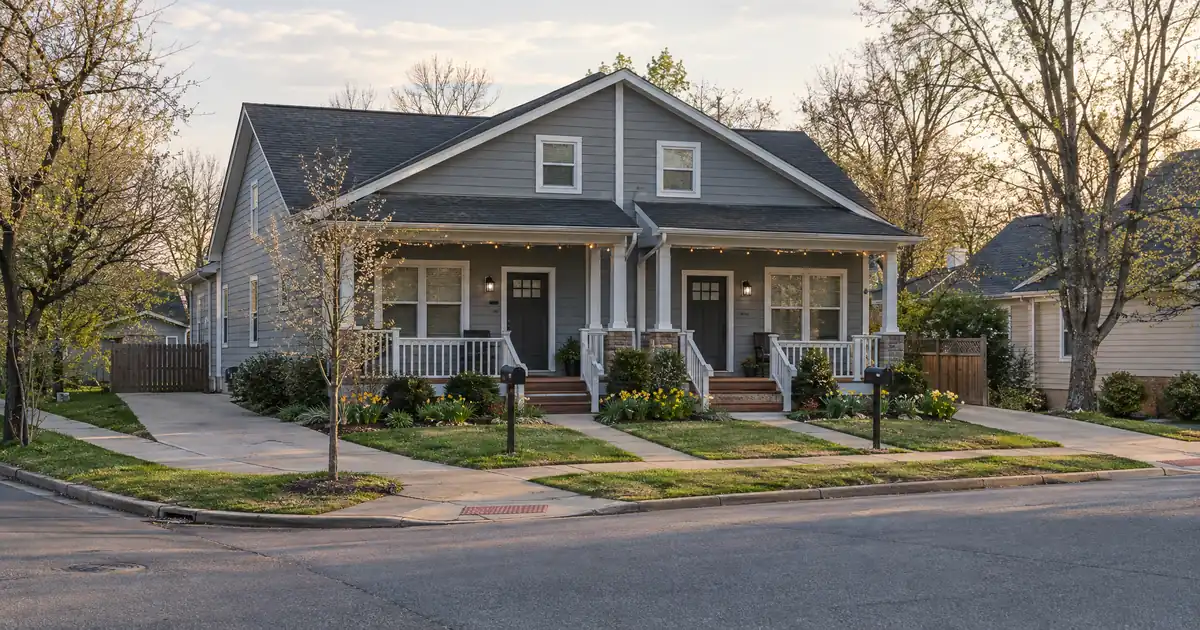
The Quick Read: Yes, as long as you live in one of the units. A conventional loan treats a two-, three- or four-unit building you occupy as a principal residence, and leverage can reach 95% of the purchase price. Rent from the other units can help you qualify, but only under specific rules, and your housing history decides how much of it counts.
What Does House Hacking With a Conventional Loan Actually Mean?
House hacking means you buy a small multi-unit building, live in one unit, and rent out the rest. A conventional loan can finance it because the lender sees an owner-occupied home with some rental income attached. It does not see an investment property.
Conventional payment estimate
The starting figures are an example price at the first-time buyer’s minimum down payment. Replace them with yours.
Editable benchmark: 7.32% as of October 22, 2026 · Freddie Mac 30-year average via FRED®. A conventional market reference, not a conventional loan quote.
Estimate seeded at the low end of Fannie Mae’s published range (0.58%–1.86% a year); the insurer prices the actual premium on the score and the leverage. Applies only above 80% loan-to-value.
Illustrative starting assumptions: a $350,000 price, the first-time buyer’s minimum down payment, a thirty-year term at the current Freddie Mac benchmark, mortgage insurance at the low end of Fannie Mae’s published range, and property taxes and insurance estimated at typical national rates. Every field is editable.
Illustrative estimate only — not a Loan Estimate, approval, quote, or commitment to lend. The rate field carries the weekly Freddie Mac thirty-year conventional benchmark, a market reference and not a conventional loan quote; your rate is set by the lender at lock. The mortgage insurance figure is an editable estimate seeded from Fannie Mae’s published typical range, not a premium quote; the insurer prices the actual premium, and the cancellation month assumes scheduled payments with no extra principal and no change in value. Taxes, insurance and dues are editable estimates; closing costs are not included. Conforming loan limits apply by county. Licensed in sixteen states for consumer mortgages.
That distinction drives almost everything else. Occupancy changes the leverage, the mortgage insurance, and how the file is underwritten. Lendmire arranges conventional loan programs through wholesale lenders. Across those programs, the occupancy line is the first thing a file gets sorted by.
Here is the contrast in one sentence. The same four-unit building can be financed up to 95% of the price if you live in it. If you buy it purely to rent, conventional leverage on two to four units drops to 75%. So the question is not whether conventional works for multi-unit. The question is whether you will really live there.
How Much Down Payment Does a 2-4 Unit Need?
For a principal residence, conventional leverage on a two- to four-unit property goes up to 95%. That means as little as 5% down. A one-unit home can reach 97% for a first-time buyer on a fixed rate, but that top tier does not extend to two to four units.
Older guides still say 85% for a duplex and 75% for a triplex or fourplex. Those caps are out of date. The current Fannie Mae eligibility matrix lists 95% for two- to four-unit principal-residence purchases. It also lists 75% for a cash-out refinance on the same property types. One caution: some secondary sources say the higher leverage does not apply to high-balance or manually underwritten loans. Confirm that against your own file.
| Purpose | Occupancy | Typical maximum leverage |
|---|---|---|
| Purchase, 2-4 units | You live in one unit | 95% |
| Purchase, 1 unit | You live there | 95%, or 97% for first-time buyers on a fixed rate |
| Purchase, 2-4 units | Rental only | 75% |
| Cash-out refinance, 2-4 units | You live in one unit | 75% |
These are agency-level ceilings, and they sit inside the wholesale programs Lendmire works with. Your own file still has to clear lender guidelines and a full review. Nothing here is a commitment to lend.
The wholesale conventional programs generally start at a 620 decision score. The automated underwriting finding governs most files, with a total debt-to-income ceiling of 50%. A thin file can sit near those edges, and a stronger one gives you more room.
How Does Rent From the Other Units Help You Qualify?
Rent from the units you don’t occupy can count as qualifying income, but it never replaces your payment. Underwriters keep the full monthly housing cost of the building in your debt-to-income ratio. They then add net rental income from the other units to your income.
Fannie Mae’s Desktop Underwriter job aid describes this treatment. The mortgage payment is not subtracted from the rent first. In plain terms:
1. The lender counts the whole payment on the building (principal, interest, taxes, insurance and any association dues) as your debt.
2. The lender adds a net figure for rent from the non-owner units to your income.
3. The resulting ratio has to fit the automated finding, with a ceiling of 50% on most files.
This is why a house hacker’s qualifying payment can look heavier than the real out-of-pocket cost. In daily life, the tenants’ rent offsets the payment. On paper, the lender sees the full payment and only a portion of the rent.
Rent from the unit you live in cannot be used to qualify. Boarder income and accessory-unit income are the exceptions, and they follow their own rules.
The paperwork follows the rent. For a two- to four-unit property with rental income, the appraisal is on the small residential income property form, which supports market rent. The Selling Guide section on subject-property rental income lays out that appraisal form and the property types that are eligible. Lenders also collect gross monthly rent for each unit, even if you aren’t using the rent to qualify. When a lease exists, the lender uses a current, fully signed one and compares it with market rent.
The Housing-History Rule That Decides the Outcome
How much rent you can use depends on your own housing history. This is the rule that surprises first-time buyers most often. Under Fannie Mae’s SEL-2019-08 policy, three situations apply:
| Your situation | Rent from the other units |
|---|---|
| Own a home or have a housing expense, plus one year of rental or property-management history | No cap on the rental income used |
| Own a home or have a housing expense, but under one year of that history | Limited to the building’s payment |
| No home and no housing expense | Cannot be used |
The third row catches people living rent-free with family. If you have no ownership and no housing expense, you must qualify on the entire payment without any rent from the building. A buyer who rents an apartment is in a different spot. Paying rent counts as a housing expense.
Keep one number from the first row in mind. A year of landlord or property-management history is what opens up uncapped rental income. A buyer who has never managed a rental should plan on qualifying with limited help from rent, and should treat extra rent as cushion.
Fannie Mae recently restructured its rental income section. Lenders are adopting the new framework, which tightens lease standards and adds rules for short-term rental income. Guides written before that change may describe outdated rules, so check how recent any source is.
What Does a Real File Look Like?
Picture a buyer who rents an apartment today and has never been a landlord. They buy a duplex with 5% down, so leverage is 95% of the price. They plan to live in one side and rent out the other. Terms depend on the lender’s guidelines, the property type, the leverage, and a full review of the credit profile.
Because they currently pay rent, they have a housing expense. But they have under a year of landlord history. Under the table above, the rent from the second unit can only count up to the amount of the building’s payment. The full payment stays in their ratio. The automated finding then looks at their credit, assets, reserves and total ratio against the 50% ceiling.
Now change one fact. The same buyer owned a home before and has managed a rental for over a year. The rent cap no longer applies. The same duplex now qualifies with more room, because more of the rent counts.
Neither version is a promise of approval. The point is that the building, the rent and your history work together. A strong building can’t fix a weak ratio on its own.
Reserves matter too. Two- to four-unit principal residences typically require reserves, and the automated finding sets the amount. Reserves are liquid funds left over after closing. Keep them in mind when you budget, because they are on top of your down payment and closing costs.
What Does the Occupancy Promise Require?
You certify at application that you will occupy the property as your principal residence. Standard security-instrument language generally expects you to move in soon after closing and stay for about a year, with exceptions for events outside your control. Treat that as general guidance and confirm the wording in your own loan documents.
Occupancy is not a formality. It is certified at application, checked before closing, and open to review afterward. Misrepresenting it is a serious problem, not a technicality. If your plans are shaky, say so before you apply. If you are unsure you will live there, the honest answer may be a different loan type, not a different answer on the form.
Life does change. A job relocation or a family change can happen, and the agencies recognize that. The lender decides case by case, so talk through your situation early instead of guessing.
Duplex, Triplex or Fourplex?
Leverage doesn’t change as you add units, but the file gets heavier. A fourplex gives you the most rent and the most management work. A duplex gives you the most privacy and the simplest file. Here is how the options compare in practice:
| Factor | Duplex | Triplex | Fourplex |
|---|---|---|---|
| Max leverage (owner-occupied) | 95% | 95% | 95% |
| Rented units | One | Two | Three |
| Loan size room | Higher than one unit | Higher still | Highest |
| Management load | Light | Moderate | Heavy |
| Rent dependency | Lower | Moderate | Higher |
Conforming loan limits are higher for two to four units than for one unit, and they are set by county. The FHFA announcement of conforming loan limits explains the baseline and high-cost areas, and your county’s figure applies. Above the conforming limit, jumbo lanes take over.
Five or more units falls outside these residential programs entirely. Four is the ceiling for this conversation. Adding an accessory dwelling unit to a two- or three-unit property is now possible under newer agency rules, as long as total units don’t exceed four. Ask your lender how a specific property would be treated.
Thinking out loud for a moment: the triplex is often the quiet sweet spot. It leaves you two rented units, so one vacancy hurts less, and it is far easier to manage than a fourplex. For a first-time landlord, though, a duplex’s simplicity can matter more than the extra rent.
Conventional, FHA or VA for a House Hacker?
Conventional tends to fit borrowers with stronger credit who want mortgage insurance that can come off the loan. FHA is a separate government program with its own limits and a different insurance structure. VA is for eligible veterans and service members. Which one fits depends on credit, down payment and how long you plan to stay.
| Factor | Conventional | FHA | VA |
|---|---|---|---|
| Who it fits | Stronger credit, steady income | Lower scores, smaller cash | Eligible veterans |
| Mortgage insurance | Cancels at 80%, ends at 78% | Different structure | Funding fee, no monthly insurance |
| Multi-unit use | 2-4 units, owner-occupied | 2-4 units, owner-occupied | 2-4 units, owner-occupied |
The decision usually comes down to two things: your credit score and how you feel about mortgage insurance. If your score is solid, conventional often gives you the most flexibility to remove insurance later. If your score is lower, FHA may be the only practical door. A veteran should look at VA first. Lendmire arranges all three through wholesale lenders, so you can compare them side by side instead of committing to one in advance.
HUD publishes its own limits, and they are higher for two to four units. A conventional file and an FHA file can look very different on the same building, so ask for both.
Mortgage Insurance: How It Ends
Mortgage insurance is required on a conventional loan above 80% leverage. With 5% down on a multi-unit, you will have it. The good news is that it isn’t permanent. The exact numbers vary by lender and program and follow a full review of property, leverage, and credit.
You can ask to cancel it once your balance reaches 80% of the original value. That generally requires a good payment history, no second liens and no drop in value. The servicer must end it automatically at 78%. Premiums vary by credit score, leverage and loan details, so your Loan Estimate shows the real figure.
The tradeoff is simple. Putting more down shrinks or removes the insurance cost. Putting less down keeps cash in your pocket for reserves and repairs. On a house hack, the cash you keep often matters more, because a building with tenants needs a cushion.
What Can Derail a Deal?
Most house-hack files fall apart for ordinary reasons, not exotic ones.
- Housing history gaps. A buyer with no housing expense can’t use rent from the building. Plan around that before you write an offer.
- Thin reserves. Down payment and closing costs can use up cash that reserves were supposed to cover.
- Rent that doesn’t match the appraisal. If market rent comes in below what you assumed, your ratio shifts.
- Condition issues. A unit that can’t be legally rented, or a property that fails appraisal, stops the file.
- Weak occupancy intent. A buyer who really means to rent all units is in the wrong lane.
- Stale information. Using a guide that predates the rental-income restructure leads to wrong expectations.
Also check local zoning and licensing for rentals before you commit. Those rules vary by place and sit outside the loan itself.
What Happens After Year One?
After the occupancy period, many owners stay put. Others move out and keep the building as a rental, then buy another home as their next residence. Whether you can keep the loan as a rental is a question for your loan documents and your lender, since the original promise was to live there.
If you later want to pull equity out of the building while living in it, the cash-out limit on a two- to four-unit principal residence is 75%. For a comparison of cash-out paths on this kind of home, see Lendmire’s piece VA Cash-Out vs Staying Conventional on a 2-4 Unit Primary Home.
Key Terms Defined
Principal residence: The home you live in as your main address, which is what unlocks the highest leverage.
LTV (loan-to-value): The loan amount as a percentage of the property’s value or price.
PITIA: The full monthly housing cost: principal, interest, taxes, insurance and any association dues.
DTI (debt-to-income ratio): Your monthly debts divided by your monthly income, which the automated finding checks against a ceiling.
Reserves: Liquid funds you still hold after closing, available to cover payments if income dips.
Net rental income: Rent from eligible units after the lender’s adjustments, added to your qualifying income.
Frequently Asked Questions
Do I have to live in the building?
Yes. A conventional loan at owner-occupied leverage requires you to occupy one unit as your principal residence. You certify that at application, and it is verified before closing. If you plan to rent every unit, the loan falls under investment rules, which cap two- to four-unit leverage at 75%. Final terms depend on the lender’s guidelines, the property type, and the borrower’s complete credit picture.
Can a first-time buyer with no rental history use the rent to qualify?
It depends on your housing expense. A buyer who pays rent has a housing expense, but with under a year of landlord history the rent counted is limited to the building’s payment. A buyer with no housing expense at all cannot use rent from the building. Plan on qualifying with the full payment in that case.
Does 95% leverage really apply to a fourplex?
For a principal-residence purchase, the current agency matrix lists 95% for two- to four-unit properties. Some secondary sources mention exceptions for high-balance or manually underwritten loans, so confirm how your specific file would be handled. Agency ceilings are the starting point, and your lender’s guidelines still apply. Each figure is subject to lender guidelines and a complete review of property type, leverage, and credit.
Is mortgage insurance forever on a house hack?
No. On a conventional loan it is required above 80% leverage, you can ask to cancel at 80% of the original value, and it ends automatically at 78%. FHA works differently, which is one reason to compare programs before you choose. Leverage, reserves, and pricing vary by lender and program; the final terms follow the full file review.
Can I rent out my own unit later and buy another house hack?
Many owners do move out and keep the building after the occupancy period. Each new purchase is underwritten fresh against the same rules, including your housing history and ratio. Ask your lender how an existing mortgage would be treated on your next file.
Next Step
If you are buying a home and want to see whether a conventional loan fits your file, Lendmire can help you compare the options and what each one asks of the file. Call 828-256-2183 or request a quote. Program figures are subject to lender guidelines and a full file review.
About Lendmire
As a mortgage broker (NMLS# 2371349), Lendmire helps homeowners and home buyers in 16 states with FHA, VA, conventional and jumbo purchase and refinance loans arranged through wholesale lenders. Lendmire is never the lender; program terms are set by the lender and the agency guidelines. Scotsman Guide named Lendmire a Top Mortgage Workplace in both 2025 and 2026.
Get Started
Ready to find the right loan for you?
In about 30 seconds you can review financing options available for your home or investment property. No commitment required.
Informational only. Not a Loan Estimate, approval, or commitment to lend. Program availability and eligibility are subject to lender guidelines, credit approval, property review, and underwriting.
References
1. Fannie Mae Eligibility Matrix
2. Fannie Mae Desktop Underwriter Job Aid: Entering Income From Rental Property
3. Fannie Mae Selling Guide: Rental Income on the Subject Property
5. FHFA Conforming Loan Limit Values
6. HUD
This article is part of Lendmire’s conventional loan program — full qualification details, guidelines, and scenarios live on the program page.
Related reading: Conventional Cash-Out LTV Limits for a 2-4 Unit Primary Home · Can You Avoid PMI on a Conventional Loan Without a Fifth Down? · Conventional Cash-Out Refinance for Homeowners Replacing a Loan to Get Cash
Brandon Miller
Founder & CEO, Mortgage Loan Originator, Lendmire LLC
- Mortgage Loan Originator · NMLS# 1129696 · Verify on NMLS Consumer Access
- North Carolina Real Estate Broker · License# 343312 · Verify on NCREC
- North Carolina Insurance Producer · License# 19053198 · Property, Casualty, Life, Health · Verify on NAIC SBS
- Lendmire LLC · Firm NMLS# 2371349 · Verify firm licensure
Compliance and disclosures. Lendmire (NMLS# 2371349) is a licensed mortgage broker and is not a direct lender, depository institution, financial advisor, or tax professional. Content in this article is general market analysis and educational information — not financial, legal, or tax advice for any specific situation. Lendmire does not guarantee loan approval; every transaction is subject to underwriting by the funding lender. Mortgage pricing and loan program guidelines are subject to change at any time without notice and vary by borrower characteristics, property type, and state regulations. Lendmire complies with Equal Housing Opportunity. Licensure verification: NMLS Consumer Access.