
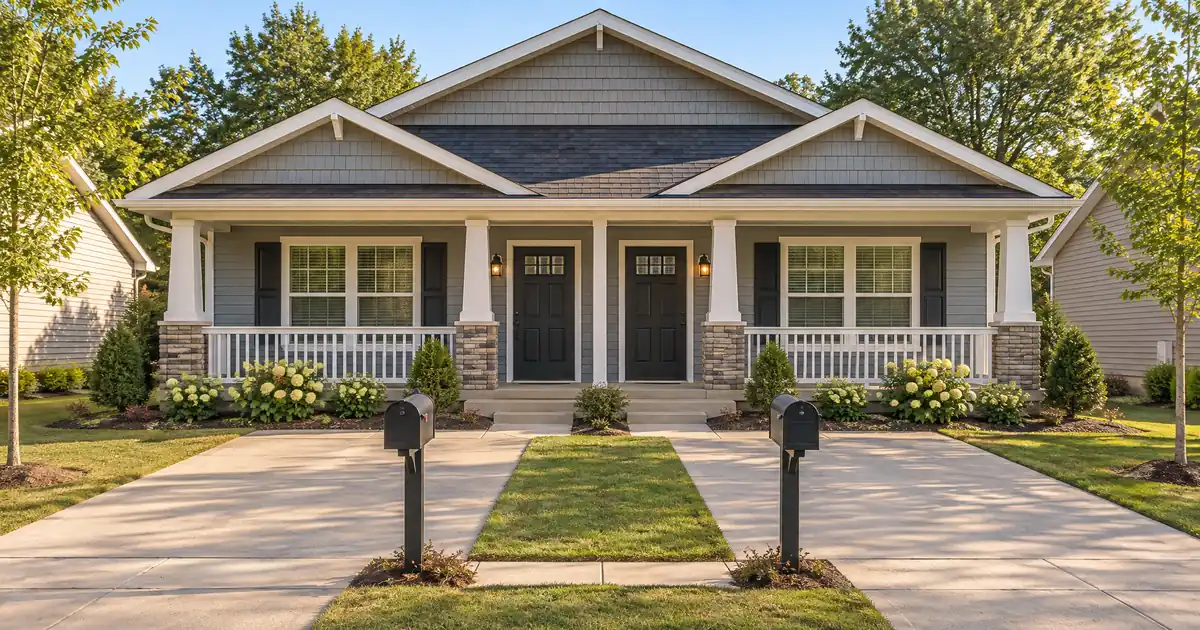
The Quick Read: How lenders underwrite a cash-out refinance on a duplex you live in comes down to five checks. Lenders treat the duplex as a two-unit principal residence. They test the appraised value against a 75% leverage cap, confirm you have owned long enough, count your full housing payment as a debt, and add only part of the other unit’s rent as income. Everything is subject to lender guidelines and full file review.
What Is a Cash-Out Refinance on a Duplex You Live In?
A cash-out refinance replaces your current mortgage with a larger one and pays you the difference. On a duplex where you occupy one unit, the lender treats the home as a two-unit principal residence. That means owner-occupied rules apply, with tighter limits than a one-unit house.
Cash-out refinance estimate
The starting figures are an example value with a balance and a cash request in proportion. Replace them with yours.
Editable benchmark: 7.18% as of November 5, 2026 · Freddie Mac 30-year average via FRED®. A conventional market reference, not a cash-out refinance quote.
Illustrative starting assumptions: a $350,000 home value, a $193,000 current balance, the agency cap on a one-unit principal residence, a thirty-year term at the current Freddie Mac benchmark, and property taxes and insurance estimated at typical national rates. Every field is editable.
Illustrative estimate only — not a Loan Estimate, approval, quote, or commitment to lend. The rate field carries the weekly Freddie Mac thirty-year conventional benchmark, a market reference and not a cash-out refinance quote; a cash-out loan is priced by the lender at lock. The cash available is the loan the program cap allows less the balances paid off, before closing costs, which are not included. The HELOC line is the program’s combined loan-to-value ceiling applied to the same value and balance. Taxes and insurance are editable estimates. Licensed in sixteen states for consumer mortgages.
A free-and-clear duplex counts too. If you own it outright and take out a new loan, that is still a cash-out refinance under Fannie Mae and Freddie Mac rules.
Living in one unit is what keeps the loan in the owner-occupied category. Lendmire’s cash-out refinance programs page covers the program lanes in more detail.
Key Terms Defined
LTV (loan-to-value): The new loan amount divided by the appraised value of the home.
Seasoning: The length of time you have owned the home or held the loan being paid off.
DTI (debt-to-income): Your monthly debts divided by your monthly income, including the full payment on the duplex.
Reserves: Liquid assets left after closing, counted in months of housing payments.
Market rent: What the appraiser says each unit would rent for, reported on the appraisal.
Limited cash-out (rate-and-term): A refinance that pays off the old loan and costs, with only small incidental cash back.
How Does a Lender Underwrite It, Step by Step?
The deal works through the same sequence every time. Here is the order an underwriter works in.
1. Classify the loan. Paying off a first mortgage and taking cash is a cash-out. So is refinancing a property with no mortgage. Both get cash-out leverage limits and cash-out credit adjustments.
2. Check the ownership clocks. At least one borrower must be on title for six months before the new loan is disbursed, per Fannie Mae Selling Guide B2-1.3-03. The first mortgage being paid off must be at least 12 months old, counted note date to note date. Exceptions exist for delayed financing, inheritance and legal awards.
3. Verify occupancy. You must actually live in one unit. The lender looks for it in your credit file, your ID, your mail and your signed occupancy statement. Misrepresenting occupancy is a serious problem, not a technicality.
4. Order the appraisal. The appraised value is the bottom half of the LTV fraction, so it decides how much cash is possible. On a duplex, the appraiser also reports market rent for each unit.
5. Run the LTV test. The new loan, including any financed costs, must fit under the cap. On a conventional cash-out, that cap is 75% for a two-unit principal residence. The cap is 80% for a one-unit home. Confirm the current figures on the Fannie Mae Eligibility Matrix.
6. Qualify income and debt. Your own income is documented the usual way. The full payment on the duplex counts as your debt. Rent from the other unit comes in at a reduced amount.
7. Check reserves. Reserves depend on the file. On Fannie Mae’s automated findings, a DTI above 45% triggers a six-month reserve requirement. Terms vary by lender guidelines, property type, leverage, credit profile, and full file review.
8. Clear conditions and close. The underwriter issues conditions, you answer them, and the file goes to closing. Because the home is your residence, the right of cancellation applies after signing.
How Does the Other Unit’s Rent Count?
Only part of it counts, and it never offsets the payment dollar for dollar. Rental income from a principal residence is generally not usable to qualify, with one named exception: a two-to-four-unit home where the borrower occupies one unit. That is your duplex.
Under Fannie Mae’s rental income rules, the lender must count the full housing payment as an obligation. The rent cannot be netted against it. Gross rent is stated for each unit, and Fannie Mae’s Form 1037 is the worksheet for a two-to-four-unit principal residence.
The Fannie Mae DU job aid shows how the math runs. Gross rent is multiplied by 75% to allow for vacancy and loss. That amount is added to your qualifying income, and the full payment goes in as a debt, so the rent is never subtracted from the payment.
| Item | How it is treated |
|---|---|
| Your own unit’s rent | Generally not counted |
| Other unit’s rent | 75% of gross, added to income |
| Full duplex payment | Counted as a debt in DTI |
| Rent documents | Leases or appraiser’s rent schedule |
Which documents a lender wants varies, so confirm with your loan officer.
How Is a Duplex Different From a House?
The duplex gets less cash from the same equity. Here is the side-by-side on conventional cash-out.
| Factor | One-unit home | Two-unit you live in |
|---|---|---|
| Cash-out max LTV | 80% | 75% |
| Rent from other unit | None | 75% of gross counts |
| Appraisal | Value only | Value plus rent per unit |
| Reserves | File-based | File-based, often stricter |
The lower cap is the part borrowers miss. Picture a duplex worth the same as a neighboring house. At 75% versus 80%, five points of the value stay locked in the home.
Where Does the General Rule Break?
These are the edge cases that change the answer.
Taking no cash on a duplex. A rate-and-term refinance on a two-unit home can use more of the value than a cash-out can. Fannie Mae’s high-LTV refinance option is a separate program for borrowers whose loan-to-value already sits above a set threshold, and its rules differ from a cash-out’s. If you only need a new term and a small amount back, that lane can be the better fit. Limited cash-out also pays off the old loan, closing costs and a purchase-money second lien, with only incidental cash back.
You do not live there. If no borrower occupies a unit, the loan is no longer a principal-residence loan. Leverage drops and the income math changes, because the property is then rated as a second home or an investment property.
Non-occupant co-borrowers. On a Freddie Mac primary-residence cash-out, all borrowers must occupy the home. A parent or relative who does not live there generally cannot be added to carry the file.
Recent cash buyers. Delayed financing waives the six-month title wait, but the loan is still a cash-out and carries cash-out pricing.
HELOCs and second liens. A first-lien HELOC is exempt from Freddie Mac’s 12-month rule. Paying off a second mortgage can also turn a loan into a cash-out, so have your loan officer check the guide for your specific payoff.
Land contracts. A cash-out cannot pay off an installment land contract.
Streamlines. The HUD FHA Streamline is not a cash-out product. It requires an existing FHA loan that is current, plus a net tangible benefit, and cash above $500 may not be taken out. The VA IRRRL also allows no cash-out. Neither is a way to pull real equity from a duplex.
Government cash-out. VA and FHA both have owner-occupied cash-out paths, and a multi-unit home can work if you occupy a unit. Details vary by lender, so ask which lanes fit your file.
What Gets These Files Conditioned or Denied?
Most problems are predictable.
- Low appraisal. A value below expectations shrinks the cash directly. Ask whether the appraiser had two-unit comparables. A reconsideration request with better local sales can sometimes help.
- Vacant unit. If the other unit is empty, there may be no lease to document. The lender may rely on the appraiser’s market-rent schedule, or may not count the rent at all.
- Conflicting documents. A lease that shows one rent and an appraisal that shows another gets a condition letter.
- Missed clocks. A recent purchase with a mortgage usually waits for the 12-month mark. Files that skip this get sent back.
- DTI after the haircut. The full payment counts, but only 75% of the rent does. A large cash-out can fail qualification even when the tenant covers much of the payment in real life.
- Rent experience limits. Fannie Mae’s SEL-2023-09 announcement ties the full use of rental income to documented experience in some cases. Ask your lender whether it applies to a duplex you have lived in for years.
What Does the Decision Look Like in Practice?
Say you own a duplex and live in the upstairs unit. A tenant rents the downstairs. You want cash for a renovation.
The lender starts with the appraised value, applies the 75% cap, and subtracts the payoff and financed costs. What remains is your possible cash. Then the income test: your own income plus 75% of the downstairs rent, against the full new payment and your other debts. If DTI comes out above 45% on an automated finding, six months of reserves enter the picture.
Costs financed into the loan reduce what reaches you. Cash-out pricing also adds credit adjustments, so a larger cash-out is not free money. Your loan officer can show both the cash available and the monthly effect before you commit.
Consider the alternatives too. Keeping your current loan and taking a smaller amount through a limited cash-out may leave you with a better budget. A borrower with a strong score and a standard conforming balance may also look at the wholesale no-mortgage-insurance lane, which reaches 89.99% LTV at a 680 score and a 50% ratio on a thirty-year fixed primary residence. That lane has its own six months of seasoning, and a two-unit property is a separate question from the one-unit figures here, so ask whether it applies. Exact terms depend on the lender’s guidelines, property type, leverage, and a full review of the borrower’s file.
When mortgage insurance applies on a conventional file, it is required above 80% LTV, except in that wholesale no-MI lane. It can be cancelled at 80% of original value on request and ends automatically at 78%.
Once you sign, a three-business-day right to cancel generally applies to a refinance on your principal dwelling. Saturdays count. Sundays and legal public holidays do not. The CFPB notes that if you cancel a refinance, you still owe the original loan.
Document Checklist
- Photo ID and proof you live in the duplex
- Pay stubs, W-2s or the income documents your program requires
- Current mortgage statement and homeowners insurance
- Leases for the other unit, if occupied
- Mortgage statements for any second lien or HELOC
- Proof of reserves, if required
Frequently Asked Questions
Can I take cash out of a duplex I live in?
Yes, when you occupy one unit and the file meets the program rules. The loan is treated as a two-unit principal residence, with a 75% cash-out cap on conventional loans instead of the 80% for a one-unit home. Seasoning, DTI and reserves still apply, subject to lender guidelines.
Does the rent from my other unit count as income?
Partly. Under Fannie Mae’s automated underwriting, 75% of the gross rent is added to your qualifying income. The full duplex payment still counts as a debt, so the rent never cancels the payment. Rent from the unit you live in generally does not count.
How long do I have to own the duplex first?
At least one borrower must be on title for six months. The loan being paid off must also be at least 12 months old, measured note date to note date. Delayed financing, inheritance and legal awards are exceptions to parts of this.
Can an FHA Streamline or VA IRRRL get me cash?
No. The FHA Streamline allows no more than $500 in cash, and the VA IRRRL allows none. Both are designed to lower the cost of an existing government loan, not to unlock equity.
Can I cancel after I sign?
Usually, yes. Most refinances on a principal dwelling carry a three-business-day right to cancel. The clock starts only after you have signed, received the Truth in Lending disclosures and received two copies of the rescission notice.
Next Step
If you are weighing a cash-out refinance against keeping the loan you have, Lendmire can help you compare the programs and the equity each one reaches. Lendmire is a mortgage broker, not a lender, and a different program may fit a different file. For leverage on more doors, Lendmire’s piece How Lenders Size LTV on a Duplex Cash-Out Refinance for More Doors is a useful companion.
For your own numbers, request a scenario review with Lendmire.
For current guidelines and terms, see Lendmire’s refinance programs page.
About Lendmire
Lendmire, NMLS# 2371349, is a mortgage brokerage with consumer lending licenses in 16 states. FHA, VA, conventional and jumbo purchase and refinance loans are arranged through wholesale lending partners, and each application is reviewed individually by the lender. Scotsman Guide named Lendmire a Top Mortgage Workplace in both 2025 and 2026.
Get Started
Ready to find the right loan for you?
See your offer in seconds. No credit pull, no obligation.
Informational only. Not a Loan Estimate, approval, or commitment to lend. Program availability and eligibility are subject to lender guidelines, credit approval, property review, and underwriting.
References
1. Freddie Mac
2. Fannie Mae Selling Guide B2-1.3-03, Cash-Out Refinance Transactions
3. Fannie Mae Eligibility Matrix
4. Fannie Mae Selling Guide B3-3.1-08, Rental Income
5. Fannie Mae DU Job Aid: Entering Income from Rental Property
6. Fannie Mae Selling Guide B5-7-01 High LTV Refinance
7. HUD FHA Streamline Refinance
9. CFPB: Right of rescission on a refinance
This article is part of Lendmire’s cash-out refinance program — full qualification details, guidelines, and scenarios live on the program page.
Related reading: How Lenders Underwrite a Cash-Out Refinance When It Resets the Mortgage to a New 30 Years · How Broker Wholesale Lenders Read a Declined Cash-Out Refinance · How Lenders Underwrite a Cash-Out Refinance for Renovations and the Appraisal Requirement
Brandon Miller
Founder & CEO, Mortgage Loan Originator, Lendmire LLC
- Mortgage Loan Originator · NMLS# 1129696 · Verify on NMLS Consumer Access
- North Carolina Real Estate Broker · License# 343312 · Verify on NCREC
- North Carolina Insurance Producer · License# 19053198 · Property, Casualty, Life, Health · Verify on NAIC SBS
- Lendmire LLC · Firm NMLS# 2371349 · Verify firm licensure
Important disclosures. Lendmire (NMLS# 2371349) is a licensed mortgage brokerage. Lendmire is not a direct lender, depository institution, or financial advisor. All loan inquiries are subject to lender underwriting; this article does not constitute a commitment to lend. Rates, terms, and program guidelines are subject to change without notice and vary by borrower profile, property type, and state. Information in this article is general in nature and is not financial, legal, or tax advice. Equal Housing Opportunity. NMLS Consumer Access: nmlsconsumeraccess.org.