
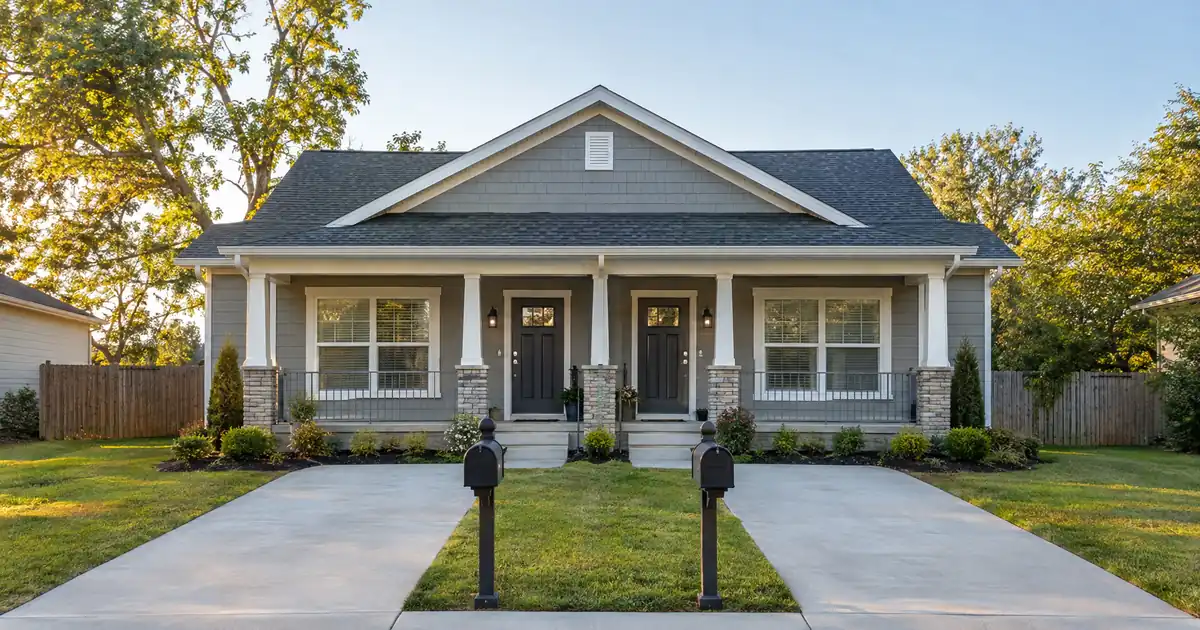
The Quick Read: On a conventional cash-out refinance of the home you live in, a two-unit property is held to a maximum loan 5 percentage points lower than a one-unit home. That cap is 75% of appraised value on the duplex and 80% on the single-family. The difference is 5% of the appraised value, and your actual check shrinks by at least that much once the payoff and closing costs come out. Every figure here is subject to lender guidelines and full file review.
Here is the part most people miss. Five points sounds small. But cash-out proceeds are what is left after you subtract your current loan from the cap, so a small cap change can take a big bite out of a small remainder. At some balances it takes the whole thing.
Key Takeaways
- Conventional cash-out caps the new loan at 80% of value on a one-unit primary residence and 75% on two- to four-unit primary residences.
- The gap in maximum loan is always 5% of appraised value, whatever the home is worth.
- Your cash equals the cap, minus your payoffs, minus your costs. The gap hits hardest when you already owe a lot.
- FHA and VA work differently, so the gap is mostly a conventional-loan feature.
- Rent from the second unit can help you qualify, but it does not raise the cap.
What “Cash Released” Actually Means
Cash released is the money that reaches you after a cash-out refinance pays everything else. A cash-out refinance replaces your current mortgage with a new, larger one. The difference between the two, after costs, is your cash.
Here is the whole thing in one line. Maximum new loan, minus what you owe, minus closing costs, equals your cash.
Loan-to-value (LTV) is the new loan divided by the appraised value of the home. A cash-out cap is the highest LTV the program allows on that transaction. The cap applies to the new loan, including the cash you take. It is not a limit on “80% of your equity,” which is a common misreading.
Brokers see this misunderstanding every week. Someone with a lot of equity assumes they can borrow against 80% of it. They can’t. The cap is measured against the home’s whole value, and your existing balance eats into the room first.
Why a Duplex Gets a Lower Cap
A two-unit home is a bigger risk to the lender than a single-family home. The risk logic is straightforward. Two-unit properties tend to be harder to resell, and the value depends partly on rental income. Lenders ask for a deeper equity cushion to cover that.
The agencies that set conventional guidelines publish the same two figures. Freddie Mac’s Guide Section 4203.1 sets cash-out maximums at 80% for a one-unit primary residence and 75% for a two- to four-unit primary residence. The Fannie Mae Eligibility Matrix lists the same split for cash-out refinances. Across the wholesale programs I place files with, the same numbers show up.
A three- or four-unit home carries the same 75% cap as a duplex on the conventional side. So the real break is between one unit and everything above it.
Occupancy matters as much as unit count. The same 75% cap applies to second homes and investment property on a cash-out. If your title question is really about a rental or second home, the short answer is that occupancy decides the leverage. This article stays with the home you live in.
The Formula, Step by Step
Estimating your cash takes five steps. Do them in this order, and don’t skip the subtraction.
1. Start with value. The appraisal sets it. For a one-unit home, that is a standard interior-and-exterior appraisal. For two to four units, the lender uses a different report form, covered below.
2. Multiply by the cap. Value times 80% for a single-family. Value times 75% for a duplex. That is your maximum new loan.
3. Subtract what must be paid off. That means your existing first mortgage and any home equity loan or line you took out after buying. Fannie Mae’s Selling Guide treats a refinance that rolls a first mortgage and a non-purchase-money second into one new first mortgage as cash-out.
4. Subtract closing costs, prepaid items and escrow deposits. These come out of your proceeds.
5. What remains is your cash. Not every dollar of headroom reaches you.
The gap between a duplex and a single-family is the first step’s difference. It is value times the five-point spread. Everything after that is the same arithmetic.
The Side-by-Side: Same Balance, Two Property Types
Picture two homeowners with identical situations except for the number of units. Each owes the same share of the appraised value. Here is how much room each has under the cap, before closing costs. All figures are percentages of appraised value.
| Balance owed | Single-family room | Duplex room |
|---|---|---|
| 60% | 20 points | 15 points |
| 70% | 10 points | 5 points |
| 75% | 5 points | — |
| 78% | 2 points | Over the cap |
The gap is a flat 5 points in every row. What changes is how much of the room it eats.
At 60% owed, the duplex owner keeps three-quarters of the single-family owner’s room. At 70% owed, the duplex owner has half. At 75% owed, there is nothing left. The duplex cap is already reached before a dollar of cash comes out.
At 78% owed, a single-family owner has a sliver of room before costs. The duplex owner can’t do a cash-out at all. That is the squeeze. A smaller remainder makes the five-point gap look huge.
Closing Costs Hit Smaller Proceeds Harder
Closing costs come out of your cash. They don’t shrink just because your cash is smaller. A duplex borrower with 5 points of room and a single-family borrower with 10 points face costs of the same general size. In percentage terms, those costs consume a larger share of the duplex proceeds.
So a thin cash-out on a duplex can end up with almost nothing in your pocket. Before you apply, ask for the maximum loan and then subtract payoffs and costs. That shows you the true cash number, not the headline one.
A duplex appraisal can also cost more and take more work than a single-family one. Costs vary by lender and area, and your Loan Estimate will list what applies to you.
The Appraisal Works Differently on a Duplex
On a one-unit home, the appraiser mainly compares your house to nearby sales. On a two- to four-unit property, Fannie Mae’s Selling Guide calls for the Small Residential Income Property Appraisal Report (Form 1025). That is an interior and exterior appraisal that also looks at rental information.
That matters for your cash. Duplex value leans partly on what the units could rent for. If the appraisal comes in below what you expected, two things happen at once. The cap applies to a lower value, and the lower value pushes your existing balance up as a share of that value. You lose cash on both ends.
Expect to provide lease or rent details tied to the appraisal’s rental analysis. Rent from the second unit can also help you qualify on income. It does not change the 75% cap. A duplex with a tenant is still a duplex to the cap.
Where the Rule Breaks
The 80% versus 75% split is the general rule. Several situations bend it.
No-cash-out refinances. A rate-and-term refinance, which only replaces your loan and pays costs, runs at much higher leverage on a duplex than a cash-out does. A duplex borrower can refinance at a very high LTV but can’t take cash out at that level. The 95% figure for two- to four-unit purchases doesn’t carry over to cash-out. The Freddie Mac guide table keeps cash-out at the lower cap.
FHA. FHA cash-out is capped at one level regardless of unit count. HUD Mortgagee Letter 2019-11 reduced that cap to the same percentage as a one-unit conventional loan. For FHA, unit count brings other requirements instead. Three- and four-unit properties face extra tests, including a self-sufficiency test and reserves after closing. FHA also requires you to have owned and lived in the home as your principal residence for a stretch before applying.
VA. A regular VA cash-out refinance can go up to a high share of the home’s reasonable value, well above the conventional caps. If you are a veteran with a duplex, the five-point gap may not apply to you. The VA streamline (IRRRL) is not a cash-out loan. It replaces an existing VA loan and limits what can be added.
FHA Streamline. Likewise, the FHA Streamline is a no-cash-out product for existing FHA loans.
Seasoning. Across the wholesale conventional programs, the first mortgage you are paying off must be at least 12 months old, counted from note date to note date. At least one borrower must also be on title for 6 months. A delayed financing exception covers buyers who paid cash. It requires the original purchase to be an arm’s-length transaction.
Texas homestead. In Texas, the state constitution caps a cash-out on the homestead at the agency figure. The wholesale lane that reaches higher leverage isn’t written there.
High-balance and jumbo loans. Loans above the conforming limit follow individual lender rules, not the agency caps. Jumbo cash-out limits vary by lender and by the lane. They are not a single national rule.
The zero-mortgage-insurance lane. One wholesale lane reaches 89.99% LTV with no mortgage insurance. It requires a 680 score, a 50% ratio and a 30-year fixed on a conforming primary residence, with its own six months of seasoning. Whether a two-unit fits it depends on the specific lender’s guidelines, so ask before you assume. Final terms depend on the lender’s guidelines, the property type, and the borrower’s complete credit picture.
Mortgage Insurance Rarely Enters the Picture
Mortgage insurance is a monthly cost lenders require when your loan is above 80% of value. You can ask to cancel it at 80% of the original value with a good payment history. It must end automatically at 78%. Conventional cash-out sits at or below 80% on a one-unit home and 75% on a duplex. So on the standard lane, mortgage insurance usually isn’t part of the cost.
That changes if you leave the standard lane. Government programs and the higher-leverage wholesale lane carry their own insurance or fee rules. The cap gap and the insurance question are separate issues.
How to Shrink the Gap
You can’t change the cap. You can change the numbers around it.
- Pay down the balance first. Every point you pay down is a point of room. Because the duplex cap is lower, each point counts for more.
- Wait for appreciation. A higher appraised value lowers your balance as a share of value.
- Pull less cash. Taking the full headroom isn’t a requirement. A smaller new loan means a smaller increase in your monthly payment.
- Check whether a second lien must be paid off. A home equity loan taken after purchase gets folded into the payoff.
- Compare programs. A government loan may use a different cap. That depends on your eligibility and your lender’s guidelines.
- Compare against a no-cash-out refinance. If your goal is a different term, not cash, the leverage is higher and the gap disappears.
What the Decision Looks Like in Practice
Start with the question you actually need answered. Do you need cash, or do you need a better loan? A duplex owner who needs no cash but wants a different term should usually look at a no-cash-out refinance first. The higher leverage works in your favor there.
If you do need cash, run the five steps with your own numbers. Include any home equity loan on the payoff list. Then ask yourself whether the true cash figure is worth the closing costs. A thin result may point to another source, such as a smaller pull or waiting.
Many cash-out borrowers use the money to pay down other debt. That can reduce overall interest costs, but the new loan is larger, so your monthly payment on the home goes up. Tax treatment can depend on your situation; borrowers should speak with a qualified tax professional before relying on any deduction or credit.
Lendmire’s cash-out refinance programs page lays out how the wholesale options compare. I’d run the maximum loan first, then the payoffs, before deciding anything else.
Key Terms Defined
Cash-out refinance: a new, larger mortgage that pays off your current loan and gives you the difference in cash.
Loan-to-value (LTV): the new loan divided by the home’s appraised value, shown as a percentage.
Cash-out cap: the highest LTV a program allows when you take cash out.
Rate-and-term refinance: a refinance that replaces your loan and pays costs, with only incidental cash back. Also called limited cash-out.
Seasoning: the waiting period a lender requires, such as how long the loan you are paying off has existed.
Mortgage insurance: a monthly cost on conventional loans above 80% LTV that protects the lender. Each figure is subject to lender guidelines and a complete review of property type, leverage, and credit.
Non-purchase-money second lien: a home equity loan or line taken after you bought the home, not as part of the purchase.
Frequently Asked Questions
Is the duplex cash-out cap really only 5 points lower?
Yes, on a conventional loan the gap is 5 percentage points of appraised value. The cap is 80% for a one-unit primary residence and 75% for a two- to four-unit primary residence. That 5% of value is the gap in maximum loan, and your check shrinks by at least that much once payoffs and closing costs come out.
Can I cash out on a duplex if I owe 75% of its value?
Not on the standard conventional lane. At 75% owed, you have already reached the duplex cap, so there is no room for cash. A single-family home with the same balance would still have room under its higher cap before costs. Paying the balance down or waiting for a higher appraisal changes that picture.
Does rent from the second unit raise my cash-out limit?
No. Rental income can help with qualifying, but it doesn’t change the loan-to-value cap. The cap is set by the program and the unit count. Your lender will explain how rent is counted on your file, since that depends on the program and lender guidelines.
Do FHA and VA loans have the same duplex penalty?
Not in the same way. FHA’s cash-out cap doesn’t depend on unit count, though three- and four-unit homes face extra tests. VA allows a high share of reasonable value, with no duplex-specific reduction. Eligibility depends on your loan history, occupancy and the lender’s review.
Is a rate-and-term refinance a better option on a duplex?
It depends on your goal. If you only want to change your loan and not take cash, a rate-and-term refinance allows much higher leverage on a duplex than a cash-out does. If you need cash, you will work within the 75% cap, subject to lender guidelines and full file review.
If you are weighing a cash-out refinance against keeping the loan you have, Lendmire can help you compare the programs and the equity each one reaches. For your own numbers, request a scenario review with Lendmire.
Whether the five-point gap matters to you comes down to one number: how much of your home’s value you already owe.
For current guidelines and terms, see Lendmire’s refinance programs page.
About Lendmire
Lendmire (NMLS# 2371349) is a mortgage brokerage serving homeowners and home buyers in 16 states. FHA, VA, conventional and jumbo purchase and refinance loans are arranged through wholesale lending channels; Lendmire brokers the financing and the lender underwrites each application. Scotsman Guide named Lendmire a Top Mortgage Workplace in both 2025 and 2026.
Get Started
Ready to find the right loan for you?
In about 30 seconds you can review financing options available for your home or investment property. No commitment required.
Informational only. Not a Loan Estimate, approval, or commitment to lend. Program availability and eligibility are subject to lender guidelines, credit approval, property review, and underwriting.
References
1. Freddie Mac Guide Section 4203.1
2. Fannie Mae Eligibility Matrix
3. Fannie Mae Selling Guide: Cash-Out Refinance Transactions
5. HUD Mortgagee Letter 2019-11
This article is part of Lendmire’s Refinance series — every loan program’s qualification details, guidelines, and scenarios live on the loan options page.
Related reading: Cash-Out Refinance Terms When You Unbundle a Blanket Loan · Can a Cash-Out Refinance Pay Off a Partner Who Only Holds a Note? · Two Individual Cash-Out Refinances vs. a Two-Property Blanket Loan
Brandon Miller
Founder & CEO, Mortgage Loan Originator, Lendmire LLC
- Mortgage Loan Originator · NMLS# 1129696 · Verify on NMLS Consumer Access
- North Carolina Real Estate Broker · License# 343312 · Verify on NCREC
- North Carolina Insurance Producer · License# 19053198 · Property, Casualty, Life, Health · Verify on NAIC SBS
- Lendmire LLC · Firm NMLS# 2371349 · Verify firm licensure
Legal disclosures. Lendmire (NMLS# 2371349) is a state-licensed mortgage brokerage that arranges financing through wholesale lender relationships. Lendmire is not a direct lender, depository institution, or registered financial advisor. The discussion above is general informational content about real estate financing — it is not financial, legal, or tax advice, and readers should consult licensed professionals for guidance on their individual circumstances. Loan inquiries are subject to lender underwriting; this article does not represent a commitment to lend. Loan terms, rates, and qualification standards vary by borrower, property, and state, and are subject to change at any time. Equal Housing Opportunity. NMLS Consumer Access: nmlsconsumeraccess.org.