
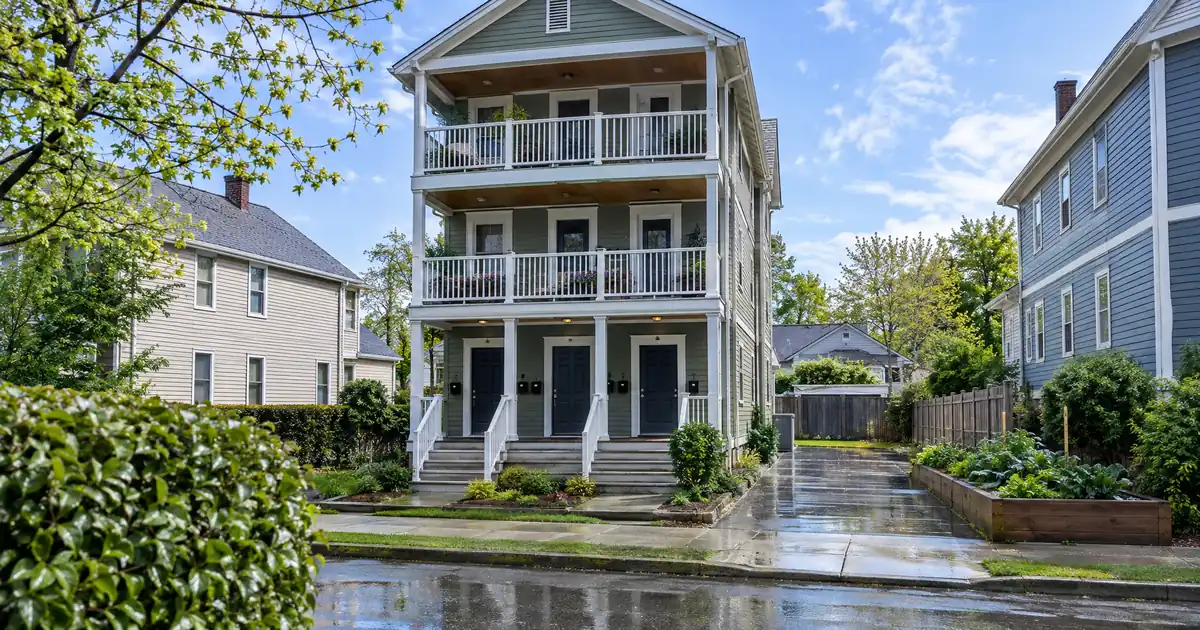
The Quick Read: On a two- to four-unit home you live in, FHA counts only part of the rent. For a duplex with no landlord history, the lender typically credits 75% of the lesser of the appraiser’s market rent or your lease. That counted rent goes on the income side of your ratios, and the full housing payment stays in the debt side. Three- and four-unit buildings face a second test: the building’s rent must cover its own payment.
Key Takeaways
- Rent never counts at 100%. The lender trims it, then adds it to your income.
- The rent does not shrink your payment in the ratios. It only raises income.
- Two different tests exist. One counts rent as income (2-4 units). The other tests the building (3-4 units only).
- The appraiser’s rent estimate controls both tests, so final numbers may wait until the appraisal is back.
- Counted rent is a paper figure. Budget from the rent you realistically collect, not the number on the worksheet.
The Rent Rules at a Glance
Most buyers mix up two separate calculations. This table keeps them apart.
FHA payment estimate
Starting assumptions reflect an example price and the FHA minimum investment. Replace them with your own figures.
Editable benchmark: 7.32% as of October 22, 2026 · Freddie Mac 30-year average via FRED®. A conventional market reference, not an FHA loan quote.
Illustrative starting assumptions: a $350,000 price, the FHA minimum investment as the down payment, a thirty-year term at the current Freddie Mac benchmark, and property taxes and insurance estimated at typical national rates. Every field is editable.
Illustrative estimate only — not a Loan Estimate, approval, quote, or commitment to lend. The rate field carries the weekly Freddie Mac thirty-year conventional benchmark, a market reference and not an FHA loan quote; your rate is set by the lender at lock. FHA mortgage insurance follows HUD’s published schedule for the term, leverage and loan size entered; taxes, insurance and dues are editable estimates; closing costs are not included; county loan limits are not checked here. Licensed in sixteen states for consumer mortgages. Lendmire is not affiliated with or acting on behalf of FHA, HUD, or the federal government.
| Item | Does it count? | Where it applies |
|---|---|---|
| Rent from units you rent out | Partly, as income | 2, 3 and 4 units |
| Rent from the unit you live in | Not as income | Included in the 3-4 unit test |
| Building self-sufficiency test | Pass or fail | 3 and 4 units only |
| Commercial space rent | Generally excluded | Confirm with your lender |
Keep reading for how each line works. Everything below is subject to lender guidelines and full file review, and nothing here is a commitment to lend.
Can FHA Really Finance a Duplex, Triplex or Fourplex?
Yes, with one condition: you live in one of the units. FHA is a home-buyer program. You must occupy the property as your principal residence, and the building can have up to four units.
The leverage works like any other FHA purchase. Across the wholesale lenders Lendmire works with, FHA loan programs reach 96.5% financing with a 3.5% minimum investment at a decision score of 580 or higher. County loan limits apply, and larger buildings can run into them. The financed upfront mortgage insurance premium is 1.75% of the base loan. An annual premium between 0.15% and 0.75% of the balance also applies, depending on term, amount and LTV.
The rent question matters because a multiunit purchase is a bigger loan than a single-family home. Rent from the other units can help you carry it on paper. Federal rules let that happen: rent from the subject property can count as income when it is a two- to four-unit dwelling, as stated in HUD Mortgagee Letter 2023-17. The rules live in HUD’s Single Family Housing Policy Handbook 4000.1. HUD revises it from time to time, so confirm details against the current handbook update.
Which Rent Figure Does the Lender Use?
The lender uses the lower of the appraiser’s market rent and your lease, then takes 75% of it. That applies when you have no rental history on the property. The appraiser’s market rent controls the starting point, and the lease can only pull it down.
For a 2-4 unit, the appraiser completes a small residential income property report (Fannie Mae Form 1025 or Freddie Mac Form 72). That report includes a fair market rent estimate for each unit. The lender compares it to any lease or rental agreement.
Here is how that plays out in common situations.
| Situation | Rent the lender starts from |
|---|---|
| Lease below market | The lease |
| Lease above market | The appraiser’s market rent |
| No lease yet | The appraiser’s market rent |
| Tenant in place, month to month | Lesser of the agreement or market |
| Rental history on your traditional personal-income documentation | Average from Schedule E |
Notice the second row. A seller who signed a high lease with a friendly tenant does not raise your qualifying income. The cap is market rent.
If you already have rental history
Suppose you owned and rented the property before. Then the lender looks at your traditional personal-income documentation instead. It averages the rent shown on Schedule E. Depreciation, mortgage interest, taxes, insurance and association dues on that schedule may be added back. For a property owned less than two years, the lender documents the acquisition date with a deed, closing disclosure or similar legal paper.
Most first-time FHA multiunit buyers fall in the no-history group. For them, the appraisal and the lesser-of rule decide everything.
Why the Lender Doesn’t Count All of It
Rent isn’t guaranteed. Units sit empty between tenants. Roofs leak. Someone stops paying. The 25% trim covers those gaps on paper, so your income doesn’t depend on a perfect year.
It also means the figure on the worksheet is lower than what you will collect when the building is full. That gap is useful. Treat it as a safety margin, not as money you are missing.
How Counted Rent Shows Up in Your Ratios
The counted rent is added to your gross monthly income. Your full housing payment stays in the debt ratio. The lender may not reduce your mortgage payment by the net rental income.
That is the opposite of a common assumption. Many buyers expect the tenants to pay the mortgage, so the payment disappears. On paper, it does not. The payment counts in full, and a slice of the rent raises your income to help carry it.
FHA’s base ratio pair is 31/43. The first number is housing payment to income. The second is total debts to income. With documented compensating factors, such as strong reserves or a solid payment history, ratios can reach 40/50 at the top tier. The automated underwriting finding governs most files, so the exact limit comes from your file, not a chart.
Picture a duplex. You live in one side and rent the other. The lender takes the lesser-of rent, trims it to 75%, and adds that to your income. Your payment still sits in full on the debt side. The rent helps, but only by the counted amount.
Three- and Four-Unit Buildings: The Self-Sufficiency Test
Triplexes and fourplexes must pass a second test. The building’s net rent must cover its own payment. The standard is simple: the full payment (principal, interest, taxes and insurance) divided by net rental income may not exceed 100%.
The steps look like this:
1. The appraiser estimates fair market rent for all units. This includes the unit you plan to live in. 2. The lender subtracts the greater of the appraiser’s vacancy-and-maintenance estimate or 25% of the market rent. 3. The remainder is net self-sufficiency rental income. 4. The lender divides the full payment by that net income. 5. The result may not exceed 100%.
You also need to show reserves equal to three months of the full payment after closing. This is separate from your down payment and must be documented.
You may hear this called “the 75% rule” as shorthand. It is only roughly right. The handbook says the greater of the appraiser’s estimate or 25%. If the appraiser’s own vacancy-and-maintenance figure is higher than 25%, the haircut is bigger.
A pass and a fail, in percentages
Say the appraiser’s rent for all units adds up to 100 on a scale. With a 25% haircut, net rent is 75.
- Pass: The building’s full payment equals 70% of the appraiser’s total rent. That is about 93% of net rent. The building covers itself.
- Fail: The full payment equals 80% of the appraiser’s total rent. That is about 107% of net rent. The building fails, even if your own income is strong.
These are modeled percentages for teaching, not market data. The lesson is that the building has to fit its own payment before your paycheck gets a vote. A triplex can fail the test even for a buyer with plenty of income.
Duplex, Triplex and Fourplex Compared
| Factor | 2 units | 3 units | 4 units |
|---|---|---|---|
| Rent counted as income | Yes, 75% rule | Yes | Yes |
| Self-sufficiency test | No | Yes | Yes |
| Three-month reserves | Not required by this rule | Yes | Yes |
| Appraisal rent report | Yes | Yes | Yes |
A duplex is the easiest to qualify for on rent. A triplex or fourplex asks more of the building and of your cash after closing.
Conventional loans also accept rent from two- to four-unit principal residences. Fannie Mae’s Selling Guide and Freddie Mac’s Guide each have their own documentation rules and percentages. Don’t assume FHA’s numbers carry over. Compare them with a lender before you pick a program.
What Doesn’t Count
- Your own unit’s rent. It is not income to you. It does feed the building test on three and four units.
- Hoped-for rent. Rent with no lease and no appraisal support isn’t counted.
- Commercial space. Commercial rent is generally excluded from the calculation. Confirm the current rule with your lender before you plan around a storefront.
- Rent from the property when it is not owner-occupied. FHA requires you to live there.
Edge cases worth knowing
A duplex with an accessory unit. HUD’s handbook language treats a duplex plus an accessory dwelling unit as a three-unit property. That brings in the self-sufficiency test. Ask the lender how it applies to your specific file.
An accessory unit on a one-unit home. This is a different case with its own limits on how much rent can count. Don’t apply the 2-4 unit rules to it.
Boarders and roommates. Lender treatment varies, so it is best not to plan around this income without written confirmation.
Which Unit Should You Live In?
Occupying the unit that rents for the least can leave more rented-out income in the building. For the self-sufficiency test, which unit you occupy matters less, since all units count. For the qualifying-income step, the units you rent out are the ones being trimmed. A lender can walk you through both versions before you commit to an offer.
Documents the Lender Will Ask For
- No rental history: the appraisal rent report and any leases or rental agreements.
- Rental history: traditional personal-income documentation with Schedule E.
- Properties owned under two years: a deed, closing disclosure or other legal document showing the acquisition date.
- Three- and four-unit buildings: proof of three months’ payment in reserves.
Lenders may ask for more than the minimum. Practice varies, and some set overlays stricter than HUD’s handbook.
If the Numbers Don’t Work
A failed test is a signal, not a dead end. Here are the usual levers.
- Lower the loan amount. A bigger down payment shrinks the payment the rent must cover.
- Pick a different property. A building with lower taxes or a better rent-to-price match may pass.
- Change the unit count. A duplex skips the self-sufficiency test entirely.
- Challenge a low appraisal rent. If the report omits comparable rentals, your lender can ask the appraiser to review it. Not every request succeeds.
- Try another program. A conventional loan may treat the same building differently.
In practice, a low rent estimate on the appraisal is the surprise that catches most buyers. The rent figure arrives with the report, so your final qualifying income may not be known until it is back. Build that uncertainty into your offer timeline and your cash plan.
Counted Rent Is Not Cash Flow
Keep two numbers in your head. One is the counted rent, which the lender uses. The other is the rent you expect to collect, which you use. They differ by design.
Budget from the second one, and include repairs, vacancy and the reserves. If the building only works on the lender’s number, it will be tight in real life. If it works on a more cautious number of your own, you have a cushion.
Key Terms Defined
Fair market rent: The appraiser’s estimate of what each unit would rent for, shown on the rent report.
Net rental income: The rent a lender counts after trimming it for vacancy and upkeep.
Self-sufficiency test: The building-level check for three- and four-unit homes. The building’s net rent must cover its full payment.
PITI: Principal, interest, taxes and insurance. This is the full monthly housing payment.
Schedule E: The tax form where landlords report rental income and expenses.
Reserves: Verified cash you keep after closing, counted in months of payment.
Debt-to-income ratio: Your monthly debts divided by your gross monthly income.
Frequently Asked Questions
Does the rent from the unit I live in count as income?
No. Your own unit’s rent is not income to you. It does count in the building-level test for three and four units, because the appraiser’s rent figure includes all units.
Is it exactly 75% of the rent?
Not always. For a 2-4 unit with no history, the lender uses 75% of the lesser of market rent or your lease. For the self-sufficiency test on three and four units, the haircut is the greater of the appraiser’s estimate or 25%. These two calculations use different mechanics, so keep them separate.
Can the rent lower my mortgage payment in the ratios?
No. The lender may not reduce your housing payment by the net rental income. The full payment stays in the debt ratio, and counted rent is added to your income instead.
What if I have a lease that is higher than market rent?
The lender uses the lesser figure. A lease above market does not help, and a lease below market lowers the number. The appraiser’s rent estimate sets the ceiling.
Do I need extra cash for a triplex or fourplex?
Yes. Three- and four-unit properties need documented reserves equal to three months of the full payment after closing. That is on top of your minimum investment. Some lenders ask for more, so confirm before you write an offer.
The Decision in Practice
Start with the unit count. A duplex lets rent help your income without a building test. A triplex or fourplex adds the test and the reserves, but offers more rent to work with.
Next, ask your lender for a worksheet using a realistic rent figure, not the seller’s. Then compare it with a conventional option, since the rules differ. Tax treatment can depend on your situation; borrowers should speak with a qualified tax professional before relying on any deduction or credit.
If you are buying a home and want to see whether an FHA loan fits your file, Lendmire can help you compare the options and what each one asks of the file.
For your own numbers, request a scenario review with Lendmire.
About Lendmire
Lendmire (NMLS# 2371349) is a mortgage brokerage serving homeowners and home buyers in 16 states. FHA, VA, conventional and jumbo purchase and refinance loans are arranged through wholesale lending channels; Lendmire brokers the financing and the lender underwrites each application. Scotsman Guide named Lendmire a Top Mortgage Workplace in both 2025 and 2026.
Get Started
Ready to find the right loan for you?
In about 30 seconds you can review financing options available for your home or investment property. No commitment required.
Informational only. Not a Loan Estimate, approval, or commitment to lend. Program availability and eligibility are subject to lender guidelines, credit approval, property review, and underwriting.
References
1. HUD Mortgagee Letter 2023-17
2. HUD Single Family Housing Policy Handbook 4000.1
3. HUD Handbook 4000.1 Update 18 transmittal
4. Fannie Mae Selling Guide B3-3.8-02
5. Freddie Mac Guide Section 5306.1
This article is part of Lendmire’s FHA loan program — full qualification details, guidelines, and scenarios live on the program page.
Related reading: FHA Loan vs Conventional Loan Appraisal on New Construction · 15-Year vs. 30-Year FHA Loan for a 2-4 Unit: Annual MIP · Can You Do an FHA Streamline Within the First Year of the Loan?
Brandon Miller
Founder & CEO, Mortgage Loan Originator, Lendmire LLC
- Mortgage Loan Originator · NMLS# 1129696 · Verify on NMLS Consumer Access
- North Carolina Real Estate Broker · License# 343312 · Verify on NCREC
- North Carolina Insurance Producer · License# 19053198 · Property, Casualty, Life, Health · Verify on NAIC SBS
- Lendmire LLC · Firm NMLS# 2371349 · Verify firm licensure
Legal disclosures. Lendmire (NMLS# 2371349) is a state-licensed mortgage brokerage that arranges financing through wholesale lender relationships. Lendmire is not a direct lender, depository institution, or registered financial advisor. The discussion above is general informational content about real estate financing — it is not financial, legal, or tax advice, and readers should consult licensed professionals for guidance on their individual circumstances. Loan inquiries are subject to lender underwriting; this article does not represent a commitment to lend. Loan terms, rates, and qualification standards vary by borrower, property, and state, and are subject to change at any time. Equal Housing Opportunity. NMLS Consumer Access: nmlsconsumeraccess.org.