
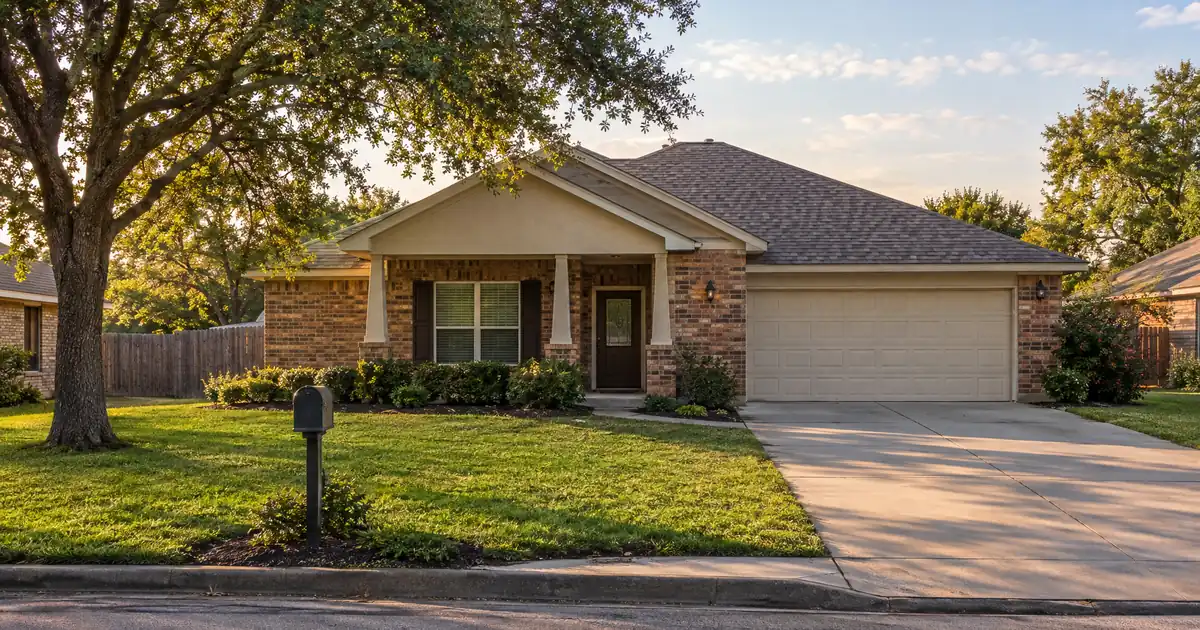
The Quick Read: Yes, but the new loan must follow one of two paths. You can refinance into another Texas home equity loan, known as a 50(a)(6) loan, or you can convert to an ordinary rate-and-term loan if the state’s conversion conditions are met. A cash-out on a free-and-clear Texas homestead is almost always a 50(a)(6) loan, and that label follows the lien into later refinances. Owing little or nothing now does not erase it.
Texas Cash-out refinance estimate
The starting figures are an example value with a balance and a cash request in proportion. Replace them with yours.
Editable benchmark: 7.40% as of October 15, 2026 · Freddie Mac 30-year average via FRED®. A conventional market reference, not a cash-out refinance quote.
Illustrative starting assumptions: a $285,000 home value, a $157,000 current balance, the agency cap on a one-unit principal residence, a thirty-year term at the current Freddie Mac benchmark, and property taxes and insurance estimated at typical rates for Texas. Every field is editable.
Illustrative estimate only — not a Loan Estimate, approval, quote, or commitment to lend. The rate field carries the weekly Freddie Mac thirty-year conventional benchmark, a market reference and not a cash-out refinance quote; a cash-out loan is priced by the lender at lock. The cash available is the loan the program cap allows less the balances paid off, before closing costs, which are not included. The HELOC line is the program’s combined loan-to-value ceiling applied to the same value and balance. Taxes and insurance are editable estimates. Licensed in sixteen states for consumer mortgages. On a Texas homestead the state constitution caps a cash-out refinance at the agency figure and adds a waiting period, a prescribed closing location, and a fee cap; the wholesale lane above the agency cap is not available on a Texas homestead.
What Does the Rule Actually Say About Refinancing Again?
Texas law decides whether your loan is a home equity loan. The lender’s product label does not. Fannie Mae’s Selling Guide says Texas law determines 50(a)(6) status, while Fannie’s own policy only decides whether the loan is delivered as cash-out or limited cash-out.
So “no cash-out” does not mean “no home equity rules.” A plain refinance of an existing 50(a)(6) loan stays a 50(a)(6) loan unless every conversion condition is met. The lender carries the burden of deciding which one applies.
Here is where I’d stop and ask a question: which of the two paths fits what you want from the next loan? That answer drives everything else.
Quick Answer by Situation
| Your situation | What’s allowed | Next step |
|---|---|---|
| Want more cash | New 50(a)(6) loan | Requalify; equity cap applies |
| Want a plain refinance | Conversion if conditions met | Check age, cash, 80% limit |
| Balance is zero | Still treated as 50(a)(6) | Ask how the lender classifies it |
| Loan under one year old | No conversion yet | Wait or use another 50(a)(6) |
| Planning to sell | Conversion is optional | Ask your title company first |
Does “Once a Home Equity Loan, Always a Home Equity Loan” Still Hold?
Mostly, but not absolutely. That was the old rule, and it is why so many articles still call the status permanent.
A 2017 constitutional amendment added a conversion path. It is found in Section 50(f)(2) of the Texas Constitution, as reproduced on Texas Legal Guide. Older advice persists because it was true for years, and because the conversion has strict conditions that many lenders simply don’t offer.
One caution: that constitutional text comes from a secondary host. Your lender and title company will work from the official statute, so let them confirm the exact wording.
The Four Conditions for Converting to an Ordinary Loan
A conversion refinance must meet all of these:
- One year has passed. It cannot close before the first anniversary of the loan being refinanced.
- No new equity. It cannot advance money beyond the payoff, closing costs and reserves.
- 80% combined limit. Total debt secured by the home cannot exceed 80% of fair market value.
- Written notice. The lender must give a specific written notice, and the timing relative to application and closing varies by file and lender.
The 80% cap sits in the state constitution. No lender or investor can waive it.
Fail any one test and the loan falls back into 50(a)(6) treatment. Even a small amount of extra cash can do that. If the conversion qualifies, the new lien is treated as a 50(a)(4) lien, and your signed acknowledgment of the conversion requirements is conclusive.
What If the Home Is Paid Off?
You are in the position this question was written for, so here is the straight version.
Having no balance does not change the label. If your last loan was a 50(a)(6) cash-out, a new loan on the same home still sits in that framework. The 50(a)(6) label comes from how the lien was created, not from what you owe today.
Two practical points follow. First, the one-year clock for conversion runs from the closing of the loan being refinanced. Paying it down or off does not restart it or shorten it. Second, if you carry no balance and want a new loan with cash, that is a new 50(a)(6) transaction. If you carry no balance and want only a plain loan, you must meet the conversion conditions, including no new cash.
Ask your lender to confirm in writing how the transaction will be classified. Also confirm that the old lien has been released of record before you rely on it. Title cleanup is the step people forget.
If you paid the loan off and the home is truly free and clear again, a fresh cash-out is a new first-lien loan on a homestead with no mortgage. That is the lane I most often see for homeowners in your spot.
Can You Take Cash Out Again?
Yes, through a new 50(a)(6) loan. Across the wholesale programs I place files with, a conventional cash-out on a one-unit principal residence tops out at 80% LTV. That is the loan-to-value ratio, meaning the loan as a percentage of the home’s appraised value. In Texas the homestead cap comes from the state constitution. Leverage, reserves, and pricing vary by lender and program; the final terms follow the full file review.
Other rules to expect:
- Seasoning. The mortgage being paid off must be at least 12 months old, counted from note date to note date. Seasoning is the waiting period before a loan can be refinanced.
- Requalification. You must requalify on income, assets and credit, even if the same lender services your current loan. Fannie Mae says so directly.
- Appraisal. Fair market value for the acknowledgment must come from an appraisal, which is attached to your written acknowledgment, per Fannie Mae’s Selling Guide. The same page says the first payment must be due no later than two months after closing.
- Credit. The wholesale conventional programs start at a 620 decision score, subject to lender guidelines and full file review.
Texas also caps lender charges on these loans at 2%. The official rule is 7 TAC §153.5, and it says escrow funds are not fees under the cap. Third-party costs such as appraisal, survey and title sit outside it.
What About FHA and VA?
Government loans are narrower in Texas. The Texas Attorney General concluded in Opinion KP-0183 that the VA guaranty counts as collateral beyond the homestead. That brings the loan within the 50(a)(6) prohibition, so a VA cash-out refinance is precluded on a Texas homestead.
The VA IRRRL and the FHA Streamline are no-cash-out options for existing government loans. Whether a streamline works when the existing loan is itself a 50(a)(6) loan is a case-by-case question. Ask a loan officer to review the specific file before you plan around it.
Your Options Compared
| Option | What you get | Watch for |
|---|---|---|
| New cash-out (50(a)(6)) | More cash | Equity cap, requalifying |
| Conversion refinance | Ordinary loan status | Four strict conditions |
| Leave the loan alone | No new costs | Status stays as is |
| Equity line or other product | Flexible access | Own rules and limits |
Three Short Scenarios
You want cash again. You own the home free and clear and want funds for a major project. You take a new 50(a)(6) loan. The balance after closing, plus any other liens, must stay within the constitutional cap. You requalify and get a new appraisal. Review Lendmire’s cash-out refinance programs to see how the equity limits play out.
You only want a plain loan. Your first cash-out closed more than a year ago. You ask for no new money. If the new debt stays at or under 80% of value and the notice was given on time, conversion is possible. If you ask for even a little extra cash, it is not.
You plan to sell. Conversion is optional. A buyer’s lender will look at the existing lien and the payoff, and your title company handles the release. You rarely need to convert just to sell. Ask the title company first.
Common Mistakes and Myths
- “Limited cash-out means no home equity rules.” Texas law decides, not the label.
- “No cash taken, so the one-year rule is moot.” The one-year test applies regardless.
- “My lender can make an exception to 80%.” It is in the constitution. No exception exists.
- “Same lender, so no new qualification.” Requalification is required even with the same servicer.
- “Paid off means plain refinance.” The label depends on how the loan began, not what you owe today.
Documents and Closing Logistics
Expect to provide income, asset and credit documents, plus your current payoff or lien release information. Spouses must consent to the loan, and Texas homestead closings take place at a lender, attorney or title company office. Read the Texas Constitution’s Section 50 text for the spousal-consent and non-recourse provisions.
Notice timing varies by file and lender, so plan your closing schedule around any required waiting period.
Borrowing against your home also adds risk. The CFPB has found that moving other debt into home-secured debt can put the home at risk of foreclosure if payments become unsustainable. Tax treatment can depend on your situation; borrowers should speak with a qualified tax professional before relying on any deduction or credit.
Questions to bring to your lender and title company:
- Is my existing loan a 50(a)(6) loan?
- Which path fits my goal: new equity loan or conversion?
- How old is the loan, counted from its closing date?
- Will my total debt stay within 80% of appraised value?
- Has the old lien been released of record?
Key Terms Defined
50(a)(6) loan: A Texas home equity loan, named for the constitutional section that governs it.
50(f)(2) conversion: The route that lets a refinance of a home equity loan become an ordinary loan, if strict conditions are met.
Rate-and-term refinance: A loan that replaces your current mortgage without giving you new cash beyond closing costs.
Seasoning: The minimum age a loan must reach before you can refinance it.
LTV: Loan-to-value ratio, the loan as a percentage of the home’s value.
Frequently Asked Questions
If I’ve paid it off, is it still a cash-out loan?
Usually yes, in the sense that matters. A loan that began as a Texas home equity loan keeps that status through later refinances unless a conversion meets every condition. A zero balance alone does not change it.
Does the one-year wait apply if I owe nothing?
Yes for conversion. The test counts from the closing of the loan being refinanced, not the payoff date. A new cash-out follows the lender’s seasoning rules instead, subject to lender guidelines.
Can I refinance with FHA or VA?
Not for cash-out. A VA cash-out is precluded on a Texas homestead, and FHA cash-out is generally unavailable. No-cash-out streamlines may exist for existing government loans, but they need a case-by-case review.
Does my current lender get to skip requalification?
No. Fannie Mae requires the borrower to requalify when one 50(a)(6) loan refinances another, even if the same servicer holds the existing loan.
Can a lender waive the 80% limit?
No. The cap is in the state constitution, so no lender or investor can grant an exception.
Where to Go From Here
If you are weighing a cash-out refinance on a home you own outright, Lendmire can help you compare the programs and the equity each one reaches. Lendmire is a mortgage broker, and every program is subject to lender guidelines and full file review. Nothing here is a commitment to lend.
For your own numbers, request a scenario review with Lendmire.
For current guidelines and terms, see Lendmire’s refinance programs page.
About Lendmire
Lendmire is a mortgage brokerage (NMLS# 2371349) licensed for consumer mortgage lending in 16 states, arranging FHA, VA, conventional and jumbo purchase and refinance loans through a wholesale lending network. Eligibility is determined by the lender on each file. Scotsman Guide named Lendmire a Top Mortgage Workplace in both 2025 and 2026.
Get Started
Ready to find the right loan for you?
In about 30 seconds you can review financing options available for your home or investment property. No commitment required.
Informational only. Not a Loan Estimate, approval, or commitment to lend. Program availability and eligibility are subject to lender guidelines, credit approval, property review, and underwriting.
References
1. Fannie Mae Selling Guide B5-4.1-02
3. Fannie Mae Selling Guide B5-4.1-03
4. Fannie Mae Selling Guide B5-4.1-01
5. 7 TAC §153.5
6. Texas Attorney General Opinion KP-0183
7. Texas Constitution’s Section 50
8. CFPB
This article is part of Lendmire’s Refinance series — every loan program’s qualification details, guidelines, and scenarios live on the loan options page.
Related reading: How to Buy Out a Spouse on a Paid-Off Home With a Cash-Out Refinance · How to Close a Cash-Out Refinance on a Paid-Off Texas Home · Is a Loan on a Paid-Off Second Home a Cash-Out Refinance?
Brandon Miller
Founder & CEO, Mortgage Loan Originator, Lendmire LLC
- Mortgage Loan Originator · NMLS# 1129696 · Verify on NMLS Consumer Access
- North Carolina Real Estate Broker · License# 343312 · Verify on NCREC
- North Carolina Insurance Producer · License# 19053198 · Property, Casualty, Life, Health · Verify on NAIC SBS
- Lendmire LLC · Firm NMLS# 2371349 · Verify firm licensure
Disclosure information. Lendmire is a state-licensed mortgage brokerage under NMLS# 2371349. Lendmire is not a depository institution, direct lender, or financial advisor — all loans referenced are placed through wholesale lender partners and are subject to each lender's underwriting standards. This article is provided for general informational purposes and is not a commitment to lend, nor does it constitute financial, legal, or tax advice. Loan programs, terms, rates, and qualification standards change without notice and depend on borrower profile, property type, and the state in which the subject property is located. Equal Housing Opportunity provider. NMLS Consumer Access: nmlsconsumeraccess.org.