
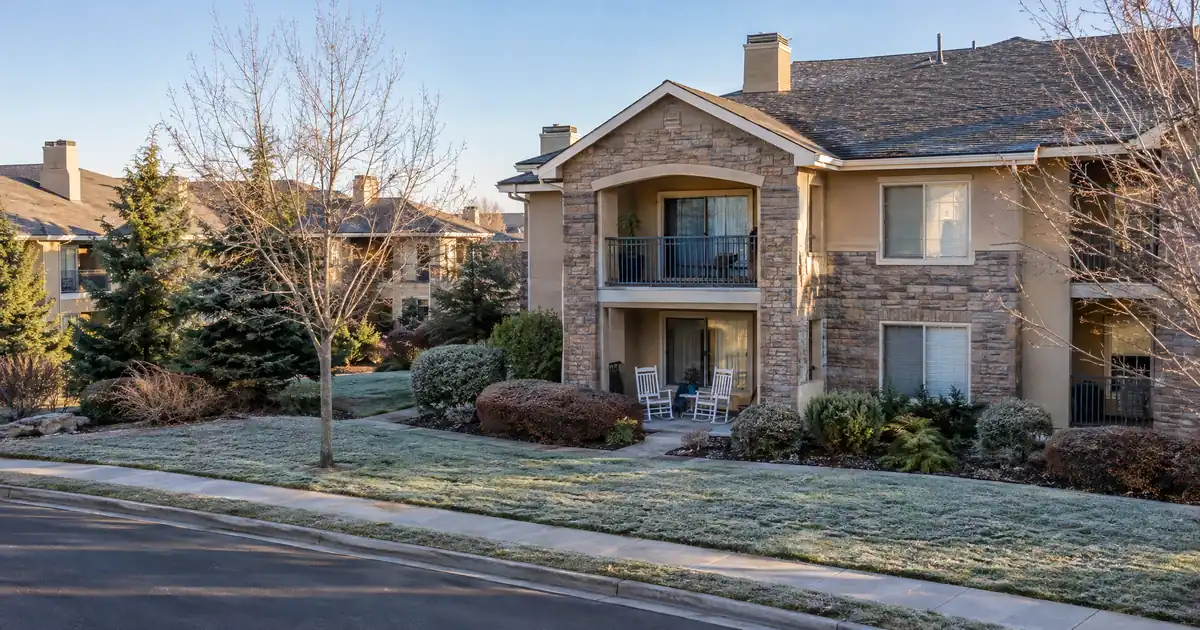
The Quick Read: No. VA will not guaranty a loan on a unit in a condo project that VA has not approved, because the approval attaches to the building, not to you. An unapproved project can be submitted for review, and the loan can move forward once VA accepts it. Your credit, income and entitlement are a separate test, and passing them does not substitute for the project clearing.
Most of the confusion around this topic comes from one phrase: “without VA approval.” It can mean three different things, and only one of them is a real path. This guide separates them, explains how to check a building, shows what to do when it isn’t approved, and covers what still has to happen after the project clears.
VA payment estimate
Starting assumptions reflect an example price with no down payment and a first-use funding fee. Replace them with your own figures.
Editable benchmark: 7.32% as of October 22, 2026 · Freddie Mac 30-year average via FRED®. A conventional market reference, not a VA loan quote.
Illustrative starting assumptions: a $350,000 price, no down payment with full entitlement, a first-use funding fee financed into the loan, a thirty-year term at the current Freddie Mac benchmark, and property taxes and insurance estimated at typical national rates. Every field is editable.
Illustrative estimate only — not a Loan Estimate, approval, quote, or commitment to lend. The rate field carries the weekly Freddie Mac thirty-year conventional benchmark, a market reference and not a VA loan quote; your rate is set by the lender at lock. The funding fee follows VA’s published table for the use and down payment entered; the residual-income figure is VA’s guideline for the region and family size, and the rough residual shown subtracts only the housing payment and the debts entered, while VA also deducts taxes, maintenance and utilities. Taxes, insurance and dues are editable estimates; closing costs are not included. Licensed in sixteen states for consumer mortgages. Lendmire is not affiliated with or acting on behalf of the Department of Veterans Affairs.
What Does “VA-Approved Condo” Actually Mean?
A VA-approved condo is a project whose legal documents and financial health VA has reviewed and accepted, so that individual units in it can carry a VA-guaranteed loan. The rule is written into federal regulation: before VA guaranties a unit loan, the Secretary must approve the legal documentation that establishes the condominium project.
Chapter 16 of the handbook states that condominiums, but not planned unit developments, must be approved by VA before any units in the project are eligible.
Two things follow from that:
- The building is being qualified, not just you. Strong credit and solid income can’t fix a building that fails review.
- Approval is a status that can change. Projects get approved, conditioned, suspended or dropped over time, so a status you saw months ago may not hold today.
Is There a Way Around It? (The Unit-Only Claim)
No primary VA source describes a unit-only route. You will see websites claiming VA allows “single-unit approval” or “spot approval” for a condo in a non-approved building. Other sites flatly say no such thing exists. The two camps contradict each other, and that alone should make you cautious.
What the regulation and Chapter 16 describe is approval of the project. Neither document creates a single-unit exception that lets a buyer skip it. Across the VA files Lendmire arranges, the practical position is this: treat project approval as required, and treat any “unit approval” promise as something to verify, not something to rely on.
If a lender or agent tells you a unit-level route exists for your building, ask for two things:
1. The VA decision in writing, naming the project or unit.
2. The specific VA rule or handbook section they are relying on.
If they can’t produce either, plan as though the building needs project approval. A verbal assurance doesn’t protect your earnest money.
There is one honest sense in which you can buy “without it already being approved.” You can write an offer on a building that isn’t on the approved list yet, as long as the project gets submitted and accepted before the loan closes. That is a timing risk you manage, not an exemption.
How Do You Check Whether a Condo Is Approved?
Search VA’s own lookup before you make an offer. The current tool is the VA Condo Report on VA’s LGY Hub, and state is the only required field. The web address printed in the handbook for the old approved list is outdated, so don’t rely on it.
Status labels vary. Based on what lenders see, only two statuses mean the project is currently approved. The rest need your lender to confirm the record with VA.
| Status you see | Can you proceed? | Next step |
|---|---|---|
| Accepted Without Conditions | Yes | Lender re-confirms current status |
| Accepted With Conditions | Yes, if conditions are met | Lender checks the conditions apply to your unit |
| Pending | Not yet | Lender confirms where the review stands |
| Rejected | Not as is | Ask why; resubmission may be possible |
| Suspended | Not yet | Lender confirms with VA |
| Deleted or Unknown | Not yet | Lender confirms the record with VA |
Check status twice: when you are deciding whether to make an offer, and again before the appraisal is ordered. Approvals are not permanent, and a listing that looked fine early can change.
What Does VA Look At in a Condo Project?
VA reviews two things: the project’s legal documents and the project’s financial health. Your own credit and income are judged separately.
On the legal side, the regulations set standards for the declaration and bylaws. They must conform to state condominium law, the association must make governing documents and financial records available to owners and lenders, and amendments made while the developer still controls the association need VA’s approval. New, expandable and phased projects face additional rules of their own.
On the financial side, reviewers look at the kinds of things any careful buyer should want to know:
- Whether the association keeps healthy reserves.
- How many owners are behind on dues.
- Whether the master insurance is adequate.
- Whether there is pending litigation against the association.
- How many units are owner-occupied versus rented.
You will see specific percentages for owner-occupancy and delinquency repeated online. Those numbers circulate widely, come from lender and secondary sources, and conflict with one another, so treat them as commonly cited rules of thumb rather than VA policy. Some lenders also add stricter limits of their own on top of VA’s rules. Those are lender overlays, and they can differ from one lender to the next.
What If the Condo Isn’t Approved? Your Options
If the building isn’t on the list, the lender can often submit it for review, but whether that works depends on the HOA and the project’s finances. Neither the buyer nor the seller submits the paperwork. The lender sends a written request and the project’s organizational documents to VA.
Here is the decision path most buyers follow:
1. Ask your loan officer whether they submit projects at all. Lenders differ. Some handle it routinely and some prefer to avoid it.
2. Get the HOA engaged. The documents come from the association or its management company. Your role is usually to supply board or manager contacts and keep the conversation moving.
3. Know the usual document package. It typically includes the recorded declaration, bylaws and covenants, the HOA budget and financial statements, reserve information, master insurance, and owner-occupancy and delinquency data. The handbook’s required-document list varies by project type.
4. Ask about fast-track routes. The handbook describes two ways review can be expedited: a project already approved by another federal agency, or organizational documents VA has previously reviewed in substance. Even then, the lender must confirm current standing.
5. Build time into the contract. An unapproved project adds an open-ended review that depends on how responsive the HOA is.
6. Decide your exit. If the review stalls or fails, you need a contingency to walk away, extend, or switch buildings.
One caution on the appraisal. When an appraisal is completed on a not-yet-approved condo, the value notice is generally conditioned on the lender confirming the project is acceptable before guaranty. Ordering it early doesn’t clear the building. It only means you may have spent money before knowing the answer.
How Should You Write the Contract?
Write the offer so that an unapproved project doesn’t trap your deposit. The goal is to keep your options open while the review runs.
| Situation | What to plan for |
|---|---|
| Project already approved | Normal timeline; lender re-confirms status before closing |
| Not approved, HOA responsive | Extra time for submission and VA review; ask for a longer financing contingency |
| Not approved, HOA slow or silent | Highest risk; shorten your commitment or pass |
A few practical points. Build extra time or an explicit contingency into the contract for project approval. Make clear in the offer that your financing depends on the project being accepted. Expect some sellers to hesitate on a VA offer when approval is uncertain, because they bear the delay too. Where the seller is motivated and the HOA is cooperative, an unapproved building can still work. Where neither is true, moving on is often the better call.
What Still Has to Happen After the Project Clears?
Project approval clears the building only. You and the unit still have to qualify.
On the borrower side, your certificate of eligibility from VA decides your entitlement, and the service requirements are VA’s rules. Residual income is the controlling underwriting test, while the 41% debt-to-income figure works as a guideline rather than a hard cap. A ratio above it generally needs residual income well above the table. VA sets no minimum credit score, and the wholesale programs Lendmire places VA loans with start at a 580 decision score, subject to lender guidelines and full file review.
On the financing side, a VA purchase can be arranged at 100% financing with no down payment, as long as the price is not above the appraised value. There is no mortgage insurance of any kind. With full entitlement there is no VA loan limit, and the programs Lendmire works with serve amounts up to $4,000,000. If you have remaining entitlement instead, a down payment may be required, so speak with a loan officer about your situation.
The VA funding fee applies to condos the same way it does to any VA loan. It can be financed into the loan, and it is waived for veterans receiving compensation for a service-connected disability and the other exempt groups. For a first-use purchase it is 2.15% with less than five percent down, 1.5% with five to under ten percent down, and 1.25% with ten percent or more down. For subsequent use, it is 3.3% with less than five percent down, with the same 1.5% and 1.25% tiers above that.
Then the unit itself has to pass appraisal and VA’s minimum property standards. Lenders also typically collect an HOA questionnaire and re-verify project status before closing.
Condos carry costs that don’t show up in the loan terms. HOA dues, special assessments and the master policy’s insurance cost all hit the monthly budget. Weak reserves and frequent special assessments are red flags in project review and in your own household math.
Does the Same Rule Apply to Other Property Types?
The approval rule is specific to condominiums. Planned unit developments are different.
| Property type | VA project approval needed? |
|---|---|
| Condominium | Yes, the project must be approved |
| Planned unit development (PUD) | No project approval, but title and lien rules still apply |
| Detached single-family home | No |
Every property in a condo or PUD must still meet VA’s title and lien rules, including that the HOA’s assessment lien is subordinate to the VA mortgage. Some states also have site condominiums, which are legally condos but look and function like detached homes. How they are treated can turn on the specific documents, so ask your lender.
A VA purchase is for a home you will occupy, so occupancy decides the leverage. Buying a condo as a rental or a vacation property is a different loan conversation.
Common Misconceptions
- “My credit and VA eligibility are enough.” The project must be approved too.
- “I can get just my unit approved.” The primary sources describe project-level approval only.
- “The buyer or seller submits the paperwork.” The lender does.
- “FHA-approved means VA-okay.” FHA project approval is governed by HUD’s own handbook, separate from VA’s rules. Projects approved by another federal agency may get a faster VA review, but the lender still has to confirm current standing.
- “Not on the list means never eligible.” Not necessarily. Many projects can be submitted, depending on HOA cooperation and finances.
What If Approval Isn’t Possible?
If the project can’t be approved, you have three real choices: pick a different building, pick a different loan type for that building, or wait and revisit it.
A different VA-approved condo is usually the cleanest fix, and it is worth searching the approved list before you fall in love with a unit. A different loan type may work for the same building, but each program has its own project rules, down payment and mortgage insurance structure, so you’d be trading the VA benefits for access to that building. Weigh that honestly. A condo VA can’t finance may cost you more under a different program, and for some buyers that tips the decision toward a different property.
Questions to Ask Your Lender and Agent
- Do you submit unapproved projects to VA, and how often?
- What does the status show on the VA Condo Report today?
- If a “unit approval” is being offered, can I see the VA decision in writing?
- What documents will the HOA need to provide, and who is contacting them?
- What contingency should my contract include if approval stalls?
- Does your lender apply any stricter limits than VA does?
If you are buying a home and want to see whether a VA loan fits your file, Lendmire can help you compare the options and what each one asks of the file. Our VA loan programs are arranged through wholesale lenders, and every figure here is subject to lender guidelines and full file review. For a closer look at how condo approval plays into a purchase, see Lendmire’s piece Can a Veteran Use a VA Loan on a Condo Not Yet VA Approved?.
Key Terms Defined
Project approval: VA’s acceptance of a condominium’s legal documents and financial health, which makes units in it eligible for a VA-guaranteed loan.
VA Condo Report: VA’s online lookup tool that shows whether a condo project is currently accepted.
Planned unit development (PUD): A community of individually owned homes with shared common areas, which does not need VA project approval.
Certificate of eligibility (COE): The VA document that confirms your entitlement to use the benefit.
Residual income: The money left each month after major obligations, which is the controlling test in VA underwriting.
Lender overlay: A stricter rule a lender adds on top of VA’s own requirements.
Frequently Asked Questions
Can a seller or the HOA get a single unit approved instead of the whole project?
Not under anything the primary sources describe. The regulation and the VA Lenders Handbook both speak to approval of the project. If someone claims a unit-only route exists, ask for VA’s decision in writing before you rely on it.
Who submits an unapproved condo to VA, and does the buyer pay for it?
The lender submits the project, sending a written request and the association’s organizational documents to VA. The HOA has to supply those documents, so its cooperation matters. Ask your lender up front what, if anything, they would expect you to cover.
Can I order the appraisal before the project is approved?
You can, but it carries risk. The value notice on a not-yet-approved condo is generally conditioned on the lender confirming the project is acceptable before guaranty. If the project is later turned down, the appraisal doesn’t rescue the deal.
Is a townhome treated like a condo?
It depends on how the community is legally structured. A townhome in a PUD does not need VA project approval, while a unit that is legally a condominium does. Title and lien rules apply to both, so your lender should check the documents.
Does an FHA-approved building automatically work for VA?
No. FHA and VA keep separate project rules. A project approved by another federal agency may be eligible for a faster VA review, but the lender must still confirm its current standing with VA.
For your own numbers, request a scenario review with Lendmire.
About Lendmire
Lendmire, NMLS# 2371349, is a mortgage brokerage with consumer lending licenses in 16 states. FHA, VA, conventional and jumbo purchase and refinance loans are arranged through wholesale lending partners, and each application is reviewed individually by the lender. Scotsman Guide named Lendmire a Top Mortgage Workplace in both 2025 and 2026.
Get Started
Ready to find the right loan for you?
In about two minutes you can review financing options available for your home or investment property. No commitment required.
Informational only. Not a Loan Estimate, approval, or commitment to lend. Program availability and eligibility are subject to lender guidelines, credit approval, property review, and underwriting.
References
1. eCFR, 38 CFR 36.4360, Condominium loans—general
2. VA Pamphlet 26-7, Chapter 16
4. eCFR, 38 CFR 36.4361, Acceptable ownership arrangements and documentation
5. Cornell LII, 38 CFR 36.4364
This article is part of Lendmire’s VA loan program — full qualification details, guidelines, and scenarios live on the program page.
Related reading: How to Buy Above the Conforming Limit on a Second VA Loan · How Many Days a VA Loan on a Condo Takes to Close · How to Remove an Ex-Spouse or Co-Borrower From a VA Loan
Brandon Miller
Founder & CEO, Mortgage Loan Originator, Lendmire LLC
- Mortgage Loan Originator · NMLS# 1129696 · Verify on NMLS Consumer Access
- North Carolina Real Estate Broker · License# 343312 · Verify on NCREC
- North Carolina Insurance Producer · License# 19053198 · Property, Casualty, Life, Health · Verify on NAIC SBS
- Lendmire LLC · Firm NMLS# 2371349 · Verify firm licensure
Disclosure information. Lendmire is a state-licensed mortgage brokerage under NMLS# 2371349. Lendmire is not a depository institution, direct lender, or financial advisor — all loans referenced are placed through wholesale lender partners and are subject to each lender's underwriting standards. This article is provided for general informational purposes and is not a commitment to lend, nor does it constitute financial, legal, or tax advice. Loan programs, terms, rates, and qualification standards change without notice and depend on borrower profile, property type, and the state in which the subject property is located. Equal Housing Opportunity provider. NMLS Consumer Access: nmlsconsumeraccess.org.