
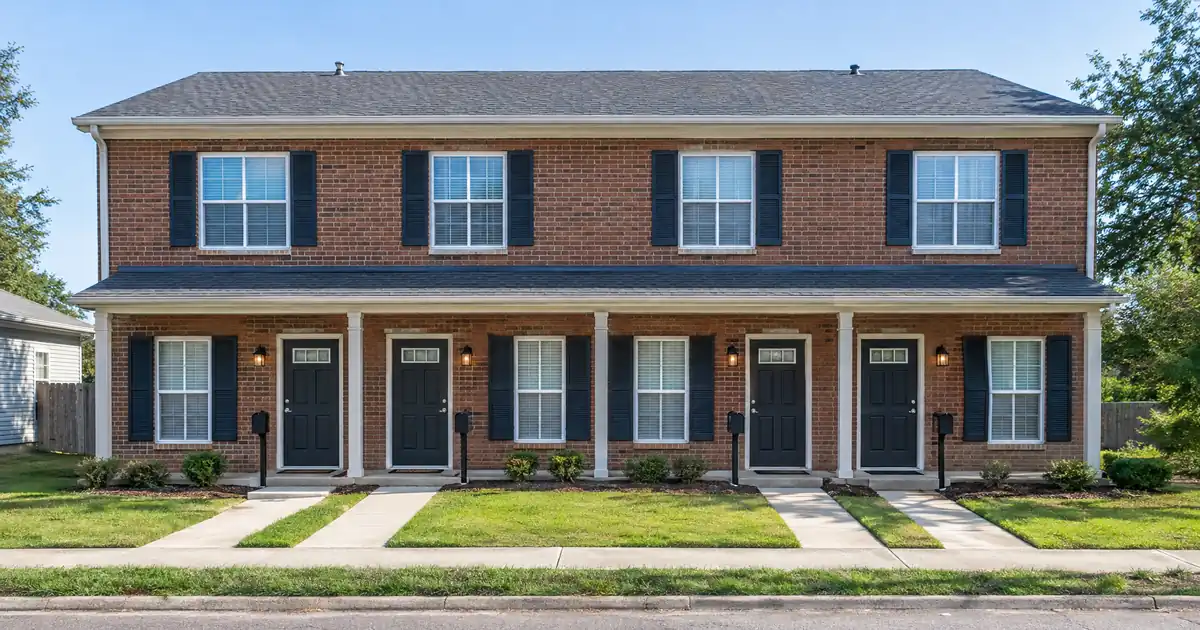
The Quick Read: Yes, if you live in one of the four units as your home. The three leased units don’t disqualify the loan, and lease income can help you qualify, but only under strict conditions. A cash-out on a fourplex you don’t live in is not eligible. Subject to lender guidelines and full file review.
Here is how that plays out in practice, where the exceptions sit, and how to decide whether this loan fits your building.
Can You Do a VA Cash-Out on a Fourplex at All?
You can, because a fourplex is the largest property VA will guarantee. The VA dwelling definition allows no more than four family units, so a five-unit building is outside the program entirely. The loan must also refinance an existing lien, so a fully paid-off building has nothing to refinance.
VA’s cash-out page lists three conditions that must all be true: you qualify for a Certificate of Eligibility, you meet VA and lender credit and income standards, and you will live in the home you’re refinancing. Nothing there bars tenants in the other units.
The existing loan can be any type. A VA cash-out refinances conventional, FHA, or other non-VA loans into a VA loan, and you don’t need a current VA loan to use it.
On the Lendmire side, the wholesale programs it arranges VA files through allow the cash-out to reach 100% of the appraised value, with the financed funding fee included, subject to lender guidelines. Some lenders set a lower cap, so the equity you can reach depends on who reviews the file.
How Does the Occupancy Rule Work on a Refinance?
Occupancy is the gate, and it’s tested at the refinance. Under 38 CFR Part 36, Subpart B, VA won’t issue guaranty evidence on a refinancing loan unless the veteran certifies they presently occupy the property as their home. For an active-duty servicemember, the spouse can certify instead.
There is one narrow exception. If extensive repairs prevent you from living there during the work, you can certify an intent to occupy or reoccupy afterward.
This is where many fourplex owners get stuck. If you moved out and rented all four units, you can’t truthfully certify occupancy, so a cash-out doesn’t fit. The VA streamline refinance (IRRRL) uses a looser test, since you can have lived there before. But it only applies to an existing VA loan, and it adds no cash.
Do the Leased Units Help, Hurt, or Not Matter?
They mostly don’t matter to eligibility, and they can help you qualify. Occupancy of one unit is the requirement. Leases on the other three are not a violation.
They can help because the lender may count some of the lease income toward your qualifying income. They can also hurt: a lender looks at tenant turnover, vacancy, and whether you can carry the full payment if rent stops. Strong leases with thin verified savings often produce a file where the rent gets little or no credit.
How Is the Rent Treated?
Lenders typically count a discounted share of rent, not all of it. The VA Lenders Handbook, Chapter 4 says the rental income counted is 75 percent of the lease or rental agreement amount, unless a greater percentage can be documented. VA has been moving the Handbook to its KnowVA site, so lenders check the current text there.
The discount exists because vacancy and upkeep are real. Your household still has to carry the full payment if a unit sits empty, and the lender knows it.
Lenders typically ask for:
| Document | What it shows | Who supplies it |
|---|---|---|
| Executed leases | Rent amount and term for each leased unit | You or your property manager |
| Landlord experience or management agreement | You can run the building | You |
| Asset statements | Reserves are in your own account | Your bank |
| Appraisal | Reasonable value that caps the loan | VA-assigned appraiser |
The exact document list varies by lender, so treat this as the typical set, not a fixed VA checklist.
What About Reserves and Landlord Experience?
Counting lease income comes with a reserves test. The Handbook ties it to at least six months of PITI (principal, interest, taxes, and insurance) in reserves. If each unit is separate and not under one mortgage, the six months applies to each unit. It also looks for a reasonable likelihood that you’ll succeed as a landlord, which is why lenders ask for experience or a management arrangement.
The funds must be your own money. Equity can’t count, gift funds can’t count, and the cash you take out of this refinance can’t count toward reserves. The money has to be in your account before the new loan closes.
Lenders do not all apply the reserve requirement to 3-4 unit properties in the same way, and some add their own requirements on top. Ask your lender which version it applies, and don’t assume. Final terms depend on lender guidelines, property type, leverage, and the borrower’s complete credit picture.
What Does the Cash-Out Itself Look Like?
The loan runs like other VA cash-outs, with a few fourplex wrinkles. A full appraisal sets the reasonable value, and the new loan can’t exceed 100 percent of it, including a financed funding fee. The property must also meet VA’s minimum property requirements, which matters on an older multi-unit building.
On the network’s programs, here is the envelope, always subject to lender guidelines:
- Leverage: up to 100% of the appraised value, including the financed fee.
- Funding fee: 2.15% on first use and 3.3% on later use for a cash-out, reviewable, and waived for veterans receiving service-connected disability compensation and other exempt groups.
- Mortgage insurance: none.
- Credit: VA sets no minimum score. The wholesale programs Lendmire places VA loans with start at a 580 decision score.
- Seasoning and benefit: a net tangible benefit is required, and the later of 210 days from the first payment or the 6th payment applies.
- Loan size: with full entitlement, the wholesale programs serve amounts to $4,000,000. With remaining entitlement, a down payment may be required, so speak with a loan officer.
VA also warns that refinance closing costs can add up to thousands of dollars. Weigh that against what the cash is for. Equity can pay off debt, fund school or improvements, or cover other needs.
What Does a Vacant Unit or Expiring Lease Do?
A vacant unit lowers the rent the lender can count, and that can tip a borderline file. A unit without a lease usually earns no rental credit. A lease that ends soon invites questions about renewal.
Underwriting here turns on residual income, the money left each month after major obligations and living costs. The 41% debt-to-income figure is a guideline, not a cap, and a higher ratio needs residual income well above the VA table. A fourplex payment is bigger than a single-family payment, so the residual income test often decides the file.
| Scenario | Effect | Typical fix |
|---|---|---|
| One unit vacant | Less rent counted | Lease it before applying |
| Thin personal savings | Rent may get no credit | Build reserves in your own account |
| You moved out | Can’t certify occupancy | Move back, or explore a different program |
| Reserves came from cash-out proceeds | Not counted | Use your own funds |
Which Loan Fits Your Situation?
Run through these in order:
1. Do you live in one unit now? If yes, a VA cash-out is on the table. If no, it isn’t.
2. Do you have an existing VA loan and want a lower rate or a fixed one, with no cash? That points to the IRRRL, a different tool.
3. Is the cash the point? Compare the VA cash-out against other owner-occupant cash-out programs on equity reached, fees, and monthly obligation.
4. Are your savings thin? The rent may count for little, so test the file without it.
A single-family home is simpler, since there is no lease income to document. A fourplex adds paperwork but often gives you more total equity to work with.
The VA cash-out refinance program page covers the basics.
Key Terms Defined
Certificate of Eligibility (COE): The VA document showing you qualify for the program, available through your lender, VA.gov, or by mail.
Residual income: The money left each month after major obligations and estimated living costs, which controls VA underwriting.
Reasonable value: The appraised value VA assigns, which caps the new loan at 100 percent.
Reserves: Your own liquid funds, held after closing, measured in months of PITI.
Net tangible benefit: A required, real gain from refinancing, such as less debt cost or a better loan structure.
Funding fee: A one-time VA charge that can be financed and is waived for exempt veterans.
Frequently Asked Questions
Do I have to live in the fourplex to get a VA cash-out?
Yes. VA requires you to occupy the home you’re refinancing, and you certify it at the refinance. For an active-duty member, a spouse can certify instead. Extensive repairs that block occupancy are the only narrow exception, with intent to reoccupy.
Can a five-unit building qualify?
No. VA’s dwelling definition stops at four family units. A five-unit property falls outside the program, and a different type of financing would apply.
Does my current loan have to be a VA loan?
No. A VA cash-out can pay off a non-VA loan and replace it with a VA loan, provided you qualify and meet occupancy. The IRRRL is the one that requires an existing VA loan.
Can I use the cash from the refinance as my reserves?
No. Reserves must be your own funds already in your account before closing. Equity, gift funds, and cash-out proceeds don’t count toward the required reserves.
What if I moved out and rented all four units?
A cash-out doesn’t fit, because you can’t certify that you currently live there. The IRRRL accepts a former residence, but it only works on an existing VA loan and adds no cash.
If you’re weighing a cash-out refinance against keeping the loan you have, Lendmire can help you compare the programs and the equity each one reaches. Reach the team at 828-256-2183 or request a quote.
About Lendmire
Lendmire, NMLS# 2371349, is a mortgage brokerage with consumer lending licenses in 16 states. FHA, VA, conventional and jumbo purchase and refinance loans are arranged through wholesale lending partners, and each application is reviewed individually by the lender. Scotsman Guide named Lendmire a Top Mortgage Workplace in both 2025 and 2026.
Get Started
Ready to find the right loan for you?
In about 30 seconds you can review financing options available for your home or investment property. No commitment required.
Informational only. Not a Loan Estimate, approval, or commitment to lend. Program availability and eligibility are subject to lender guidelines, credit approval, property review, and underwriting.
References
1. VA.gov: Cash-out refinance loan
2. 38 CFR Part 36, Subpart B (eCFR)
3. VA Lenders Handbook, Chapter 4: Credit Underwriting
This article is part of Lendmire’s VA Loans series — every loan program’s qualification details, guidelines, and scenarios live on the loan options page.
Related reading: How to Get a VA Cash-Out After a Quitclaim Deed From a Parent · How to Apply for a VA Cash-Out Refinance Step by Step · Can You Use a VA Cash-Out on a Texas Homestead After a PCS?
Brandon Miller
Founder & CEO, Mortgage Loan Originator, Lendmire LLC
- Mortgage Loan Originator · NMLS# 1129696 · Verify on NMLS Consumer Access
- North Carolina Real Estate Broker · License# 343312 · Verify on NCREC
- North Carolina Insurance Producer · License# 19053198 · Property, Casualty, Life, Health · Verify on NAIC SBS
- Lendmire LLC · Firm NMLS# 2371349 · Verify firm licensure
Important disclosures. Lendmire (NMLS# 2371349) is a licensed mortgage brokerage. Lendmire is not a direct lender, depository institution, or financial advisor. All loan inquiries are subject to lender underwriting; this article does not constitute a commitment to lend. Rates, terms, and program guidelines are subject to change without notice and vary by borrower profile, property type, and state. Information in this article is general in nature and is not financial, legal, or tax advice. Equal Housing Opportunity. NMLS Consumer Access: nmlsconsumeraccess.org.