
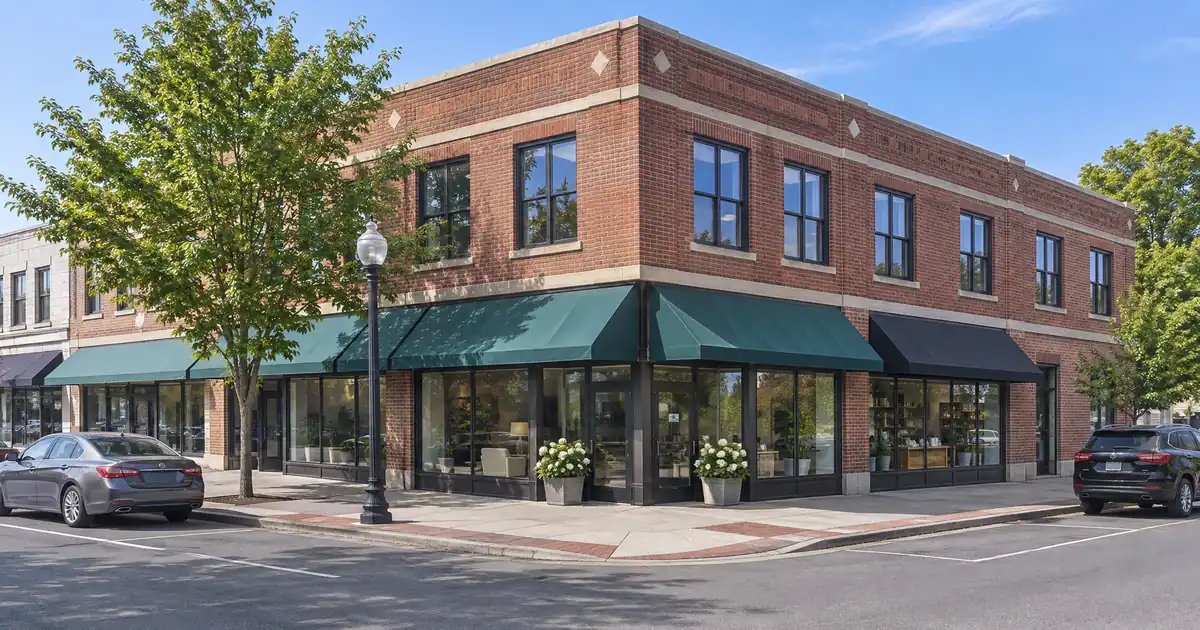
The Quick Read: The building matters more than you do. A VA cash-out can reach 100% of the appraised value with no mortgage insurance, but the condo project has to clear VA’s document review, and the commercial floor adds no value to the appraisal. Conventional financing is more predictable about commercial space because Fannie Mae uses a bright-line test, though that test can rule out a building outright.
Two gates decide the outcome. Gate one is the borrower: eligibility, residual income, credit. Gate two is the building: project approval, how much of it is commercial, and how the lender’s investor treats that mix. A strong borrower can still lose on gate two.
VA cash-out estimate
Seeded with an example value, a typical balance, and a round cash request at the first-use fee; change any field.
Editable benchmark: 7.18% as of November 5, 2026 · Freddie Mac 30-year average via FRED®. A conventional market reference, not a VA cash-out refinance quote.
Illustrative starting assumptions: a $350,000 home value, a $193,000 current balance, the full-value VA cap with the first-use funding fee financed, a thirty-year term at the current Freddie Mac benchmark, and property taxes and insurance estimated at typical national rates. Every field is editable.
Illustrative estimate only — not a Loan Estimate, approval, quote, or commitment to lend. The rate field carries the weekly Freddie Mac thirty-year conventional benchmark, a market reference and not a VA cash-out refinance quote; a VA loan is priced by the lender at lock. The total loan, funding fee included, is capped at the program leverage on the reasonable value; the fee follows the tier chosen. The cash available is what the cap allows less the balances paid off and the fee, before closing costs, which are not included. The HELOC line is the line program’s combined loan-to-value ceiling applied to the same value and balance. Taxes and insurance are editable estimates. The debt-to-income figure is a guideline; residual income decides a VA file. Licensed in sixteen states for consumer mortgages.
Here is the honest sorting. VA cash-out suits a veteran with a certificate of eligibility who lives in the unit, wants maximum equity access, and lives in a building that is already approved or can be. Conventional suits the owner whose building passes the commercial-space test and who either lacks VA entitlement or has plenty of equity and wants to avoid a funding fee.
Side-by-Side
| Factor | VA Cash-Out | Conventional Cash-Out |
|---|---|---|
| Leverage | Up to 100% of appraised value, fee included | Lower than VA; set by investor |
| Credit floor | VA sets none; wholesale programs start at 580 | Set by lender and investor |
| Mortgage insurance | None | Often applies at higher leverage |
| Occupancy | You must live in the home | Primary, second home or other rules apply |
| Project review | VA reviews the condo’s legal documents | Fannie Mae project standards |
| Commercial space | Four-part mixed-use test, no stated percentage | 35% cap on the building |
| Core documentation | COE, residual income, zoning proof | Income, assets, project questionnaire |
| One-time fee | Funding fee unless exempt | No VA funding fee |
Every figure above is a program guideline, subject to lender guidelines and full file review. Nothing here is a commitment to lend.
How a VA Cash-Out Works on a Condo
Lendmire’s VA cash-out refinance program page lays out the basics. The short version: VA’s own cash-out page says you qualify with a Certificate of Eligibility and the intent to live in the home. The loan can pull equity out, or refinance a non-VA loan into a VA-backed one. VA doesn’t lend. A private lender does.
That second point matters here. If your current loan on the condo is conventional, a VA cash-out can replace it. You don’t need an existing VA loan. A streamline (IRRRL) can’t do this job, since it only refinances a VA loan and can’t take equity out.
Across the wholesale programs we place files with, the VA cash-out reaches 100% of the appraised value, financed fee included. It carries seasoning and a net tangible benefit requirement, which is one of VA’s eight listed benefits. The rate-reduction and fee-recoupment tests belong to the streamline. They don’t apply to cash-out.
Underwriting leans on residual income, which is what’s left each month after your major obligations and living costs. The 41% debt-to-income figure is a guideline, not a cap. A higher ratio needs residual income well above the table. VA sets no minimum credit score, though the wholesale programs we use start at a 580 decision score.
The funding fee is the cost to plan around. On a cash-out it is 2.15% for first use and 3.3% for later use. It can be financed, and it’s waived for veterans receiving service-connected disability compensation and the other exempt groups.
The Building Is the Real Test
For a condo, VA’s regulation, 38 CFR 36.4360, requires the project’s legal documents to be approved before VA guaranties a loan on any unit. Approval covers the whole project, not your unit.
Does a refinance need it too? Yes, in practice the building’s status carries over from purchase to refinance. That’s where files stall. An owner who bought with a conventional loan may never have learned whether the building was VA-approved.
Now the commercial floor. VA’s current handbook treatment of mixed-use property, in the Chapter 12 minimum property requirements, lists four tests:
- The property is primarily residential.
- The non-residential use doesn’t impair residential character.
- The property has no more than one business unit.
- The use is zoning-legal, or a legal non-conforming use accepted locally.
Those tests are written around a single property, and the handbook page doesn’t spell out how they apply to a condo building with several commercial tenants. That’s a real gray area, and a lender should get written VA guidance before you pay for an appraisal.
You’ll also see “VA caps commercial space at 25%” repeated online. Treat it as stale. Still, many lenders and their investors add their own commercial-space caps on top of VA’s rules, so the practical answer may be stricter than the regulation.
One more wrinkle. The same handbook page says no value may be given to business operations or commercial fixtures in the appraisal. If your equity depends on the commercial floor being worth something, a VA appraisal won’t count it.
How Conventional Treats Commercial Space
Conventional is blunter. The Fannie Mae Selling Guide says no more than 35% of a condo project, or of the building it sits in, can be commercial or mixed-use space. The calculation counts commercial space above and below grade. The lender divides non-residential square footage by total square footage.
A second test can sink a project too. If the association gets more than 10% of its budgeted income from non-incidental business arrangements, such as amenities or services open to owners and the public, the project is ineligible.
Fail either test and the loan can’t be sold to Fannie Mae, which makes it non-conforming. Your income and credit don’t fix that.
For context, FHA also limits commercial space in condo projects, set through HUD’s rulemaking. Read the final rule, not a blog’s summary, before relying on any FHA number.
When VA Cash-Out Is the Better Fit
VA tends to win in these situations:
- You have entitlement and live in the unit. Occupancy is the price of admission, and you already meet it.
- You want maximum equity access. Reaching 100% of appraised value with no mortgage insurance is a different reach than conventional offers.
- Your building is already VA-approved. Gate two is solved, and the rest is paperwork.
- Your commercial space is modest and clearly separate. A small ground-floor retail footprint in a mostly residential tower fits the “primarily residential” test more easily.
- Your credit or debt-to-income is imperfect. Residual income is the controlling test, and VA sets no credit score minimum, although the lender’s floor still applies.
- You hold a conventional loan now. You can move it into VA.
The flip side is the funding fee. If you’re exempt, it disappears. If you’re not, the 3.3% on subsequent use is a meaningful cost to weigh against what you’d pay for conventional mortgage insurance, and the right answer depends on how much equity you’re taking and how long you’ll keep the loan.
Honestly, it’s a toss-up in some files. The VA path is stronger on leverage and insurance, but it’s more exposed to a building that nobody has reviewed.
When Conventional Is the Better Fit
Conventional tends to win here:
- The building passes the 35% test. A clear pass gives you a defined standard instead of a judgment call.
- The building isn’t VA-approved and nobody is likely to pursue approval. Project approval isn’t yours to file, and an unapproved building can end the VA route before it starts.
- You lack VA entitlement. Obvious, but worth saying.
- You have substantial equity and don’t need 100%. At lower leverage, the VA advantage narrows and you skip the funding fee.
- You don’t live in the unit. VA requires occupancy. Conventional has its own occupancy rules, which differ by use.
- Your equity depends on the commercial floor. Since VA gives no value to commercial fixtures, a conventional appraisal may reflect the building differently. Don’t assume it will.
If the building fails Fannie Mae’s test, the picture changes again. A commercial share above the cap makes conventional agency financing unavailable, so VA is the remaining agency-backed route to test, though only if the building clears project approval and VA’s four-part test, which is itself a gray area for condos. Reverse it too: a building with a handful of commercial units may satisfy Fannie Mae’s math and still struggle under VA’s one-business-unit language.
Decision Path: Which Gate Fails?
| Your situation | Likely route | Why |
|---|---|---|
| Veteran, approved building, small retail | VA cash-out | Leverage and no insurance |
| Veteran, unapproved building | Ask lender about approval first | Project gate comes before borrower |
| Non-veteran, commercial under 35% | Conventional | Clear test |
| Commercial share over 35% | VA, or non-agency options | Fannie Mae test fails |
| Both routes blocked | Portfolio or non-agency lender | Higher cost, more flexibility |
What to Gather Before You Apply
Walk into the first conversation with these in hand:
- Your Certificate of Eligibility, or permission for the lender to pull it.
- The condo association’s budget and governing documents.
- A description of the commercial uses: who occupies them, how much square footage, and how they’re zoned.
- Any record of whether the project is on VA’s approved list.
- Your mortgage statement and a rough sense of your equity.
Experience tells me that building questions kill more of these files than borrower questions do. A wasted appraisal fee is the usual cost of finding out late. Ask the lender for project status before ordering anything, and ask whether the lender’s own investor applies a stricter commercial cap than the program does. That overlay, not the rule itself, is often what decides.
Common Mistakes
- Assuming “VA approved my unit.” VA approves the project’s documents, not the unit.
- Quoting the 25% figure as current VA law.
- Treating a streamline as a way to get cash.
- Skipping the building check until after the appraisal.
- Assuming conventional is more flexible on commercial space. It has a hard 35% test.
- Expecting the commercial floor to add appraised value under VA.
A Balanced Verdict
If you’re a veteran who lives in the unit and your building is approved or approvable, VA cash-out usually gives you more leverage and no mortgage insurance, at the cost of a funding fee unless you’re exempt. If you’re not a veteran, or your building can’t clear VA’s document review, conventional is the practical route, provided the commercial share stays under 35% and the association’s business income stays inside the 10% test.
Neither route fixes a building that fails both. In that case the choice isn’t VA versus conventional. It’s whether a non-agency lender is worth the added cost and tighter terms, or whether keeping your current loan is the smarter play.
If you are weighing a cash-out refinance against keeping the loan you have, Lendmire can help you compare the programs and the equity each one reaches.
Key Terms Defined
Certificate of Eligibility (COE): The VA document that confirms you qualify for a VA-backed loan.
Residual income: The money left each month after your major obligations and living costs, which is VA’s controlling test.
Project approval: VA’s review of a condo building’s legal documents, which covers the whole building rather than one unit.
Mixed-use property: A building that combines residential space with business or commercial use.
Non-conforming loan: A loan that doesn’t meet Fannie Mae’s rules and so can’t be sold to it.
Seasoning: The waiting period before you can refinance a recent loan.
Frequently Asked Questions
Can I use a VA cash-out if my condo building has a commercial floor?
Possibly, if the project’s legal documents are approved by VA and the property meets the mixed-use tests. Those tests ask whether the property is primarily residential, whether the commercial use impairs that character, whether there’s more than one business unit, and whether the use is zoning-legal. Lenders may add their own limits, so the answer varies by file.
Does VA set a percentage cap on commercial space in a condo?
The 25% figure that circulates online comes from an older version. Lender and investor overlays may still be stricter, so ask the lender what it applies.
What’s the commercial-space limit for conventional?
Fannie Mae’s guide caps commercial or mixed-use space at 35% of the project or the building it’s in, counting space above and below grade. It also screens out projects where the association earns more than 10% of budgeted income from non-incidental business arrangements.
Can I refinance a conventional loan into a VA cash-out?
Yes. VA’s cash-out page says the loan can refinance a non-VA loan into a VA-backed one. You’d still need a Certificate of Eligibility, the intent to live in the home, and a building that clears VA’s project review.
What if the building fails both tests?
Neither agency route works, so the options narrow to a non-agency lender that keeps loans on its own books, or leaving your current loan in place. Expect different terms and tighter standards, and ask whether the cost makes sense before ordering an appraisal.
For your own numbers, request a scenario review with Lendmire.
About Lendmire
Lendmire (NMLS# 2371349) is a mortgage broker licensed for consumer lending in 16 states. Lendmire arranges FHA, VA, conventional and jumbo purchase and refinance loans through wholesale lenders; every file is underwritten by the lender under the applicable program guidelines. Scotsman Guide named Lendmire a Top Mortgage Workplace in both 2025 and 2026.
Get Started
Ready to find the right loan for you?
See your offer in seconds. No credit pull, no obligation.
Informational only. Not a Loan Estimate, approval, or commitment to lend. Program availability and eligibility are subject to lender guidelines, credit approval, property review, and underwriting.
References
1. VA.gov: Cash-out refinance loan
3. KnowVA: VA Pamphlet 26-7, Chapter 12 Minimum Property Requirements
4. Fannie Mae Selling Guide B4-2.1-03
This article is part of Lendmire’s VA cash-out refinance program — full qualification details, guidelines, and scenarios live on the program page.
Related reading: How a VA Cash-Out Lender Applies a Credit Floor Overlay · Can You Remove a Co-Borrower With a VA Cash-Out Refinance? · How a Co-Borrower Buyout Works on a VA Cash-Out Refinance
Brandon Miller
Founder & CEO, Mortgage Loan Originator, Lendmire LLC
- Mortgage Loan Originator · NMLS# 1129696 · Verify on NMLS Consumer Access
- North Carolina Real Estate Broker · License# 343312 · Verify on NCREC
- North Carolina Insurance Producer · License# 19053198 · Property, Casualty, Life, Health · Verify on NAIC SBS
- Lendmire LLC · Firm NMLS# 2371349 · Verify firm licensure
Disclosures. The information presented in this article is general market commentary, not financial, legal, or tax advice. Lendmire is a mortgage brokerage (NMLS# 2371349) — not a direct lender or depository institution — and loan placement is subject to lender underwriting. Nothing in this content represents a commitment to lend. Loan terms, pricing, and program availability vary based on borrower qualifications, property characteristics, and state of subject property, and are subject to change at any time. Lendmire complies with Equal Housing Opportunity requirements. Consumer access: nmlsconsumeraccess.org.