
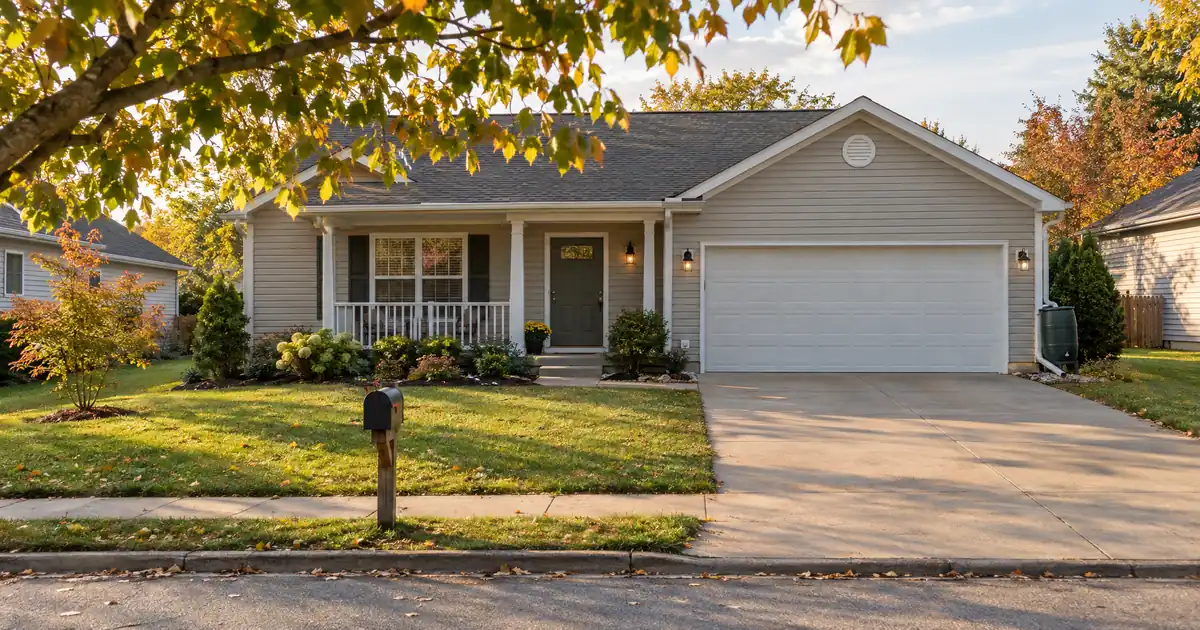
The Quick Read: A VA loan is for a home you will live in, so you certify that you occupy it, or intend to move in, before you can rent it out. The rule centers on your intent at closing, and the published standard for moving in is a “reasonable time.” Renting later is possible, but renting too soon can raise questions about what you certified. Exceptions exist for spouses, deployments, repairs and certain life events.
What Does VA Actually Require?
Here is the rule in one breath. At closing, you certify that you live in the property as your home, or that you intend to move in within a reasonable time. That is all the rule asks of you at the start. The rest of this article is about what that sentence means in practice.
VA payment estimate
Starting assumptions reflect an example price with no down payment and a first-use funding fee. Replace them with your own figures.
Editable benchmark: 7.32% as of October 22, 2026 · Freddie Mac 30-year average via FRED®. A conventional market reference, not a VA loan quote.
Illustrative starting assumptions: a $350,000 price, no down payment with full entitlement, a first-use funding fee financed into the loan, a thirty-year term at the current Freddie Mac benchmark, and property taxes and insurance estimated at typical national rates. Every field is editable.
Illustrative estimate only — not a Loan Estimate, approval, quote, or commitment to lend. The rate field carries the weekly Freddie Mac thirty-year conventional benchmark, a market reference and not a VA loan quote; your rate is set by the lender at lock. The funding fee follows VA’s published table for the use and down payment entered; the residual-income figure is VA’s guideline for the region and family size, and the rough residual shown subtracts only the housing payment and the debts entered, while VA also deducts taxes, maintenance and utilities. Taxes, insurance and dues are editable estimates; closing costs are not included. Licensed in sixteen states for consumer mortgages. Lendmire is not affiliated with or acting on behalf of the Department of Veterans Affairs.
The certification is made by signing VA Form 26-1820 at closing. The VA Lenders Handbook, Chapter 3 describes this step. It applies to all VA loans.
The regulation backs this up. Under 38 CFR 36.4301, a “home” is a place of residence. A “dwelling” is a building designed mainly as a home, with up to four family units. A VA loan buys a home. It does not buy an investment property.
That is the whole legal frame. Everything else is how lenders and borrowers handle it.
Who Sets Which Rule?
Much of the confusion online comes from blending three different things. Sorting them out clears most of it.
| Rule | Who sets it | What it says |
|---|---|---|
| Occupancy certification | VA | You live there or intend to move in |
| “Reasonable time” to move in | VA guidance | Generally the first couple of months, with limits |
| A “12-month stay” | Lender habit | A common benchmark, not a VA rule |
Here is the straight version. VA’s rule is framed around your intent at closing. VA does not publish a minimum stay requirement in so many words. That is not the same as saying nothing can ever matter after you move in. It means the formal test is about what you certified and meant.
The 12-month number does show up in two places. One is lender practice, where a year of living in the home is often treated as good evidence that your intent was real. The other is the outer limit on a delayed move-in, covered next. Neither one is a VA minimum-stay rule.
What Is the “Reasonable Time” to Move In?
The usual yardstick for “reasonable” is a move-in shortly after closing, and the exact timing depends on the file and the lender. Treat that as a guide, not a trapdoor. The Handbook allows a longer wait in specific situations.
A later move-in can be reasonable if two things are true. First, you certify a specific future date. Second, a particular event makes moving in possible on that date. “In the near future” does not meet the test.
There is also an outer limit. A move-in more than 12 months after closing generally cannot be considered reasonable. So the 12-month figure applies to how late you can start living there. It does not set how long you must stay.
Retirement is a good example of how specific this gets. Per the Handbook, retiring on a specific date within 12 months qualifies. Retiring “within the next few years” does not.
How Does the Process Work, Step by Step?
Think of it as a short sequence. Each step is simple on its own.
1. Application. You state that the home will be your primary residence.
2. Closing. You sign the occupancy certification on VA Form 26-1820.
3. Move-in. You move in within the reasonable-time window, or on a documented later date if an exception applies.
4. Living there. You occupy it as your home. This is where lender practice often looks for a real stretch of time.
5. Later change. If life changes, you decide whether to keep the home as a rental.
Across the wholesale programs Lendmire places VA files with, this is the order of operations. The VA program is built for a primary residence. The financing itself, with 100% financing, no mortgage insurance and no VA loan limit on full entitlement, is subject to lender guidelines and full file review. The details of VA loan programs are worth reading before you start.
VA does not appear to monitor occupancy after you move in. Do not read that as a guarantee of safety. The rule is about your certified intent. A move-out right after closing that looks pre-planned can draw questions. A misrepresentation on a certification can carry serious consequences, so ask your lender before you act, not after.
Where the General Rule Bends
The rule has named exceptions. These are the ones worth knowing.
Spouse or dependent child. For an active-duty Veteran who cannot move in within a reasonable time, occupancy or intended occupancy by a spouse or dependent child can satisfy the requirement.
Deployment. Per the Handbook as quoted in secondary material, a servicemember deployed away from their permanent duty station is in temporary duty status. They are generally treated as able to meet the requirement. Confirm this against the current official Handbook.
Retirement. Only a specific date within 12 months works, as covered above.
Repairs or improvements. Extensive work that blocks occupancy is an exception. You certify that you will move in, or move back in, when the work is done.
Multi-unit homes. A dwelling can have up to four units. You live in one and may rent the others. How a lender treats those rents is a separate question, covered below.
Interest rate reduction refinance (IRRRL). An IRRRL refinances an existing VA loan into a lower rate or from adjustable to fixed. It can be based on your previous occupancy, so a home that is now rented can still be refinanced this way. The program carries no VA appraisal, a 0.5% funding fee unless you are exempt, a net tangible benefit, and seasoning of the later of 210 days from the first payment or the sixth payment. The regulation sits in 38 CFR 36.4301.
Cash-out refinance. Mechanically, the VA cash-out reaches 100% of the appraised value including the financed fee. It refinances any loan type into VA and carries the same seasoning and net tangible benefit. Lendmire’s piece VA Cash-Out Occupancy Requirements When the Home Becomes a Rental goes deeper.
What Early Move-Outs Look Like in Practice
Here is the honest read, from a broker who sees these files. How defensible a case is depends on whether the change was real and unplanned, and whether you can show it.
| Situation | How it tends to read | What to gather |
|---|---|---|
| PCS or military orders | Strong, documented event | Copy of orders |
| Job relocation (civilian) | Less clear-cut than orders | Offer letter, start date |
| Hardship or family emergency | Case by case | Records of what changed |
| Health change | Case by case | Supporting documents |
| “I changed my mind” | Weakest | Nothing helps much |
Picture a buyer who closes, moves in, and gets orders months later. The intent was real and the change was documented. That file reads very differently from a buyer who lists the home for rent weeks after closing with no new event behind it.
Timing carries the story. A listing posted soon after closing invites the question of what you meant at the closing table. A move-out after a period of real living there, with a documented reason, answers it.
Proof of occupancy also matters. Lenders and others look for ordinary signs of residence, such as a mailing address, a driver’s license, utility accounts and tax filings. If you plan a PCS move, Lendmire’s guide How to Certify VA Cash-Out Occupancy Before a PCS Move covers the paperwork.
Can You Count the Rent on Your Next Loan?
Often not right away. This surprises people more than anything else.
Under VA’s credit underwriting guidance, counting rent from an existing rental generally takes two years of traditional personal-income documentation showing that rental income. It also takes reserves of at least three months of the full housing payment, and cash-out proceeds cannot count as those reserves. They must be in the account before the new loan closes. That comes from Chapter 4 of the Handbook. Older versions of that chapter cite a different reserve figure, so confirm the current number with your lender.
When rent cannot be used, the full payment on the first home counts against you. That raises your debt-to-income ratio. On VA files, residual income is the controlling test, and the 41% debt-to-income figure is a guideline, not a cap. A higher ratio needs residual income well above the table.
For a multi-unit home where you live in one unit, the Handbook counts 75 percent of the lease or rent amount. Budget for vacancies and repairs yourself. The other 25 percent exists to cover them.
Tax treatment can depend on your situation; borrowers should speak with a qualified tax professional before relying on any deduction or credit.
Keeping the Home and Buying Another
Many Veterans keep the first home as a rental and buy a new one with a VA loan. This works when you have enough remaining entitlement and the new home will be your primary residence.
Here is the catch. Keeping the first loan ties up part of your entitlement. With remaining entitlement, a down payment may be required on the next purchase. Speak with a loan officer about your numbers. With full entitlement there is no VA loan limit, and the program serves amounts to $4,000,000 through the wholesale lenders Lendmire works with.
The funding fee also changes. Subsequent use carries 3.3% with less than five percent down, against 2.15% for first use. Both come down with larger down payments. Exempt Veterans, including those receiving compensation for a service-connected disability, pay none. The certificate of eligibility from VA decides your status.
One-time restoration is also possible after a VA loan is paid off, even if you keep the home. Details on entitlement and restoration live on VA.gov, so check there for your own numbers.
Key Terms Defined
Occupancy certification: Your signed statement on VA Form 26-1820 that you live in the home or intend to move in within a reasonable time.
Entitlement: The amount of VA guaranty you have available. It decides how much you can borrow without a down payment.
Residual income: What is left of your monthly income after taxes, debts and housing costs. VA uses it as the controlling test.
IRRRL: The interest rate reduction refinance, a streamlined way to refinance an existing VA loan.
PCS: A permanent change of station, meaning military orders to a new duty location.
Certificate of eligibility (COE): The VA document that confirms you qualify for the program.
Questions to Bring to Your Lender
- How does this file treat a move-in date after the first couple of months?
- What documents would show my intent and any change of circumstances?
- If I rent later, can the rent count on my next loan, and what history does that need?
- How will my remaining entitlement affect a down payment on the next purchase?
- Do you apply any rules beyond VA’s own?
Those answers shape the whole decision. Some lenders set stricter standards than VA does, and you want to know before you sign.
Frequently Asked Questions
Do I have to live in a VA-financed home for 12 months before renting it?
The VA’s occupancy rules don’t set a firm 12-month minimum stay. The 12-month figure shows up as the outer limit on a delayed move-in and as a common lender benchmark. A year of living there helps show your intent was real, so lenders often treat it that way.
Can I rent the home if I get PCS orders?
Often yes, if the orders are a real change after you moved in or planned to. Keep a copy of the orders and your lender’s guidance. A documented event makes the strongest case, though each file is reviewed individually.
Can I rent out other units in a duplex or fourplex right away?
Yes in principle, because you occupy one unit and the dwelling can have up to four. How a later lender counts that rent is a separate matter. For an existing property, 75 percent of the lease amount counts under the Handbook, and documentation is required.
Do I have to refinance before I rent the home?
No. Renting does not require a refinance. An IRRRL can also be based on your previous occupancy, so a home that is now rented can still be refinanced this way.
Can a VA loan buy an investment property?
No. The loan finances a home you will occupy. Occupancy also decides the leverage, so a home you do not live in does not get VA financing.
What to Do Next
Decide your plan before you close, not after. If you may move within a year, ask the questions above and get the answers in writing where you can. If you are buying a home and want to see whether a VA loan fits your file, Lendmire can help you compare the options and what each one asks of the file. Program figures are subject to lender guidelines and full file review, and nothing here is a commitment to lend.
Honest planning beats clever timing here, because the certification you sign at closing is the one thing everything else is measured against.
For your own numbers, request a scenario review with Lendmire.
About Lendmire
Lendmire is a mortgage brokerage (NMLS# 2371349) licensed for consumer mortgage lending in 16 states, arranging FHA, VA, conventional and jumbo purchase and refinance loans through a wholesale lending network. Eligibility is determined by the lender on each file. Scotsman Guide named Lendmire a Top Mortgage Workplace in both 2025 and 2026.
Get Started
Ready to find the right loan for you?
In about two minutes you can review financing options available for your home or investment property. No commitment required.
Informational only. Not a Loan Estimate, approval, or commitment to lend. Program availability and eligibility are subject to lender guidelines, credit approval, property review, and underwriting.
References
1. VA Pamphlet 26-7 Ch. 3, The VA Loan and Guaranty
4. VA Pamphlet 26-7 Ch. 4, Credit Underwriting
This article is part of Lendmire’s VA loan program — full qualification details, guidelines, and scenarios live on the program page.
Related reading: How to Work Out Your VA Loan Amount on a High-Cost Home Using the COE · VA Cash-Out Refinance and IRRRL Requirements by Refinance Type · VA Loan Documentation for Military Income on a Home Purchase
Brandon Miller
Founder & CEO, Mortgage Loan Originator, Lendmire LLC
- Mortgage Loan Originator · NMLS# 1129696 · Verify on NMLS Consumer Access
- North Carolina Real Estate Broker · License# 343312 · Verify on NCREC
- North Carolina Insurance Producer · License# 19053198 · Property, Casualty, Life, Health · Verify on NAIC SBS
- Lendmire LLC · Firm NMLS# 2371349 · Verify firm licensure
Disclosure information. Lendmire is a state-licensed mortgage brokerage under NMLS# 2371349. Lendmire is not a depository institution, direct lender, or financial advisor — all loans referenced are placed through wholesale lender partners and are subject to each lender's underwriting standards. This article is provided for general informational purposes and is not a commitment to lend, nor does it constitute financial, legal, or tax advice. Loan programs, terms, rates, and qualification standards change without notice and depend on borrower profile, property type, and the state in which the subject property is located. Equal Housing Opportunity provider. NMLS Consumer Access: nmlsconsumeraccess.org.