
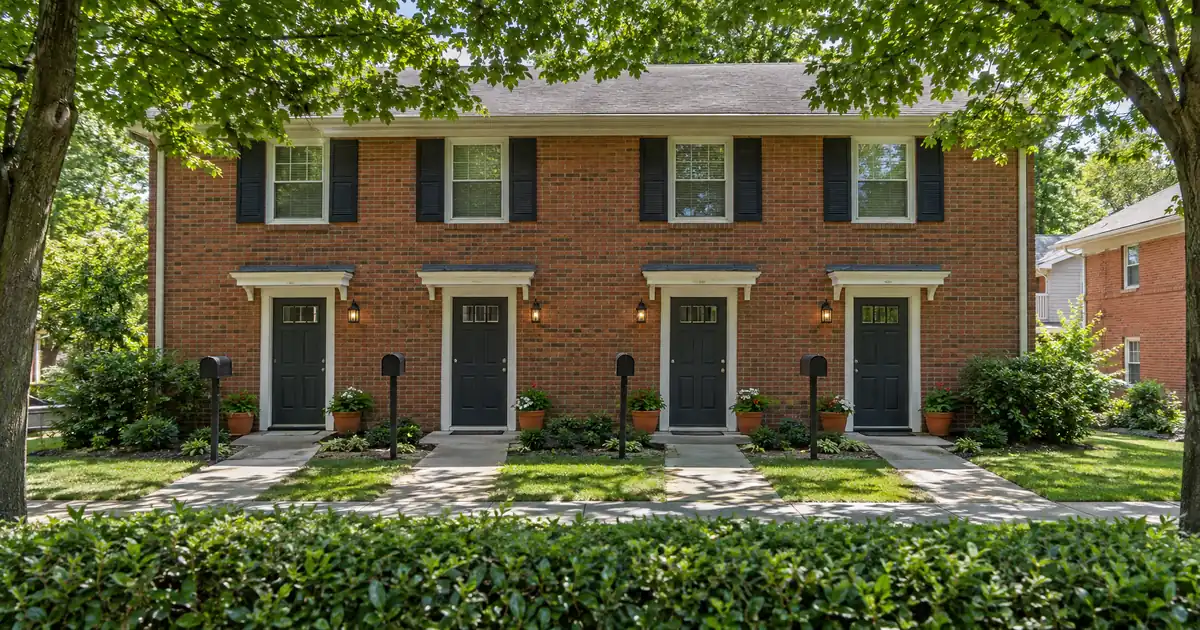
The Quick Read: VA loan occupancy rules require you to live in one unit of the fourplex as your home, or intend to. You certify that intent, and you generally have a short window after closing to move in. If active duty keeps you from occupying the property, a spouse or dependent child can satisfy the requirement, and a deployed service member is treated as being on temporary duty. A VA loan cannot buy a pure investment property. The fourplex works only because you occupy one unit and rent the other three.
The rest of this article walks the file from start to finish: what the rule says, how the rent gets underwritten, the situations where active-duty life bends the rule, and what you should have documented before the file goes to the lender.
VA payment estimate
Starting assumptions reflect an example price with no down payment and a first-use funding fee. Replace them with your own figures.
Editable benchmark: 7.32% as of October 22, 2026 · Freddie Mac 30-year average via FRED®. A conventional market reference, not a VA loan quote.
Illustrative starting assumptions: a $350,000 price, no down payment with full entitlement, a first-use funding fee financed into the loan, a thirty-year term at the current Freddie Mac benchmark, and property taxes and insurance estimated at typical national rates. Every field is editable.
Illustrative estimate only — not a Loan Estimate, approval, quote, or commitment to lend. The rate field carries the weekly Freddie Mac thirty-year conventional benchmark, a market reference and not a VA loan quote; your rate is set by the lender at lock. The funding fee follows VA’s published table for the use and down payment entered; the residual-income figure is VA’s guideline for the region and family size, and the rough residual shown subtracts only the housing payment and the debts entered, while VA also deducts taxes, maintenance and utilities. Taxes, insurance and dues are editable estimates; closing costs are not included. Licensed in sixteen states for consumer mortgages. Lendmire is not affiliated with or acting on behalf of the Department of Veterans Affairs.
What Does the Occupancy Rule Actually Say?
You must certify that you will occupy the property as your home. That is the condition for VA to guarantee a purchase loan. The certification is a requirement of the federal regulations in 38 CFR Part 36, Subpart B, and VA will not issue evidence of guaranty without it.
Two points matter most on a fourplex file.
First, “occupy” means one unit. Not all four. The other three are rental units, and that is allowed.
Second, the rule is about intent and timing, not a fixed residency term. The lender handbook guidance asks for one of two things: you live there now, or you intend to move in within a reasonable time. The default reasonable time is 60 days after closing. Confirm that wording against the live handbook chapters through the VA Lenders Handbook index, which lists Chapter 3 (the loan guaranty), Chapter 4 (credit underwriting) and Chapters 10 and 11 (appraisal).
One sentence on the rental angle: a VA loan is an owner-occupied program, so occupancy decides the leverage, and the VA terms below apply only because you live in one of the units.
Key Terms Defined
Occupancy certification: The signed statement that you live in the property or intend to move in within a reasonable time.
Reasonable time: The window to move in after closing. The standard is 60 days. A longer window needs a specific date and a real future event that makes it possible.
Certificate of Eligibility (COE): The VA document that confirms your entitlement. The lender starts here.
Residual income: What is left of your monthly income after debts and living costs. On VA files it is the controlling test.
Fair-rent opinion: The appraiser’s estimate of what the rented units would earn. It feeds the rental-income analysis.
Entitlement: The portion of the guaranty you hold. Full entitlement means no VA loan limit applies.
How Is a VA Fourplex Loan Underwritten, Step by Step?
The deal works through a fixed order. Missing a step early creates a gap later.
1. Eligibility and entitlement. The COE is the starting point. Active-duty applicants have their own section in the handbook, so tell the loan officer your status at the first conversation.
2. Pick your unit. Choose the unit you will occupy before the contract goes to the appraiser. The appraisal, the lender file and the leases should all point to the same unit. This is a practical step, not a VA rule, and it prevents a lot of cleanup.
3. Sign the occupancy certification. In practice borrowers sign at application and again at closing. Treat that two-signature habit as common practice. The regulation requires the certification in whatever form VA prescribes.
4. Appraisal. On a multi-unit purchase, the VA appraiser’s fair-rent opinion feeds the income analysis. Expect the appraiser to need access to every unit. If tenants are in place, arrange that access early. Locked units are a common reason an appraisal stalls.
5. Underwrite the rent. This is where a fourplex differs from a single-family file. Older VA training material describes a reserve requirement of six months of housing payments and evidence of rental or property-maintenance experience. It also describes counting rental income at 75% of prior rents collected, or the appraiser’s fair rental opinion. That material is dated, so treat those figures as the shape of the test and confirm current numbers in Chapter 4 before relying on them. Some lenders add their own self-sufficiency test on three- and four-unit properties. That is a lender overlay, not a VA rule, and it varies lender to lender. Final terms depend on the lender’s guidelines, the property type, and the borrower’s complete credit picture.
6. Count the shortfall. If the discounted rent does not cover the full payment, the gap is added to your obligations. It hits debt-to-income and residual income. On the wholesale programs I place VA files with, residual income is the controlling test, and the 41% debt-to-income figure is a guideline, not a cap. A higher ratio needs residual income well above the table.
7. Close and move in. The 60-day clock starts at closing. If orders prevent a move-in, the date and the triggering event belong in the file at application, not after the fact.
What decides the outcome: whether your intent is credible and documented, whether any delayed date is tied to a real event, whether the reserves and experience are in the file, and whether the appraised rent supports the numbers.
What Does the Money Look Like at the Program Level?
On the wholesale VA programs Lendmire works with, a purchase carries no down payment as long as the price is not above the appraised value. There is no mortgage insurance of any kind. With full entitlement there is no VA loan limit, and the programs reach amounts up to $4,000,000. With remaining entitlement a down payment may be required, so speak with a loan officer rather than guessing.
VA sets no minimum credit score. The wholesale programs start at a 580 decision score. Lenders may set a higher floor.
The funding fee is separate from mortgage insurance. It is waived for veterans receiving compensation for a service-connected disability and for other exempt groups. On first use it is 2.15% with less than 5% down, 1.5% with 5% to under 10% down, and 1.25% with 10% or more down. On subsequent use it is 3.3% with less than 5% down, with the same 1.5% and 1.25% tiers above that. All of this is subject to lender guidelines and full file review.
You can read more on VA loan programs.
Where Active-Duty Life Bends the Rule
This is where fourplex buyers in uniform get into trouble, usually through bad assumptions, not bad faith.
| Situation | What the rule supports | What to document | Fourplex caution |
|---|---|---|---|
| Deployed, married | Temporary duty status; requirement can be met | Orders showing deployment | Name the unit you will return to |
| Deployed, single | Same temporary duty treatment | Orders, intended unit | Lease the other three, not yours |
| Cannot move in, married | Spouse can certify and occupy | Spouse certification, proof of residence | Spouse must actually live in the unit |
| Dependent child occupies | Handbook allows spouse or dependent child | Dependent’s residence evidence | Confirm with the lender, since practice varies |
| Delayed move-in | Needs a specific date and a future event | Dated statement, event proof | Outer limit generally 12 months |
| Repairs before move-in | Separate handbook treatment | Repair scope and schedule | Rent only the units the appraisal supports |
| PCS orders after closing | Not a retroactive violation, per practitioner reading | Orders and closing dates | Intent at closing must be honest |
Some detail on the harder rows.
Active duty and unable to occupy. For a veteran who cannot occupy because of active-duty status, the regulation names the spouse as the one who can make the certification. A parallel provision for manufactured homes in 38 CFR 36.4206 uses similar wording. That section covers manufactured homes only. Treat it as a pointer, not as authority for a fourplex. The handbook guidance also lets a spouse or dependent child satisfy occupancy when the veteran is on active duty and cannot move in within a reasonable time.
Deployed from your permanent station. A deployed service member, single or married, is treated as in temporary duty status. Occupancy can be met with or without a spouse. Some advice online says a spouse is required. That conflicts with the handbook language, so resolve it with your lender against the live chapter.
Delayed move-in. More than 60 days can be reasonable, but only with two things: a certified specific future date and a particular event that makes the date possible. Occupancy beyond 12 months after closing generally cannot be considered reasonable. Vague plans do not satisfy this.
Rent from the home you are leaving. Older VA training material says prospective rent from a previously occupied home can only offset that home’s payment. It cannot count as effective income. Rent from other properties that do not secure the VA loan has its own tax-return and reserve conditions.
Five or more units. Not eligible. Confirm the legal unit count against zoning and county records, not the listing. Handbook summaries also describe a limit on nonresidential space, reported as 25% of floor area, which you should confirm against the live chapter.
How These Files Go Sideways
Across the wholesale programs I place VA files with, occupancy problems are almost always file-consistency problems. The certification says one unit, the appraisal ordered a different one, and the lease for the occupied unit was signed before closing. Or orders arrive that were foreseeable at application and never disclosed. Nothing is wrong with the deal. The paper just disagrees with itself.
The fix is boring. Name the unit once. Put orders, dates and the spouse’s role in the file at application. Keep leases for the other three units clean and dated after closing.
Does the Self-Sufficiency Test Collide With Occupancy?
Sometimes. Where a lender applies a self-sufficiency test on a three- or four-unit property, the rent has to carry the property on its own terms. If you will be away, the occupied unit is still yours in the file, but the other units’ rent does the heavy lifting. Run that scenario before you write the offer. This is a lender-by-lender overlay, not a VA rule, so ask early which version your lender uses.
When Can You Move Out or Rent Your Unit?
Here is the point the internet gets wrong. The VA guidance does not state a minimum-stay period. A 12-month period is a lender and practitioner expectation, not VA text. Do not present it as a federal rule, and do not assume it does not matter to your lender either.
What does matter: the certification is a statement of intent at the time you signed. If you intended to occupy and then orders changed, that is a different file than one where you never planned to live there. A false certification can be treated as fraud and can cost you VA benefits. That is the real risk, and it is why honest, dated documentation at application protects you.
Worked Scenarios
Deployed and married. A service member buys a fourplex while orders send them overseas within the first month. The spouse certifies and moves into the chosen unit. The file carries the orders and the spouse’s certification. The other three units are leased to tenants.
Deployed and single. The member is in temporary duty status. Intent to return to the chosen unit is documented. A trusted manager handles the other three units. The risk is not the rule, it is the self-sufficiency overlay if the lender applies one.
PCS inbound. Orders to the new base arrive before the contract. The member buys near the base, closes, and moves in within the standard window. This is the most straightforward scenario.
PCS outbound shortly after closing. If orders arrive after closing and the intent was honest, the commitment is generally not treated as retroactively void, though that is practitioner reading and not VA text. If the orders were in hand at application, the file looks very different. Disclose them.
Retirement within a year. The member plans to separate and move into the unit. A delayed date tied to a real event, inside the 12-month outer limit, is the shape the handbook describes.
Documentation Checklist
- Certificate of Eligibility
- Orders, if deployment or a move is foreseeable
- Written statement naming the unit you will occupy and the date
- Spouse or dependent certification and proof of residence, if used
- Reserve documentation in your own funds (confirm what counts in Chapter 4)
- Landlord or property-maintenance experience, where required
- Current leases and access arrangements for the appraisal
- Repair scope and schedule, if the move-in is delayed for work
VA Rules Versus Lender Overlays
| Item | VA rule | Lender overlay |
|---|---|---|
| Occupy one unit | Required | Same |
| 60-day move-in default | Handbook guidance | May be stricter |
| Minimum stay | None verified | Often 12 months |
| Self-sufficiency test | Not a VA rule | Varies by lender |
| Landlord experience | In older VA training material | Varies |
| Max units | Four | Same |
Common Mistakes
- Treating the fourplex as an investment because three units rent.
- Assuming 12 months to move in. The default is 60 days.
- Counting all the rent. Only a discounted share counts.
- Waiting until after closing to document orders.
- Using gift or cash-out funds for reserves without checking whether they count.
- Leasing the unit you certified you would occupy.
Frequently Asked Questions
Can I buy a VA fourplex if I am deployed right now?
Yes, if you meet the other requirements. A deployed service member is treated as being in temporary duty status, and the occupancy requirement can be met whether or not a spouse is available. Document the orders and the unit you intend to occupy at application.
Can my spouse live in the unit instead of me?
Yes. When active duty keeps the veteran from occupying, the spouse can make the certification and occupy. The handbook guidance also allows a dependent child in this situation, though lender practice varies, so confirm with yours.
How long do I have to move in after closing?
The default is 60 days. Longer can be reasonable only with a certified specific date and a particular future event, and occupancy beyond 12 months generally cannot be considered reasonable.
Can I rent my own unit later?
That depends on your lender and your honest intent at closing. Renting out your unit after PCS orders is a different file than never intending to live there.
Does all the rent count toward qualifying?
No. Only a discounted share counts, and the rest of the file must meet reserve and experience conditions. Any shortfall is added to your obligations and affects debt-to-income and residual income.
If you are buying a home and want to see whether a VA loan fits your file, Lendmire can help you compare the options and what each one asks of the file. For a related look at occupancy on the refinance side, Lendmire’s piece VA Cash-Out Occupancy Rules for an Active-Duty PCS Move covers how occupancy works when you are refinancing instead of buying.
For your own numbers, request a scenario review with Lendmire.
About Lendmire
Lendmire (NMLS# 2371349) is a mortgage broker licensed for consumer lending in 16 states. Lendmire arranges FHA, VA, conventional and jumbo purchase and refinance loans through wholesale lenders; every file is underwritten by the lender under the applicable program guidelines. Scotsman Guide named Lendmire a Top Mortgage Workplace in both 2025 and 2026.
Get Started
Ready to find the right loan for you?
In about 30 seconds you can review financing options available for your home or investment property. No commitment required.
Informational only. Not a Loan Estimate, approval, or commitment to lend. Program availability and eligibility are subject to lender guidelines, credit approval, property review, and underwriting.
References
1. 38 CFR Part 36, Subpart B (eCFR)
2. VA Lenders Handbook (Pamphlet 26-7) index
This article is part of Lendmire’s VA loan program — full qualification details, guidelines, and scenarios live on the program page.
Related reading: VA Loan Entitlement Restoration Rules for a Repeat VA Buyer · Does Residual Income Offset High DTI on an Active-Duty VA Loan? · VA Loan Income Rules for a First-Time User on Active Duty
Brandon Miller
Founder & CEO, Mortgage Loan Originator, Lendmire LLC
- Mortgage Loan Originator · NMLS# 1129696 · Verify on NMLS Consumer Access
- North Carolina Real Estate Broker · License# 343312 · Verify on NCREC
- North Carolina Insurance Producer · License# 19053198 · Property, Casualty, Life, Health · Verify on NAIC SBS
- Lendmire LLC · Firm NMLS# 2371349 · Verify firm licensure
Important disclosures. Lendmire (NMLS# 2371349) is a licensed mortgage brokerage. Lendmire is not a direct lender, depository institution, or financial advisor. All loan inquiries are subject to lender underwriting; this article does not constitute a commitment to lend. Rates, terms, and program guidelines are subject to change without notice and vary by borrower profile, property type, and state. Information in this article is general in nature and is not financial, legal, or tax advice. Equal Housing Opportunity. NMLS Consumer Access: nmlsconsumeraccess.org.