
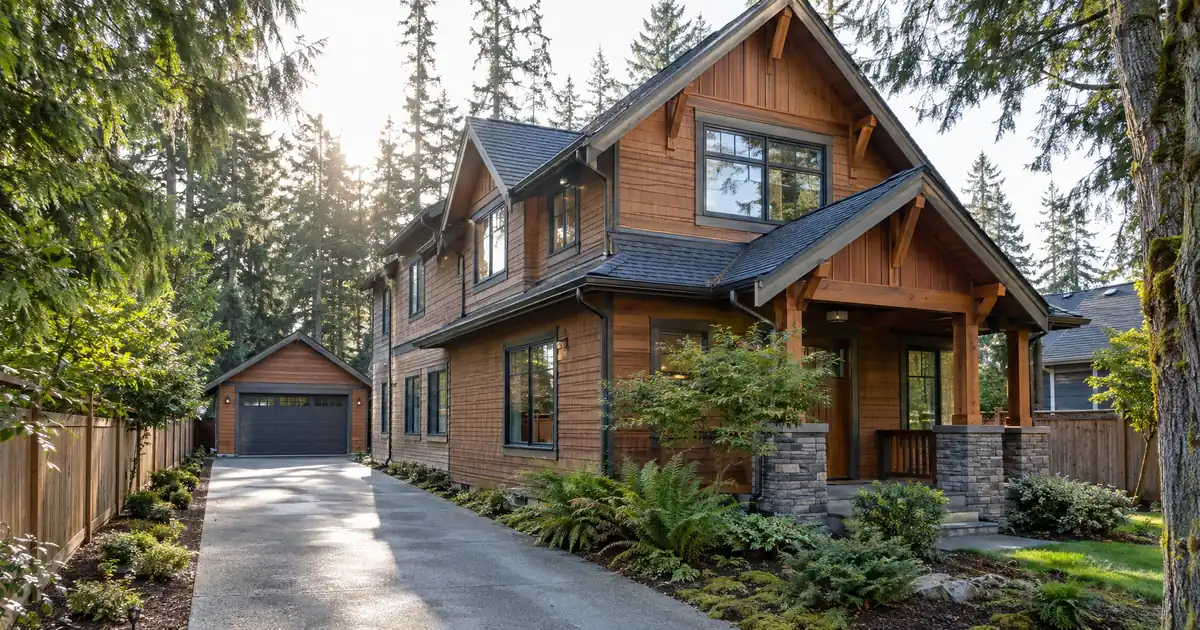
The Quick Read: Yes, you can buy a winter home with savings alone, either by paying cash or, through select asset-based programs, by qualifying on your account balances instead of paycheck income, subject to underwriting and lender guidelines.
- Paying cash needs no lender at all. You prove funds and close.
- An asset-based mortgage lets you keep savings liquid. It documents your assets with statements, not traditional personal-income documentation, pay stubs or employment verification.
- Asset-based programs come in two paths. One covers the whole loan with assets. The other turns assets into monthly income.
- A winter home you will never rent is a poor fit for rental-income loans. Cash or an asset-based mortgage is the realistic lane.
- Cash buying ties up your money. That is the real cost, not the purchase price.
What Does “Savings Alone” Actually Mean?
It means one of three different things, and each has its own rules. Buyers often mix them up, then get surprised at the closing table. Pick your meaning first.
| Path | What you need | What gets documented | Main trade-off |
|---|---|---|---|
| All cash | Full price plus closing costs | Proof of funds | Liquidity drained |
| Savings as down payment | Income a lender can verify | Pay stubs, returns, statements | Hard if income is low |
| Assets as the qualifier | Eligible assets and credit | Account statements | Program limits apply |
The middle row is the standard second-home mortgage. It works well for buyers with steady paychecks. It works poorly for a retiree with a large portfolio and little taxable income. That gap is where asset-based lending lives.
How Common Is Buying a Winter Home With Cash?
Very common. NAR’s Economists’ Outlook reports that 57% of vacation-home buyers paid all cash. The same analysis says all-cash buyers skew toward vacation buyers and investors.
Overall, all-cash purchases hit 26% of buyers in NAR’s most recent buyer profile, an all-time high, per Virginia REALTORS®’ summary. Cash buyers are often repeat buyers sitting on equity from a prior sale. A Washington retiree who sold or downsized a primary home fits that picture.
So you are not odd for asking. You are in the majority of vacation buyers.
The Cash Route: What You Are Signing Up For
Cash is simple at closing and demanding afterward. You show a bank or brokerage statement as proof of funds. Sellers usually like that, because the offer has no loan to fall through. Title, deed and settlement still happen the usual way.
The work comes after. With no lender, there is no escrow account. You pay property taxes, insurance, HOA dues and upkeep directly, and a local brokerage notes that cash owners handle exactly these items themselves. Winter condos in resort areas often carry steep association dues. Budget them before you make an offer.
The bigger issue is liquidity. Northwestern Mutual lays out the trade: cash avoids interest and lender fees but can drain emergency money. A sound rule of thumb is to price the purchase so you still hold a comfortable cushion after closing. Medical costs, a roof, a special assessment. These arrive uninvited.
One note on the northern home. Many Washington snowbirds fund the purchase from the sale of a primary home. Sequence matters. Know where the money will sit, and in what kind of account, before you write an offer.
The Asset-Based Route: Keep Savings, Still Borrow
An asset-based mortgage is reviewed around what you own rather than what you earn. Across the wholesale network Lendmire works with, the programs fall into two paths. You are qualified on one path at a time, never a blend. Lendmire is the broker. It places the file with select lenders, and every file is fully underwritten. Lendmire’s asset-based mortgage programs are available to consumer borrowers in 16 states, Washington included.
Path one: the asset qualifier
Your eligible assets, after the credit percentages below, must equal or exceed the entire loan amount. No employment or income is documented. Through select programs, typical terms look like this, subject to underwriting:
- Leverage up to 80% on a purchase and 75% on a refinance, for a principal residence or second home.
- Loans up to $4,000,000.
- A 600 minimum credit score.
- Brokerage accounts, CDs, money market and savings count at 100%.
- Retirement accounts count at 90% if you are under 59½ and 100% at 59½ or older.
- Sixty days of seasoning and two months of statements for each qualifying account.
- No reserves required at or below 75% loan-to-value. Above that, the lender sets them. Final terms depend on lender guidelines, property type, leverage, and the borrower’s complete credit picture.
Here is the illustrative math. Say you want an $800,000 loan. You hold $330,000 in brokerage accounts (counts at 100%), $300,000 in a 401(k) while under 59½ (counts at 90%, or $270,000) and $200,000 in savings (100%). That is $800,000 of usable assets, which is reviewed on assets alone. The lender’s own calculation governs. Ask how your lender treats funds used for the down payment, since those dollars are also part of the balance being counted.
Path two: asset depletion
Here the lender converts assets into monthly income. Usable assets divided by 60 months become your qualifying income, and that income must carry the housing payment and other debts through the debt-to-income test.
- Leverage on a second home: up to 80% on a purchase or rate-and-term refinance, 60% on a cash-out refinance.
- On an investment property: up to 65% on a purchase or rate-and-term refinance, 60% on a cash-out refinance.
- Loans from $125,000 to $3,500,000.
- Cash and CDs count at 100%, securities at 80%, private stock at 75%, retirement accounts at 70% at any age and real-estate equity at 60%.
- Statements must be at least 120 days old at application, plus one recent statement within 45 days.
- Minimum assets are the lesser of $1,000,000 or 1.25 times the loan, and never below $250,000 liquid if assets are your only income source.
- Credit follows the lender’s matrix. First-time investors need a 700 score.
The illustrative math: $1,500,000 in securities counts at 80%, or $1,200,000. Add $300,000 in cash at 100%. That is $1,500,000 usable. Divide by 60 months and you get $25,000 of monthly qualifying income. That figure then has to carry the housing payment and your other debts. Cash-out proceeds never count as qualifying assets.
What does not count
Crypto, precious metals, collectibles and borrowed or pledged funds are not published as eligible on either path. The documented workaround is to convert them to a seasoned cash balance in a regulated account. The lender reviews the source of those funds. Custodial accounts, deferred compensation, escrow accounts, foreign funds and stock options are also out on the depletion path.
Which Path Fits Which Washington Snowbird?
Your balance sheet decides. Here is how it usually sorts out.
| Your situation | Likely fit | Why |
|---|---|---|
| Liquid savings cover the whole price | Cash | Simplest close, no loan |
| Large portfolio, want to stay liquid | Asset qualifier | Assets cover the loan |
| Portfolio, plus some pension or Social Security | Asset depletion | Assets supplement income |
| Steady documented income | Standard second-home loan | Income does the work |
The depletion path can also supplement documented income up to a 45% debt-to-income ratio. When it supplements, the minimum-assets rule is waived.
Honestly, this is a close call for many buyers. Cash is cleaner. Borrowing preserves capital for the next surprise or the next purchase. Retirees with big portfolios often weigh market risk too. Selling stocks to buy a condo can lock in gains at a bad time, while a loan lets the portfolio keep working. Tax treatment varies; consult a qualified professional before pulling money from retirement accounts or taxable holdings.
What If You Plan to Rent It Out?
Then your options widen, and so do the strings. Business-purpose rental financing, which is DSCR lending, qualifies primarily on property-level rental income covering the payment, subject to lender guidelines. It suits an owner who will actually run the place as a rental. It does not suit a home you keep empty for your own use.
Standard second-home loans usually restrict how much you can rent the property. Rental-income loans do not use that framework, but they expect the rental to be real. If you want rental income to qualify for the loan, you are buying an investment property in the lender’s eyes. If you want winter use with a little rent on the side, an asset-based mortgage or cash usually fits better.
A snowbird twist: your own stays reduce rentable nights. Appraisers can estimate market rent regardless. Your actual cash flow still shrinks. Short-term rental rules can vary by city, county, HOA, and property type, so investors should confirm local rules before relying on projected rental income.
If you buy with cash now and want liquidity later, refinancing is an option down the road. Seasoning and eligibility depend on the program.
Common Mistakes
- Treating the purchase price as the whole cost. Taxes, insurance, dues and upkeep run every year, and cash buyers pay them directly.
- Draining the cushion. Buying with every spare dollar leaves nothing for repairs.
- Assuming assets-only means no paperwork. Statements are required for every qualifying account. Every file is underwritten.
- Counting ineligible assets. Crypto or borrowed funds do not count at a percentage. Convert and season them first.
- Ignoring seasoning. New deposits need time in the account before they count.
Key Terms Defined
Proof of funds: A bank or brokerage statement showing you hold enough money to close a cash purchase.
Seasoning: The waiting period money must sit in an account before a lender counts it.
Loan-to-value (LTV): The loan amount divided by the property’s value. Lower means more of your own money in the deal.
Asset depletion: A method that divides usable assets by 60 months to create a monthly qualifying income.
Usable assets: Your account balances after the program’s credit percentages are applied.
Escrow: An account a lender uses to collect taxes and insurance. Cash buyers have none.
Frequently Asked Questions
Can I buy a winter home with no paycheck income?
Yes, two ways. Cash needs no income at all. An asset-based mortgage, through select programs, is reviewed around documented assets instead of employment, subject to underwriting. You still show credit, statements and the property.
Does my age affect which retirement money counts?
It does on the asset qualifier path. Retirement balances count at 90% if you are under 59½ and 100% at 59½ or older. On the depletion path, retirement accounts count at 70% at any age.
Should I pay cash or borrow against my assets?
It depends on what you would rather protect. Cash gives simplicity and a stronger offer. Borrowing preserves liquidity and keeps investments in place. Many buyers split the difference by putting down a large share and financing the rest.
Will my own winter stays disqualify the loan?
Not for an asset-based mortgage on a second home, which is built for personal use. They matter for rental-income loans, where the property is expected to be a real rental and your stays cut into rentable nights.
How much should I keep after closing?
There is no universal number. Set aside enough for a year of taxes, insurance, dues and repairs, plus your normal emergency fund. The qualifier path requires no reserves at or below 75% loan-to-value, but your own cushion matters more than the lender’s.
If you are qualifying on assets rather than income and want to see how the numbers work, Lendmire can help you compare asset-based mortgage options based on your statements, the property, credit profile, leverage, and your goals. Reach out at 828-256-2183.
Washington snowbirds who keep one eye on liquidity tend to enjoy the second home more than those who put every dollar into the front door.
Lendmire’s asset-based mortgage in Washington page presents the program for Washington borrowers.
About Lendmire
Lendmire (NMLS# 2371349) is a mortgage brokerage serving self-employed and high-net-worth borrowers in 16 states. Bank statement, P&L-only, 1099-only and asset-based mortgages are arranged through wholesale lending channels; Lendmire brokers the financing and the lender underwrites each application. Scotsman Guide named Lendmire a Top Mortgage Workplace in both 2025 and 2026.
Get Started
Ready to find the right loan for you?
In about 30 seconds you can review financing options available for your home or investment property. No commitment required.
Informational only. Not a Loan Estimate, approval, or commitment to lend. Program availability and eligibility are subject to lender guidelines, credit approval, property review, and underwriting.
References
1. NAR Economists’ Outlook: The Cash Buyer
2. Virginia REALTORS®: Key Takeaways From NAR’s Profile of Home Buyers and Sellers
3. Deer Valley Real Estate: Buying a Vacation Home in Cash
4. Northwestern Mutual: Buying a House in Cash, Pros and Cons
This article is part of Lendmire’s asset-based mortgage program — full qualification details, guidelines, and scenarios live on the program page.
Related reading: Can a Pennsylvania Snowbird Buy a Winter Home on Savings Alone? · Can You Buy a Home on Savings While Your Business Is Still Ramping Up? · How California Business Owners Buy a Home on Savings Instead of Tax Returns
Guides: Asset-Based Mortgage in Washington
Brandon Miller
Founder & CEO, Mortgage Loan Originator, Lendmire LLC
- Mortgage Loan Originator · NMLS# 1129696 · Verify on NMLS Consumer Access
- North Carolina Real Estate Broker · License# 343312 · Verify on NCREC
- North Carolina Insurance Producer · License# 19053198 · Property, Casualty, Life, Health · Verify on NAIC SBS
- Lendmire LLC · Firm NMLS# 2371349 · Verify firm licensure
Disclosures. The information presented in this article is general market commentary, not financial, legal, or tax advice. Lendmire is a mortgage brokerage (NMLS# 2371349) — not a direct lender or depository institution — and loan placement is subject to lender underwriting. Nothing in this content represents a commitment to lend. Loan terms, pricing, and program availability vary based on borrower qualifications, property characteristics, and state of subject property, and are subject to change at any time. Lendmire complies with Equal Housing Opportunity requirements. Consumer access: nmlsconsumeraccess.org.