
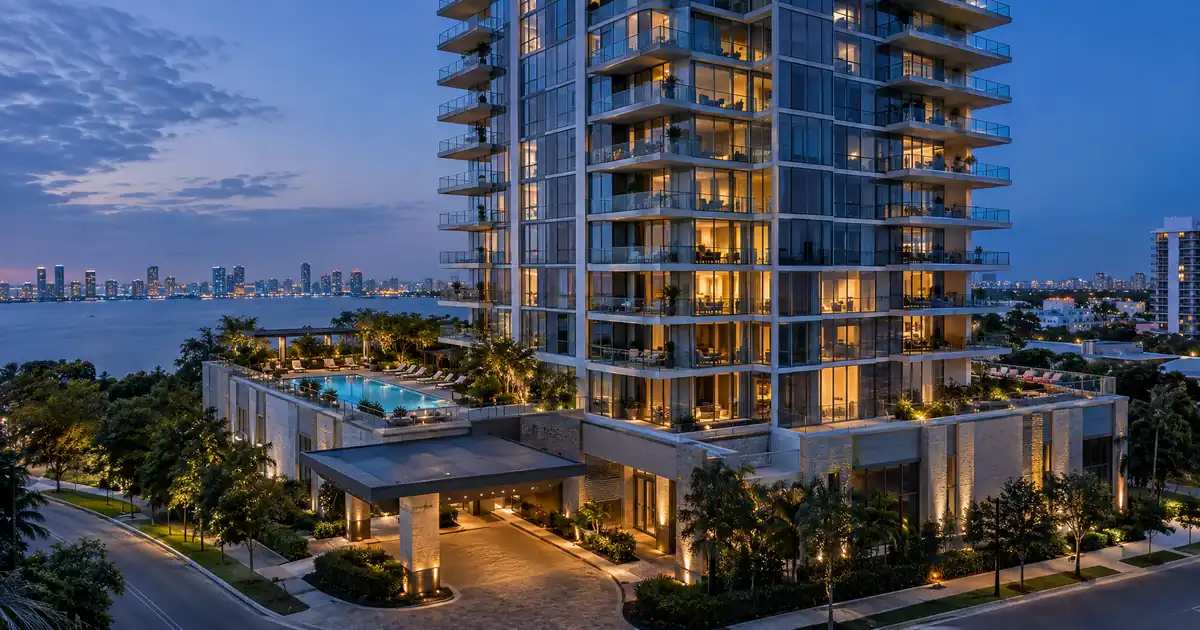
How To Finance A Condotel With A Bank Statement Loan — The Quick Read: A condotel — a condo unit inside a building run with hotel-style services — almost never qualifies for a conventional mortgage. A bank statement loan works around that by qualifying you off deposit history instead of traditional personal-income documentation, and it can be paired with condotel-specific leverage through select lenders in a wholesale non-QM network. Sizing, down payment, and documentation all shift once the property carries a condotel label, so the planning has to start there, not at the offer stage.
Key Takeaways
- A condotel is disqualified from agency financing at the property level, not the borrower level — good credit and strong deposits don’t fix a hotel-operated building.
- Bank statement loans use 12 or 24 months of deposit history and an expense factor to calculate qualifying income instead of a tax return.
- Condotel leverage runs lower than a standard condo or single-family rental — typically 75% LTV on a purchase and 65% on a cash-out through a portfolio program, with a separate ladder as low as 50% cash-out on a bank-portfolio program.
- The standard rental appraisal form used for most investment properties doesn’t translate cleanly to nightly-rate income, which changes how a condotel’s rental value gets documented.
- Self-employed buyers, founders, and investors with income-suppressing traditional personal-income documentation are the strongest fit for this pairing; W-2 borrowers with simple files usually have cheaper paths available.
Why a Bank Statement Loan Fits This Property Type
A bank statement loan solves a documentation problem, and a condotel purchase usually creates two documentation problems at once — the property and the borrower. That overlap is why the two show up together so often.
The first issue is the building itself. Most condotels have front-desk check-in, daily housekeeping, and sometimes required participation in a rental-management program. That’s nothing like a normal residential condo, so lenders who sell loans to mortgage-purchasing agencies won’t finance them. The second issue is the borrower. Self-employed buyers, consultants, and business owners often show lower income on paper because of tax deductions. This can hurt them in standard debt-to-income underwriting, even if their bank accounts show strong cash flow.
Lenders apply an expense factor to business account deposits to estimate real income. This factor depends on the business’s size and type — lower for a one-person service business, higher for businesses with employees or physical products. It accounts for the cost of running the business before counting what’s left as income. In some cases, an accountant’s ratio can replace this default number, or a profit-and-loss method can be used instead, capped at 80% of stated income. Money the borrower transfers from their own business account to their personal account counts in full, since it’s already their income.
That mechanism is the whole appeal for a condotel buyer whose traditional income documentation run light: the loan gets built on what actually landed in the bank, not what the IRS return shows after deductions.
Why the Property Locks Out Conventional Financing First
The disqualification is structural, not a paperwork issue that gets fixed with a better application. A condotel that runs hotel-style operations is permanently outside agency financing, regardless of the borrower’s credit or income.
This rule comes from how mortgage-purchasing agencies define an “ineligible project.” Fannie Mae’s selling guide says a project can’t be run like a hotel, motel, or similar business. One sign of this is if the homeowners’ association is licensed as a hotel or hospitality entity — see the Fannie Mae Selling Guide’s ineligible projects section. Fannie Mae’s condo FAQ adds an important detail many buyers miss: even if a hotel or resort company just helps owners manage short-term rentals, that alone can make the project ineligible, according to the Fannie Mae Condo FAQ.
Condotels never qualify for standard agency loans, so there’s no special exception or upgrade once a building is flagged. These loans go straight to a non-QM or portfolio program. This is different from DSCR loans, which are business-purpose investor loans reviewed under separate rules than owner-occupied mortgages. That distinction matters if your plan ever shifts from qualifying by bank statements to qualifying by property income instead. Lendmire’s complete DSCR loans guide explains that option in more detail.
Key Terms Defined
Bank statement loan — a mortgage that calculates qualifying income from bank deposit history over 12 or 24 months instead of conventional personal-income paperwork.
Condotel — a condo unit inside a building operated with hotel-style services, such as front-desk check-in, daily housekeeping, or mandatory rental-pool participation.
Non-warrantable — a condo project that fails the mortgage-purchasing agencies’ eligibility rules, whether for a fixable reason like underfunded reserves or a structural one like hotel operation.
Expense factor — the flat percentage applied to business bank deposits to estimate operating costs before the rest counts as personal income.
LTV (loan-to-value) — the loan amount expressed as a percentage of the property’s value; lower LTV means a bigger down payment.
Interest-only period — a stretch of the loan term where payments cover only interest, common on higher-leverage condotel and jumbo bank-statement structures.
What Leverage and Sizing Actually Look Like
Condotel loans work differently than a standard rental loan. Loan size also affects which program you can use. Some lenders offer condotel loans through a wholesale non-QM network. For a purchase, these loans typically go up to 75% LTV. For cash-out refinances, the cap is usually around 65% under a portfolio program, and closer to 50% under a bank-portfolio program’s ladder. These numbers apply specifically to condotels, not standard single-family rentals, and are subject to underwriting.
Loan sizes on this type of file run from around $300,000 up to $30,000,000 across two separate wholesale structures. A portfolio non-QM bank-statement program carries files to about $6,000,000. Above that, a bank-portfolio program picks up twelve-month-statement files on its own leverage ladder — roughly 65% to $5,000,000, 60% to $10,000,000, and 55% out to $30,000,000, with interest-only available at 60% or the band’s own ceiling, whichever is lower. Every file above $4,000,000 goes through case-by-case review before it’s even submitted; there’s no flat “up to” figure that applies once a loan crosses that size.
For a straight investment-property purchase in the $1,000,000 to $2,000,000 band, purchase leverage typically runs 80% with a credit score generally in the high 600s to low 700s, on most files through select programs, subject to full underwriting. Cash-out on an investment property in that same band usually caps closer to 75%. As the loan size climbs past $3,000,000 to $4,000,000, leverage steps down meaningfully — often into the 60% range — and above $4,000,000 everything shifts to individual review rather than a published grid. Credit sits on a 660 floor for the portfolio program, moving to 680 on the bank program and up to a 700 floor once a file crosses into the super-jumbo range. Debt-to-income can run as high as 50%, and reserve requirements scale with loan size — typically three months of payments up to $500,000, six months up to $1,500,000, and nine months above that, plus additional months for each other financed property already on the borrower’s books.
Under the portfolio program, cash-out amounts are basically unlimited at or below 60% LTV. But above that, there’s a $1,500,000 cap on how much cash you can actually receive. This can surprise buyers cashing out equity from a condotel that’s gone up in value. Final terms always depend on the lender’s guidelines, the property type, the loan’s leverage, and the borrower’s full credit picture.
The Appraisal Wrinkle Most Buyers Don’t See Coming
The appraisal on a condotel does more than set value — it also sets the rental figure that some lenders lean on when weighing the property’s income potential, and that’s where condotels break from a typical rental appraisal.
The standard rent-schedule form used for most one-unit rentals is built for monthly leases, not nightly stays. You can’t just multiply a nightly Airbnb rate to get a monthly number — that’s not how the form works. That’s why condotel and short-term-rental loans usually skip this form. Instead, they rely on actual booking history, income statements from management companies, or third-party market data tools, when a lender’s guidelines allow it. Lendmire’s guide on financing a condo or condotel with a bank statement loan explains how this documentation comes together.
There’s also an insurance layer that catches people off guard. A homeowners’ association master policy usually covers only the building’s shell and common areas — not the unit’s interior, contents, or the owner’s personal liability — so a separate individual unit policy is almost always required to close. When the master policy is a bare-walls form, that individual policy needs to carry more coverage to fill the gap, which adds real cost to the monthly carrying obligation. On any file where rental income is being weighed against that obligation, expressed as a coverage ratio rather than a dollar payment, a heavier insurance line pulls that ratio down. Coverage ratios below 1.00 do come up on condotel and STR-heavy files, and some lenders in a wholesale network will still review those scenarios — though leverage and terms adjust to compensate, and it’s never a guaranteed outcome.
Short-term rental rules can vary by city, county, HOA, and property type, so investors should confirm local rules before relying on projected rental income.
Who This Combination Fits — and Who It Doesn’t
This pairing fits self-employed buyers, business owners, and high earners whose standard personal-income documentation doesn’t reflect their real cash flow, buying into a building that a conventional lender has already flagged as ineligible. It fits less well for a W-2 borrower buying a warrantable, non-hotel condo, where a standard mortgage is cheaper and simpler.
The best fit for this loan: a founder or consultant with strong, steady bank deposits, manageable personal debt, and enough reserves to meet the 3/6/9-month scaling rule — especially if they’re buying in a resort market where a condotel may be the only option in their price range. The weaker fit: a first-time buyer with a short deposit history, few reserves, or a building close to meeting standard condo rules, where a regular condo loan might still work with extra paperwork.
Run a scenario for texture. Picture a $950,000 condotel purchase in a resort market, structured as an investment property at 75% LTV through a portfolio bank-statement program. The borrower’s trailing twelve months of business deposits, after a 40% expense factor for a small operation with a few employees, support the income side of the file. On the property side, the appraiser’s booking-history analysis and management-agreement revenue back a rental coverage ratio landing in the mid-1.1x range — enough cushion for most programs at that leverage, though every file still goes through full underwriting before that number is confirmed.
Tax treatment can depend on how the funds are used and how the property is held; investors should keep clear records and speak with a qualified tax professional before relying on any deduction.
This article is for general information only and isn’t legal or tax advice — talk with a qualified attorney or CPA about how any of this applies to your specific situation.
For deeper background on the mechanics discussed here, see Fannie Mae Condo FAQ PDF (August 2026).
Frequently Asked Questions
Can a condotel ever qualify for a conventional mortgage?
Not if the project operates with hotel-style services or mandatory rental pooling — that’s a structural disqualifier under agency rules, not something that clears up with a stronger borrower file. Some non-warrantable issues, like underfunded HOA reserves, are fixable over time, but true hotel-style operation isn’t one of them.
Do I need 12 or 24 months of bank statements?
It depends on your income trend and how the underwriter reads your account activity, not on the property type. Some borrowers with steady, consistent deposits qualify off 12 months; others with more variable income get a stronger result showing 24 months of history.
Will my business write-offs on my tax return hurt my approval?
No — that’s the point of this loan type. Qualifying income comes from deposits into your accounts, run through an expense factor, not from the net income line on your filed tax return.
Can I use this loan on a condotel I plan to rent out short-term?
Some lenders in a wholesale network will consider actual booking history or management-agreement revenue toward the property’s income picture, subject to underwriting and local short-term-rental rules. This differs from a standard long-term-rental file, where a monthly rent schedule typically governs instead.
How much down payment should I plan for on a condotel?
Plan for meaningfully more than a standard rental — condotel purchases typically size closer to 75% LTV on a portfolio program, meaning roughly 25% down at minimum, with cash-out refinances capping lower still. Exact figures depend on loan size, credit profile, and which program in the wholesale network fits the file.
For current guidelines and terms, see Lendmire’s super jumbo bank statement loan programs page.
About Lendmire
A non-QM mortgage broker (NMLS# 2371349), Lendmire arranges DSCR financing for real estate investors in 40 markets — 39 states plus Washington, D.C. Because deals are underwritten primarily on property cash flow rather than personal income documentation, the structure suits self-employed buyers and entity-owned portfolios. Lendmire places loans through wholesale investor lenders; it is not a direct lender. Scotsman Guide named Lendmire a Top Mortgage Workplace in both 2025 and 2026.
Get Started
Ready to find the right loan for you?
In about 30 seconds you can review financing options available for your home or investment property. No commitment required.
Informational only. Not a Loan Estimate, approval, or commitment to lend. Program availability and eligibility are subject to lender guidelines, credit approval, property review, and underwriting.
References
1. Fannie Mae Selling Guide – Ineligible Projects
2. Fannie Mae Condo FAQ PDF (August 2026)
Brandon Miller
Founder & CEO, Mortgage Loan Originator, Lendmire LLC
- Mortgage Loan Originator · NMLS# 1129696 · Verify on NMLS Consumer Access
- North Carolina Real Estate Broker · License# 343312 · Verify on NCREC
- North Carolina Insurance Producer · License# 19053198 · Property, Casualty, Life, Health · Verify on NAIC SBS
- Lendmire LLC · Firm NMLS# 2371349 · Verify firm licensure
Disclosure information. Lendmire is a state-licensed mortgage brokerage under NMLS# 2371349. Lendmire is not a depository institution, direct lender, or financial advisor — all loans referenced are placed through wholesale lender partners and are subject to each lender's underwriting standards. This article is provided for general informational purposes and is not a commitment to lend, nor does it constitute financial, legal, or tax advice. Loan programs, terms, rates, and qualification standards change without notice and depend on borrower profile, property type, and the state in which the subject property is located. Equal Housing Opportunity provider. NMLS Consumer Access: nmlsconsumeraccess.org.


