
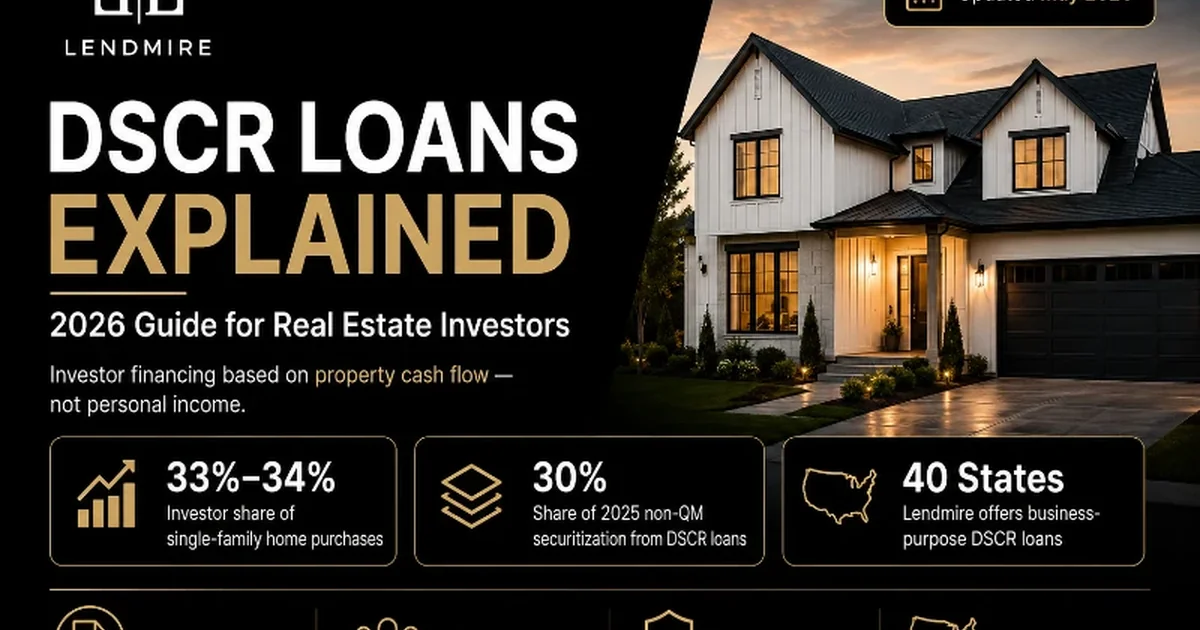
A comprehensive reference on debt-service-coverage ratio (DSCR) loans — how they work, how to qualify, how they compare to conventional mortgages, and how Lendmire helps real estate investors finance rental properties across 41 markets, including Washington, D.C.
Last updated: May 2026 · Published by Lendmire LLC (NMLS# 2371349)
DSCR Calculator
Run the numbers in your market
Rate source: Freddie Mac 30-yr average via FRED® — Federal Reserve Bank of St. Louis · effective Jul 30, 2026
Program parameters update from Lendmire’s centralized guideline source. Taxes and insurance are editable estimates.
As of Jul 30, 2026 · General Freddie Mac market benchmark, not a Lendmire loan offer. Rent, nightly rate, occupancy, taxes, and insurance are editable estimates. Short-term rental figures are estimates only and vary significantly by season, property type, management approach, and local short-term-rental rules — confirm local regulations before relying on them. Qualifying income for short-term rentals varies by program — some use appraisal market rent, others use documented STR history or projections — and is confirmed in underwriting. Not a Loan Estimate, approval, or commitment to lend. Program availability and eligibility are subject to lender guidelines, credit approval, property review, and underwriting.
Why This Guide Matters Right Now
Real estate investors purchased between 33% and 34% of all single-family homes sold in the United States in 2025 — the highest investor share in five years, according to the Q2 and Q3 2025 BatchData Investor Pulse Reports. Behind that shift, debt-service-coverage ratio (DSCR) loans have moved from a niche product to one of the fastest-growing segments of the U.S. mortgage market. Non-QM securitization volume reached a record high in 2025, with DSCR loans representing roughly 30% of that activity, according to HousingWire.
If you’re a real estate investor evaluating financing options in 2026, DSCR loans are likely the most relevant product on the market — and yet they remain widely misunderstood. This guide covers what DSCR loans are, how they’re calculated, how they compare to conventional mortgages, who they’re built for, and how to qualify. It’s written by Lendmire, a non-QM mortgage brokerage that specializes in DSCR lending for real estate investors and offers business-purpose DSCR loans across 41 markets, including Washington, D.C.
What Is a DSCR Loan?
A debt-service-coverage ratio (DSCR) loan is a type of non-qualified mortgage (non-QM) that qualifies borrowers based on the rental cash flow of an investment property — not the borrower’s personal income, tax returns, or W-2 documentation. DSCR loans are also classified as business-purpose loans under federal lending regulations, meaning they are exempt from many of the consumer-lending rules (including the SAFE Act’s mortgage loan originator licensing requirements) that apply to owner-occupied home loans.
In a conventional mortgage, a lender evaluates whether the borrower can afford the loan by analyzing personal income, W-2s, tax returns, debt-to-income ratio, and employment history. In a DSCR loan, the lender evaluates whether the property can afford the loan by analyzing its projected rental income against its proposed mortgage payment. The borrower’s personal income is largely irrelevant.
This structural difference is what makes DSCR loans the financing product of choice for serious real estate investors. Conventional mortgages typically limit borrowers to 6–10 financed properties through Fannie Mae and Freddie Mac. DSCR loans have no portfolio cap. Self-employed investors who write off most of their income on tax returns — and would not qualify under traditional underwriting — can qualify for a DSCR loan if the property’s rent supports the debt service.
DSCR loans are designed exclusively for investment properties. They are not available for primary residences. The investment-only requirement is what makes them business-purpose loans and what allows them to operate under a different regulatory framework than consumer mortgages.
How DSCR Is Calculated
The debt-service-coverage ratio is calculated by dividing a property’s gross rental income by its annual mortgage debt service:
DSCR = Gross Rental Income ÷ Annual Debt Service (PITIA)
Where PITIA is Principal + Interest + Taxes + Insurance + Association dues (HOA, if applicable).
Worked Example (Illustrative)
The figures below are hypothetical and provided to illustrate how DSCR is calculated. They do not represent a loan offer or actual program terms.
Consider a single-family rental property with the following profile:
- Monthly rent: $2,200
- Assumed monthly mortgage payment (PITIA): $1,760
Annual rent: $2,200 × 12 = $26,400 Assumed annual debt service: $1,760 × 12 = $21,120 DSCR: $26,400 ÷ $21,120 = 1.25.
A DSCR of 1.25 means the property generates 25% more income than its debt service costs. This is generally considered a strong DSCR.
DSCR Thresholds
- DSCR below 1.0: The property does not generate enough rent to cover the mortgage. Most lenders will not finance below 1.0, though some specialty programs accept ratios as low as 0.75 with compensating factors and lower LTV.
- DSCR of 1.0: Break-even. The property’s rent exactly covers the debt service. Available with most lenders.
- DSCR of 1.25: Generally considered strong. Borrowers typically qualify for the strongest DSCR loan pricing tiers at 1.25 or above.
- DSCR of 1.5 or higher: Excellent. Often unlocks the most favorable LTV and program structures.
The specific DSCR thresholds vary by wholesale lender. Lendmire shops each scenario across its wholesale lender network to identify the program that best fits the borrower’s DSCR profile.
Key DSCR Terms Defined
Debt-Service-Coverage Ratio (DSCR): The ratio of a property’s gross rental income to its annual debt service (PITIA). Used to determine whether the property’s cash flow can support the proposed mortgage.
DSCR Loan: A non-QM mortgage that qualifies borrowers based on property cash flow rather than personal income. Used for investment properties only.
Non-QM (Non-Qualified Mortgage): A loan that does not meet the Consumer Financial Protection Bureau’s Qualified Mortgage standards, typically because it uses alternative documentation or qualification methods. Non-QM includes DSCR loans, bank statement loans, asset-based loans, and other specialty products.
Business-Purpose Loan: Financing extended for investment, business, or commercial purposes rather than personal/consumer use. Business-purpose loans are exempt from many consumer-lending regulations including the SAFE Act’s mortgage loan originator licensing requirements. Because DSCR loans are made on investment properties, they qualify as business-purpose loans.
1007 Rent Schedule: The Fannie Mae appraisal form used to project market rent for a 1-unit single-family rental property. The 1007 is the standard rent-projection document for DSCR loans on single-family rentals.
1025 Operating Income Statement: The Fannie Mae appraisal form used for 2–4 unit rental properties.
LTR DSCR Loan: Long-term rental DSCR loan. Qualifies the property using either a market-rent appraisal (1007) or an active lease agreement.
STR DSCR Loan: Short-term rental DSCR loan. Qualifies the property using AirDNA revenue projections or historical short-term rental income for Airbnb, VRBO, and similar vacation rental properties.
LTV (Loan-to-Value): The loan amount divided by the property’s appraised value. Most DSCR loans fund up to 75–80% LTV, with some programs going up to 85% for highly qualified borrowers.
AirDNA: An industry-standard data platform that projects short-term rental revenue based on comparable property performance. Used to qualify STR DSCR loans where no historical rental data exists.
Cash-Out Refinance: A refinance in which the new loan amount exceeds the existing loan balance, with the difference paid to the borrower in cash. DSCR cash-out refinances let investors extract equity from rental properties without proving personal income.
DSCR Loans vs Conventional Mortgages
For a deeper side-by-side, see Lendmire’s DSCR vs Conventional Investment Loan comparison. The table below summarizes the structural differences.
| Feature | DSCR Loan | Conventional Mortgage |
|---|---|---|
| Qualification basis | Property rental cash flow | Borrower personal income |
| Documentation | Lease, rent roll, or AirDNA projection; appraisal with 1007 or 1025 | Tax returns, W-2s, pay stubs, employment verification, DTI calculation |
| Property type | Investment properties only (1–4 unit residential and small multifamily) | Primary residence, second home, or investment |
| Property limit | No portfolio cap | Typically 6–10 financed properties via Fannie/Freddie |
| Borrower entity | Often closed in an LLC or business entity (subject to lender program eligibility) | Usually requires personal name (some lenders allow entity) |
| Licensing | Business-purpose loan; SAFE Act exempt | Consumer mortgage; requires state MLO licensing |
| Personal income required? | No | Yes |
| Typical close timeline | 21–30 days; as few as 15 days on clean scenarios | 30–45 days, often longer |
| Best use case | Scaling a rental portfolio; self-employed investors; entity ownership; bypassing portfolio caps | Primary residence financing; first 1–10 investment properties for W-2 borrowers |
The two products serve different purposes. Conventional mortgages remain the right tool for primary residence financing and the first few investment properties for borrowers with strong W-2 income. DSCR loans become the right tool the moment an investor begins scaling beyond conventional limits, prefers entity ownership, or generates most income from self-employment or rental activity itself.
Who DSCR Loans Are Built For
DSCR loans serve a specific borrower profile. The most common Lendmire borrowers include:
- Buy-and-hold real estate investors building long-term rental portfolios across single-family and small multifamily properties.
- Short-term rental and Airbnb operators acquiring vacation rentals, urban STRs, and resort-area properties where AirDNA revenue projections support qualification.
- Investors expanding beyond conventional limits, who have reached the Fannie/Freddie cap of 6–10 financed properties and need an alternative financing path.
- Self-employed real estate professionals whose tax returns reflect significant write-offs and do not support conventional underwriting, even though their cash flow is strong.
- LLC and entity-owned investment property buyers who prefer to hold properties in business entities for liability protection, tax structuring, or partnership ownership (subject to lender program eligibility).
- 1031 exchange buyers needing predictable, fast-closing financing to meet the 45-day identification and 180-day closing windows.
- Investors in secondary and tertiary markets acquiring lower-priced rental properties (often $80,000–$200,000) where many DSCR lenders enforce loan-amount minimums that exclude these properties. Lendmire accommodates smaller DSCR loan amounts that many lenders will not consider.
Property Types Eligible for DSCR Financing
DSCR financing is available across the residential investment property spectrum:
- Single-family rentals (SFRs) — long-term rentals qualified via 1007 rent schedule or active lease.
- 2–4 unit small multifamily — duplex, triplex, fourplex; qualified via 1025 operating income statement or rent rolls.
- Short-term rentals — Airbnb, VRBO, and similar properties; qualified via AirDNA projections or historical platform revenue.
- Condominiums — both warrantable and non-warrantable condos, subject to program eligibility.
- Townhomes and PUDs — qualified the same as SFRs.
- Small-balance multifamily (5+ units) — qualified using commercial-style cash-flow analysis.
Property condition, location, and rental potential all factor into DSCR loan eligibility. Properties must generally be rent-ready or near rent-ready; full rehab projects typically require a separate fix-and-flip or construction product before refinancing into a long-term DSCR loan.
How DSCR Loan Qualification Works at Lendmire
The Lendmire DSCR loan process typically follows five steps:
1. Property identification and rent estimation. The borrower identifies a target property. Lendmire estimates the property’s rental income using a current lease, rent roll, market-rent projection, or AirDNA report (for short-term rentals).
2. DSCR calculation. Lendmire calculates the proposed DSCR by dividing projected gross rental income by the expected annual debt service (PITIA).
3. Lender selection. Lendmire shops the scenario across its wholesale lender network spanning long-term and short-term rental DSCR programs. The firm identifies the specific lender, product structure, and program tier that best fits the borrower’s DSCR, LTV, credit profile, and property type.
4. Appraisal and documentation. The property is appraised using the appropriate form: the 1007 rent schedule for single-family rentals, the 1025 operating income statement for 2–4 unit rentals, or a commercial-style cash-flow analysis for small-balance multifamily.
5. Underwriting, lock, and close. The selected lender underwrites the loan and the loan closes — often in 21–30 days, with some scenarios closing in as few as 15 days subject to program eligibility.
Borrowers do not provide personal tax returns, W-2s, or pay stubs as part of DSCR loan qualification. Credit score, asset reserves, and property profile drive the underwriting decision. Investors evaluating a specific property can request a scenario quote or reach Lendmire at 828-256-2183 for a direct conversation.
Common DSCR Loan Structures and Terms
DSCR loans are available in a range of term structures designed to fit different investor strategies:
- 30-year fixed-rate DSCR loan — most common; predictable payment for the life of the loan.
- 5/6, 7/6, and 10/6 ARMs — adjustable-rate structures with an initial fixed period followed by semi-annual adjustments. Typically priced below the 30-year fixed.
- Interest-only DSCR loans — typically a 10-year interest-only period followed by 20-year amortization. Lowers monthly payment to improve DSCR but does not pay down principal during the IO period.
- DSCR cash-out refinance — extracts equity from an existing rental without proving personal income.
- DSCR rate-and-term refinance, DSCR purchase loans, and 1031-exchange-compatible structures.
Typical loan-to-value (LTV) ranges from 70% to 80% for most programs, with premium-credit borrowers occasionally reaching 85% LTV on select scenarios. Down payments of 20–25% are most common, though some programs accommodate 15% down on highly qualified borrower profiles.
The specific structure, LTV, and program parameters that fit each scenario depend on the borrower’s DSCR profile, credit, property type, and entity structure. Lendmire shops each scenario across its wholesale lender network to identify the best-fit program. Contact Lendmire for scenario-specific eligibility review.
2026 DSCR & Non-QM Market Statistics
Key data points on the current state of the DSCR and non-QM market:
- 33–34% — Real estate investor share of single-family home purchases in Q2 and Q3 2025, the highest in five years (BatchData Investor Pulse Reports, Q2 and Q3 2025)
- 30% — Investor share of all single-family home purchases for full-year 2025, up from 29% in 2024 (Cotality Q4 2025 Home Investor Report)
- 80,000–100,000 — Investor single-family home purchases per month in late 2025 (Cotality Q4 2025 Home Investor Report)
- 87% — Share of investor-owned single-family rentals held by investors owning 1–5 properties (BatchData)
- 2% — Share held by institutional investors owning 1,000+ properties (BatchData)
- 6 consecutive quarters — Number of quarters institutional investors have been net sellers of single-family homes (BatchData)
- 30% — DSCR loans as a share of total 2025 non-QM securitization activity (HousingWire)
- 5.21% → 8.0% — Growth of non-QM loans as a share of all U.S. mortgages from July 2024 to July 2025 (National Mortgage Professional)
- 28.7% — Investor and DSCR loan share of non-QM volume as of July 2025, up 2.79 percentage points year-over-year (National Mortgage Professional)
Hypothetical Borrower Scenarios
The following scenarios illustrate how DSCR loans work in practice. These are hypothetical examples for educational purposes only and do not represent actual transactions, loan offers, or program terms.
Scenario 1: Buy-and-Hold Investor
An investor purchases a $215,000 single-family rental property in Columbus, Ohio with $1,950/month projected market rent based on the 1007 rent schedule. With a 75% LTV loan structure, the property’s projected rental income generates a DSCR comfortably above the 1.25 threshold most lenders consider strong. The investor qualifies through Lendmire’s long-term rental DSCR program without providing tax returns or W-2s, closes in an LLC for liability protection (subject to lender program eligibility), and adds the property to a portfolio that already includes seven conventionally financed rentals — properties that previously capped further conventional financing.
Scenario 2: Short-Term Rental Investor
An operator acquires a $475,000 mountain-area vacation home in Western North Carolina to operate as a short-term rental. The property has no rental history. An AirDNA market analysis projects $58,000 in annual gross revenue based on comparable nearby STR properties. At 75% LTV, the projected DSCR comfortably exceeds the 1.25 threshold thanks to strong AirDNA-projected revenue. The borrower qualifies through Lendmire’s STR DSCR program using AirDNA projections in place of historical income. Closing takes approximately 25 days.
Scenario 3: Portfolio Expansion
A self-employed investor has reached the conventional financing cap at 10 financed properties through Fannie Mae and Freddie Mac. Tax returns show low taxable income due to depreciation and business write-offs, even though monthly cash flow is strong. The investor identifies an 11th property — a $185,000 single-family rental in Memphis, Tennessee with $1,725/month projected rent. Conventional qualification is no longer possible. The investor qualifies through Lendmire’s long-term rental DSCR program based on the property’s projected rental income exceeding the standard DSCR threshold, closes in an LLC (subject to lender program eligibility), and continues scaling without portfolio limits.
States Where Lendmire Offers DSCR Loans
Lendmire offers business-purpose DSCR loans across 41 markets, including Washington, D.C., serving real estate investors across the major U.S. investor markets including Texas, Florida, Georgia, the Carolinas, Tennessee, Ohio, Indiana, Pennsylvania, Alabama, Kentucky, Missouri, and others. The firm is headquartered in Boone, North Carolina (Watauga County, in the Appalachian region of Western North Carolina). Because DSCR loans are business-purpose loans exempt from the SAFE Act’s mortgage loan originator licensing requirements, Lendmire’s 40-state-plus-D.C.
Why Choose a DSCR Specialist Like Lendmire
Many mortgage brokers offer DSCR loans as one product among many. Lendmire is organized specifically around DSCR specialization. The practical implication for investors is meaningful.
A single retail lender can only offer what its own credit box allows. A specialized DSCR broker like Lendmire can shop the same scenario across dozens of wholesale programs and find the structure that actually fits the borrower’s strategy. The right lender for one DSCR scenario is rarely the right lender for the next. Property type, DSCR ratio, LTV, borrower entity, geographic location, and credit profile all interact to determine which lender will produce the best execution — and that determination requires deep program knowledge across the entire wholesale DSCR market.
Lendmire’s specific advantages include:
- Wholesale lender network spanning both long-term rental and short-term rental DSCR programs, recently expanded to broaden program structures, qualification methods, and program tiers.
- Multiple qualification methodologies — AirDNA-based revenue projections, lease and rent-roll qualification, the 1007 rent schedule, the 1025 operating income statement, and commercial-style cash-flow analyses for multifamily.
- One of the most comprehensive independent appraiser networks in the United States — a meaningful structural advantage in DSCR transactions, where the accuracy of rental comparables can materially affect both loan approval and final terms.
- Smaller DSCR loan amounts accommodated — Lendmire serves investors in secondary and tertiary markets where rental properties trade at $80,000–$200,000, a price range many large DSCR lenders will not consider.
- Entity and LLC closings supported across all DSCR programs (subject to lender program eligibility).
- Fast close timelines — typically 21–30 days, with some scenarios closing in as few as 15 days subject to program eligibility.
Frequently Asked Questions
What is a DSCR loan in simple terms?
A DSCR loan is a mortgage for an investment property that’s approved based on the property’s rental income, not the borrower’s personal income. You don’t need to provide tax returns, W-2s, or pay stubs. The lender looks at how much rent the property generates compared to the mortgage payment and approves the loan if the math works.
What credit score do I need for a DSCR loan?
Most DSCR programs require a minimum credit score in the 660–680 range, though some programs accept scores as low as 620 with stronger compensating factors (higher DSCR, lower LTV, larger reserves). Lendmire works with multiple wholesale programs across the credit spectrum.
Can I get a DSCR loan with no income?
Yes. DSCR loans do not require personal income documentation. You do not need to provide tax returns, W-2s, pay stubs, or any verification of personal income. The property’s projected rental income is what qualifies the loan. Borrowers must still demonstrate adequate credit and asset reserves.
Can I put a DSCR loan in an LLC?
Yes. DSCR loans are commonly closed in LLCs and other business entities, subject to lender program eligibility. This is one of the structural advantages over conventional mortgages, which typically require personal-name ownership. Closing in an LLC provides liability protection and supports partnership ownership structures.
How much down payment do I need for a DSCR loan?
Most DSCR loans typically require 20–25% down (i.e., 75–80% LTV). Some programs accommodate 15% down on highly qualified borrower profiles. Down payment requirements vary by DSCR ratio, credit score, property type, and lender program.
What’s the minimum DSCR to qualify?
Most lenders require a minimum DSCR of 1.0 (property income equals debt service). Some specialty programs accept DSCR ratios as low as 0.75 with compensating factors such as lower LTV and higher credit. A DSCR of 1.25 or higher generally unlocks the strongest program eligibility.
Are DSCR loans only for single-family rentals?
No. DSCR loans are available for single-family rentals, 2–4 unit small multifamily, condominiums, townhomes, short-term rentals (including Airbnb and VRBO), and small-balance multifamily of 5+ units. Each property type uses a slightly different appraisal and qualification approach.
How long does a DSCR loan take to close?
Most DSCR loans close in 21–30 days. Some scenarios — clean borrower profile, ready appraisal, no condition issues — can close in as few as 15 days subject to program eligibility. Complex scenarios, multifamily properties, or properties requiring extensive appraisal review may take 30–45 days.
Can I refinance my existing rental property with a DSCR loan?
Yes. DSCR refinance and DSCR cash-out refinance are widely available. Many investors use DSCR cash-out refinances to extract equity from existing rentals without proving personal income, then redeploy that capital into additional rental property acquisitions. For broader investment property refinance scenarios — including rate-and-term refinances and refinances out of hard-money bridge loans — Lendmire’s wholesale program access spans the full investor-refinance market.
What’s the difference between long-term rental and short-term rental DSCR loans?
Long-term rental (LTR) DSCR loans qualify the property using either an active lease or a market-rent appraisal (1007 rent schedule). Short-term rental (STR) DSCR loans qualify the property using AirDNA revenue projections or historical short-term rental income. STR programs typically apply stricter eligibility because short-term rental income is considered more variable than long-term lease income.
Can foreign nationals get DSCR loans?
Some DSCR programs accept foreign national borrowers, typically requiring larger down payments, U.S.-based asset reserves, and additional documentation, each set by the program. Foreign national DSCR loans are a specialty product offered through select wholesale lenders.
Are DSCR loans regulated like conventional mortgages?
DSCR loans are business-purpose loans for investment properties, which means they are exempt from many of the consumer-lending rules that govern conventional mortgages, including the SAFE Act’s mortgage loan originator licensing requirements. They are still subject to state-level lending regulations, fair lending laws, and standard underwriting oversight.
How is Lendmire different from a retail mortgage lender?
Retail lenders can only offer what their own internal credit box allows. Lendmire is an independent mortgage brokerage that shops each DSCR scenario across dozens of wholesale lender programs to identify the lender, product structure, and program tier that best fits the borrower’s strategy. A specialized DSCR broker can access program structures that a single retail lender cannot.
About Lendmire
Lendmire LLC (NMLS# 2371349 / 1129696) is a non-QM mortgage brokerage headquartered in Boone, North Carolina, specializing in debt-service-coverage ratio (DSCR) loans for real estate investors, who holds mortgage originator licenses in 16 states for consumer mortgage transactions, the firm offers business-purpose DSCR loans across 41 markets, including Washington, D.C. Lendmire is one of a small number of independent mortgage brokerages organized specifically around DSCR specialization rather than offering DSCR as one product among many. Scotsman Guide named Lendmire a Top Mortgage Workplace in both 2025 and 2026.
Sources Referenced
- BatchData Q2 2025 Investor Pulse Report (PR Newswire)
- BatchData Q3 2025 Investor Pulse Report (National Mortgage Professional)
- Cotality Home Investor Report Q4 2025 (National Mortgage Professional)
- HousingWire — Why DSCR demand ramped up in 2025 and will continue into 2026
- National Mortgage Professional — Non-Conforming Loans Surge, Led by Record Non-QM Share
Get Started
Ready to find the right loan for you?
In about 30 seconds you can review financing options available for your home or investment property. No commitment required.
Informational only. Not a Loan Estimate, approval, or commitment to lend. Program availability and eligibility are subject to lender guidelines, credit approval, property review, and underwriting.
References
1. Freddie Mac 30-yr average via FRED® — Federal Reserve Bank of St. Louis
2. BatchData Q2 2025 Investor Pulse Report (PR Newswire)
3. BatchData Q3 2025 Investor Pulse Report (National Mortgage Professional)
4. Cotality Home Investor Report Q4 2025 (National Mortgage Professional)
5. HousingWire — Why DSCR demand ramped up in 2025 and will continue into 2026
6. National Mortgage Professional — Non-Conforming Loans Surge, Led by Record Non-QM Share
This article is part of Lendmire’s DSCR loan program — full qualification details, guidelines, and scenarios live on the program page.
Related reading: DSCR Loan Vs Traditional Mortgage: Which Fits Investors? · Best Lender To Refinance Investment Property · How To Compare No Tax Return HELOC Offers From Different Lenders?
Brandon Miller
Founder & CEO, Mortgage Loan Originator, Lendmire LLC
- Mortgage Loan Originator · NMLS# 1129696 · Verify on NMLS Consumer Access
- North Carolina Real Estate Broker · License# 343312 · Verify on NCREC
- North Carolina Insurance Producer · License# 19053198 · Property, Casualty, Life, Health · Verify on NAIC SBS
- Lendmire LLC · Firm NMLS# 2371349 · Verify firm licensure
Disclosure information. Lendmire is a state-licensed mortgage brokerage under NMLS# 2371349. Lendmire is not a depository institution, direct lender, or financial advisor — all loans referenced are placed through wholesale lender partners and are subject to each lender's underwriting standards. This article is provided for general informational purposes and is not a commitment to lend, nor does it constitute financial, legal, or tax advice. Loan programs, terms, rates, and qualification standards change without notice and depend on borrower profile, property type, and the state in which the subject property is located. Equal Housing Opportunity provider. NMLS Consumer Access: nmlsconsumeraccess.org.