
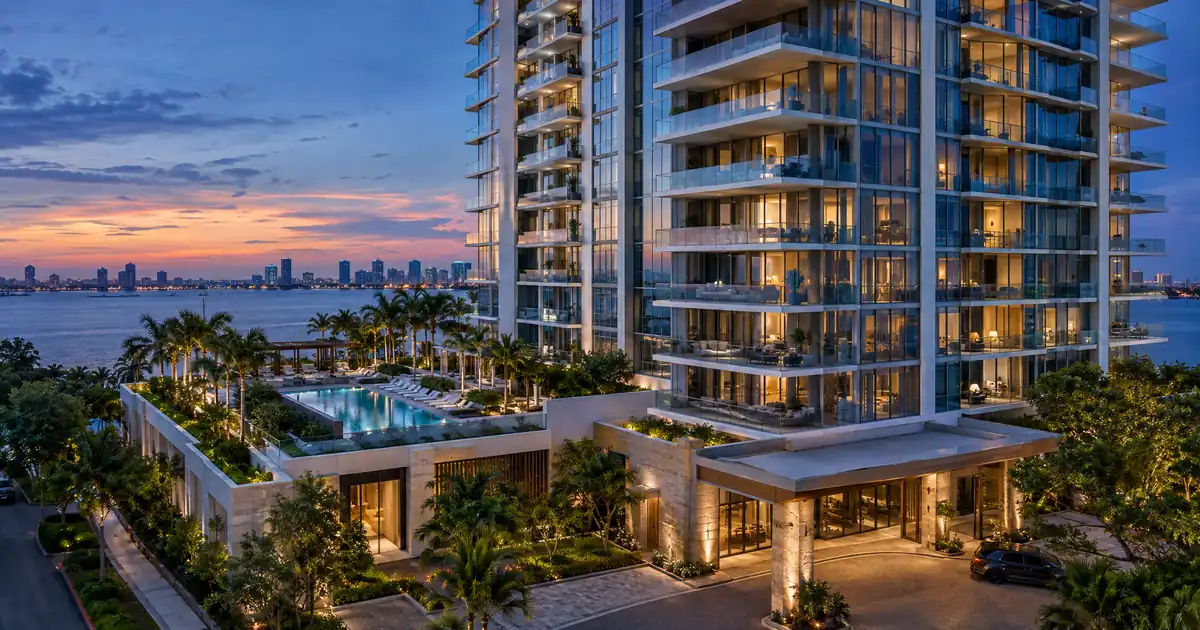
Condotel Be Financed With A Super Jumbo — The Quick Read: Yes, a condotel can be financed with a super jumbo bank statement loan through select lenders in a wholesale network, but the property type sets the leverage ceiling — not the loan size. On these programs, expect roughly 75% loan-to-value on a purchase and 65% on cash-out through the portfolio program, or around 50% through the twelve-month bank statement program that carries files to $30,000,000. The bank statement income calculation and the “super jumbo” loan-size tier are two separate underwriting questions, and the condotel classification is a third question layered on top of both.
Investors chasing waterfront or resort units often assume that once their bank statements qualify them for a large loan, the building type is a formality. It isn’t. Below is how the three variables — property type, documentation method, and loan size — actually interact, and where each one bites.
Key Terms Defined
Condotel — a condo unit inside a building that also operates like a hotel, often with a front desk, a rental management pool, and short-term nightly bookings mixed in with owner use.
Bank statement loan — a mortgage that qualifies income from deposit history on personal or business bank statements instead of traditional personal-income documentation, used mainly by self-employed borrowers whose returns understate real cash flow.
Super jumbo — a lender-defined loan-size tier well above the standard jumbo threshold; no regulator draws this line, so where it starts varies by lender.
Loan-to-value (LTV) — the loan amount expressed as a percentage of the property’s appraised value or purchase price, whichever is lower.
Non-QM — short for non-Qualified Mortgage, meaning the loan doesn’t fit the government’s standardized documentation box and runs instead on private investor guidelines.
Case-by-case review — a manual underwriting step, common above roughly $4,000,000, where a file is evaluated on its individual merits before it moves forward, rather than approved off a published leverage grid.
Why Standard Underwriting Won’t Touch a Condotel
Agency financing is off the table here, full stop. Fannie Mae’s own selling guide states plainly that Fannie Mae does not purchase or securitize mortgages on units in condo or co-op hotels, and the ineligible-projects criteria flag any project that is primarily transient in nature as falling under that exclusion. That rule has nothing to do with how the borrower documents income — it disqualifies the building itself.
This is why condotel purchases almost always route into portfolio and non-QM lending. Say a borrower has excellent bank statement income and a strong credit profile. Even then, they can’t use a conventional pipeline if the subject property is a condotel. The property type closes that door before income documentation even enters the conversation.
The Three Questions That Actually Decide the File
Every condotel file gets sorted along three separate axes, and mixing them up is where borrowers get bad expectations.
- What is the property? Warrantable condo, non-warrantable condo, or condotel — this sets the leverage ceiling before anyone looks at income.
- How is income documented? Bank statements, asset-based, or a profit-and-loss method — this is a documentation choice, not a loan-size category.
- How big is the loan? Loan size determines whether the file even qualifies for agency purchase and, separately, which internal size band it falls into once it’s non-QM.
A condotel purchase can clear the documentation test easily and still be capped hard by the property test. That’s the part borrowers miss most often.
How the Super Jumbo Ladder Works
Through select lenders in Lendmire’s wholesale network, super jumbo bank statement loans run from $300,000 to $30,000,000 across two separate programs. A portfolio non-QM program carries files to roughly $6,000,000, and a separate bank portfolio program uses twelve consecutive months of bank statements to carry files all the way to $30,000,000 on its own size-based ladder.
| Loan Size Band | Program | Best-Tier LTV Ceiling | Interest-Only |
|---|---|---|---|
| $300K – $4M | Portfolio non-QM | Slides from roughly 90% down to 75%, by size and occupancy | Up to 85% LTV, 700 credit floor |
| $4M – $6M | Portfolio non-QM | Case-by-case review | Case-by-case |
| Up to $5M | Bank portfolio program | 65% | Capped at 55% LTV |
| $5M – $10M | Bank portfolio program | 60% | Capped at 55% LTV |
| $10M – $30M (on review, case by case) | Bank portfolio program | 55% | Capped at 55% LTV |
That ladder describes leverage for eligible property types generally. A condotel doesn’t get to use it.
Property Type Sets the Ceiling — Not Loan Size
Here’s the part that surprises most borrowers: a condotel’s leverage ceiling doesn’t slide down gradually with loan size the way the general ladder does. It’s a flat property-type cap that sits underneath the size ladder and usually governs instead of it.
On the portfolio program, condotels typically max out around 75% loan-to-value on a purchase and 65% on cash-out. On the bank statement program that carries files to $30,000,000, that ceiling drops further, to roughly 50%. So a $3,000,000 condotel purchase doesn’t get the 75-80% leverage a comparable warrantable condo might see at that price point — it gets whatever the condotel ceiling allows, even if the borrower’s income and credit would otherwise support more.
Say an investor is eyeing a $2,400,000 beachfront condotel unit as an investment property. Even with strong twelve-month bank statement deposits and a 720 credit score, the file gets sized against the condotel ceiling — roughly 75% on the purchase side through the portfolio program — rather than the general investment-property ladder that would otherwise apply to a warrantable condo at that price. The extra down payment isn’t a documentation penalty. It’s a property penalty. Exact terms depend on the lender’s guidelines, property type, leverage, and a full review of the borrower’s file.
Documentation: What Counts as Income
Bank statement qualification uses 12 or 24 consecutive months of personal or business deposits. Lenders run these through an expense ratio to get a qualifying income figure. For business accounts, the borrower needs at least 25% ownership before those deposits count. Transfers from the borrower’s own business into a personal account count at 100%. Expense ratios typically run 20% for a service business with no employees, 40% for a small team, or 50% for larger or product-based businesses. An accountant letter or a profit-and-loss method can sometimes support a different figure.
None of that changes because the subject property is a condotel. What changes is what the appraiser is allowed to use for rental income analysis if the file leans on projected rent at all. Fannie Mae’s own appraisal guidance for the standard rent schedule form is explicit that nightly short-term rates can’t simply be multiplied out to estimate a monthly figure — the appraiser has to analyze comparable monthly leases instead. That distinction matters less for a bank statement file, where income comes from the borrower’s deposits rather than the subject property’s projected rent, but it’s worth knowing if the same investor is comparing this path against DSCR financing, where rental income drives lender review.
Credit floors sit at 660 on the portfolio program and 680 on the bank program, stepping up to 700 above the super-jumbo size line. Reserve requirements run 3 months on smaller balances, 6 months up to $1,500,000, and 9 months above that, with 2 extra months for each additional financed property. Every figure here varies by lender and program — guidelines, property type, leverage, and credit profile all apply.
Where Case-By-Case Review Kicks In
Above roughly $4,000,000, every file gets a manual, case-by-case review before submission. This applies whether it’s a condotel or not. Overlays tighten a lot at that point. Lenders require a 700 credit floor. They also require seasoning on any past credit event. Borrowers must be U.S. citizens or permanent residents. Non-occupant co-borrowers aren’t allowed. And cash-out proceeds can’t be used to meet reserve requirements. A condotel purchase above this threshold isn’t automatically turned away. But it needs a cleaner file across the board to get serious consideration. Final terms depend on lender guidelines, property type, leverage, and the borrower’s full credit picture.
Cash-out is its own conversation on a condotel. Above 60% LTV, the portfolio program caps cash-in-hand at $1,500,000; the bank statement program publishes no comparable cap but applies its own lower condotel ceiling instead. These specifics are subject to lender guidelines and a full review of property, leverage, and credit.
Asset-Based and DSCR Alternatives Worth Knowing
Some borrowers don’t have clean bank statement deposits. For them, an asset-allowance path divides liquid assets by 36, 60, or 84 months, depending on debt-to-income and loan size. But this route tops out at 80% LTV. It only applies to primary residences and second homes, not investment property. It’s a documentation alternative, not a way around condotel rules — the same property ceiling still applies. Terms vary by lender guidelines, property type, leverage, credit profile, and full file review.
Some investors buy a condotel purely as a rental. For them, DSCR financing is often the better fit than a personal bank statement loan. DSCR loans qualify mainly on the property’s rental income covering the payment, subject to lender guidelines, rather than on the borrower’s bank statements. It’s worth comparing DSCR financing against a bank statement approach directly before choosing a path. The qualifying logic and the leverage math differ between the two. Lendmire’s complete DSCR loans guide walks through how that rental-income review actually works. Short-term rental rules can vary by city, county, HOA, and property type. So investors should confirm local rules before relying on projected rental income either way.
DSCR loans are business-purpose products. They’re made for non-owner-occupied investment property. Lenders review them as investor loans, not owner-occupied mortgages. So the underwriting path looks different from the personal bank statement file described above. Want a full comparison of condotel eligibility under both paths? See how a condo or condotel qualifies for a super jumbo loan.
This network offers consumer bank statement lending in 16 states. These are: Alabama, California, Colorado, Florida, Georgia, Indiana, Michigan, Montana, New Mexico, North Carolina, Ohio, Pennsylvania, Tennessee, Texas, Virginia, and Washington. Availability, terms, and eligibility depend on the borrower, the property, and current lender guidelines. Nothing here is a commitment to lend.
Tax treatment can depend on how the funds are used and how the property is held; investors should keep clear records and speak with a qualified tax professional before relying on any deduction.
Frequently Asked Questions
Does a higher credit score offset a condotel’s lower leverage cap? Not really. Credit tier moves a borrower between rows on the general size ladder, but the condotel property ceiling — roughly 75% purchase and 65% cash-out on the portfolio program, or around 50% on the bank program — sits underneath that ladder and typically governs regardless of credit strength.
Can the same condotel unit qualify through both the portfolio program and the bank statement program? Potentially, and it’s worth comparing both, since the ceilings differ meaningfully. The portfolio program’s roughly 75%/65% condotel caps are generally more generous than the bank program’s roughly 50% ceiling, though the bank program can carry a much larger loan amount out to $30,000,000.
Is a building automatically exempt from condotel treatment if the HOA doesn’t call it one? No. Heavy short-term rental activity and a public booking presence can pull a building into condotel-style review even without that label attached, so the underlying operating structure matters more than the marketing name.
What happens if the loan amount and the condotel status both push into case-by-case territory? The file gets a fuller manual review rather than an automatic decline. Above roughly $4,000,000, tighter overlays apply on top of the condotel property ceiling, so documentation, reserves, and credit history all need to be stronger to get a serious look.
Does cash-out work differently on a condotel than on a standard condo? Yes. Cash-out on a condotel typically caps around 65% LTV on the portfolio program, versus higher ceilings available on warrantable condos, and cash-in-hand above 60% LTV is capped at $1,500,000 on that program regardless of property type.
If you’re weighing a condotel purchase against a comparable rental-property loan, Lendmire can help compare bank statement and DSCR options side by side based on the property, the documentation path, and the leverage that fits the deal.
Self-employed borrowers can compare both super jumbo programs on Lendmire’s self-employed mortgages page.
About Lendmire
Lendmire is a DSCR-focused mortgage brokerage, NMLS# 2371349, placing investor loans across 40 markets, including Washington, D.C. DSCR eligibility is generally reviewed by the lender around a property’s rental income rather than personal income documentation, which fits LLC-held rentals, self-employed investors, and portfolios scaling past conventional financed-property limits. Scotsman Guide named Lendmire a Top Mortgage Workplace in both 2025 and 2026.
Get Started
Ready to find the right loan for you?
In about 30 seconds you can review financing options available for your home or investment property. No commitment required.
Informational only. Not a Loan Estimate, approval, or commitment to lend. Program availability and eligibility are subject to lender guidelines, credit approval, property review, and underwriting.
References
1. Fannie Mae Selling Guide — B2-3-01 General Property Eligibility
2. Fannie Mae — Ineligible Projects, Condo/Co-op Hotel Detail
Brandon Miller
Founder & CEO, Mortgage Loan Originator, Lendmire LLC
- Mortgage Loan Originator · NMLS# 1129696 · Verify on NMLS Consumer Access
- North Carolina Real Estate Broker · License# 343312 · Verify on NCREC
- North Carolina Insurance Producer · License# 19053198 · Property, Casualty, Life, Health · Verify on NAIC SBS
- Lendmire LLC · Firm NMLS# 2371349 · Verify firm licensure
Disclosure information. Lendmire is a state-licensed mortgage brokerage under NMLS# 2371349. Lendmire is not a depository institution, direct lender, or financial advisor — all loans referenced are placed through wholesale lender partners and are subject to each lender's underwriting standards. This article is provided for general informational purposes and is not a commitment to lend, nor does it constitute financial, legal, or tax advice. Loan programs, terms, rates, and qualification standards change without notice and depend on borrower profile, property type, and the state in which the subject property is located. Equal Housing Opportunity provider. NMLS Consumer Access: nmlsconsumeraccess.org.


