
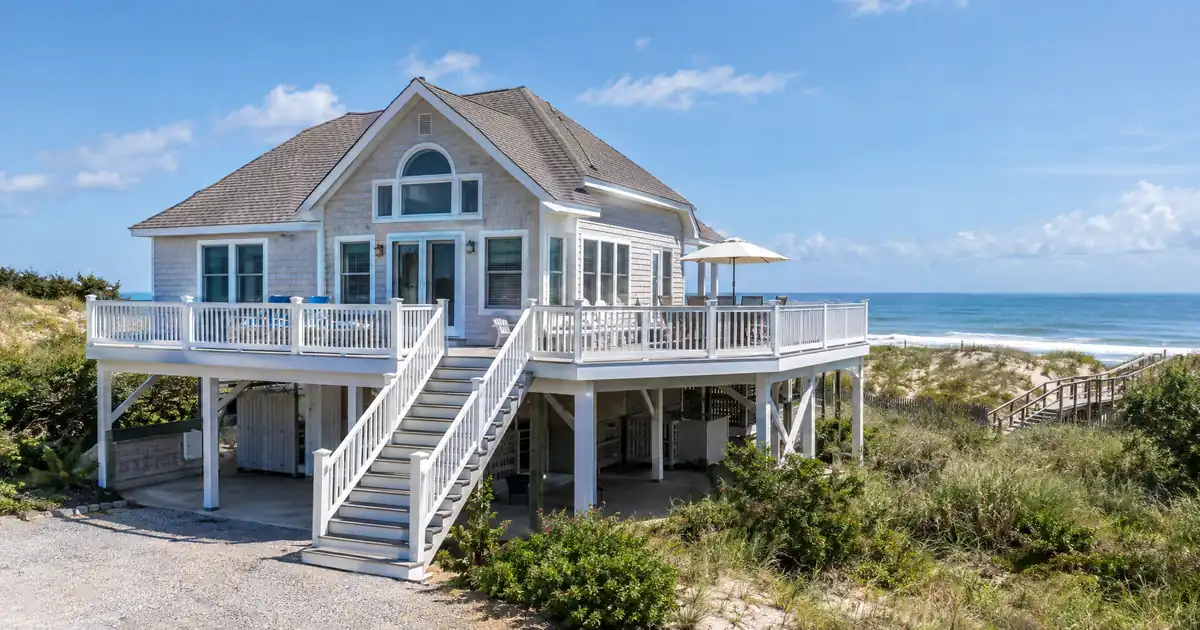
Vacation Home in Santa Rosa Beach — The Quick Read: Buying a vacation home in Santa Rosa Beach on bank statements means a lender is reviewed against your own deposit history — 12 or 24 months of personal or business statements — instead of traditional personal-income documentation. It works when you plan to use the property yourself and rent it only sometimes. If your real goal is running it as a short-term rental business, the property’s own income, not yours, should drive the file, which usually points toward a different loan type entirely.
Santa Rosa Beach sits inside Walton County, along Scenic Highway 30A. It draws a specific kind of buyer: self-employed professionals whose traditional personal-income documentation understate what they actually earn. That’s exactly the borrower bank statement underwriting was built for.
Key Takeaways
- A bank statement loan verifies your income, not the property’s rental income — that’s the core distinction to get right before you shop for financing.
- Lenders typically review 12 or 24 consecutive months of statements and apply an expense ratio to convert deposits into qualifying income.
- Leverage on a second home in the wholesale network varies with loan size and is subject to underwriting, so borrowers should expect the allowable amount to narrow as the loan grows larger.
- If the plan is to run the property as a short-term rental business rather than a personal getaway, DSCR financing — qualifying off the property’s rental income — is usually the better fit.
- Walton County requires a short-term vacation rental certificate for any property rented short-term, separate from how the mortgage was underwritten.
What “Buying on Bank Statements” Actually Means
A bank statement loan is a non-QM mortgage. This means it sits outside the standard conforming-loan box. It substitutes deposit history for the traditional personal-income documentation and W-2s a conventional lender wants. It’s a documentation method, not a property-income method.
This matters in Santa Rosa Beach specifically because the market attracts buyers whose income doesn’t fit neatly into a pay stub: business owners, consultants, real estate investors with several revenue streams. Their cash flow is often strong every month, but heavy write-offs shrink the taxable income on their returns. Bank statement underwriting looks past that number and asks a simpler question: what actually landed in the account?
The key thing to hold onto before going further — a bank statement loan is reviewed for the person buying the house. It doesn’t care what the house might earn as a rental. That’s a different loan entirely, and the two get confused constantly.
Key Terms Defined
Bank statement loan — a non-QM mortgage that uses 12 or 24 months of deposit history, instead of traditional income documentation, to establish qualifying income.
DSCR loan — a business-purpose loan that qualifies primarily on the property’s rental income covering the payment, subject to lender guidelines, rather than the borrower’s personal income.
Expense ratio — a percentage the underwriter subtracts from gross deposits to account for business costs before calculating qualifying income.
Second home — a property the borrower occupies part of the year for personal use, which cannot be tied to a rental-management agreement that controls occupancy.
Ownership stake — the percentage of a business a borrower must own for that business’s bank statements to count toward the loan file, typically around 25% on business accounts in the wholesale network.
Reserves — liquid funds a borrower must have left over after closing, measured in months of housing payment.
How Underwriting Treats the File, Step by Step
The mechanics are consistent across the wholesale network, even though every file gets underwritten on its own facts.
Step one — pick personal or business statements. Most programs in the network want either 12 or 24 consecutive months, personal or business accounts, never a mix that skips months. Transfers from the borrower’s own business into a personal account count in full, at 100%, which helps business owners who move money between accounts regularly.
Step two — apply the expense ratio. On business statements, deposits get reduced by a fixed ratio before they count as income: commonly 20% for a service business with no employees, 40% for a business with one to five employees, or 50% for a business with six or more employees or any business selling a product. An accountant-prepared ratio, or a profit-and-loss method capped at 80%, is available where it fits the borrower’s file better.
Step three — confirm the ownership stake. Business statements generally need at least 25% ownership in that business for the deposits to qualify. This step alone knocks out a lot of borrowers who assumed any business account would work.
Step four — layer on credit, DTI, and reserves. Credit floors typically start around 660 on the portfolio program, debt-to-income runs to roughly 50%, and reserves scale with loan size — commonly 3 months to $500,000, 6 months to $1,500,000, and 9 months above that, plus 2 additional months per other financed property, up to a 12-month cap. First-time investors are often held to a 12-month reserve standard regardless of size.
Step five — the appraisal. For a vacation home bought on personal income, the appraisal is a standard residential valuation. It typically will not carry a Fannie Mae Form 1007 rent schedule attached, because that form exists to support rental-income review framework — a DSCR concept, not a bank statement one, as getblueprint.io’s explanation of Form 1007 lays out.
That fifth step is where the two loan types visibly diverge on paper, even though the borrower may not notice until the file is already moving.
What Size and Leverage Look Like at Santa Rosa Beach Price Points
Loan sizes in the wholesale network run from $300,000 to $30,000,000, split across two programs — a portfolio non-QM bank statement program carrying files to $6,000,000, and a bank portfolio jumbo program that handles 12-month-statement files on its own ladder above that: 65% at the low end of its range, stepping down to 60% and then 55% as size climbs toward $30,000,000, with interest-only capped at 60% or the band’s ceiling, whichever is lower.
On a second home specifically — the classification a personal-use vacation property in Santa Rosa Beach usually falls under — leverage steps down as price climbs. On most files in the network, purchase leverage runs around 85% up to $1,000,000, roughly 80% between $1,000,000 and $2,500,000, and closer to 75% between $2,500,000 and $3,000,000, each tied to a rising credit floor as size increases. Above $3,000,000, leverage compresses further, and above $4,000,000 every file goes to case-by-case review before it’s even submitted — never a flat “up to” number at that size.
Above $3,000,000 on a second home, super-jumbo overlays typically apply: a 700 credit floor, a clean 24-month housing history, 48-month seasoning on any credit event, and no non-occupant co-borrowers. Rural properties are capped at ten acres and generally excluded above $3,000,000 outright.
Say the buyer’s plans change. Instead of using the property for personal use, they now want to run it as a rental business. This shifts the leverage table too. Investment property leverage in the network runs slightly tighter at most sizes than second-home leverage. This reflects the different risk profile of a business-purpose loan.
The Structures and Variations Available
Bank statement documentation isn’t the only alternative-income path in the network, and Santa Rosa Beach buyers with unusual income profiles sometimes fit a different structure better.
An asset allowance path divides liquid assets by 36, 60, or 84 months to generate a qualifying income figure — useful for a borrower sitting on investment accounts but light on regular deposits. The 36-month divisor applies when it’s supplemental income and DTI sits at or below 60%; the 60-month divisor applies when DTI runs above that; the 84-month divisor is used standalone, or on any loan above $3,500,000. This path tops out at 80% leverage and applies to primary and second homes only — not investment property. These specifics are subject to lender guidelines and a full review of property, leverage, and credit.
An assets-only path skips DTI math entirely, but requires liquid U.S. assets equal to the loan amount, plus closing costs, plus 60 months of any net loss carried on other residential property. Retirement accounts count at 70%, or 80% for borrowers over 59.5. Business funds, gifts, trusts other than a revocable living trust, unvested stock, and cryptocurrency don’t count toward either asset path.
A profit-and-loss statement, prepared by an accountant, can sometimes substitute for raw deposit analysis, capped at an 80% expense allowance — a route worth exploring for borrowers whose bank statements don’t tell a clean story on their own.
Where the General Rule Breaks: Vacation Home vs. Rental Business
The general rule — bank statements qualify the person, not the asset — breaks down fast once a “vacation home” starts behaving like a rental business. This is the single most common source of confusion in this corner of the market.
Passive rental income generally doesn’t count as qualifying deposits under most bank statement programs. A borrower can’t deposit short-term rental income from the Santa Rosa Beach property into a personal account and expect it to count as qualifying self-employment income — the underlying source has to be an active trade or business, not the rental itself.
There’s also a tax-code wrinkle worth knowing, separate from the financing question entirely. Under IRS Topic No. 415, a dwelling used as a residence and rented fewer than 15 days in a year generates no reportable rental income and no deductible rental expenses. Past that, the rule compares personal-use days against rental days at fair market rent to decide how the property gets treated at tax time — a comparative test, not an automatic switch. That classification affects your tax return, not your mortgage file, but it shapes the deposit pattern a future bank statement application would show if income ever needed re-verifying.
Local rental rules add another layer. This has nothing to do with financing, but everything to do with risk. Walton County requires any owner renting a residential unit short-term to hold a valid short-term vacation rental certificate. This certificate must be renewed annually, under Walton County’s Land Development Code. Operating without one, or with a suspended certificate, carries a $500-per-day penalty. This is separate from any code violation fine. Picture a buyer who is reviewed on bank statements while intending personal use. If they quietly convert the property to full-time short-term rental operation without certification, they’re stacking a real compliance risk on top of a loan file built on a different premise.
This is exactly where the two loan types should split. If the real plan is to run the Santa Rosa Beach property as a rental business — not a personal getaway with occasional guests — the property’s own income should be doing the qualifying, not the buyer’s bank deposits. That’s what Lendmire’s DSCR loan vs. bank statement loan comparison walks through in more detail, and it’s worth reading before deciding which path fits.
Rental-market data for Santa Rosa Beach illustrates why that property-income conversation matters on its own terms. AirDNA reports occupancy near 54% with a daily rate around $693 and monthly revenue near $70,379, while AirROI’s dataset shows a lower occupancy figure near 39.3% with annual revenue closer to $60,989. That spread between data providers is a real gap, not a rounding error — a reminder that any purchase decision leaning on projected rental income deserves more than one data source, and ultimately rests on an appraiser’s rent opinion or actual booking history rather than an aggregator average.
What the Investor Decision Looks Like in Practice
The decision usually comes down to one honest question: what is the lender actually being asked to believe in — your income, or the property’s?
If personal or business cash flow can comfortably carry the payment on its own, bank statement financing lets a buyer purchase a genuine vacation home — one used personally and rented only now and then — without needing the property to perform like a business on paper. Lendmire’s complete guide to financing a vacation home with bank statements goes deeper into how that documentation path is built out for exactly this kind of buyer.
If the plan leans the other way — buy it primarily to run as a short-term rental, with personal use as the secondary use case — the file should be built around the property’s income instead. That points toward DSCR underwriting, where qualification runs primarily on rental income covering the payment, subject to lender guidelines, rather than personal deposit analysis. Lendmire’s complete DSCR loans guide covers how that qualification path works from the ground up, including how coverage ratios are calculated and where leverage tends to land.
DSCR loans are business-purpose investor loans, which means they’re reviewed differently than a standard owner-occupied mortgage — a distinction worth understanding before assuming either path automatically fits.
A borrower buying at the higher end of Santa Rosa Beach’s price range — where loan amounts start pushing past $2,000,000 or $3,000,000 — should expect the leverage conversation to get more detailed regardless of which documentation path applies, since higher balances mean tighter leverage ceilings and, above $4,000,000, individual case review before the file even goes out. That’s not a reason to avoid the higher end of the market; it’s a reason to have the leverage and reserve conversation early, before falling in love with a specific property.
Tax treatment can depend on how the funds are used and how the property is held; buyers should keep clear records and speak with a qualified tax professional before relying on any deduction.
Frequently Asked Questions
Can I use my Airbnb income from another property to qualify for a bank statement loan on this purchase? Generally, no — passive or portfolio rental income is typically excluded from bank statement qualifying deposits under most programs in the network. The income source has to trace back to an active trade or business, not to a rental you already own. If rental income is the real financial story, a DSCR loan built around the target property’s own income usually fits better.
Do I need 12 months of statements or 24? Both options exist in the network, and which one applies depends on the borrower’s overall file. Twelve months is common on the bank portfolio program specifically; 24 months gives a longer income history that can help a borderline file on the portfolio non-QM side.
What if I want to rent out the vacation home occasionally? Occasional personal-use rental doesn’t automatically change how the mortgage is underwritten, but it can trigger local obligations regardless. Walton County generally requires a short-term vacation rental certificate for any short-term rental activity, independent of the loan structure used to buy the home.
Does buying on bank statements mean I skip income verification entirely? No — it changes the documentation, not the underwriting standard. The file still has to show income the lender can rely on; it simply comes from deposit history and an expense ratio instead of conventional personal-income paperwork and W-2s.
What credit score do I need for a Santa Rosa Beach vacation home on bank statements? Credit floors in the network typically start around 660 to 680 depending on the program, rising to roughly 700 or higher once loan size or leverage pushes into super-jumbo territory. Exact requirements depend on loan size, occupancy, leverage, and the borrower’s full file, subject to underwriting.
Are you weighing a vacation home purchase in Santa Rosa Beach? Not sure whether bank statements or property-income underwriting fits your situation? Lendmire can help. We’ll compare both paths based on your income documentation, credit profile, leverage, and what you actually plan to do with the property.
For current guidelines and terms, see Lendmire’s super jumbo bank statement loan programs page.
Self-employed borrowers can compare both super jumbo programs on Lendmire’s self-employed mortgages page.
About Lendmire
A DSCR-focused mortgage broker, Lendmire (NMLS# 2371349) places investor financing across 40 markets — 39 states plus Washington, D.C. — with DSCR eligibility generally reviewed by the lender on property cash flow instead of tax returns, subject to lender guidelines. Scotsman Guide named Lendmire a Top Mortgage Workplace in 2025 and 2026.
Lendmire’s Top Mortgage Workplace recognition is documented by Scotsman Guide 2025 Top Mortgage Workplace and Scotsman Guide 2026 Top Mortgage Workplace.
Get Started
Ready to find the right loan for you?
In about 30 seconds you can review financing options available for your home or investment property. No commitment required.
Informational only. Not a Loan Estimate, approval, or commitment to lend. Program availability and eligibility are subject to lender guidelines, credit approval, property review, and underwriting.
References
1. IRS Topic No. 415 — Renting Residential and Vacation Property
2. AirDNA — Santa Rosa Beach, FL Overview
3. AirROI — Santa Rosa Beach, Florida Data
Brandon Miller
Founder & CEO, Mortgage Loan Originator, Lendmire LLC
- Mortgage Loan Originator · NMLS# 1129696 · Verify on NMLS Consumer Access
- North Carolina Real Estate Broker · License# 343312 · Verify on NCREC
- North Carolina Insurance Producer · License# 19053198 · Property, Casualty, Life, Health · Verify on NAIC SBS
- Lendmire LLC · Firm NMLS# 2371349 · Verify firm licensure
Required disclosures. Lendmire (NMLS# 2371349) operates as a licensed mortgage broker, not a direct lender or depository. The discussion in this article is general in nature and should not be relied upon as financial, legal, or tax advice — every investment scenario is unique and should be reviewed by a qualified professional. Any loan inquiry is subject to lender underwriting, and this article is not a commitment to lend or a guarantee of approval. Mortgage rates, loan terms, and program guidelines vary by borrower, property, and state, and may change without notice. Equal Housing Opportunity. Verify licensure at NMLS Consumer Access.


