
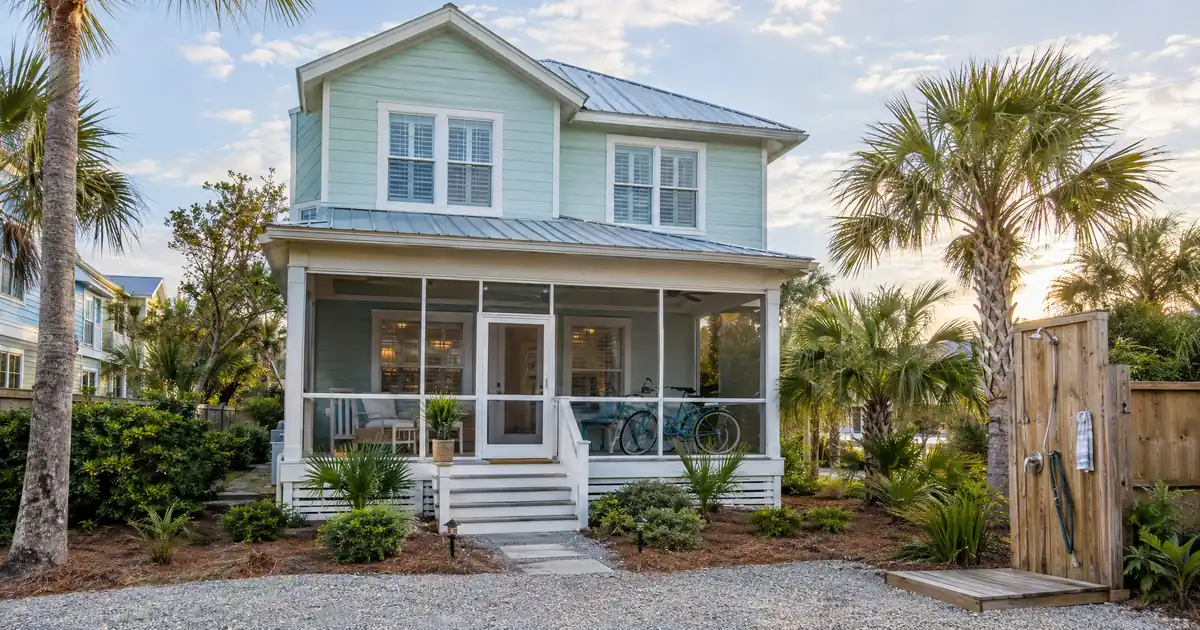
Second-Home Financing In Amelia Island — The Quick Read: A DSCR loan cannot finance a personal second home, because DSCR programs are built exclusively for non-owner-occupied rental property. A business owner buying a coastal second home instead qualifies through a bank statement, P&L, or asset-based non-QM path that reads real cash flow instead of a tax-return bottom line. The occupancy label a borrower signs at closing decides everything downstream — the loan program, the paperwork, and even which consumer protection rules apply.
This matters more for business owners than for W-2 buyers. A Schedule C or an S-corp K-1 often understates what a business actually generates, and a lender reading only the tax return can miss real qualifying income entirely. The fix isn’t a different rate — it’s a different documentation path.
Key Terms Defined
DSCR loan — a loan sized around a rental property’s own income, where the property’s rent divided by the monthly housing payment produces a coverage ratio lenders use to qualify the file.
Business-purpose loan — a loan made for an investment or business reason rather than personal use; it sits outside standard consumer mortgage rules.
Occupancy certification — the signed statement at closing where a borrower confirms whether a property is a primary residence, a second home, or an investment property.
Bank statement loan — a non-QM mortgage that qualifies a borrower using 12 to 24 months of deposit history instead of traditional personal-income documentation.
Repayment-capacity (repayment-capacity) — the federal requirement that a lender make a reasonable, good-faith determination a consumer borrower can repay a loan; it applies to consumer-purpose loans, not business-purpose ones.
Key Takeaways
- A DSCR loan cannot finance a second home a borrower plans to personally use — DSCR products require non-owner-occupied, business-purpose collateral.
- Business owners buying a personal-use coastal property qualify through bank statements, a P&L, or liquid assets — not through the property’s rental income.
- Occupancy classification happens before program selection and determines leverage, reserves, and paperwork.
- Light personal use paired with occasional rental can still fit a second-home structure; heavy rental use pushes the file toward investment classification instead.
- A coastal barrier island setting like Amelia Island can restrict standard federal flood insurance, which changes the cost picture even when the loan itself is straightforward.
What “Second Home” Actually Means, and Why DSCR Doesn’t Apply
A second home is a property the borrower personally occupies for part of the year. This is the opposite of an investment property, which the owner never occupies. This distinction comes from Fannie Mae’s own occupancy definitions. We use it here only as a contrast point, because DSCR programs don’t follow agency rules at all. Individual non-QM lenders build them instead.
Here’s the part that trips up a lot of business owners shopping for a coastal getaway: DSCR loans are built for rental property, full stop. Every DSCR file in Lendmire’s wholesale network requires the borrower to sign an occupancy certification confirming they won’t live in the property as a primary residence or second home, and won’t occupy it more than 14 days a year. That’s not a technicality. It’s the entire structure of the product. DSCR loans exist because the lender is qualifying the property’s income, not the borrower’s — and a property the owner is living in part of the year doesn’t generate that kind of independent, arm’s-length rental income.
So take a business owner who wants a coastal second home for personal use, with maybe some occasional rental income on the side. This person isn’t shopping for DSCR financing at all. They’re shopping for an alternative-documentation loan instead. This type of loan treats second-home occupancy as eligible and reads the borrower’s actual cash flow instead of a rent roll.
How Underwriting Actually Treats a Business Owner’s Second-Home File, Step by Step
First, occupancy gets classified. Second, income documentation gets matched to the borrower’s business structure. Then the deposit history gets traced — not just totaled — before a number gets finalized. Every other decision on the file flows from those three steps.
Step one: occupancy classification. Before leverage, reserves, or documentation type gets discussed, the file gets labeled primary, second home, or investment. That label sets the leverage ladder and the paperwork trail for everything that follows.
Step two: income method selection. For a business owner buying a personal-use second home, the standard non-QM paths are bank statements, a profit-and-loss statement, or liquid asset qualification. On a bank statement file, Lendmire’s wholesale network typically looks at 12 or 24 consecutive months of personal or business deposits, applies an expense ratio, and arrives at a qualifying income number. Fixed ratios tend to rise with employee count and business type, with service businesses that have no staff sitting at the low end and product-based businesses or larger staffs pushing the ratio higher — or an accountant can supply a custom ratio. Transfers the borrower moves from their own business into a personal account count in full, which matters a lot for owners who pay themselves irregularly.
Step three: deposit tracing. Underwriters don’t just add up deposits — they trace them. A large or unusual deposit inside the statement window gets flagged and needs an explanation, but one odd deposit rarely sinks a file on its own.
Step four: the income analysis has to carry the whole file. On a pure rental purchase, weak owner income doesn’t matter much, because Lendmire’s DSCR programs qualify primarily on the property’s own rental income covering the payment, subject to lender guidelines. A second home has no such backstop. There’s no rent check to lean on, so the deposit or asset analysis has to stand on its own.
Step five: the consumer-protection layer changes. DSCR loans are designed for non-owner-occupied investment properties. Because they are business-purpose investor loans, they are reviewed under the CFPB’s business-purpose exemption rather than full Ability-to-Repay review. A second home the borrower will personally use doesn’t fit that exemption, so the file goes through full consumer-purpose underwriting instead — a real difference in paperwork, not just a label.
Step six: appraisal. A second home purchased for personal use gets a standard property valuation. There’s no rent schedule form involved, because rental income isn’t the basis for qualifying — that tool is reserved for investment purchases.
The Structures and Variations Available to Business Owners
Bank statement, P&L, and asset-based qualification are the three real paths — and business owners often qualify faster on assets than income if their business retained earnings rather than distributed them. Across Lendmire’s wholesale network, loan sizing for these files runs from $300,000 up to $30,000,000 through two separate program tracks: a portfolio non-QM program carrying files to $6,000,000, and a bank portfolio program that carries twelve-month-statement files up to $30,000,000 on its own ladder — 65% loan-to-value to $5,000,000, stepping to 60% through $10,000,000, and 55% through $30,000,000.
On a second home specifically, leverage steps down as the loan size climbs. On most files in the $300,000 to $1,000,000 range, purchase leverage runs around 85% with a 700 credit floor. Move into the $1,000,000 to $2,500,000 bands and leverage generally settles near 80%, with credit expectations climbing toward 720. Above $2,500,000, leverage tightens further — the $3,000,000 to $4,000,000 range typically runs around 65% purchase leverage with a 760 floor, and files above $4,000,000 move into the bank program’s own ladder, reviewed case by case before submission.
For business owners whose businesses hold significant liquid reserves rather than distributed income, an asset-based path can work instead of deposit analysis. One version divides liquid assets by 36, 60, or 84 months to produce a supplemental qualifying income figure, available on primary and second homes up to 80% loan-to-value. A standalone assets-only path skips debt-to-income math entirely, provided U.S. liquid assets equal the loan amount plus closing costs plus sixty months of any net loss on other owned residential property. Retirement accounts count toward that liquidity at 70%, rising to 80% once the borrower is past 59½ — though business funds, gifts, and cryptocurrency never count.
Credit floors on most portfolio-program files run around 660, rising to 700 above the super-jumbo threshold that kicks in at $3,000,000 on a second home. Reserve requirements typically run three months of housing payment for loan amounts up to $500,000, six months through $1,500,000, and nine months above that, plus two additional months for every other financed property the borrower carries.
Where the General Rule Breaks: Named Edge Cases
The clean line between “second home” and “investment property” gets blurry fast once a business owner wants occasional rental income, and that’s where files most often stall or get misclassified.
Light personal use with occasional rental. A business owner who uses the property personally most of the year and rents it out occasionally generally still fits a second-home structure. The mix of personal versus rental use — not the mere presence of a rental listing — is what decides the classification.
A listing doesn’t equal a rental. Putting a property on a short-term rental platform doesn’t automatically establish it as a rental for underwriting purposes. Property type, any lease in place, local rental restrictions, and appraisal findings all factor into how a lender treats the file — a listing alone proves nothing.
Co-mingled business and personal accounts. Business owners frequently run personal and business deposits through the same accounts. That complicates the review but doesn’t automatically disqualify a file — some lenders in Lendmire’s network will still work through co-mingled statements, though separating the accounts before applying tends to make underwriting considerably smoother.
Converting a primary residence into a rental later. Some business owners eventually vacate a primary residence in favor of a new one and want the old home’s rent to help qualify the new purchase. That rental income can be considered under DSCR-style refinance logic, provided a lease and proof of rent payments back it up — but it’s ineligible if the borrower is living rent-free elsewhere or hasn’t actually established a new primary residence.
Coastal barrier geography changes the cost equation, not the loan mechanics. A coastal barrier island setting can restrict where standard federal flood insurance is even available, independent of anything the lender does. That’s a cost-and-availability issue for the borrower to confirm early with an insurance carrier — it doesn’t change how the loan itself gets underwritten, but it can change what the buyer budgets for carrying costs.
What the Investor Decision Actually Looks Like
The decision that matters most happens before any paperwork gets pulled: is this property going to be lived in, or is it going to be run as a rental? Get that answer honestly, and the rest of the file follows a predictable path.
Suppose the answer is “I’ll use it personally, with maybe some rental income on the side.” Then the business owner needs bank statement or asset-based financing. The file’s success depends on deposit or liquidity analysis, not on the property itself. But suppose the answer is “I’m buying this purely to rent it out and I won’t be using it myself.” That’s a different conversation. It’s closer to Lendmire’s second-home financing coverage for business owners in other coastal markets. The same occupancy-first logic applies there, no matter the specific coastline.
Business owners looking at a coastal property like Amelia Island — barrier-island geography, resort-adjacent, condo-heavy — should treat the occupancy conversation as the first call, not the last one. A lender qualifying a file on business deposits needs clean records. A lender qualifying a file on assets needs documented liquidity. And a lender reviewing a rental purchase under Lendmire’s DSCR framework, covered in similar detail for Rosemary Beach, needs none of that personal financial picture at all. Picking the wrong lane costs time. More often, it costs the buyer a program that would have fit better from the start.
Tax treatment can depend on how the funds are used and how the property is held; investors should keep clear records and speak with a qualified tax professional before relying on any deduction.
Frequently Asked Questions
Can I use a DSCR loan to buy a second home I’ll personally use part of the year?
No. DSCR loans are built exclusively for non-owner-occupied rental property, and every file in Lendmire’s wholesale network requires a signed occupancy certification confirming the borrower won’t use the property as a second home. A personal-use coastal property needs a bank statement, P&L, or asset-based non-QM loan instead.
How does a lender treat my business income if my traditional personal-income documentation understate it?
Bank statement and P&L programs qualify off actual deposits or documented earnings rather than a tax-return bottom line. Lendmire’s wholesale network typically reviews 12 or 24 months of deposits, applies an expense ratio based on the business type, and counts transfers from the borrower’s own business into a personal account in full.
What if I want to rent the property occasionally when I’m not using it?
Light personal use paired with occasional rental generally still fits a second-home structure, subject to lender guidelines. Heavy rental use, or treating the property primarily as an income source, tends to push the file toward investment-property classification, which carries different leverage and documentation.
Does my business’s checking account co-mingling personal and business deposits disqualify me? Not automatically. Co-mingled accounts complicate the deposit tracing review, and some lenders in the network will still work through them, but separating personal and business accounts before applying generally makes the file move more smoothly.
Why does the occupancy label matter so much if the loan amount is the same either way?
Occupancy classification determines leverage, reserve requirements, documentation type, and which consumer-protection framework applies to the loan. A second-home file and an investment-property file at the identical price point can carry meaningfully different terms once that label is set. Final terms depend on lender guidelines, property type, leverage, and the borrower’s complete credit picture.
Are you a business owner weighing a coastal second home? Do you want to see how bank statement, P&L, or asset-based qualification works for your income picture? Lendmire can help. We compare options based on your leverage needs, your reserves, and how your business actually generates cash.
For current guidelines and terms, see Lendmire’s super jumbo bank statement loan programs page.
Self-employed borrowers can compare both super jumbo programs on Lendmire’s self-employed mortgages page.
About Lendmire
Lendmire (NMLS# 2371349), a non-QM mortgage broker serving investors in 40 markets including Washington, D.C., helps structure DSCR scenarios commonly evaluated around a property’s rental income rather than personal income paperwork, subject to lender guidelines. A Scotsman Guide Top Mortgage Workplace in 2025 and 2026, Lendmire places loans through wholesale investor lenders and is not a direct lender.
Lendmire’s Top Mortgage Workplace recognition is documented by Scotsman Guide 2025 Top Mortgage Workplace and Scotsman Guide 2026 Top Mortgage Workplace.
Get Started
Ready to find the right loan for you?
In about 30 seconds you can review financing options available for your home or investment property. No commitment required.
Informational only. Not a Loan Estimate, approval, or commitment to lend. Program availability and eligibility are subject to lender guidelines, credit approval, property review, and underwriting.
References
1. Fannie Mae Selling Guide — B2-1.1-01 Occupancy Types
2. Consumer Financial Protection Bureau — §1026.3 Exempt Transactions
Brandon Miller
Founder & CEO, Mortgage Loan Originator, Lendmire LLC
- Mortgage Loan Originator · NMLS# 1129696 · Verify on NMLS Consumer Access
- North Carolina Real Estate Broker · License# 343312 · Verify on NCREC
- North Carolina Insurance Producer · License# 19053198 · Property, Casualty, Life, Health · Verify on NAIC SBS
- Lendmire LLC · Firm NMLS# 2371349 · Verify firm licensure
Required disclosures. Lendmire (NMLS# 2371349) operates as a licensed mortgage broker, not a direct lender or depository. The discussion in this article is general in nature and should not be relied upon as financial, legal, or tax advice — every investment scenario is unique and should be reviewed by a qualified professional. Any loan inquiry is subject to lender underwriting, and this article is not a commitment to lend or a guarantee of approval. Mortgage rates, loan terms, and program guidelines vary by borrower, property, and state, and may change without notice. Equal Housing Opportunity. Verify licensure at NMLS Consumer Access.


