
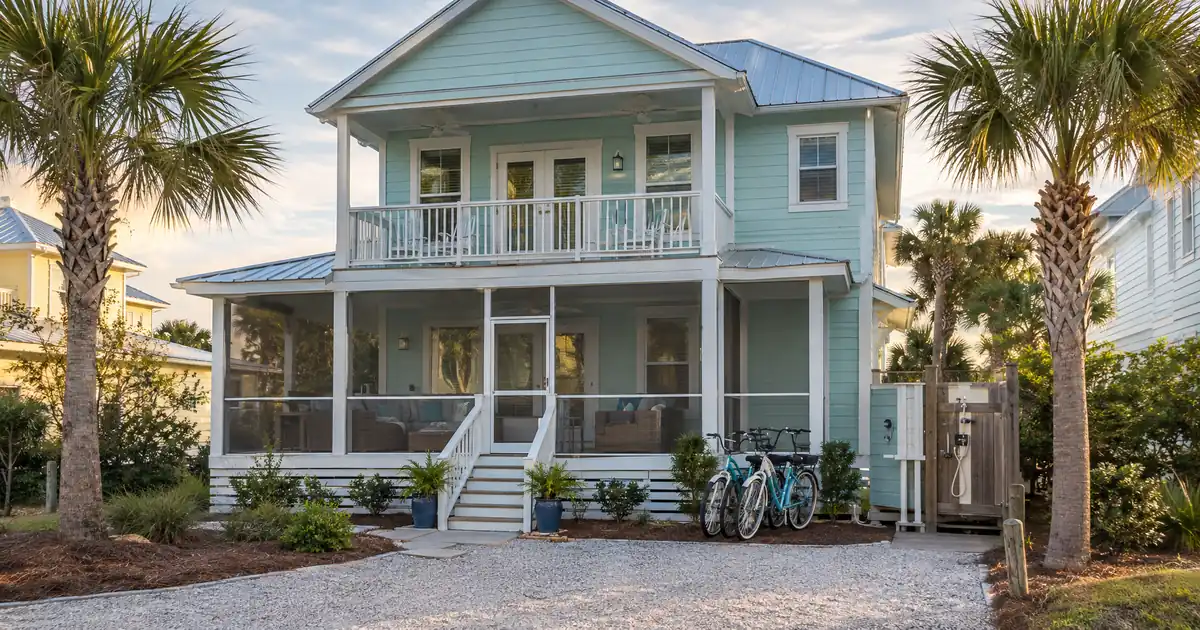
Second Home in Clearwater Beach — The Quick Read: A genuine second home — one you use part of the year rather than rent full-time — usually gets financed on bank statements, not on the property’s rental income. Underwriters look at your deposit history instead of traditional personal-income documentation, apply an expense factor if you use business accounts, and size the loan on a monthly average. Occupancy, not the borrower’s overall investor status, decides whether that path even applies. Get the occupancy classification wrong before you go under contract, and the whole file — appraisal form, program, leverage — has to be rebuilt.
Key Takeaways
- A second home is qualified on the borrower’s cash flow (bank statements, assets, or a P&L), while a rental property is qualified on the property’s own income through a DSCR loan.
- Bank statement programs through select lenders in Lendmire’s wholesale network run from $300,000 to $30,000,000, with leverage stepping down as the loan size climbs.
- Calling a property a “rental” on paper or titling it in an LLC does not change its occupancy classification — actual use controls.
- Condo-heavy coastal markets like Clearwater Beach add a warrantability layer that has nothing to do with how the borrower documents income.
- Everything above roughly $4,000,000 in this space is reviewed case by case before submission — there’s no flat percentage above that line.
What Counts As A Second Home, And Why It Matters
A second home is a one-unit property you personally occupy for part of the year, keep under your own control, and don’t run through a mandatory rental pool. That last piece is the trap. If a management company controls bookings — a condotel arrangement, for example — the “exclusive control” element fails and the file typically has to move to an investment or DSCR structure instead, per the occupancy framework built into Fannie Mae’s Selling Guide, which the wider non-QM market uses as its definitional reference point even outside agency lending.
This distinction decides the entire underwriting path before documentation type is even discussed. A genuine second home routes to bank statement underwriting. A property purchased mainly to generate rental income routes to a DSCR loan, which qualifies the property’s cash flow rather than the borrower’s. Lendmire’s complete DSCR loans guide covers that side of the split in depth — this article stays on the personal-use, bank-statement side.
Occupancy percentage isn’t the only tell underwriters watch. A second home that sits blocks from the borrower’s primary residence, or one located in an area without a real vacation-home market, tends to draw questions. A beachfront condo in a resort corridor like Clearwater Beach fits the profile cleanly — it’s the kind of location where seasonal, part-time use is normal rather than suspicious.
Key Terms Defined
Second home — a property you occupy for part of the year, keep under your own control, and don’t place in a mandatory rental program.
Bank statement loan — a loan qualified on deposit history (12 or 24 months) instead of traditional personal-income documentation or pay stubs.
Expense ratio — the percentage of business deposits treated as overhead rather than usable income when a borrower uses business bank statements.
DSCR loan — a loan qualified on a property’s rental income covering its own payment, used for non-owner-occupied investment property, not second homes.
Non-warrantable condo — a condo building that fails one or more standard eligibility tests (rental concentration, pending litigation, deferred reserves), which limits loan programs and leverage regardless of the borrower’s documentation type.
How Bank Statement Underwriting Actually Works, Step By Step
The process runs in a fixed order, and skipping a step is usually what generates a stipulation later.
1. Occupancy gets classified first. Before anyone talks about statements, the file is tagged primary, second home, or investment. This single decision determines everything downstream.
2. Statement type and length get selected. Personal statements are simplest — deposits are reviewed, transfers and one-time non-income items are excluded, and a monthly average is calculated. If business statements are used instead, an expense ratio applies to estimate what’s actually usable income after overhead, with the ratio generally scaling by employee count and business type — lower for a service business with no employees, moderate for a small team, and higher for larger staffs or product-based businesses — plus alternatives such as an accountant-supplied ratio or a profit-and-loss method capped at a program-set share of stated income. Exact ratio tiers vary by program and lender, so borrowers should confirm current guidelines rather than assume a fixed schedule. Transfers from the borrower’s own business into a personal account count in full, at 100%, which matters for owner-operators who move money between accounts routinely.
3. The averaging window matters. Most programs work off 12 or 24 consecutive months of statements — transaction histories don’t substitute, and the months have to be consecutive. Twenty-four months tends to smooth out seasonal swings; a business with strong recent growth sometimes benefits from a shorter 12-month window instead, program-dependent.
4. Underwriting is manual, not algorithm-only. Non-QM files get a human look at the full financial picture. Large unexplained deposits, frequent overdrafts, or irregular cash patterns generate follow-up questions rather than automatic denial. But they do slow the file down if the statements aren’t clean going in.
5. The appraisal form follows the occupancy decision. Because the loan is qualified on the borrower, not the property’s rental income, a standard appraisal report applies rather than the rent-schedule forms (Form 1007) used on investment-property files. A second-home file simply doesn’t use rental income to qualify, so that rent-comparison step isn’t part of the package.
6. Reserves and debt-to-income still apply. A bank statement second-home file is different from a DSCR file. It runs a real debt-to-income calculation against the averaged deposit income. Investment-property underwriting skips personal DTI entirely, so this is a meaningful difference.
DSCR loans are designed for non-owner-occupied investment properties. Because they’re business-purpose investor loans, they’re reviewed differently from a standard owner-occupied or second-home mortgage — which is exactly why the occupancy call at step one matters so much.
Bank Statement Second Home vs. DSCR Investment Property
| Factor | Bank Statement | DSCR (Investment Property) |
|---|---|---|
| Reviewed on | Borrower’s deposit/cash-flow history | Property’s rental income |
| Occupancy | Personal use part of the year | Non-owner-occupied only |
| Appraisal form | Standard residential form | Rent-schedule appraisal (Form 1007) |
| DTI reviewed | Yes | Typically not |
| Rental pool allowed | No — breaks the classification | Expected/required |
A self-employed buyer who already owns DSCR-financed rentals elsewhere is often surprised that the same product doesn’t extend to a personal vacation purchase. It doesn’t. A vacation condo you plan to use yourself isn’t eligible for DSCR financing, no matter how the entity is titled. A business entity, a lease template, or a stated rental plan can’t turn genuine personal use into an eligible non-owner-occupied transaction. Actual use controls the file, not paperwork.
Sizing And Leverage For Bank Statement Second Homes
Loan sizes through select lenders in Lendmire’s wholesale network run $300,000 to $30,000,000 across two overlapping programs — a portfolio non-QM program that carries files to $6,000,000, and a separate bank portfolio program that carries twelve-month-statement files up to $30,000,000 on its own ladder (65% to $5,000,000, 60% to $10,000,000, and 55% to $30,000,000, with interest-only capped at 60% or the band’s ceiling, whichever is lower). The bank program’s ladder starts above $4,000,000 and overlaps the portfolio program through $6,000,000 before standing on its own beyond that point.
Leverage on a second home steps down as the loan size climbs, roughly five points below what the same file would get as a primary residence:
| Loan Size | Purchase LTV | Rate-Term LTV | Cash-Out LTV | Credit Floor |
|---|---|---|---|---|
| $300K–$1M | 85% | 85% | 75% | 700+ |
| $1M–$1.5M | 80% | 80% | 75% | 680+ |
| $1.5M–$2M | 80% | 80% | 75% | 700+ |
| $2M–$2.5M | 80% | 80% | 70% | 720+ |
| $2.5M–$3M | 75% | 75% | 60% | 720+ |
| $3M–$4M | 65% | 60% | 55% | 760+, case by case |
| $4M–$5M | 65% | 60% | 55% | 760+, case by case |
Above $5,000,000, files move to the bank program’s own ladder — 55% at the $5M–$10M band, 50% from $10M to $30M — and everything above $4,000,000, regardless of ladder, gets reviewed case by case before submission rather than approved off a flat percentage.
Above $3,000,000 on a second home, super-jumbo overlays kick in: a 700 credit floor, a clean 0x30x24 housing-payment history, 48-month seasoning on any credit event, U.S. citizens and permanent residents only, no non-occupant co-borrowers, and cash-out proceeds that can’t be used to satisfy reserve requirements. Reserves themselves scale with loan size — typically 3 months of payments to $500,000, 6 months to $1,500,000, and 9 months above that, plus 2 months for each additional financed property up to a 12-month cap.
For a borrower who doesn’t want to lean on deposit history at all, an asset-based path exists: liquid assets divided by 36, 60, or 84 months can supplement or, on files above $3,500,000 or as a standalone qualification, replace income documentation entirely, capped at 80% loan-to-value on primary and second homes. An assets-only variation goes further — no debt-to-income calculation at all, provided liquid U.S. assets equal the loan amount plus closing costs plus 60 months of any net loss carried on other residential property. Retirement funds count at 70% (80% once the borrower is past 59½); business funds, gifts, revocable-trust exceptions aside, unvested stock, and cryptocurrency don’t count toward either path.
Where “Second Home” Breaks Down In A Market Like Clearwater Beach
Clearwater Beach’s inventory leans heavily condo. That adds a layer of due diligence, and it has nothing to do with how the borrower documents income. Florida’s post-Surfside reforms require structural inspections and reserve studies for condo and cooperative buildings three stories or taller. Buildings must complete a Structural Integrity Reserve Study at least every 10 years, regardless of the building’s age. A building can land in non-warrantable territory if it has a deferred reserve study, an active special assessment, or a failed milestone inspection. Through select lenders, non-warrantable condos are reviewable to 80% loan-to-value. But that ceiling and the credit tier attached to it apply on top of the borrower’s own documentation review — not instead of it.
Warrantable condos fare better, up to 85% loan-to-value. Condotels — units inside a hotel-style rental program — cap out lower still. They’re capped at 75% on a purchase and 65% on cash-out through the portfolio program, or 50% on the bank program. A unit sitting inside a mandatory rental pool also usually fails the “exclusive control” test. That test defines a true second home in the first place. This is why a condotel unit meant for personal use so often gets mischaracterized at application and has to be rebuilt mid-transaction.
There’s a tax wrinkle too, separate from the mortgage occupancy question. The IRS treats a dwelling rented for fewer than 15 days a year as pure personal use — no rental income reported, no rental expenses deducted — under IRS Topic No. 415. Once personal use exceeds 14 days or 10% of the days the unit is rented at fair value, the tax treatment shifts, a threshold explained further by the University of Illinois Tax School. That’s a tax rule, not a mortgage rule, but a buyer describing plans to rent the unit heavily on the tax side while certifying personal-use occupancy on the mortgage side is exactly the kind of mismatch that generates underwriting friction. Tax treatment can depend on how the funds are used and how the property is held; investors should keep clear records and speak with a qualified tax professional before relying on any deduction.
A related dynamic plays out in Miami Beach’s bank-statement second-home market. There, high-rise condo litigation and rental-restriction bylaws create the same kind of occupancy friction. These mechanics travel across coastal Florida markets, not just Clearwater. The same logic shows up further down the Gulf Coast in Sarasota’s second-home segment as well.
Running The Numbers On A Realistic File
Picture a self-employed buyer purchasing a $2.1 million beachfront condo for part-time personal use, with an occasional short-term rental when the family isn’t there. Because actual use — not the occasional rental — controls the classification, this stays a second-home file, not a DSCR file. At the $2M–$2.5M band, purchase leverage through select programs runs to 80% loan-to-value at a 720+ credit floor. The borrower supplies 24 months of business bank statements; with a five-employee operation, a 40% expense ratio applies to the deposit average before the qualifying income figure is set. Reserve requirements at this size fall in the 9-month range, and pricing and available terms vary by lender, borrower profile, property type, and full underwriting review.
A near-identical file at $3.4 million would look different. Leverage drops to 65% on a purchase, the credit floor rises to 760+, and the super-jumbo overlays — clean housing history, 48-month credit-event seasoning, no non-occupant co-borrowers — all come into play. The jump from $2.5 million to $3 million is the single biggest inflection point on this ladder, and it’s worth structuring the purchase price around if a deal sits close to that line.
Frequently Asked Questions
Can I use rental income from my Clearwater Beach condo to help qualify on a bank statement loan? No. A bank statement second-home file is qualified on the borrower’s own deposit history or assets, not on the property’s rental income. If rental income is the plan and the property won’t be personally occupied, that’s a DSCR conversation instead, subject to lender guidelines.
Does putting the condo in an LLC change how it’s classified? No. Entity titling doesn’t change occupancy classification — actual use does. A business entity, lease template, or investment label on paper doesn’t convert genuine personal use into an eligible non-owner-occupied transaction.
What happens if the building isn’t warrantable? Non-warrantable status caps leverage rather than closing the door — through select lenders in the network, non-warrantable condos are typically eligible to 80% loan-to-value, subject to underwriting, but the building’s reserve funding and litigation status still get checked before the deal works forward.
How many months of bank statements do I actually need? Most programs use 12 or 24 consecutive months, program-dependent; business statements carry an expense ratio applied to the deposit average, while personal statements are averaged directly after excluding transfers and other non-income deposits.
Is there a size ceiling on this program? Through the two overlapping wholesale programs Lendmire places files with, sizing runs from $300,000 up to $30,000,000, though anything above roughly $4,000,000 is reviewed case by case rather than approved off a flat percentage.
If you’re weighing a second-home purchase or refinance and want to see how the numbers actually run — deposit history, asset options, leverage by size — Lendmire can help compare bank statement programs against your credit profile, reserves, and goals. Reach the team at 828-256-2183 or request a quote to start the file review.
For current guidelines and terms, see Lendmire’s super jumbo bank statement loan programs page.
Self-employed borrowers can compare both super jumbo programs on Lendmire’s self-employed mortgages page.
About Lendmire
Lendmire, NMLS# 2371349, is a mortgage brokerage focused on investor financing, arranging DSCR loans in 39 states plus Washington, D.C. — 40 markets total. Qualification is based on the property’s income rather than personal income documentation, subject to lender guidelines, making it a fit for LLC-held rentals and scaling portfolios. Scotsman Guide named Lendmire a Top Mortgage Workplace in both 2025 and 2026.
Get Started
Ready to find the right loan for you?
In about 30 seconds you can review financing options available for your home or investment property. No commitment required.
Informational only. Not a Loan Estimate, approval, or commitment to lend. Program availability and eligibility are subject to lender guidelines, credit approval, property review, and underwriting.
References
1. Fannie Mae Selling Guide — Occupancy Types
2. Florida DBPR — Condominium FAQs
3. IRS Topic No. 415 — Renting Residential and Vacation Property
4. Illinois Tax School — Tax Rules for Rentals and Vacation Homes
Brandon Miller
Founder & CEO, Mortgage Loan Originator, Lendmire LLC
- Mortgage Loan Originator · NMLS# 1129696 · Verify on NMLS Consumer Access
- North Carolina Real Estate Broker · License# 343312 · Verify on NCREC
- North Carolina Insurance Producer · License# 19053198 · Property, Casualty, Life, Health · Verify on NAIC SBS
- Lendmire LLC · Firm NMLS# 2371349 · Verify firm licensure
Important disclosures. Lendmire (NMLS# 2371349) is a licensed mortgage brokerage. Lendmire is not a direct lender, depository institution, or financial advisor. All loan inquiries are subject to lender underwriting; this article does not constitute a commitment to lend. Rates, terms, and program guidelines are subject to change without notice and vary by borrower profile, property type, and state. Information in this article is general in nature and is not financial, legal, or tax advice. Equal Housing Opportunity. NMLS Consumer Access: nmlsconsumeraccess.org.


