
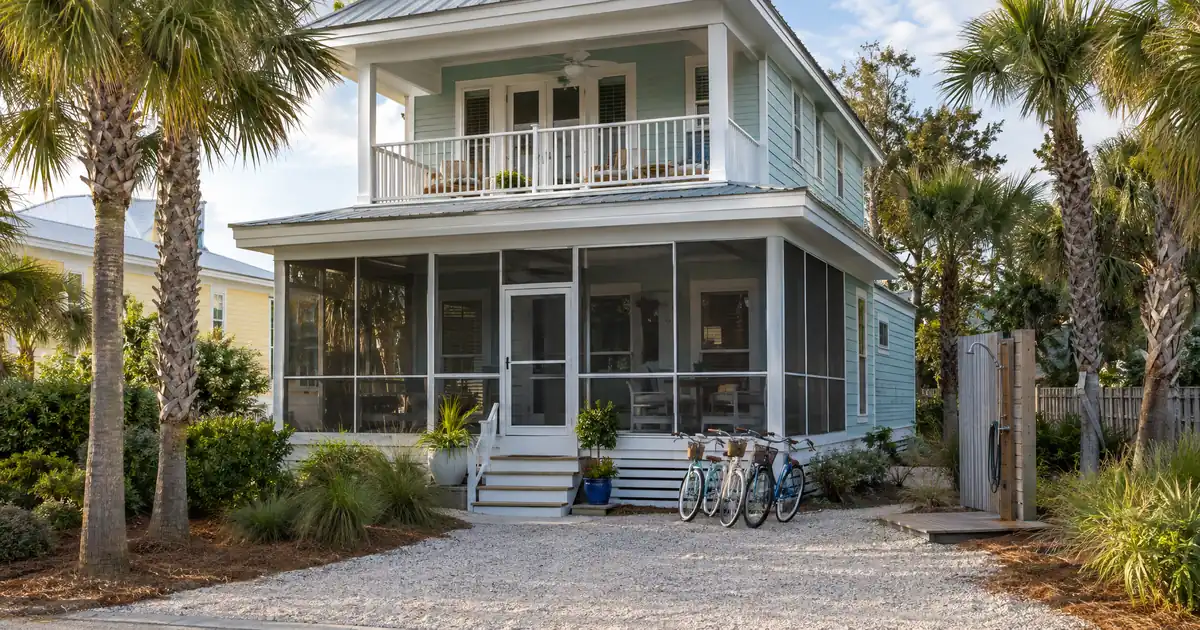
Buying A Vacation Home In Ponte Vedra Beach On Bank Statements — The Quick Read: A self-employed buyer can qualify for a Ponte Vedra Beach vacation home using 12 or 24 months of bank deposits instead of traditional personal-income documentation, through select wholesale bank-statement programs. The property’s occupancy — second home versus rental — changes the leverage and credit floor you’ll be offered. If the plan is to rent the place out short-term, a DSCR loan, which qualifies the property on its own rental income, may fit the math better than a bank-statement file built around your business.
Key Takeaways
- Bank statement loans qualify the borrower using deposit history, not traditional personal-income documentation — useful for self-employed buyers whose write-offs shrink taxable income.
- Ponte Vedra Beach’s median home value runs around $1.12 million, per NeighborhoodScout, which lands most purchases in the mid-tier of a lender’s leverage ladder rather than at the top.
- A vacation home bought purely for personal use is financed differently than one bought to rent — the second path usually points toward a DSCR loan instead.
- Leverage steps down as the loan size climbs, and files above roughly $3 million on a second home get reviewed case by case with tighter overlays.
- Oceanfront pricing in the area can reach a $3.2 million median, according to Momentum Realty, which pushes many oceanfront buyers into that case-by-case tier.
Key Terms Defined
Bank statement loan — a mortgage that qualifies a self-employed borrower’s income from deposits shown on personal or business bank statements, instead of traditional personal-income documentation.
Expense ratio — the percentage of business deposits a lender assumes goes to overhead before counting the rest as usable income.
DSCR loan — a business-purpose mortgage that qualifies a rental property based on its own rent, not the borrower’s personal income.
Non-QM — short for non-qualified mortgage, a category of loans that document income in ways other than the standard tax-return method, while still following a repayment-capacity standard.
LTV — loan-to-value, the percentage of a property’s price or appraised value that the loan covers.
What a Bank Statement Loan Actually Verifies
A bank statement loan solves one specific problem: the buyer’s traditional income documentation doesn’t tell the whole income story. Self-employed founders, physicians with private practices, and business owners routinely write off legitimate expenses that shrink their taxable income on paper. A traditional lender reading only the tax return can undercount what that borrower actually earns.
Instead of conventional personal-income paperwork, the file leans on 12 or 24 consecutive months of bank statements. A lender in the wholesale network reviews the deposits, strips out transfers and one-time inflows, and calculates a monthly average. That average becomes the qualifying income figure.
This is a personal-income documentation method. It says nothing, on its own, about whether the Ponte Vedra Beach property being purchased will generate rental income. That’s a separate question — and one that trips up a lot of vacation-home buyers who assume “bank statements” and “rental income” are the same conversation. They aren’t.
How Underwriting Treats the File, Step by Step
the deal works through a fairly consistent sequence across the wholesale lenders that offer this program.
First, the borrower picks personal or business statements, or both. Personal account deposits generally count in full. Business account deposits get an expense ratio applied first — a fixed haircut based on the type of business, ranging from around 20% for a service business with no employees up to 50% for a business with six or more employees or any product-based operation. An accountant-provided ratio, or a profit-and-loss method capped at 80%, can sometimes replace the fixed percentage. Transfers the borrower makes from their own business into their personal account count at 100%, since that money already belongs to them.
Second, the lender averages the eligible deposits over the statement window and arrives at a monthly qualifying income number.
Third, that income gets weighed against debt-to-income limits, which run up to 50% on most files in the network.
Fourth, the lender checks credit, reserves, and the property itself. A 660 credit floor applies on the portfolio bank-statement program; the bank portfolio program that carries larger balances typically wants 680. Reserve requirements scale with loan size — commonly three months of payments up to $500,000, six months up to $1.5 million, and nine months above that, plus additional months for other financed properties.
Fifth, the file is priced and sized against the applicable leverage ladder for the occupancy type — primary residence, second home, or investment property — since each has its own ceiling.
Two Ladders, Not One: The Programs Behind the Bank Statement
There isn’t one single bank-statement program — there are two, and they carry a buyer to very different loan sizes. A portfolio non-QM program handles loans from $300,000 up to $6,000,000. A separate bank portfolio program, built for larger balances documented with 12 months of statements, carries files all the way to $30,000,000 on its own size ladder: 65% loan-to-value to $5,000,000, 60% to $10,000,000, and 55% up to $30,000,000, with interest-only capped at 60% loan-to-value or the band’s ceiling, whichever is lower.
These two ladders overlap between roughly $4,000,000 and $6,000,000, where either program might apply depending on the file. Above $6,000,000, only the bank portfolio program’s ladder is in play, and every loan above $4,000,000 gets reviewed case by case before it’s even submitted — leverage figures at that size are a starting point for discussion, not a guarantee.
Neither ladder names a specific bank or lender, and neither figure is a rate or fee. They’re ceilings, offered through select lenders in Lendmire’s wholesale network, subject to full underwriting.
Second Home vs. Investment Property: Why Occupancy Changes the Math
Occupancy classification is the single biggest lever on a Ponte Vedra Beach vacation-home file, and it gets decided before anything else. A property bought for the buyer’s own use, with no rental intent, is a second home. A property bought specifically to generate rental income is an investment property — and lenders price the two very differently.
On a $1.1 million second home — close to the area’s median home value per NeighborhoodScout — a bank-statement borrower with a 680 credit score is typically looking at up to 80% purchase leverage on most files in the network, stepping down to 75% cash-out. Move into the $1.5 million to $2 million band, and the credit floor for that same 80% purchase leverage typically climbs to 700.
At $2.5 million to $3 million, purchase leverage generally tightens to 75% with a 720 credit floor. Cross above $3 million on a second home, and the file lands under super-jumbo overlays: a 700 credit floor, 48 months of seasoning on any credit event, and every loan reviewed case by case, with purchase leverage typically around 65%. That threshold matters here — an oceanfront purchase near the area’s reported $3.2 million median, per Momentum Realty’s market data, sits squarely in that case-by-case tier, not the standard ladder.
Investment property files run about five points lower than second-home leverage at every size band, and they carry a different documentation path entirely — one built around the property’s rent rather than the buyer’s bank deposits.
Where the General Rule Breaks: The Short-Term Rental Edge Case
The cleanest bank-statement file breaks down fast the moment the plan shifts from “vacation home for us” to “vacation rental for guests.” That’s because a bank statement loan documents the borrower’s income — it says nothing about what the property itself can earn on Airbnb or VRBO.
If rental income is going to help qualify the purchase, most lenders lean on Fannie Mae’s Form 1007, the standard single-family rent schedule an appraiser fills out. The catch: Form 1007 estimates a long-term, annually-leased market rent. It was never built to capture nightly-rate, seasonal Airbnb income, and appraisal-industry guidance is explicit that assessing that kind of business income is out of scope for the form. A property that could earn strong nightly revenue in-season can appraise for a much lower “market rent” than its actual short-term booking history would suggest.
That gap is exactly why DSCR programs exist alongside bank-statement programs, and why some DSCR files layer in platform-history statements or short-term-rental-specific income documentation rather than relying on the rent schedule alone. Short-term rental rules can vary by city, county, HOA, and property type, so investors should confirm local rules before relying on projected rental income at all.
A few other edge cases worth flagging on a Ponte Vedra Beach file: co-mingled personal and business deposits in one account complicate the averaging math, and most lenders in the network would rather see the two kept separate from the start. A property with no existing lease at purchase — the normal case for a vacation home — leaves the appraiser’s rent opinion as the only number on the table, since there’s no signed lease to check it against.
Why a Pure Rental Purchase Usually Moves to DSCR
Once the buyer’s intent is clearly a rental, not a personal getaway, the practical path usually flips from bank statements to DSCR. A DSCR loan is reviewed primarily on the property’s rental income covering the payment, subject to lender guidelines — not on the buyer’s deposits, standard personal-income documentation, or employment history at all. That distinction is covered in more depth in Lendmire’s complete DSCR loans guide.
On an investment-property purchase in the $1 million to $1.5 million range — a realistic band for a Ponte Vedra Beach rental given the area’s median pricing — a borrower with 680+ credit is typically looking at up to 80% purchase leverage on most files in the network, with reserves scaling by loan size. Move into the $2.5 million to $3 million band and purchase leverage generally tightens to 75% with a 720 credit floor. Cross $3 million on an investment property and the file hits the same super-jumbo overlay tier as the second-home ladder — case-by-case review, a 700 credit floor, and tighter terms across the board.
Cash-out on a DSCR refinance works differently too: proceeds are typically unlimited at or below 60% loan-to-value on the portfolio program, with a cash-in-hand cap above that threshold. None of this is a promise of approval — every file still runs through full underwriting, and DSCR loans are business-purpose loans reviewed differently from a standard owner-occupied mortgage.
The Ponte Vedra Beach Price Point
Ponte Vedra Beach’s median home value sits around $1.12 million, per NeighborhoodScout data, while local market reporting from Momentum Realty puts the broader median sale price near $1.1 million with oceanfront properties running closer to a $3.2 million median. That spread — a roughly three-times jump from typical inland pricing to oceanfront — is exactly why so many Ponte Vedra Beach files land in two very different leverage tiers depending on the block.
Making the Decision: Bank Statements or DSCR?
The choice usually comes down to which number is stronger on paper: the buyer’s business cash flow, or the property’s rental cash flow. A buyer with clean, well-documented business deposits and no firm rental plan generally does better on a bank-statement second-home file. A buyer planning to rent the property out — long-term or short-term — usually gets a cleaner qualification path, and often better leverage, through a DSCR loan built around that projected rent. Investors weighing both options in more detail can review Lendmire’s comparison of a DSCR loan vs. a bank statement loan for a side-by-side look at how each program treats income.
Tax treatment can depend on how the funds are used and how the property is held; investors should keep clear records and speak with a qualified tax professional before relying on any deduction.
If you’re weighing a vacation home purchase against a straight rental purchase, Lendmire can help you compare bank-statement and DSCR loan options based on the property’s intended use, your credit profile, available leverage, and your broader investment goals. Reach the team at 828-256-2183 to talk through a specific scenario.
Frequently Asked Questions
Can I use bank statements to qualify for a vacation home I plan to rent out on Airbnb?
You can, but it’s usually the wrong tool for that goal. Bank statements document your personal income, not the property’s rental income, so a DSCR loan built around projected short-term rental cash flow typically fits a rental-intent purchase better and may unlock more leverage.
Does a higher-priced oceanfront property automatically get lower leverage?
Generally yes. Leverage steps down as loan size increases across every occupancy type in the network, and second homes or investment properties above roughly $3 million move into a case-by-case overlay tier with a 700 credit floor and tighter terms.
What counts as income on a bank statement loan if I run my own business?
Personal account deposits generally count in full, while business account deposits get an expense ratio deducted first — commonly 20% to 50% depending on the business type — unless an accountant-provided ratio or profit-and-loss method applies instead.
Will Form 1007 capture what my vacation home could earn on nightly bookings?
Not reliably. Form 1007 estimates a long-term, annually-leased market rent and isn’t designed to reflect seasonal, nightly-rate Airbnb income, which is why some DSCR files pull in separate short-term rental documentation.
Is a 24-month statement window always required?
No — many programs in the network accept 12 or 24 months, and the larger bank portfolio program specifically works from 12 months of statements. Which window applies depends on the specific program and the borrower’s file.
For current guidelines and terms, see Lendmire’s super jumbo bank statement loan programs page.
Self-employed borrowers can compare both super jumbo programs on Lendmire’s self-employed mortgages page.
About Lendmire
Lendmire is a non-QM mortgage brokerage (NMLS# 2371349) arranging DSCR investor loans in 40 markets, including Washington, D.C. DSCR eligibility is generally reviewed around property-level rental income rather than personal income, subject to lender and program guidelines, a fit for self-employed investors and LLC-owned portfolios. Lendmire was recognized as a Scotsman Guide Top Mortgage Workplace in 2025 and 2026.
Lendmire’s Top Mortgage Workplace recognition is documented by Scotsman Guide 2025 Top Mortgage Workplace and Scotsman Guide 2026 Top Mortgage Workplace.
Get Started
Ready to find the right loan for you?
In about 30 seconds you can review financing options available for your home or investment property. No commitment required.
Informational only. Not a Loan Estimate, approval, or commitment to lend. Program availability and eligibility are subject to lender guidelines, credit approval, property review, and underwriting.
References
1. NeighborhoodScout — Ponte Vedra Beach real estate
2. Momentum Realty — Ponte Vedra Beach market report
3. Fannie Mae — Form 1007 official form page
Brandon Miller
Founder & CEO, Mortgage Loan Originator, Lendmire LLC
- Mortgage Loan Originator · NMLS# 1129696 · Verify on NMLS Consumer Access
- North Carolina Real Estate Broker · License# 343312 · Verify on NCREC
- North Carolina Insurance Producer · License# 19053198 · Property, Casualty, Life, Health · Verify on NAIC SBS
- Lendmire LLC · Firm NMLS# 2371349 · Verify firm licensure
Important disclosures. Lendmire (NMLS# 2371349) is a licensed mortgage brokerage. Lendmire is not a direct lender, depository institution, or financial advisor. All loan inquiries are subject to lender underwriting; this article does not constitute a commitment to lend. Rates, terms, and program guidelines are subject to change without notice and vary by borrower profile, property type, and state. Information in this article is general in nature and is not financial, legal, or tax advice. Equal Housing Opportunity. NMLS Consumer Access: nmlsconsumeraccess.org.


