
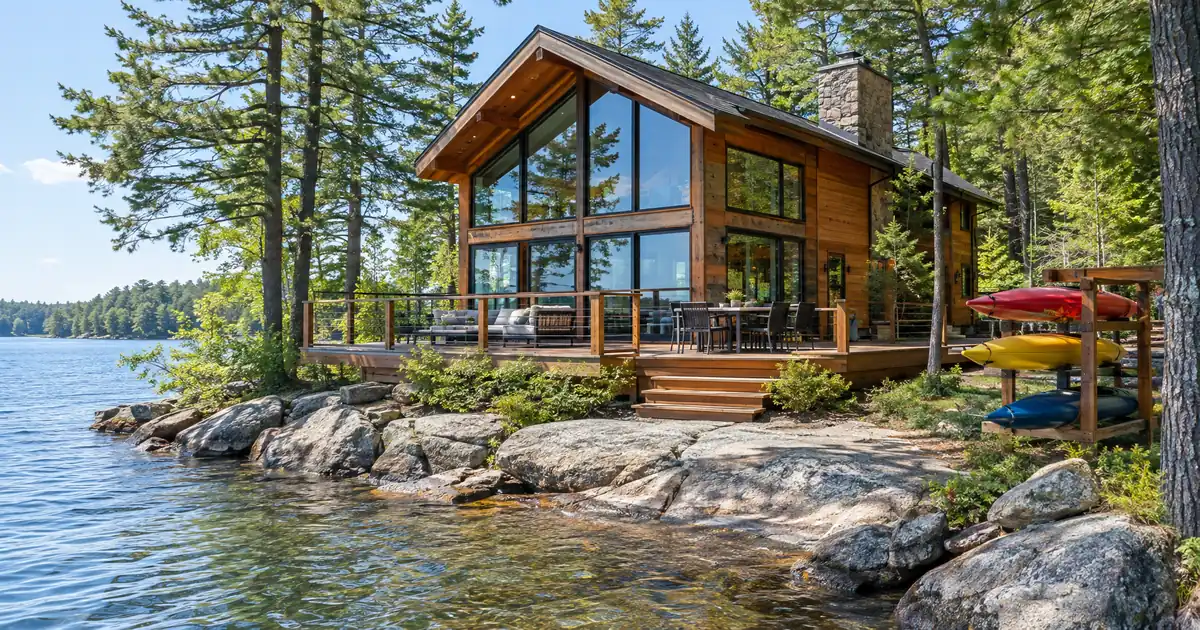
Second Home in Lake Arrowhead — The Quick Read: A cabin you plan to actually use is a consumer-purpose loan, not a DSCR investment loan, and that single fact decides which paperwork a lender wants. Bank statement programs qualify self-employed buyers on deposit history instead of traditional personal-income documentation, which matters when write-offs shrink taxable income on paper. Leverage on a second home runs a bit tighter than on a primary residence and steps down as the loan size grows. Above roughly $4,000,000, every file gets reviewed case by case before it goes anywhere.
Key Terms Defined
Second home: a property you occupy personally for part of the year, sitting between a primary residence and a pure rental investment property.
Bank statement loan: a non-QM mortgage that estimates income from 12 or 24 months of deposit history instead of traditional personal-income documentation or W-2s.
Non-QM: a mortgage that falls outside the Consumer Financial Protection Bureau’s Qualified Mortgage rulebook, which gives lenders more room on how they verify income.
Expense ratio: the percentage of gross deposits an underwriter subtracts before counting the rest as qualifying income, since a business account holds both revenue and overhead.
DSCR loan: a business-purpose loan that qualifies a rental property on its own rent instead of the borrower’s personal income, and is never available for a home you plan to occupy.
LTV (loan-to-value): the loan amount as a percentage of the purchase price or appraised value — the flip side of your down payment percentage.
Key Takeaways
- A genuine second home cannot be financed with a DSCR loan, no matter how the entity is titled or how the file is written up.
- Bank statement programs read cash flow instead of traditional personal-income documentation, which helps a self-employed buyer whose write-offs make taxable income look thin.
- Leverage on a second home in select wholesale programs runs roughly five points below a comparable primary-residence file at every size tier.
- Loan size and credit score both affect how much down payment a lender will ask for — bigger loans generally mean lower leverage.
- Above about $4,000,000, pricing and leverage stop following a published grid and get reviewed loan by loan.
What “Second Home” Actually Means for a Lake Arrowhead Cabin
Occupancy intent decides the loan category before anything else does. A primary residence is where you live full time. An investment property is one you never occupy. A second home sits in between — a place you use personally for part of the year, even if it also earns some rental income when you’re not there.
This distinction is not a formality. It is the line that determines whether the property can even be financed with a business-purpose DSCR loan or has to go through a consumer-purpose product like a bank statement mortgage. Federal rules treat credit extended for a rental property that isn’t owner-occupied as business purpose, but that special treatment falls away the moment an owner expects to occupy the property for more than 14 days a year, per eCFR 12 CFR 1026.3. Buy a Lake Arrowhead cabin planning three weeks of summer use and a few holiday weekends, and that property is a second home by definition — not a DSCR candidate.
This trips up plenty of investors who already own DSCR-financed rentals elsewhere. They assume the same product works for a personal getaway. It doesn’t. Occupancy plans decide the classification. It doesn’t matter how many other properties you already hold, or what entity is on the deed.
Why Bank Statement Underwriting Fits Self-Employed Buyers
Bank statement loans exist because taxable income and real cash flow often don’t match for business owners. A borrower can run substantial monthly deposits through a business account. Yet after legitimate deductions, that same borrower can still show a modest net income. This can shrink the debt-to-income math a tax-return underwriter uses.
Bank statement programs sidestep that by reading actual deposit history instead. Because bank statement loans sit outside that Qualified Mortgage framework, lenders in this space can build their own verification approach around deposit history instead of a return.
That doesn’t mean deposits get counted blindly. Underwriters trace and source large or irregular deposits to confirm they represent real, ongoing income rather than a one-time event like a property sale. A stack of bank statements with no context behind an unusual deposit is not enough on its own.
The Underwriting Walkthrough, Step by Step
Lendmire places files with several wholesale programs. A bank statement file for a second home purchase usually follows the same steps. The Consumer Financial Protection Bureau’s Ability-to-Repay standard says lenders must check several factors, including debt-to-income and credit history. Lenders must use reasonably reliable records to do this. You can read more in the CFPB Ability-to-Repay Summary.
Step 1 — Confirm occupancy classification. Before anything else, the file gets sorted into primary, second home, or investment. This choice locks in which loan family applies.
Step 2 — Pick 12 or 24 months. Most programs in the network let a borrower choose either window and run both calculations, then use whichever produces the stronger qualifying income. Twelve months tends to help a borrower whose income has grown recently; 24 months smooths out a rough patch.
Step 3 — Apply the expense ratio. Business account deposits get reduced by a set percentage before they count as income. Programs in this space commonly use a fixed expense ratio that varies with staffing and business type, with higher ratios applied as headcount or inventory needs grow, and larger operations or product-based businesses generally facing the steepest reductions. A borrower can also submit an accountant letter documenting a lower actual expense ratio, or use a profit-and-loss method capped at 80% of deposits. Transfers from the borrower’s own business into a personal account count in full, with no ratio applied.
Step 4 — Verify assets separately from income. Down payment, closing costs, and reserves get verified through a separate set of statements, seasoned in the account rather than freshly deposited before closing.
Step 5 — Order the appraisal. For a rental-relevant analysis on a one-unit property, appraisers commonly reference Fannie Mae’s Form 1007 rent schedule as a standard industry form — noted here purely as terminology, not as a rule that governs bank statement underwriting.
Down Payment and Leverage on a Second Home
Leverage on a second home runs roughly five points below what the same borrower could get on a primary residence, and it steps down as the loan size climbs. Every figure below is a ceiling through select wholesale programs, subject to full underwriting — never a guaranteed number.
| Loan Size | Purchase LTV | Credit Floor |
|---|---|---|
| $300K–$1M | up to 85% | 700+ |
| $1M–$1.5M | up to 80% | 680+ |
| $1.5M–$2M | up to 80% | 700+ |
| $2M–$2.5M | up to 80% | 720+ |
| $2.5M–$3M | up to 75% | 720+ |
| $3M–$4M | up to 65% | 760+ |
A $2.2 million cabin purchase, for example, might see up to 80% leverage with a strong credit profile — the down payment is a percentage of price, not a fixed dollar figure, and the calculator handles that conversion. Once a loan crosses roughly $3,000,000 on a second home, super-jumbo overlays kick in: a 700 credit floor, a clean 24-month housing payment history, 48 months of seasoning past any credit event, and U.S. citizenship or permanent residency. Cash-out proceeds also can’t be used to satisfy reserve requirements at that tier. Terms vary by lender guidelines, property type, leverage, credit profile, and full file review.
Where the Loan Size Ladder Changes the Math
Files up to about $6,000,000 generally run through a portfolio non-QM bank statement program. Above that, a separate bank portfolio program can carry a 12-month-statement file up to $30,000,000 on its own size ladder — roughly 65% leverage to $5,000,000, 60% to $10,000,000, and 55% up through $30,000,000, with interest-only capped at 60% or the band’s ceiling, whichever is lower.
Reserves scale with size too: 3 months of payments up to $500,000, 6 months up to $1,500,000, and 9 months above that, plus 2 additional months for each other financed property, up to a 12-month cap. A first-time investor — someone who has never owned a financed rental before — typically needs the full 12 months regardless of loan size.
Above roughly $4,000,000, every one of these figures is reviewed case by case before submission. That’s not a formality — pricing, leverage, and documentation all get individually underwritten at that tier rather than pulled off a published grid.
Where the General Rule Breaks
A few situations don’t fit the clean second-home-vs-investment split.
Light rental use alongside personal use. A cabin used personally most weekends but rented out occasionally generally still fits a second-home structure. Once rental income becomes central to why the property was bought and personal use shrinks to almost nothing, an investment-property or DSCR structure usually fits better.
No clean hybrid answer. Some buyers genuinely want meaningful personal use and rental income covering most of the carrying cost. There usually isn’t a single loan product built for both goals at once — the honest move is to decide which use case matters more and finance around that.
Occupancy misrepresentation carries real consequences. DSCR borrowers sign a business-purpose certification stating they will not occupy the property at any point while the loan is outstanding. Treating a cabin you actually use as a pure DSCR rental to chase easier qualification is a misrepresentation, not a workaround.
Converting a primary residence into a rental. A borrower vacating their current home for a new primary residence can sometimes refinance the old one into a DSCR loan once it becomes a true rental, with lease documentation and proof of the new residence supplied.
Local governance can complicate the rental story. Lake Arrowhead lake access runs through a homeowners association, and access rules for short-term renters have shifted over time. Short-term rental rules can vary by city, county, HOA, and property type, so buyers should confirm current local rules before relying on projected rental income to support any loan structure — DSCR or otherwise. Market data on the area’s short-term rental performance also matters here: Airbtics places Lake Arrowhead’s typical short-term rental yield in the lowest 6% nationally, which is a reason a “mostly personal, occasionally rented” second home rarely pencils as a real investment property in the first place.
Bank Statement vs. DSCR — Which Fits
DSCR loans are designed for non-owner-occupied investment properties. Because they are business-purpose investor loans, they are reviewed differently from a standard owner-occupied mortgage, qualifying primarily on property-level rental income covering the payment, subject to lender guidelines. Investment property leverage in select wholesale programs runs up to roughly 75% cash-out on a standard long-term rental and closer to 70% if the collateral is a short-term rental, with figures dropping further above $2,500,000 and reviewed case by case past $4,000,000.
Bank statement loans, by contrast, qualify the person rather than the property and can finance a primary residence, second home, or investment purchase — the occupancy tier just changes the leverage available. Readers comparing the two side by side in more depth can look at Lendmire’s DSCR loan vs. bank statement loan comparison, and anyone new to DSCR mechanics generally can start with the complete DSCR loans guide. Buyers looking at similar second-home scenarios in other resort markets may also find the second home in Naples breakdown useful for comparison.
Lendmire’s DSCR investor loan programs run through select lenders in 40 markets. This includes Washington, D.C. Lendmire’s consumer mortgage lending is licensed in 16 states. This includes bank statement second home loans. The states are Alabama, California, Colorado, Florida, Georgia, Indiana, Michigan, Montana, New Mexico, North Carolina, Ohio, Pennsylvania, Tennessee, Texas, Virginia, and Washington.
Common Misconceptions
“Non-QM means the same occupancy rules apply everywhere.” That’s not accurate. Non-QM describes how income gets documented, not how occupancy works. Bank statement loans can finance a primary residence, second home, or investment property. DSCR loans are structurally limited to non-owner-occupied property.
“An LLC converts a personal-use home into a business-purpose loan.” It doesn’t. Occupancy, use, and borrower intent decide loan purpose — the entity on title doesn’t change the facts.
“Any distance from your primary home makes a place a second home.” A mileage rule is a lender overlay in some corners of the industry, not a universal standard. What actually matters is whether the location makes sense for personal use.
“You can quietly stay in a DSCR-financed property sometimes.” No. Living in a property financed with a DSCR loan violates the loan agreement — this is a fundamental requirement, not a guideline with wiggle room.
Tax treatment can depend on how the funds are used and how the property is held; investors should keep clear records and speak with a qualified tax professional before relying on any deduction.
Frequently Asked Questions
Can I use bank statements to qualify for a Lake Arrowhead cabin I plan to visit myself? Yes. A property you intend to occupy personally is a second home or primary residence by definition, and bank statement programs are built for exactly that consumer-purpose scenario, unlike DSCR loans which require non-occupancy.
Do I need two years of self-employment to qualify? Most programs in the network want an established self-employment history, though some allow one year if the borrower is staying in the same industry or role. Requirements vary by lender, so this depends on the specific program and file.
What credit score do I need for a second home bank statement loan? Select wholesale programs generally start around a 700 credit floor at smaller loan sizes, climbing to 760 once the loan crosses into super-jumbo territory above roughly $3,000,000. Every figure is a typical range, not a guarantee.
Can rental income from occasional short-term stays help me qualify? On a second home, rental income generally isn’t the basis for qualification — bank statement income and assets carry that role. If rental income is meant to be the primary driver of the purchase, an investment-property or DSCR structure is usually the better fit.
What happens if my loan is above $4,000,000? Every file at that size gets reviewed case by case before submission rather than following a fixed leverage grid, and documentation, reserves, and pricing all get evaluated individually.
Are you weighing a second home purchase or an investment property in a market like Lake Arrowhead? Lendmire can help you compare bank statement and DSCR loan options. This comparison looks at your income documentation, credit profile, leverage needs, and occupancy plans.
For current guidelines and terms, see Lendmire’s super jumbo bank statement loan programs page.
Self-employed borrowers can compare both super jumbo programs on Lendmire’s self-employed mortgages page.
About Lendmire
Lendmire (NMLS# 2371349) is a mortgage brokerage built around DSCR investor lending, with programs available in 40 markets, including Washington, D.C. DSCR lenders commonly evaluate rental-income coverage instead of personal income paperwork — a practical fit for LLC-owned and multi-property investors. Terms vary by lender, property, leverage, and program. Scotsman Guide named Lendmire a Top Mortgage Workplace in both 2025 and 2026.
Get Started
Ready to find the right loan for you?
In about 30 seconds you can review financing options available for your home or investment property. No commitment required.
Informational only. Not a Loan Estimate, approval, or commitment to lend. Program availability and eligibility are subject to lender guidelines, credit approval, property review, and underwriting.
References
1. eCFR 12 CFR 1026.3 (Regulation Z exempt transactions)
2. CFPB Ability-to-Repay Summary
3. Airbtics — Lake Arrowhead Airbnb Data
Brandon Miller
Founder & CEO, Mortgage Loan Originator, Lendmire LLC
- Mortgage Loan Originator · NMLS# 1129696 · Verify on NMLS Consumer Access
- North Carolina Real Estate Broker · License# 343312 · Verify on NCREC
- North Carolina Insurance Producer · License# 19053198 · Property, Casualty, Life, Health · Verify on NAIC SBS
- Lendmire LLC · Firm NMLS# 2371349 · Verify firm licensure
Disclosures. The information presented in this article is general market commentary, not financial, legal, or tax advice. Lendmire is a mortgage brokerage (NMLS# 2371349) — not a direct lender or depository institution — and loan placement is subject to lender underwriting. Nothing in this content represents a commitment to lend. Loan terms, pricing, and program availability vary based on borrower qualifications, property characteristics, and state of subject property, and are subject to change at any time. Lendmire complies with Equal Housing Opportunity requirements. Consumer access: nmlsconsumeraccess.org.


