
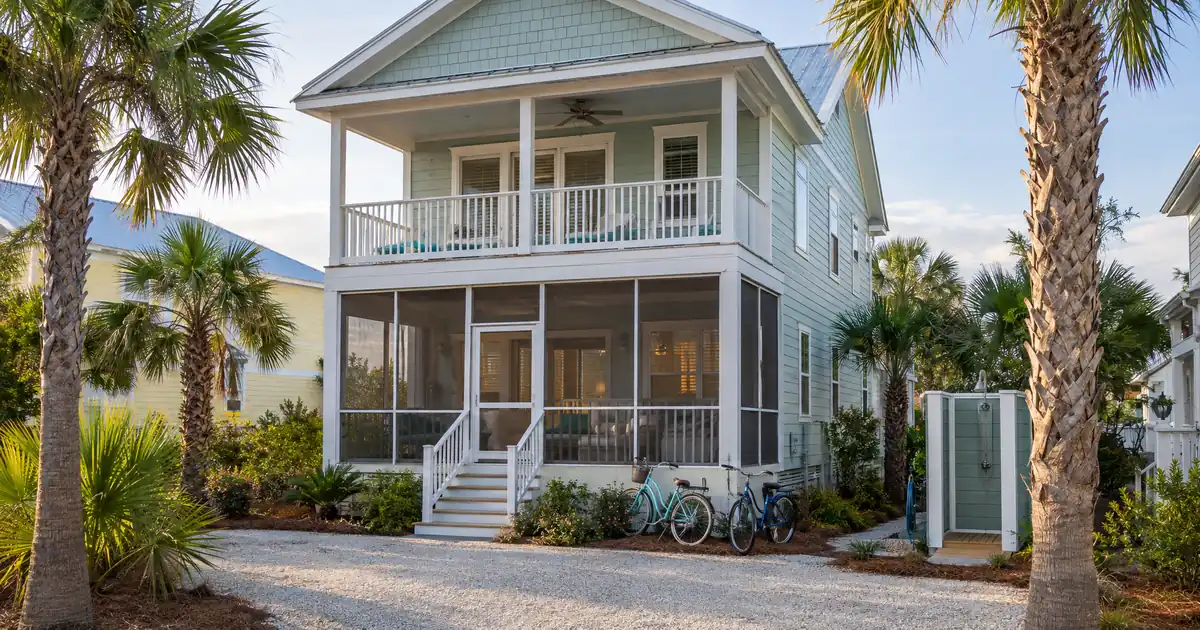
Second Home in Hilton Head Island — The Quick Read: Financing a second home in Hilton Head Island on bank statements means a lender is reviewed against 12 or 24 months of deposit history instead of traditional personal-income documentation. This works well for self-employed buyers whose write-offs make their taxable income look thin. Leverage runs lower than a primary residence, credit needs to clear a higher floor, and loans over roughly $3 million to $4 million get individual underwriter review rather than a fixed leverage number. The mechanics are consistent across price points — it’s the size of the loan that changes how much flexibility is left on the table.
Key Takeaways
- Bank statement loans replace traditional personal-income documentation with deposit history — usually 12 or 24 consecutive months of personal or business statements.
- Second-home leverage typically runs about five points below what the same borrower could get on a primary residence, at every loan size.
- Loans above roughly $3 million to $4 million on a second home move into case-by-case underwriter review rather than a published leverage figure.
- The distinction between “second home” and “investment property” is not just paperwork — it can change pricing, reserves, and how the file is documented.
- A separate program, DSCR financing, exists for buyers who want to qualify off the property’s own rental income instead of personal deposits — worth understanding as an alternative path.
Key Terms Defined
Bank statement loan — a mortgage where the lender calculates your income from bank deposits over a set lookback period, instead of from traditional personal-income documentation.
Expense ratio — a percentage the underwriter subtracts from business-account deposits to estimate the cost of running the business, since not every dollar deposited is personal income.
Loan-to-value (LTV) — the loan amount expressed as a percentage of the home’s price or appraised value; an 80% LTV means the loan covers 80% of the value and the rest comes from the down payment or existing equity. Exact terms depend on the lender’s guidelines, property type, leverage, and a full review of the borrower’s file.
Second home — a property you personally use part of the year, that isn’t part of a rental pool and isn’t controlled by a property manager on your behalf; this is a mortgage-industry classification, and it’s different from how the IRS defines a vacation home for tax purposes.
Case-by-case review — a manual underwriting decision made file by file at larger loan sizes, rather than an automatic leverage number pulled from a published grid.
What Counts as a Second Home, and Why It Matters for Financing
A second home is a property you occupy part of the year and control yourself. It isn’t rented out through a management company, and it isn’t booked as a short-term rental most of the time. That single distinction — personal use and control versus rental-pool participation — is the line lenders draw between second-home financing and investment-property financing. It changes the leverage available at every price point.
Hilton Head Island sells itself on exactly the ambiguity that trips buyers up here. Take a villa in Sea Pines or a home near Palmetto Dunes: the family might use it for six or eight weeks a year and rent it out through a management company the rest of the time. That’s a common ownership pattern on the island. It’s also the scenario most likely to get reclassified from “second home” to “investment property” during underwriting — a distinction covered in more depth in Lendmire’s comparison of DSCR loans versus bank statement loans for investors. If you’re planning heavy short-term rental activity with a management agreement controlling bookings, the file usually needs to be underwritten as investment property from the start. It’s better to set this up correctly from the beginning than to adjust it later.
Home values on the island sit well above the national median, which raises the stakes of getting the classification right. Zillow puts the average home value in Hilton Head Island at $789,690, up 2.9% over the past year, while Redfin shows a median sale price near $772,000, up 8.0% year over year. At those prices, a five-point swing in available leverage — the typical gap between second-home and primary-residence terms — moves real money either into or out of the down payment column.
How the Underwriting Actually Works, Step by Step
The underwriter’s job is to turn a stack of bank statements into one usable monthly income number, then decide if that number, along with your credit and reserves, supports the loan you’re asking for. Here’s the sequence in practice, across the wholesale programs Lendmire places these files with.
Step one: gather the statements. Twelve or twenty-four consecutive months of bank statements, personal or business, depending on the program and how the income flows. The bank portfolio program in our network uses a fixed 12-month lookback; the broader portfolio non-QM program can run either 12 or 24 months. Statements need to be consecutive — a transaction history printout from the bank doesn’t substitute.
Step two: separate personal and business deposits. If the statements are personal, most of the deposits typically count toward income directly. If they’re business statements, an expense ratio gets applied first — a fixed percentage based on business type and staffing level gets subtracted before the remaining deposits are averaged into monthly income. An accountant-prepared ratio, or a profit-and-loss method capped at 80%, can sometimes replace the fixed grid. Business ownership generally needs to be at least 25% for the statements to count.
Step three: exclude the noise. Underwriters strip out transfers between the borrower’s own accounts, loan proceeds, and other non-income deposits before calculating the average. This is the manual, line-by-line part of the file — there’s no automated system built for deposit-based income the way there is for traditional personal-income review, so a human underwriter reviews every statement.
Step four: credit, reserves, and debt-to-income. The calculated income feeds into a standard debt-to-income calculation, typically allowed up to 50% on these programs. Credit needs to clear a 660 floor on the portfolio non-QM program (680 on the bank program, and 700 once a loan crosses the super-jumbo threshold discussed below). Reserves — verified liquid funds left over after closing — typically scale with loan size, running higher as the balance climbs, plus two additional months for each other financed property you own, capped at twelve months total, with the exact timing and documentation depending on the file and lender.
Step five: decision. Once the file is complete and documentation is clean, the underwriter renders a decision based on the calculated income, the credit profile, and the property. Getting a CPA-prepared profit-and-loss statement in front of underwriting before the review — not scrambling to produce one after a question comes back — is consistently the difference between a smooth file and a stalled one.
The Structures and Variations That Exist
Bank statement financing isn’t one program — it’s a family of documentation paths, and the right one depends on how your income actually shows up.
Personal statements versus business statements. Personal account income generally avoids the expense-ratio haircut that business accounts carry, which can mean a higher qualifying income for the same deposit total. Some lenders in the network will still work with a co-mingled account that mixes personal and business activity, but most prefer the two kept separate from day one — it simplifies the math and speeds up the review.
Transfers from your own business. If you move money from a business account into a personal account you control, that transfer typically counts at 100% toward qualifying income, since it’s already your money moving between accounts you own.
Asset-based alternatives. For borrowers whose liquid net worth tells a stronger story than their deposit history, an asset allowance path divides total liquid assets by 36, 60, or 84 months to generate a monthly income figure — the 84-month version is standalone or required above $3.5 million in loan amount. A separate assets-only path skips income calculation entirely, requiring liquid U.S. assets equal to the loan amount, closing costs, and 60 months of any net loss on other residential real estate you own. Retirement accounts count toward these calculations at 70% of value (80% if you’re past 59½); business funds, gifts, trusts other than a revocable living trust, unvested stock, and cryptocurrency don’t count at all.
Interest-only structuring. For borrowers managing cash flow rather than paying down principal aggressively, interest-only is available up to 85% LTV with a 700 credit floor on the portfolio program (structured as a 40-year term with a 10-year interest-only period), and up to 60% LTV on the bank program using five- and seven-year fixed-period adjustable structures. Every figure here varies by lender and program — guidelines, property type, leverage, and credit profile all apply.
For the mechanics of how DSCR loans differ — qualifying off the property’s own rental income rather than the borrower’s personal cash flow — Lendmire’s complete DSCR loans guide walks through that separate path in full.
Loan Sizes and Leverage on a Second Home
Leverage on a Hilton Head second home steps down as the loan gets bigger, and it runs roughly five points below what the same borrower could get financing a primary residence at the same price point.
| Loan Amount | Purchase LTV | Credit Floor | Notes |
|---|---|---|---|
| $300K–$1M | 85% | 700+ | Standard bank-statement second-home terms |
| $1M–$1.5M | 80% | 680+ | |
| $1.5M–$2M | 80% | 700+ | |
| $2M–$2.5M | 80% | 720+ | |
| $2.5M–$3M | 75% | 720+ | Super-jumbo overlays begin above this band |
| $3M–$4M | 65% | 760+ | Case-by-case review |
| $4M–$5M | 65% | 760+ | Case-by-case review |
| $5M–$30M | 50–55% | 680+ | Bank portfolio program’s own size ladder |
Loans run from $300,000 up to $30,000,000 through two distinct wholesale channels in Lendmire’s network. A portfolio non-QM bank-statement program carries files to $6,000,000. A separate bank portfolio program, using 12-month statements only, carries files up to $30,000,000 on its own leverage ladder — roughly 65% at the top up to $5,000,000, stepping to 60% up to $10,000,000, and 55% up to $30,000,000, with interest-only capped at 60% or the band’s ceiling, whichever is lower. Everything above $4,000,000 gets individual review before it’s even submitted — there’s no flat “up to” figure that applies automatically at that size, on a second home or otherwise.
Above $3,000,000 on a second home, a set of super-jumbo overlays kicks in, no matter which program the file runs through. These include: a 700 credit floor; a clean 24-month housing payment history with no late payments in the prior 24 months; a 48-month waiting period after any credit event like a bankruptcy or foreclosure; U.S. citizenship or permanent residency; no non-occupant co-borrowers; no rural properties; a ten-acre maximum; and cash-out proceeds that can’t count toward reserve requirements. Final terms depend on lender guidelines, property type, leverage, and the borrower’s complete credit picture.
Here’s a pattern worth knowing. Some files mix heavy short-term-rental income into the bank deposits, even when the property is meant to be a genuine second home. These files tend to draw more underwriter scrutiny than files with clean, separated personal and business statements. You can get ahead of this. Before the file goes to underwriting, explain clearly what counts as rental income and what counts as personal deposits. That step avoids a round of follow-up questions later.
Where the General Rule Breaks: Edge Cases
The standard second-home path assumes light personal use and no rental control. Several situations push a file outside that assumption.
Heavy short-term rental activity. If bookings run through a management company and personal use is limited to a few weeks a year, many lenders will treat the loan as investment property rather than second home, regardless of what the buyer intends the property to feel like. That reclassification changes leverage, reserves, and documentation — it’s worth confirming with your lender how the property will be classified before you write an offer, not after.
The IRS’s separate 14-day rule. Mortgage occupancy classification and tax classification are two different tests run by two different institutions. Under IRS guidance, if you rent a dwelling for fewer than 15 days in a year, you don’t report the rental income and you don’t deduct rental expenses — but that threshold has nothing to do with how your lender classifies the loan. A property can be a second home for mortgage purposes and still fail the IRS’s personal-use test depending on how many nights it gets rented out. Tax treatment can depend on how the funds are used and how the property is held; investors should keep clear records and speak with a qualified tax professional before relying on any deduction.
Condotels and non-warrantable condos. Hilton Head has plenty of condo-hotel and resort-style ownership, and those carry their own leverage caps — 75% purchase leverage on condotels through the portfolio program, dropping to 65% on cash-out (50% on the bank program). Non-warrantable condos generally cap at 80%. These caps apply on top of, not instead of, the size-based leverage ladder above.
Rural and acreage limits. Second-home financing on these programs stops at ten acres and never exceeds $3,000,000 on a rural property, regardless of how strong the borrower’s file otherwise looks.
Cash-out on a second home. Cash-out leverage runs consistently lower than purchase leverage at every size band, and above 60% LTV on the portfolio program, cash-in-hand proceeds cap at $1,500,000. The bank program has no published cash-out cap, but every cash-out request above $4,000,000 still goes through the same case-by-case review as any other large loan. These specifics are subject to lender guidelines and a full review of property, leverage, and credit.
What the Decision Looks Like in Practice
Bank statement financing exists to help self-employed buyers, physicians, business owners, or anyone whose tax documents understate their real cash flow. It bridges the gap between what your tax returns show and what you actually earn. Qualification runs on your documented deposit history, not a tax-return-derived income figure, subject to lender guidelines. There’s a trade-off, though: it comes down to leverage. A buyer with strong deposits but a loan size north of $3 million should expect a lower LTV ceiling and a higher credit bar than the same buyer would face on a $700,000 purchase.
Two questions usually settle which path makes sense. First: how will the property actually get used — genuine personal use most of the year, or a rental-heavy schedule run through a management company? That answer decides whether the file should even be structured as a second home. Second: does the borrower’s personal deposit history or the property’s own rental income tell the stronger qualifying story? If it’s the property’s income, a DSCR loan — the subject of Lendmire’s DSCR loan versus bank statement loan comparison — may be the more direct route, since it qualifies off the rental cash flow the property itself produces rather than the owner’s personal accounts.
DSCR loans are for business purposes, not for homes you live in. So lenders review them differently than a standard owner-occupied mortgage. That’s a separate underwriting conversation from the bank statement path covered here. But buyers often weigh both options side by side.
Short-term rental rules can vary by city, county, HOA, and property type, so investors should confirm local rules before relying on projected rental income anywhere in a loan file.
If you’re weighing bank statement financing against other second-home or vacation-property strategies, Lendmire’s coverage of second-home financing in Palm Desert walks through a comparable market where the same second-home-versus-investment-property question comes up constantly.
Frequently Asked Questions
Do I need 12 months or 24 months of bank statements?
It depends on the program. The bank portfolio program in Lendmire’s network uses a fixed 12-month lookback, while the broader portfolio non-QM program can run either 12 or 24 months depending on the file. A longer lookback sometimes helps smooth out an uneven deposit pattern, but it also means more paperwork to assemble up front.
Can I use rental income from Airbnb to help qualify on a second-home bank statement loan?
Rental deposits mixed into your bank statements typically get scrutinized carefully, and heavy rental activity can push the file into investment-property classification instead of second-home. If the plan includes significant short-term rental income, it’s worth discussing upfront whether the loan should be structured as investment property or whether a DSCR loan, qualifying off the property’s own income, fits better.
What credit score do I need for a bank statement second home?
Most files clear with a 660 credit floor on the portfolio program, though the bank program and any loan above the super-jumbo threshold — roughly $3 million on a second home — typically require 700 or higher. Exact requirements depend on loan size, reserves, and the overall file, subject to lender guidelines.
Why does leverage drop so much once the loan gets over $3 million?
Larger loans carry more underwriting risk on any non-owner-occupied or lightly-used property, so lenders in the network apply stricter overlays above that threshold — tighter housing-history requirements, longer seasoning after a credit event, and case-by-case review instead of a fixed leverage grid. It’s not a penalty; it’s how these programs manage exposure at size.
Is a bank statement loan the same as a stated-income loan from before the housing crash?
No. Bank statement programs require actual, verified deposit history and a calculated monthly average — not a borrower’s self-reported income figure. The underwriting is manual and documentation-heavy, which is a meaningfully different process from pre-2008 stated-income lending.
Are you trying to decide whether bank statement financing or DSCR financing fits your Hilton Head purchase better? Lendmire can help. We’ll compare the leverage, documentation, and reserve requirements across both paths based on your income profile, credit, and the property itself. Terms vary by lender guidelines, property type, leverage, credit profile, and full file review.
For current guidelines and terms, see Lendmire’s super jumbo bank statement loan programs page.
Self-employed borrowers can compare both super jumbo programs on Lendmire’s self-employed mortgages page.
About Lendmire
Lendmire — NMLS# 2371349 — is a mortgage brokerage specializing in DSCR investor loans, helping arrange financing across 40 markets, including Washington, D.C., through wholesale and investor-lending channels. The model centers on property-level rental income reviewed by the lender rather than W-2 documentation, subject to lender guidelines, suiting entity-owned and multi-property investors. Lendmire holds Scotsman Guide Top Mortgage Workplace recognition for 2025 and 2026.
Lendmire’s Top Mortgage Workplace recognition is documented by Scotsman Guide 2025 Top Mortgage Workplace and Scotsman Guide 2026 Top Mortgage Workplace.
Get Started
Ready to find the right loan for you?
In about 30 seconds you can review financing options available for your home or investment property. No commitment required.
Informational only. Not a Loan Estimate, approval, or commitment to lend. Program availability and eligibility are subject to lender guidelines, credit approval, property review, and underwriting.
References
1. Zillow — Hilton Head Island, SC Housing Market
2. Redfin — Hilton Head Island Housing Market
3. IRS Topic No. 415 — Renting Residential and Vacation Property
Brandon Miller
Founder & CEO, Mortgage Loan Originator, Lendmire LLC
- Mortgage Loan Originator · NMLS# 1129696 · Verify on NMLS Consumer Access
- North Carolina Real Estate Broker · License# 343312 · Verify on NCREC
- North Carolina Insurance Producer · License# 19053198 · Property, Casualty, Life, Health · Verify on NAIC SBS
- Lendmire LLC · Firm NMLS# 2371349 · Verify firm licensure
Disclosure information. Lendmire is a state-licensed mortgage brokerage under NMLS# 2371349. Lendmire is not a depository institution, direct lender, or financial advisor — all loans referenced are placed through wholesale lender partners and are subject to each lender's underwriting standards. This article is provided for general informational purposes and is not a commitment to lend, nor does it constitute financial, legal, or tax advice. Loan programs, terms, rates, and qualification standards change without notice and depend on borrower profile, property type, and the state in which the subject property is located. Equal Housing Opportunity provider. NMLS Consumer Access: nmlsconsumeraccess.org.


