
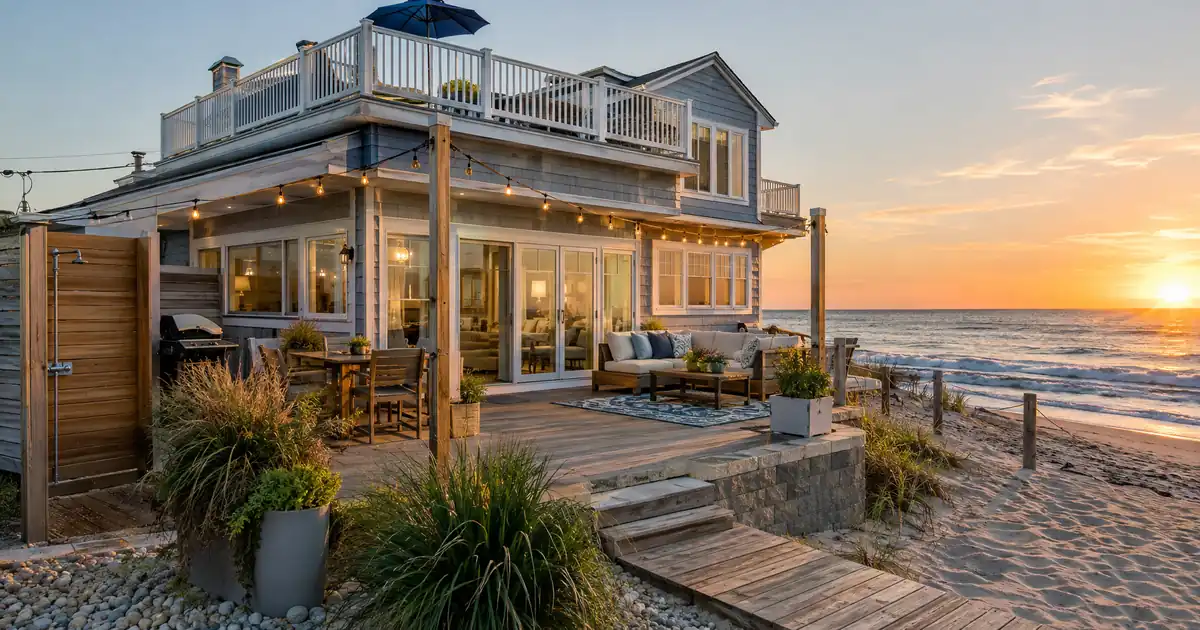
Financing A Second Home In Bald Head Island On Bank Statements — The Quick Read: A bank statement loan lets a self-employed or business-owning buyer qualify using deposit history instead of traditional personal-income documentation, and it’s usually the right tool for a Bald Head Island purchase when the buyer plans genuine personal use. The bigger underwriting wrinkle here isn’t income documentation — it’s flood insurance, because parts of the island sit inside Coastal Barrier Resources System boundaries where standard federal flood coverage can be restricted. Get the occupancy classification and the flood determination right early, and the deal works the way any well-documented bank statement purchase moves.
Key Takeaways
- Bank statement loans qualify a borrower on 12 or 24 months of deposit history instead of traditional personal-income documentation — they’re consumer-purpose, occupancy-based products, not DSCR loans.
- Second home vs. investment property classification hinges on personal use, not on whether the buyer already owns rental property elsewhere.
- Bald Head Island’s barrier-island geography means some parcels may fall inside Coastal Barrier Resources System boundaries, where standard NFIP flood coverage can be limited or unavailable depending on construction date.
- No bridge connects the island to the mainland — appraisals, inspections, and closings all run on ferry schedules, which appraisers and closing agents need to plan around.
- Leverage on a bank statement second home purchase typically runs from the mid-80s down into the 60s as loan size climbs, through select lenders in Lendmire’s wholesale network, subject to underwriting.
Why Bank Statement Financing Fits This Market
Most Bald Head Island buyers don’t fit a W-2 underwriting box. The buyer pool leans toward business owners, professionals with complex compensation, and high-net-worth purchasers. These buyers often don’t want to hand over two years of traditional personal-income documentation. That’s because their traditional income documentation tends to understate their real income anyway.
A bank statement loan solves that problem. It uses 12 or 24 months of personal or business bank deposits to calculate qualifying income. For business accounts, an expense ratio is applied before arriving at an usable figure. It’s still a fully documented mortgage. Non-QM doesn’t mean undocumented — it means the documentation method is different from the standard tax-return model.
That distinction matters because Bald Head Island properties are almost universally marketed and comped as vacation rentals, even when the buyer’s real intent is personal use. The loan program that fits depends on which one is actually true.
Second Home, Investment Property, or DSCR — Which One Applies?
Occupancy decides the classification, not investor history. A primary residence is occupied full-time. An investment property is never occupied by the borrower. A second home sits between the two — it allows personal use while still permitting occasional rental.
This trips up investors who already run a DSCR-financed rental portfolio. They assume the same product covers a Bald Head Island purchase, but it usually doesn’t. DSCR loans are designed for non-owner-occupied investment properties. Because they are business-purpose investor loans, they are reviewed differently from a standard owner-occupied mortgage.
If the plan is meaningful personal use — weeks at a time on the island during the year — with light rental in the off-months, a second home structure fits. If rental income is the actual point of the purchase and personal use is minimal, an investment-property or DSCR structure fits better. There’s no single fixed day-count that draws the line across every program; the underlying expectation is that the borrower genuinely uses the home as a residence for part of the year rather than handing it entirely to a rental manager.
Short-term rental rules can vary by city, county, HOA, and property type, so investors weighing the rental side of that decision should confirm local rules before relying on projected rental income.
For investors comparing this decision against similar coastal markets, the same occupancy test applies to a second home in Hilton Head Island or a second home in Wrightsville Beach — the underwriting logic doesn’t change with the zip code.
How the Underwriting Actually Works, Step by Step
The mechanics run in a fixed order.
Statement collection. Twelve or 24 consecutive months of personal or business bank statements go into the file. Transaction histories don’t substitute — the underwriter needs the actual statements.
Income calculation. Average monthly deposits get calculated, and for business accounts, a fixed or accountant-provided expense ratio reduces that figure to usable income. Through select lenders in Lendmire’s wholesale network, that ratio typically rises with business size and complexity — running lower for a service business with no employees, higher for a business with several employees, and higher still for a larger operation or any business selling a product, subject to each lender’s guidelines. Money the borrower transfers from their own business into a personal account counts in full.
Ownership threshold. Borrowers using business statements typically need at least a 25% ownership stake in that business, subject to lender guidelines.
Credit, reserves, and DTI run alongside the income review — bank statement underwriting replaces the documentation method, not the rest of the file. Debt-to-income can run up to roughly 50% on most files, and reserve expectations generally scale with loan size — commonly three months of payments on smaller loans, stepping up toward nine months on larger ones, plus additional months for other financed properties.
Appraisal. Because a genuine second-home purchase isn’t being qualified on the property’s own rental income, the standard one-unit appraisal applies rather than the income-focused forms. On the agency side, when a property’s rental income is used to qualify, Fannie Mae’s Selling Guide calls for the comparable rent schedule or small residential income property report — but those forms aren’t the operative document on a bank statement second-home file the way they would be on an investor-purpose loan.
Flood determination. This is the step that most often surprises Bald Head Island buyers, and it deserves its own section.
The Flood Insurance Wrinkle Almost Nobody Flags Early
Bald Head Island is a barrier island, and parts of it may fall inside federally designated Coastal Barrier Resources System boundaries — where standard NFIP flood insurance can be restricted or unavailable. This is a documented, property-specific issue on this island, not a generic coastal disclaimer.
Congressional testimony from the early 2000s described this exact problem for a section of Bald Head Island called NC07P. Inaccurate mapping denied flood insurance to some property owners. The problem came from how coastal barrier lines translated onto actual property boundaries. The U.S. Fish and Wildlife Service confirms the underlying rule. Federal flood insurance through NFIP is generally not allowed inside Coastal Barrier Resources System units. There’s an exception if the structure was built, or permitted and under construction, before the relevant prohibition date.
That exception is why a construction-date check matters as much as a flood-zone check. The village government confirms that Bald Head Island does participate in the National Flood Insurance Program generally. Structures inside a Special Flood Hazard Area carry roughly a 26% chance of flooding over a standard 30-year mortgage term. But NFIP participation at the village level doesn’t automatically mean every individual parcel qualifies. A property sitting inside a CBRS unit built after the prohibition date can be shut out of standard coverage, regardless of the village’s overall program status.
Buyers shouldn’t assume either way. A formal property-level check through the CBRS determination process is worth running early in the transaction. Run it before the file is far enough along that a flood-coverage surprise becomes a closing problem. If a property can’t secure standard NFIP coverage, private flood insurance usually fills the gap. Because a bank statement loan is reviewed for the borrower’s personal debt-to-income, rather than a rental coverage ratio, that insurance cost flows directly into the monthly obligation used in underwriting. This differs from a DSCR file, where the insurance cost would instead affect the coverage ratio.
Ferry Access Shapes the Transaction Timeline
There’s no bridge to Bald Head Island — buyers, appraisers, and closing agents get there by ferry, a roughly three-mile crossing from Southport, North Carolina. That’s not a lifestyle footnote; it’s a logistics fact that affects how the deal works.
Appraisers have to schedule around ferry departures instead of driving up whenever they want. The same goes for inspectors and closing agents coordinating signatures. A lender’s standard appraisal turn-time assumptions are built for a drive-to market. Those assumptions don’t automatically hold on an island where access runs on a boat schedule rather than a road.
The buyer pool also skews cash-heavy, especially at the luxury end, which thins the pool of financed comparable sales an appraiser can pull from. That’s a practical appraisal-support issue worth flagging early, not a regulatory one.
What Leverage Actually Looks Like on a Second Home Purchase
Leverage steps down as loan size climbs, and it’s roughly five points lower across the board on a second home compared to a primary residence of the same size. These figures reflect typical ranges through select lenders in Lendmire’s wholesale network, subject to underwriting on every file — never a guarantee.
| Loan Size | Purchase | Rate-Term Refi | Cash-Out | Typical Credit Floor |
|---|---|---|---|---|
| $300K–$1M | 85% | 85% | 75% | 700+ |
| $1M–$1.5M | 80% | 80% | 75% | 680+ |
| $1.5M–$2M | 80% | 80% | 75% | 700+ |
| $2M–$2.5M | 80% | 80% | 70% | 720+ |
| $2.5M–$3M | 75% | 75% | 60% | 720+ |
Bald Head Island’s own price points map onto most of that ladder. Condos and villas typically start in the mid-to-high $600s, single-family homes in the island’s maritime forest often begin around $1 million, and undeveloped lots range from roughly $94,500 up to nearly $2 million, according to local market coverage from Bald Head Island real estate brokerages.
Above $3 million on a second home, super-jumbo overlays apply — a 700 credit floor, clean housing history, and case-by-case review before submission. Above $4 million, every file gets that same case-by-case treatment regardless of the exact size, and any leverage figure at that level should be read as a starting point for underwriting discussion, not a promise.
Sizing the Loan Above the Standard Ladder
For buyers purchasing at the top of the Bald Head Island market — larger maritime forest estates or oceanfront compounds — loan sizing runs through two overlapping wholesale channels. A portfolio non-QM bank statement program carries files to $6 million. A separate bank portfolio program, built around 12-month statements, carries files all the way to $30 million on its own leverage ladder: roughly 65% to $5 million, 60% to $10 million, and 55% up to $30 million, with interest-only capped at 60% or the tier’s ceiling, whichever is lower. Both tracks are reviewed loan by loan, and neither is a fixed “up to” figure — they’re bands, not guarantees.
For buyers who’d rather qualify on liquidity than deposit history, an asset-based path exists too. Liquid assets can be divided across 36, 60, or 84 months to support qualifying income, or a standalone assets-only path can work with no debt-to-income calculation at all if liquid assets cover the loan amount, closing costs, and a cushion for any documented loss on other real estate. Retirement accounts typically count at a reduced rate — commonly 70%, or 80% for a borrower over 59½ — while business funds, gifts, and unvested stock generally don’t count at all.
Key Terms Defined
Bank statement loan: A non-QM mortgage that qualifies a borrower using average monthly bank deposits instead of conventional personal-income paperwork.
Non-QM: Short for non-qualified mortgage — a loan underwritten outside the federal Qualified Mortgage documentation standard, using an alternative but still fully documented income method.
Second home: A property the borrower personally occupies for part of the year, with occasional rental permitted without changing the loan classification.
Coastal Barrier Resources System (CBRS): A federally designated set of undeveloped coastal areas where standard federal flood insurance is generally restricted, with limited exceptions tied to construction date.
Expense ratio: A percentage deducted from gross business deposits to estimate real usable income before it’s used to qualify a borrower.
DSCR loan: A business-purpose investor loan that qualifies primarily on a rental property’s own income covering the payment, rather than on the borrower’s personal income — a different tool from a second-home purchase loan.
Frequently Asked Questions
Can I use a DSCR loan to buy a Bald Head Island vacation home I plan to use myself?
Generally no, if personal use is the real intent — DSCR loans are structured for non-owner-occupied investment property, and occupancy classification, not investor history, decides which loan fits. A property the buyer plans to occupy for real personal time typically needs a second-home or bank statement structure instead.
What if I want to rent the property out most of the year and only visit occasionally?
That leans toward an investment-property or DSCR structure rather than a second home. The more central rental income is to the purchase decision, and the less personal use involved, the more the file looks like an investment property to an underwriter.
Does owning other rental properties financed with DSCR loans help me qualify here?
Not directly. Existing rental income from other properties can support reserves and overall financial strength, but it doesn’t change how this specific purchase gets classified. The occupancy test applies property by property.
How do I know if a specific lot or home is inside a CBRS boundary?
There’s no way to assume it either way from a map glance — a formal check through the CBRS Mapper tool or an official property determination is the reliable way to confirm status before relying on standard flood coverage assumptions.
Does the ferry-only access affect financing itself, or just the closing logistics?
It mainly affects logistics — appraisal scheduling, inspection access, and closing coordination — rather than the loan terms themselves. Building extra lead time into the schedule for anyone who needs to physically visit the property is the practical takeaway.
Are you weighing a Bald Head Island purchase against the numbers for a personal residence versus a rental? Lendmire’s complete DSCR loans guide breaks down the investor-purpose side of that comparison. Its team can also help you sort through bank statement, asset-based, or DSCR options based on how you actually plan to use the property.
Tax treatment can depend on how the funds are used and how the property is held; investors should keep clear records and speak with a qualified tax professional before relying on any deduction.
Are you exploring a second home purchase? Do you want to see how bank statement qualification, leverage, and reserves work together for your situation? Lendmire can help you compare financing paths. This comparison is based on your income documentation, credit profile, and how you plan to use the property.
For current guidelines and terms, see Lendmire’s super jumbo bank statement loan programs page.
Self-employed borrowers can compare both super jumbo programs on Lendmire’s self-employed mortgages page.
About Lendmire
Lendmire is a non-QM mortgage brokerage (NMLS# 2371349) arranging DSCR investor loans in 40 markets, including Washington, D.C., through wholesale and investor-lending channels. DSCR loans are evaluated by the lender on rental income rather than personal income, subject to lender guidelines — a fit for LLC-owned portfolios, self-employed investors, and operators scaling beyond conventional loan caps. Recognized as a Scotsman Guide Top Mortgage Workplace in 2025 and 2026.
Lendmire’s Top Mortgage Workplace recognition is documented by Scotsman Guide 2025 Top Mortgage Workplace and Scotsman Guide 2026 Top Mortgage Workplace.
Get Started
Ready to find the right loan for you?
In about 30 seconds you can review financing options available for your home or investment property. No commitment required.
Informational only. Not a Loan Estimate, approval, or commitment to lend. Program availability and eligibility are subject to lender guidelines, credit approval, property review, and underwriting.
References
1. Fannie Mae Selling Guide — Rental Income
2. U.S. Fish and Wildlife Service — Federal Flood Insurance and CBRA
3. Village of Bald Head Island — Flood Protection
Brandon Miller
Founder & CEO, Mortgage Loan Originator, Lendmire LLC
- Mortgage Loan Originator · NMLS# 1129696 · Verify on NMLS Consumer Access
- North Carolina Real Estate Broker · License# 343312 · Verify on NCREC
- North Carolina Insurance Producer · License# 19053198 · Property, Casualty, Life, Health · Verify on NAIC SBS
- Lendmire LLC · Firm NMLS# 2371349 · Verify firm licensure
Important disclosures. Lendmire (NMLS# 2371349) is a licensed mortgage brokerage. Lendmire is not a direct lender, depository institution, or financial advisor. All loan inquiries are subject to lender underwriting; this article does not constitute a commitment to lend. Rates, terms, and program guidelines are subject to change without notice and vary by borrower profile, property type, and state. Information in this article is general in nature and is not financial, legal, or tax advice. Equal Housing Opportunity. NMLS Consumer Access: nmlsconsumeraccess.org.


