
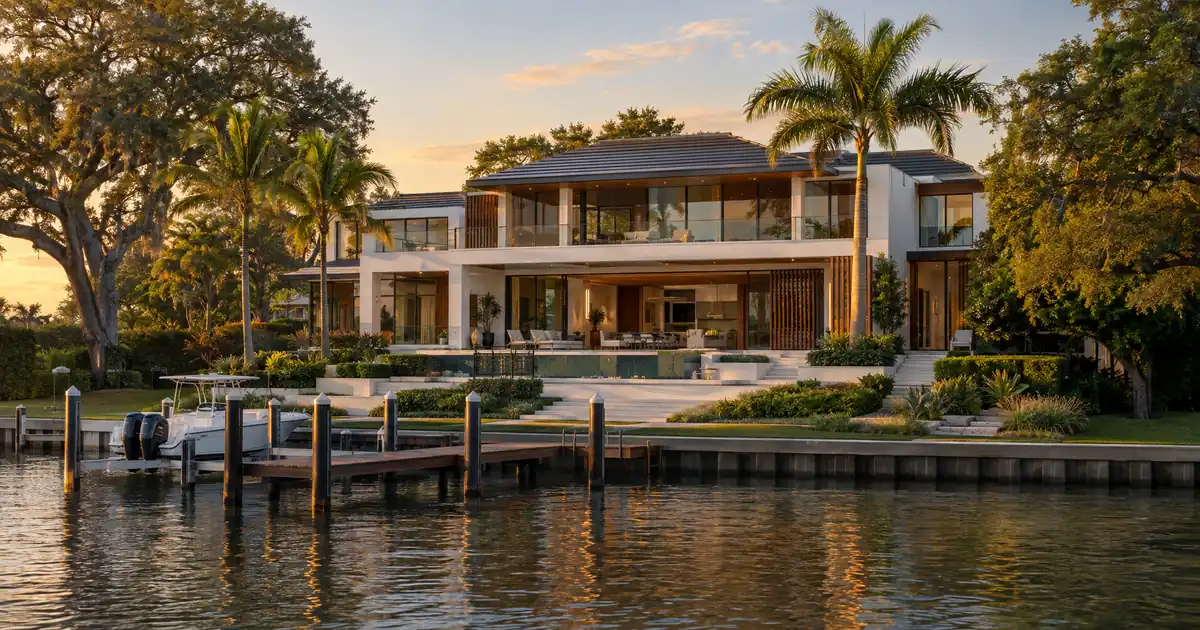
Finance An Acreage Estate On A Super Jumbo — The Quick Read: A large acreage estate usually breaks conventional financing before the buyer ever gets to the income question — the acreage itself, not the price tag, is often the first wall. A super jumbo bank statement loan solves the income side by qualifying self-employed borrowers on deposit history instead of traditional personal-income documentation. But the property still has to clear its own hurdles: acreage limits, appraisal comp scarcity, and how the underwriter classifies the land. Get the property question right first, and the income question is usually the easier half.
Key Takeaways
- Super jumbo bank statement programs qualify borrowers on 12 or 24 months of deposits rather than traditional personal-income documentation — useful for owners whose write-offs make their real cash flow invisible on paper.
- Loan sizing runs through two separate wholesale ladders: one that carries files to $6,000,000, and a bank portfolio ladder built for larger balances that steps down to 65%, 60%, and 55% as size climbs toward $30,000,000.
- Acreage itself has a hard limit inside this niche: most wholesale programs cap rural collateral at ten acres and cannot go above roughly $3,000,000 in loan size once a property is classified as rural.
- Above roughly $3.5 million on a primary residence (or $3 million on a second home or investment property), rural property is excluded from the program entirely — the estate has to appraise as a residential property, not agricultural or rural land.
- The appraisal, not the borrower’s income file, is usually the part of an acreage-estate deal most likely to derail financing.
Why Bank Statement Income Fits This Buyer
The setup here is specific: someone with real cash flow and a large-acreage property, but traditional personal-income documentation that don’t tell the true story. Bank statement loans exist for exactly that person. Instead of W-2s or two years of returns, the file runs on 12 or 24 consecutive months of personal or business deposit history.
This is not a return to the pre-2008 stated-income world, where a borrower simply wrote down a number. That’s the regulatory backbone under this whole product category, even though the day-to-day underwriting feels nothing like a government form.
Buyers who fit this profile tend to be founders, physicians, attorneys, business owners, or entrepreneurs. Their legitimate deductions shrink taxable income well below their actual take-home pay. If you’re buying a rental property and want the property’s own rent to carry the payment, a DSCR loan is usually the better tool. This article focuses on something different: the primary-residence or personal-use acreage estate. Here, your own cash flow qualifies the file — not the property’s rent roll.
The Mechanics: How Income Gets Calculated
The math starts with the account type. Personal bank statements are simple — eligible deposits get averaged over the statement period, with no deduction for expenses. Business account statements are treated differently, because a chunk of those deposits is assumed to cover overhead rather than personal income.
Across the wholesale network, the overhead assumption — called the expense ratio — generally follows a tiered structure. Service businesses with no employees get lower ratios. Businesses with a small staff get higher ratios. Larger operations, or any business that sells a product, get the highest ratios. Your own accountant can certify a lower ratio. A profit-and-loss method is also available, capped at 80% of the stated figure. Money you transfer from your business account to your personal account counts in full — no discount applied.
Ownership matters too. Business statements generally require at least 25% ownership stake in the entity, and the statements have to be consecutive months — a transaction summary or year-end printout doesn’t substitute for the real bank record.
Sizing the Loan: Two Ladders, One Property
Loan size on this program runs from $300,000 up to $30,000,000, but it does not move on one ladder — it moves on two. A portfolio non-QM bank statement program carries files to $6,000,000. A separate bank portfolio program, built around twelve-month statement files, carries much larger balances on its own leverage curve: 65% loan-to-value to $5,000,000, 60% to $10,000,000, and 55% up to $30,000,000, with interest-only capped at 60% or the band’s ceiling, whichever is lower. The two programs overlap between roughly $4,000,000 and $6,000,000, and above that range only the bank ladder applies on its own. Every deposit gets reviewed, and the CFPB’s ability-to-repay standard requires lenders to make a documented, good-faith determination that the borrower can actually repay the loan — deposit history is the verification method, not a shortcut around it.
Every file above $4,000,000 is reviewed case by case before it ever goes to submission. That’s not boilerplate — it means the leverage numbers below are the best available cell in the ladder, not a guaranteed offer, and every one of them assumes full underwriting through select lenders in the wholesale network.
The Leverage Ladder as Price Climbs
On a primary residence, leverage steps down steadily as the loan size grows. At $300,000 to $1,000,000, purchase and rate-term financing can run to 90% with credit around 680 or better. By the $1,500,000 to $2,000,000 band, that ceiling drops to roughly 85%, with credit expectations moving up toward 700 to 720. Push into $3,000,000 to $3,500,000 and leverage typically settles around 75%, still requiring strong credit. The Bureau’s own compliance summary lists the factors any lender has to weigh, including debt ratios and credit history, using reasonably reliable records rather than a borrower’s self-declared figure (CFPB Ability-to-Repay Summary).
Cross $3,500,000 on a primary residence, and the file enters the super-jumbo overlay zone. Credit floors step up to 700 regardless of what the general ladder cell shows, seasoning on any past credit event extends to 48 months, non-occupant co-borrowers are excluded, and — critical for this article’s subject — rural property is off the table entirely. In the $4,000,000 to $5,000,000 band itself, purchase leverage typically runs around 65%, on review.
Second homes and investment properties run roughly five points lower at every size tier than a primary residence, and the super-jumbo overlay kicks in slightly earlier for those occupancy types — above roughly $3,000,000 rather than $3,500,000.
The Acreage Ceiling — Where This Path Hits a Wall
Here is the part that trips up more acreage-estate buyers than the income documentation ever does: rural collateral has its own hard limit inside this program, separate from the general leverage ladder. Standard wholesale guidelines cap rural property at 80% loan-to-value on ten acres or less, and the loan amount cannot exceed roughly $3,000,000 once a property is classified as rural.
Push past the super-jumbo overlay thresholds — roughly $3,500,000 on a primary residence, $3,000,000 on a second home or investment property — and rural property is excluded from the program outright, full stop, regardless of leverage requested. That single rule is the real ceiling on financing a large acreage estate through this niche. It means the practical path for a bigger estate is getting the appraiser and underwriter to classify the property as a residential estate rather than rural or agricultural land — a distinction that has nothing to do with the borrower’s income file and everything to do with how the parcel gets used and described.
This classification fight shows up often in rural residential lending. An underwriter may decide a property’s highest and best use is agricultural, not residential. That decision can stop a loan cold — even when your income and credit are strong. Acreage alone doesn’t disqualify a property. What matters is intended use, zoning, and how much of the property’s value comes from outbuildings.
The Appraisal Problem
Comparable sales are the backbone of any residential appraisal, and that backbone weakens fast on large acreage. A typical suburban tract has dozens of recent comps within a mile. A ten-acre estate with a guest house and an equestrian barn might have three usable comps in the entire county, forcing the appraiser to widen the search into neighboring towns or a different region entirely.
Rural appraisal guidance separates deeded acreage from functional acreage. Deeded acreage is the land on paper. Functional acreage is the land that can actually support the property’s use. Comp adjustments need to spell out that gap clearly. Specialized structures make the problem worse. Think of a heated wash rack, professional footing in a riding arena, or an oversized equipment barn. These often get depreciated toward zero if the appraiser can’t find a similar local sale to anchor the value. That opens a gap between what the buyer is paying and what the file will support.
On investment-property files, appraisers rely on standardized rent schedules to document market rent. They use Form 1007 for single-family rentals and Form 1025 for multi-unit properties (Fannie Mae Appraiser Update). These forms matter less on an owner-occupied acreage estate. But the underlying problem they were built around — a scarcity of good comps — is the same challenge facing any acreage appraisal, whether occupied or rented. One of the few things you can control before the appraisal gets ordered: make sure the appraiser has real rural or estate experience, not just experience with production subdivisions.
Working files like this one, we see the same pattern again and again. The borrower’s deposit history usually clears underwriting without much friction. But the appraisal on the acreage itself is what stalls the timeline or forces a renegotiated value. Getting a rural-experienced appraiser assigned early matters more than almost any other decision in the file.
Reserves, Credit, and Documentation
Reserve requirements on this program are a floor, not a formula that scales endlessly with loan size. Files up to $500,000 typically need three months of reserves; from there to $1,500,000, six months; above that, nine months, plus two additional months for every other financed property the borrower holds, capped at twelve months overall. First-time investors are generally held to twelve months regardless of size. That floor holds across a wide loan-size band even as leverage caps and credit minimums keep tightening as the balance grows — reserves don’t multiply the way some borrowers assume.
Credit starts at a 660 floor on the portfolio program and 680 on the bank program, stepping up to 700 once a file crosses into super-jumbo overlay territory. Debt-to-income can run as high as 50%. Cash-out is capped at $1,500,000 above 60% loan-to-value on the portfolio program; the bank program has no published cap of its own.
For borrowers whose liquid assets tell a stronger story than their deposits do, an asset-based path exists as an alternative — liquid assets divided by 36, 60, or 84 months of qualifying income, with the 84-month version available standalone on any loan above $3,500,000. That path sits alongside the bank statement route rather than replacing it; which one fits depends on whether the borrower’s strength is cash flow or balance sheet. The complete DSCR loans guide covers how that income-qualification decision plays out on the rental side, and a closer look at bank statement versus DSCR qualification is useful for anyone weighing whether the estate should be financed as a residence or, on the investment side, as a rental.
Who This Fits — and Who It Doesn’t
This path fits a self-employed or business-owning buyer with real cash flow, a credit profile in the 680-to-700-plus range, and an acreage estate that appraises as residential rather than agricultural. It fits someone with liquidity to cover a reserve floor that holds steady even as leverage tightens above $4,000,000.
It doesn’t fit a buyer counting on financing a working farm, a property well over ten acres with heavy agricultural use, or a deal priced above roughly $3,000,000 to $3,500,000 where the land itself — not just the house — is the primary asset. It also doesn’t fit someone expecting a fast conditional approval on outbuildings an appraiser has never comped before; that part of the file takes real underwriting attention, not a rubber stamp.
This is informational, not legal or tax advice. Financing terms, program availability, and qualification outcomes depend on your full file, the specific property, and current lender guidelines. If you’re weighing the tax treatment of a large acreage purchase, talk to a qualified CPA or attorney about your own situation.
Frequently Asked Questions
Does owning more than ten acres automatically disqualify a property from this program?
Not automatically, but it usually forces the file into different territory. Standard rural guidelines cap acreage at ten acres and roughly $3,000,000 in loan size; above the super-jumbo overlay thresholds, rural-classified property is excluded outright, so the property generally needs to appraise as a residential estate rather than agricultural or rural land to move forward.
Can bank statement income cover both the acreage estate purchase and a separate investment property at the same time? It can, subject to reserves and debt-to-income limits. Each additional financed property typically adds two months to the reserve requirement, up to a twelve-month cap, and the borrower’s overall debt-to-income still has to fit within program limits, generally up to 50%.
Why does the appraisal matter more than the income documentation on a large acreage file?
Because comparable sales are scarce on big parcels, and specialized structures like barns or arenas are hard to value without local precedent. A borrower’s deposit history is usually straightforward to verify; getting an accurate, well-supported value on the land and its improvements is often the harder problem.
Is a 700 credit score always required for a super jumbo bank statement loan?
No — 700 becomes the floor specifically once a file crosses into super-jumbo overlay territory, generally above $3.5 million on a primary residence or $3 million on a second home or investment property. Below those thresholds, credit floors on the general ladder can run lower, typically starting around 660 to 680 depending on the specific program and loan size.
What happens if the appraiser classifies the estate as agricultural rather than residential? That classification can stop financing under this program regardless of the borrower’s income or credit strength, since agricultural or heavily rural-use property runs into the acreage and rural-exclusion limits described above. Getting an appraiser with genuine rural or estate experience assigned early is one of the few levers a borrower has to influence that outcome.
Say you’re buying a large acreage estate, but your income documents don’t fit a standard W-2 file. Lendmire can help. We compare bank statement and asset-based options across our wholesale network. We base this on the property, your credit profile, and the leverage the deal needs.
For current guidelines and terms, see Lendmire’s super jumbo bank statement loan programs page.
Self-employed borrowers can compare both super jumbo programs on Lendmire’s self-employed mortgages page.
About Lendmire
As a non-QM mortgage broker (NMLS# 2371349), Lendmire facilitates DSCR investor loans across 40 markets, including Washington, D.C. DSCR eligibility is generally reviewed around property-level rental income instead of personal income documentation, subject to lender guidelines, serving LLC-structured portfolios and self-employed borrowers who don’t fit conventional boxes. A two-time Scotsman Guide Top Mortgage Workplace (2025, 2026).
Lendmire’s Top Mortgage Workplace recognition is documented by Scotsman Guide 2025 Top Mortgage Workplace and Scotsman Guide 2026 Top Mortgage Workplace.
Get Started
Ready to find the right loan for you?
In about 30 seconds you can review financing options available for your home or investment property. No commitment required.
Informational only. Not a Loan Estimate, approval, or commitment to lend. Program availability and eligibility are subject to lender guidelines, credit approval, property review, and underwriting.
References
1. CFPB — What is the ability-to-repay rule
2. CFPB — Summary of the Ability-to-Repay and Qualified Mortgage Rule
Brandon Miller
Founder & CEO, Mortgage Loan Originator, Lendmire LLC
- Mortgage Loan Originator · NMLS# 1129696 · Verify on NMLS Consumer Access
- North Carolina Real Estate Broker · License# 343312 · Verify on NCREC
- North Carolina Insurance Producer · License# 19053198 · Property, Casualty, Life, Health · Verify on NAIC SBS
- Lendmire LLC · Firm NMLS# 2371349 · Verify firm licensure
Compliance and disclosures. Lendmire (NMLS# 2371349) is a licensed mortgage broker and is not a direct lender, depository institution, financial advisor, or tax professional. Content in this article is general market analysis and educational information — not financial, legal, or tax advice for any specific situation. Lendmire does not guarantee loan approval; every transaction is subject to underwriting by the funding lender. Mortgage pricing and loan program guidelines are subject to change at any time without notice and vary by borrower characteristics, property type, and state regulations. Lendmire complies with Equal Housing Opportunity. Licensure verification: NMLS Consumer Access.


