
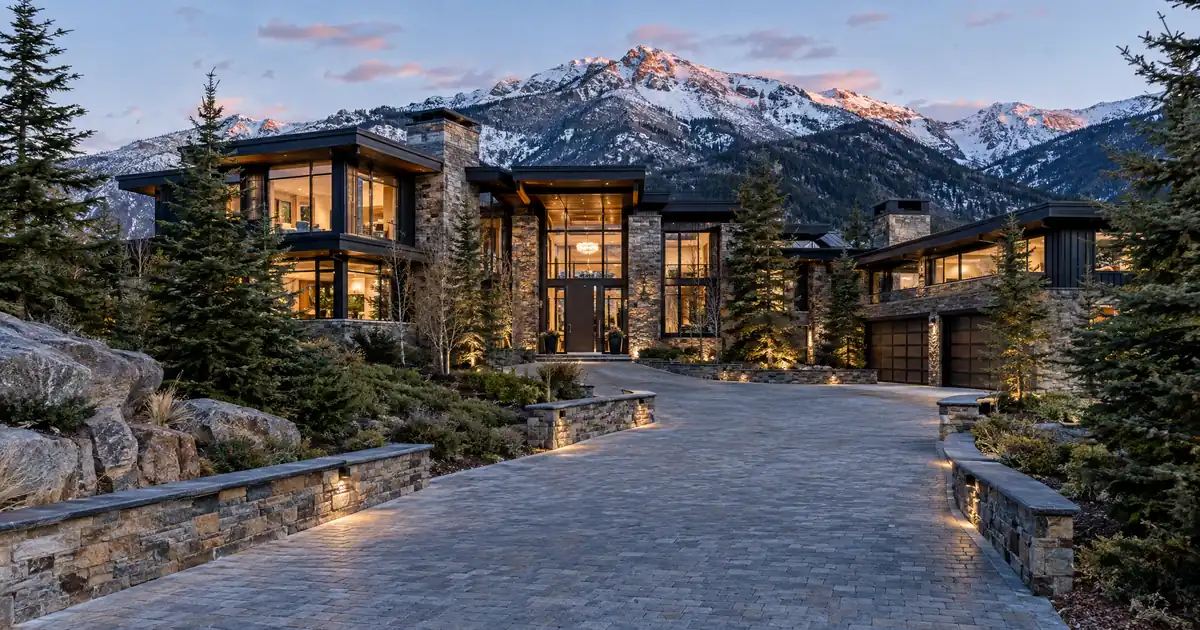
Property On Twenty Acres Qualify For A Bank Statement Mortgage — The Quick Read: Yes, in most cases — but acreage isn’t the whole test. Whether twenty acres qualifies depends on loan size, land use, and whether the appraiser can find enough comparable large-lot sales nearby. Cross into super-jumbo territory and a ten-acre ceiling kicks in, no exceptions. Stay under that line, and a twenty-acre residential parcel is usually just a normal file with an unusual appraisal.
A bank statement mortgage is a loan that qualifies a self-employed borrower using deposits into personal or business bank accounts instead of traditional personal-income documentation. It’s a non-QM product — meaning it sits outside the standard rules that govern conventional, FHA, and VA loans. Because non-QM lenders write their own guidelines, there’s no single federal acreage cap that applies across the board. Every lender in the wholesale network sets its own line, and that line moves depending on how large the loan is.
What Actually Decides Whether Twenty Acres Qualifies?
Four things decide it: loan amount, land use, zoning, and comparable sales. None of them is “acreage” by itself.
The first filter is loan size. Across most of the wholesale network, twenty-acre rural properties get underwritten individually rather than declined by a blanket rule — up until the loan crosses into super-jumbo territory. Once a loan crosses roughly $3,500,000 on a primary residence, or $3,000,000 on a second home or investment property, a hard set of overlays attaches, and one of them is a ten-acre maximum with no override. That means the same twenty-acre parcel can sail through underwriting at a moderate loan size and get stopped cold once the number gets big enough to trigger super-jumbo review.
The second filter is land use. A property with a barn, a fence line, and a garden that supports the house reads very differently than a working farm that generates crop or livestock income. DSCR and bank statement programs are built to evaluate a residence, not a business. Across the network, programs generally decline six categories outright: owner-occupied homes on a DSCR file, raw land, fix-and-flip properties mid-renovation, working agricultural land, manufactured housing, and severely deteriorated structures. Take twenty acres of pasture that doubles as an active cattle operation — it belongs in agricultural lending, not residential non-QM. That’s true even though the acreage number looks identical to a quiet twenty-acre homestead next door.
The third filter is zoning and present use. Some underwriters mistakenly treat any parcel over five acres as automatically “rural,” but that’s not how appraisers actually work. Practicing appraisers have pushed back on this directly, noting that raw acreage alone doesn’t make a property rural — the real test is zoning, present use, and whether the neighborhood pattern supports it (per discussion on AppraisersForum.com).
The fourth filter, and often the real bottleneck, is the appraisal itself.
The Appraisal Is Where Twenty-Acre Deals Actually Get Stuck
Most twenty-acre files that stall don’t stall over acreage — they stall over comparable sales. Appraisers need three to five genuinely similar large-lot properties within a reasonable radius, and in low-density rural markets, those comps can be thin on the ground.
For contrast, it helps to look at how agency guidelines handle large lots, even though DSCR and bank statement loans sit outside that world entirely. Fannie Mae’s own selling guide doesn’t use an acreage number as its test at all — it asks whether the site size is typical for the area and whether comparable sales support that conclusion, using an example where even a two-acre lot can be fine as long as it fits the local pattern (Fannie Mae Selling Guide B4-1.3-03). Non-QM lenders don’t inherit that specific test, but the underlying logic — does the appraiser have enough support? — shows up in every large-lot file regardless of loan type.
Appraisers also watch something called the land-to-value ratio: how much of the total appraised value is tied up in the dirt versus the structure. When land makes up an unusually large share of value relative to what’s typical, it raises a flag and can trigger a request for supporting land sales, because it suggests the property’s current use might not match its highest and best use as vacant land (discussion at AppraisersForum.com). On a twenty-acre parcel with a modest house, this ratio deserves attention before the appraisal gets ordered, not after.
Key Terms Defined
Bank statement mortgage — a non-QM loan that qualifies income from bank deposits instead of traditional personal-income documentation, common for self-employed and business-owner borrowers.
Non-QM — “non-qualified mortgage,” a category of loans that sit outside the standard rules governing conventional, FHA, and VA financing, allowing lenders to write custom guidelines.
DSCR — debt-service coverage ratio, a measure of whether a rental property’s income covers its own monthly obligation, used on investment-property loans that qualify on property cash flow rather than the borrower’s personal income.
Highest and best use — the appraiser’s determination of the most reasonable and profitable use for a site, used to check whether current improvements make sense given the land underneath them.
Land-to-value ratio — the share of a property’s total appraised value attributed to the land itself rather than the structure, watched by appraisers as a signal that something about the use or comps needs a second look.
Super-jumbo overlay — a set of stricter, add-on requirements — including acreage caps — that attach once a loan crosses a defined dollar threshold, regardless of how flexible the base program is below that line.
How Loan Size Changes the Acreage Answer
Loan size is the single biggest variable, and it works like a ladder. On the portfolio non-QM bank statement program, files typically run to $6,000,000, with leverage stepping down as the loan gets bigger — around 90% on a primary residence in the $300,000-$1,000,000 range, tapering through the mid-tiers, down to roughly 75% at the top credit tier near $3,500,000-$4,000,000, then case-by-case review above that. A separate bank portfolio program carries twelve-month-statement files all the way to $30,000,000, on its own ladder — roughly 65% to $5,000,000, 60% to $10,000,000, and 55% up through $30,000,000, with interest-only available at 60% or the band’s ceiling, whichever is lower. Second homes and investment properties generally run about five points lower in leverage at every size tier.
Here’s why that matters for a twenty-acre buyer specifically: the super-jumbo overlays — including the ten-acre cap — attach once the loan crosses roughly $3,500,000 on a primary residence or $3,000,000 on an investment property. Below that line, a twenty-acre rural residential property is generally reviewed on its own merits. Above that line, twenty acres runs straight into a wall that no amount of strong income or reserves gets around. For a buyer eyeing a large parcel, keeping the loan amount under the super-jumbo trigger — through a bigger down payment, for instance — can be the difference between an approvable file and an automatic decline on acreage alone.
Above $4,000,000, every file in the network gets reviewed case by case before it’s even submitted. That’s not a formality — it reflects how much variation there is in how individual lenders treat large rural parcels once the numbers get big.
What About Income Qualification on a Large Rural Property?
Income qualification runs on an entirely separate track from the acreage question. This part often surprises new bank statement borrowers. Underwriters total eligible deposits over 12 or 24 consecutive months. They strip out transfers and non-income items, apply an expense ratio, then average the result to arrive at qualifying income. Business account deposits require at least 25% ownership in the business. Transfers from the borrower’s own business into a personal account count in full.
The expense ratio typically runs on a tier system. A service business with no employees gets a lower ratio. A business with a small handful of employees gets a moderate ratio. Larger staffed operations or any product-based business get a higher ratio. An accountant can also sign off on actual expenses, which may lead to a documented lower ratio. A profit-and-loss-only path is available too, generally capped at a higher ratio. Separately, an asset-based path exists for borrowers with substantial liquidity but thinner deposit activity. One version, the asset allowance approach, divides qualifying liquid assets by 36, 60, or 84 months, depending on the file. Another version, the assets-only path, requires liquidity equal to the full loan amount plus closing costs, with no DTI calculation at all.
None of this changes based on whether the property sits on a quarter-acre lot or twenty acres. A borrower with a clean bank statement income profile and strong reserves can still get stopped by a collateral-side acreage or land-use issue — and the reverse is just as true. These are two independent underwriting tracks that happen to converge on the same closing table.
Credit typically needs to clear a 660 floor on the portfolio program, moving to 700 once a loan crosses into super-jumbo territory. Reserve requirements generally run 3 months of payments up to $500,000, 6 months up to $1,500,000, and 9 months above that, with debt-to-income allowed as high as 50% on most files. All of these figures reflect typical guidelines through select lenders in the wholesale network, subject to full underwriting — not a guarantee for any individual file.
When Does Twenty Acres Become an Agricultural Loan Instead?
The line is income, not acreage. A property crosses out of residential bank statement lending and into agricultural financing once the land itself generates separate revenue. This includes crops, livestock, leased hunting rights, or similar operations — not simply land that surrounds a house.
The federal government treats this as a truly different lending world. Farm properties financed through USDA’s Farm Service Agency need appraisals from a qualified Certified General Real Estate Appraiser. These appraisers work under FSA’s own underwriting rules. This is a completely separate framework from residential appraisal standards (per USDA Farm Service Agency Appraisal Guidelines). This confirms something worth remembering. Once a property genuinely operates as a working farm, it leaves the residential and DSCR lane entirely. It follows its own separate standards, which have nothing in common with a bank statement mortgage.
A hobby garden or a barn used to store a lawn tractor doesn’t trigger this. An income-producing agricultural operation does. The distinction sounds simple on paper, but it’s exactly where files get miscategorized — an investor should be honest about how the land is actually used before an offer gets written.
Are you an investor looking at a rural property as a rental, not a place to live? Then it helps to know how property-income loans compare to bank statement loans. Lendmire’s comparison of DSCR loans versus bank statement loans for investors explains when each option fits better. Lendmire’s complete DSCR loans guide also covers how property-income qualification works for a rental purchase. With this path, your personal deposits don’t decide the outcome at all.
Rural and semi-rural demand isn’t a fringe case anymore, either. Remote and hybrid work keeps pushing buyer and renter interest toward larger-lot properties outside major metros. Demand is expected to stay strong for land within a few hours of city centers (per LandHub’s rural land trends coverage). Investor sentiment heading into 2026 backs this up. A large share of investors expect strong rental demand to continue, and the majority expect conditions to hold steady or improve (per RentRedi’s 2026 rental market outlook). More investors are chasing yield outside saturated urban submarkets. That means more twenty-acre files are landing in underwriting queues. So it’s worth understanding this acreage question well before you make an offer — not after an appraisal comes back.
Tax treatment can depend on how the funds are used and how the property is held; investors should keep clear records and speak with a qualified tax professional before relying on any deduction.
Frequently Asked Questions
Does a twenty-acre property automatically get declined for a bank statement loan?
No. Acreage alone isn’t a disqualifier on most files under the super-jumbo threshold. What actually matters is whether the land generates separate income, whether zoning and use still read as residential, and whether the appraiser can find enough comparable large-lot sales to support the value.
Why does loan amount affect whether twenty acres qualifies?
Because the strictest acreage rules — including a firm ten-acre ceiling — attach specifically to super-jumbo files, generally once a loan crosses roughly $3,500,000 on a primary residence or $3,000,000 on an investment property. Below that threshold, a twenty-acre parcel is typically reviewed individually rather than blocked outright.
Can a working farm on twenty acres qualify for a bank statement mortgage?
Generally not through a standard bank statement or DSCR program. Working agricultural land that generates crop or livestock income falls outside what these programs are built to evaluate, and typically needs a dedicated agricultural lending program instead.
What’s the biggest reason twenty-acre appraisals get delayed?
Comparable sales, more often than the acreage itself. Rural markets often have fewer large-lot sales to pull from, and appraisers need several genuinely similar properties nearby to support the value — a scarcity problem, not a rule problem.
Does the acreage rule apply the same way to an investment property as a primary residence?
The underlying logic is the same, but the loan-size thresholds differ. Super-jumbo overlays, including the ten-acre cap, generally attach at a lower loan amount on second homes and investment properties than they do on a primary residence, so an investor buying a large rural rental should factor that in earlier in the process.
Are you evaluating financing for a large-lot property? Do you want to see how the numbers actually work — loan size, land use, and leverage, all together? Lendmire can help. It compares bank statement and DSCR options based on the property, the borrower’s income documentation, and the lender guidelines that apply at that loan size.
For current guidelines and terms, see Lendmire’s super jumbo bank statement loan programs page.
Self-employed borrowers can compare both super jumbo programs on Lendmire’s self-employed mortgages page.
About Lendmire
Lendmire (NMLS# 2371349) is a mortgage brokerage built around DSCR investor lending, with programs available in 40 markets, including Washington, D.C. DSCR lenders commonly evaluate rental-income coverage instead of personal income paperwork — a practical fit for LLC-owned and multi-property investors. Terms vary by lender, property, leverage, and program. Scotsman Guide named Lendmire a Top Mortgage Workplace in both 2025 and 2026.
Get Started
Ready to find the right loan for you?
In about 30 seconds you can review financing options available for your home or investment property. No commitment required.
Informational only. Not a Loan Estimate, approval, or commitment to lend. Program availability and eligibility are subject to lender guidelines, credit approval, property review, and underwriting.
References
1. AppraisersForum.com: Land Exceeds 30% of Value Discussion
2. Fannie Mae Selling Guide B4-1.3-03: Neighborhood Section of the Appraisal Report
3. USDA Farm Service Agency Appraisal Guidelines
4. LandHub: Rural Land Trends to Watch Going Into 2026
5. RentRedi 2026 Rental Market Outlook
Brandon Miller
Founder & CEO, Mortgage Loan Originator, Lendmire LLC
- Mortgage Loan Originator · NMLS# 1129696 · Verify on NMLS Consumer Access
- North Carolina Real Estate Broker · License# 343312 · Verify on NCREC
- North Carolina Insurance Producer · License# 19053198 · Property, Casualty, Life, Health · Verify on NAIC SBS
- Lendmire LLC · Firm NMLS# 2371349 · Verify firm licensure
Important disclosures. Lendmire (NMLS# 2371349) is a licensed mortgage brokerage. Lendmire is not a direct lender, depository institution, or financial advisor. All loan inquiries are subject to lender underwriting; this article does not constitute a commitment to lend. Rates, terms, and program guidelines are subject to change without notice and vary by borrower profile, property type, and state. Information in this article is general in nature and is not financial, legal, or tax advice. Equal Housing Opportunity. NMLS Consumer Access: nmlsconsumeraccess.org.


