
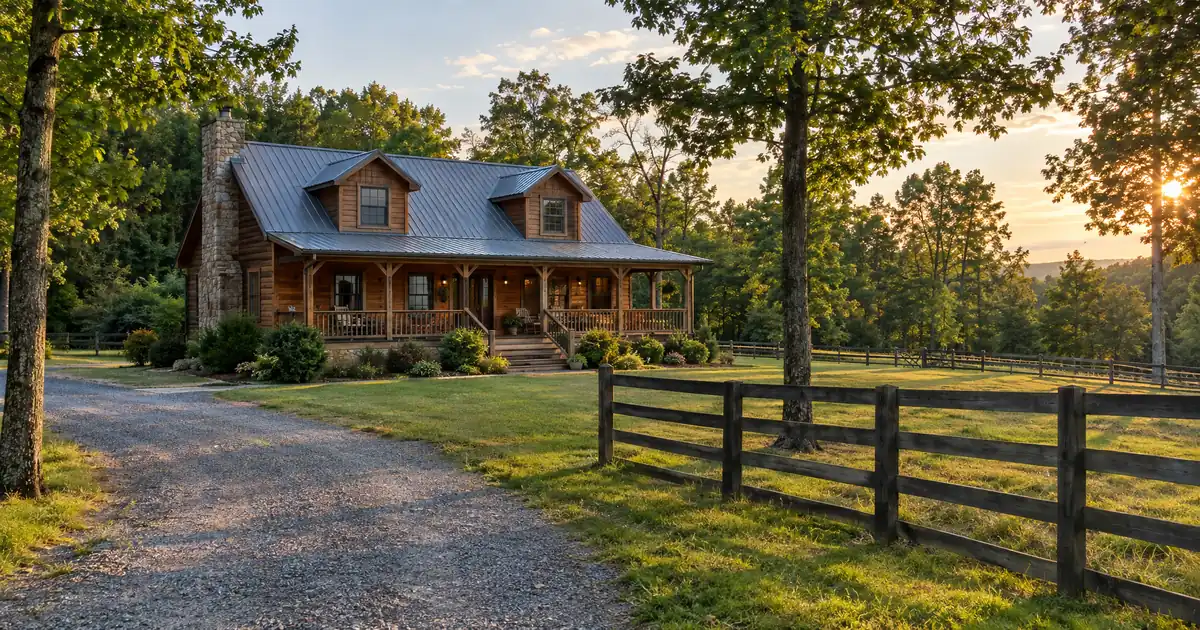
Acreage Affects The Appraisal On A Bank Statement Second-Home Loan — The Quick Read: Extra land doesn’t add value dollar-for-dollar. Appraisers classify acreage beyond what a typical lot needs as either “excess” (separately sellable, adds real value) or “surplus” (locked to the home, adds little). Most bank-statement second-home programs cap rural acreage near ten acres, and land above that line usually gets carved out of the collateral rather than killing the file outright.
A straight answer, then the mechanics. Acreage on a second home doesn’t automatically raise the appraised value, and it doesn’t automatically sink the loan either. The appraiser’s job is to figure out whether the land past your typical lot size has its own independent use — buildable, sellable, zoned separately — or whether it just sits there enlarging the yard. That single classification decision determines whether the extra acres add meaningful dollars to the valuation, and it happens before your bank-statement file ever reaches an underwriter.
Key Terms Defined
Excess land is the portion of a parcel not needed to support the home, but which could legally and physically be sold off on its own, with its own use.
Surplus land is also not needed for the home, but it can’t be separated and sold — no independent use, no separate value.
Highest and best use (HBU) is the appraiser’s conclusion about the most profitable legal use of a site, given zoning, access, and market demand.
Comparable sales (comps) are recently sold properties the appraiser uses to support a value opinion; on large-acreage properties, comps get harder to find nearby.
Built-up ratio describes how developed the surrounding neighborhood is — appraisers generally want to see at least a quarter of the area holding structures before treating a rural file as standard.
Land-to-value ratio is the share of total appraised value coming from the dirt rather than the structure; once that ratio runs high, appraisers flag it for extra commentary.
What the Appraiser Actually Does With Extra Acres
The appraiser doesn’t just measure acreage and multiply.
The appraiser’s first job in that section is deciding whether the current improvements represent the best use of the site as a whole. That highest-and-best-use test is written into the appraisal report’s site section, and it’s the same framework non-QM and bank-statement appraisers lean on even though these loans sit outside agency purchase rules entirely.
From there, the appraiser asks one practical question about the extra land: can it be split off and used or sold separately under current zoning and physical access? If yes, it’s excess land, and it typically carries real, if discounted, value. If no — maybe it’s landlocked, or zoning won’t allow a second structure — it’s surplus land, described in the report but not independently valued. A 10-acre parcel next to a comparable 1-acre home almost never appraises at ten times the value. The incremental acres get priced at whatever the local land market actually supports, which is usually a steep discount once you’re past the size buyers in that neighborhood expect.
Comps get thinner as acreage grows, too. Large-lot and rural properties often don’t have close matches nearby, so appraisers widen the search radius and timeframe to find sales that credibly indicate value. Underwriting guidance built for agency loans still shapes how this works in practice, and it explains the logic clearly: appraisers can use comps that are farther away, as long as they document why those sales were chosen and the analysis still holds up.
Excess Land vs. Surplus Land — Why This Distinction Decides Your Value
This is the single most misunderstood part of an acreage appraisal, and it’s worth stating plainly: size alone tells you nothing. A landlocked eight-acre parcel behind the house can be surplus — no separate value, just extra yard. A road-fronting three-acre lot on the same street can be excess — legally separable, independently marketable, and worth real dollars.
Investors buying acreage often assume more land automatically means a bigger number on the appraisal. It’s a reasonable assumption, and it’s often wrong. The excess-versus-surplus classification, not the raw acre count, drives how much the land contributes. If your extra acreage gets classified as surplus, it may barely move the needle on value even though you’re paying for it at the purchase price.
That gap between what a seller (or listing agent) prices the land at and what the appraisal actually supports is a real financing risk on a bank-statement file, because leverage is calculated against the appraised value, not the contract price.
How Acreage Interacts With Bank-Statement Underwriting
Bank-statement lending qualifies a borrower based on deposits instead of traditional personal-income documents. But the collateral still has to clear appraisal review, just like on any other program. Across the wholesale network Lendmire works with, rural second homes are capped at 80% loan-to-value on parcels of ten acres or less. Rural collateral also isn’t eligible above roughly $3,000,000 in loan amount. On top of that, once a second-home file crosses roughly $3,000,000, super-jumbo overlays that many lenders apply exclude rural property altogether. These overlays also cap acreage at ten acres flat, with no exceptions, and they’re reviewed case by case.
Below those thresholds, second-home leverage on most files still runs on a size ladder: purchase leverage near 85% on loans under $1,000,000, stepping down to the 80% range through the $1.5 million to $2.5 million bracket, and tightening further as the loan size climbs — all subject to credit tier and full underwriting through select lenders in the network. Acreage doesn’t change that ladder directly, but a low appraised value caused by surplus-land treatment can shrink the loan amount the ladder is applied against, which is where acreage quietly costs an investor leverage.
Documentation on these files runs on 12 or 24 consecutive months of personal or business bank statements. Lenders calculate qualifying income by dividing eligible deposits by the statement period, after applying an expense ratio. That ratio is generally lower for a service business with no employees, and higher for larger operations with more overhead, subject to underwriting review. Acreage doesn’t change any of this. What acreage changes is the collateral side of the file — and that determination falls squarely to the appraiser, not the underwriter.
When Does Acreage Trigger a Full Appraisal or a Carve-Out?
Acreage rarely kills a file outright. What it usually does is force a fuller, slower review. Properties with large acreage, along with rural ZIP codes and other unique-feature homes, almost always require a full appraisal rather than a desktop or automated valuation, regardless of the loan’s price band. That’s a scheduling and budgeting issue for the investor as much as an underwriting one — plan for it before locking a purchase contract, not after.
Once a program’s acreage cap is exceeded, the more common outcome is that the land above the cap gets carved out of the appraised collateral rather than the loan getting declined. That carve-out complicates the file — it forces a fresh look at comps and value allocation — but it’s a materially different result than an automatic decline, and it’s the edge case investors most often get wrong.
A related trigger is the neighborhood’s built-up ratio. Appraisers generally want to see the surrounding area at least a quarter developed with structures before treating a rural file as standard. A property surrounded by nothing but open farmland in every direction is a harder file to place, even if the parcel itself sits under the acreage cap.
Land-to-value ratio matters too. When the site itself represents an outsized share of total appraised value — commonly flagged once that share crosses roughly 30% — the appraiser has to comment on it directly, since it signals the improvement isn’t really the primary value driver. That’s a common outcome on large-acreage second homes and waterfront lots, and it tends to draw closer underwriter attention on a business-purpose or bank-statement file.
One more hard line worth knowing up front: working farms, ranches, and orchards are typically treated as harder exclusions than raw acreage alone. Agricultural use introduces non-rental income into what’s supposed to be residential collateral, and most bank-statement and non-QM programs steer away from it regardless of how the acreage itself would otherwise classify.
Common Misconceptions Investors Bring to This
The most persistent myth is that a bigger lot always means a bigger appraisal. It doesn’t. Surplus land can add little to no measurable value, even on a genuinely large parcel, because it lacks an independent use beyond supporting the home that’s already there.
A second common mix-up: treating excess and surplus land as interchangeable terms. They’re not. Both describe land beyond what the home needs, but only excess land carries its own separately marketable use — and that distinction is exactly what determines whether the appraiser assigns it real dollars or simply describes it and moves on.
Third, investors often assume rural property can’t get bank-statement financing at all. That’s not true. Lenders scrutinize rural property more closely — appraisers dig into rental demand, comp density, and market activity. But being rural doesn’t trigger an automatic decline. The CFPB’s rural and underserved areas tool is one resource lenders and appraisers use to sort out how rural a given address really is.
Finally, some investors expect the appraiser to put a dollar figure on every acre regardless of classification. Not true. Surplus land gets described in the report — acknowledged as part of the whole — but it isn’t required to carry its own independent valuation the way excess land does.
What This Means for Loan Size and Leverage
Say an investor is buying a second home priced at $2.2 million sitting on eight acres, well under the ten-acre rural cap and under the $3 million threshold where super-jumbo overlays would exclude rural collateral entirely. If the appraiser classifies most of that acreage as excess — separately sellable under current zoning — the appraised value likely lands close to the contract price, and leverage runs off the standard second-home ladder for that size tier, roughly in the 75-80% purchase range on most files, subject to credit tier and full underwriting.
Now run the same price on a parcel where six of the eight acres get classified as surplus — landlocked, no separate use. The appraised value could come in below the contract price, since the extra land isn’t contributing the dollars the buyer assumed. Leverage still applies off the ladder, but it’s applied against a lower number, which means less loan and more cash required at closing to bridge the gap.
That’s the real cost of acreage risk on a bank-statement file: it rarely shows up as a flat decline. It shows up as a smaller appraised base, and the loan amount follows the appraisal, not the purchase price.
Bank-statement programs Lendmire places through its wholesale network run from $300,000 up to $30,000,000, structured across two separate size ladders — one carrying files to roughly $6,000,000, and a second bank-portfolio ladder for twelve-month-statement files running to $30,000,000 with leverage stepping down as size increases. Every figure above roughly $4,000,000 is reviewed case by case before submission, and acreage-heavy rural files above the thresholds noted earlier get scrutinized even harder inside that review.
Some investors buy a similar property purely as a rental rather than as a second home. For them, the qualification path looks different. DSCR loans qualify borrowers mainly on whether the property’s rental income covers the payment, subject to lender guidelines. This differs from qualifying on personal bank statements. Lendmire’s complete DSCR loans guide walks through how that qualification works. It’s a useful comparison if the acreage in question could support rental use instead of personal second-home use.
If you’re considering an estate-style property with acreage, you should also learn how appraisals handle larger, unique properties in general. Lendmire’s piece on how to navigate the estate appraisal on a bank statement covers this related topic in more depth.
Flag your total acreage early, before you sign a purchase contract. This gives your broker room to match your file to a program whose overlay actually fits. Otherwise, you may end up restructuring a deal after it’s already under contract and the appraisal is already ordered.
Tax treatment can depend on how the funds are used and how the property is held; investors should keep clear records and speak with a qualified tax professional before relying on any deduction.
For deeper background on the mechanics discussed here, see Consumer Financial Protection Bureau – Rural and Underserved Areas Tool.
Frequently Asked Questions
Does a bigger parcel always mean a higher appraisal on a second home? Not necessarily. Whether extra acreage adds value depends on whether the appraiser classifies it as excess land, which carries its own separately marketable use, or surplus land, which doesn’t. A large parcel classified as surplus can add little to the appraised number even though the buyer paid a premium for it.
What acreage cap should I expect on a rural second home? Across the wholesale network Lendmire works with, rural collateral is generally capped near 80% loan-to-value on parcels of ten acres or less, and rural property isn’t eligible on loans above roughly $3,000,000. Above that loan size, many programs exclude rural property from second-home eligibility entirely.
If my property exceeds a lender’s acreage cap, is the loan automatically declined? Usually not. The more common outcome is that the land above the cap gets carved out of the appraised collateral, which complicates the file and can affect leverage, but it doesn’t automatically kill the deal. It’s a structuring issue best flagged before the purchase contract is signed.
How does a bank-statement lender treat farm or ranch acreage differently from a residential lot with extra land? Working farms, ranches, and orchards are typically treated as harder exclusions than plain acreage, because agricultural use introduces non-rental income into what’s meant to be residential collateral. A quiet eight-acre lot with no working agricultural use is a very different file than a working orchard of the same size.
Can I use bank statements to qualify on an investment property instead of a second home? Yes, through separate program guidelines with their own leverage and reserve requirements, though rental-property files more commonly qualify through DSCR programs based on the property’s own income rather than personal deposits, subject to lender guidelines.
Are you weighing a second-home purchase on acreage? Do you want to see how the appraisal risk and leverage actually work for your file? Lendmire can help. We compare bank-statement options based on the property, the acreage classification, your credit profile, and your reserves. Reach our team at 828-256-2183 or request a quote.
For current guidelines and terms, see Lendmire’s super jumbo bank statement loan programs page.
Self-employed borrowers can compare both super jumbo programs on Lendmire’s self-employed mortgages page.
About Lendmire
A DSCR-focused mortgage broker, Lendmire (NMLS# 2371349) places investor financing across 40 markets — 39 states plus Washington, D.C. — with DSCR eligibility generally reviewed by the lender on property cash flow instead of tax returns, subject to lender guidelines. Scotsman Guide named Lendmire a Top Mortgage Workplace in 2025 and 2026.
Lendmire’s Top Mortgage Workplace recognition is documented by Scotsman Guide 2025 Top Mortgage Workplace and Scotsman Guide 2026 Top Mortgage Workplace.
Get Started
Ready to find the right loan for you?
In about 30 seconds you can review financing options available for your home or investment property. No commitment required.
Informational only. Not a Loan Estimate, approval, or commitment to lend. Program availability and eligibility are subject to lender guidelines, credit approval, property review, and underwriting.
References
1. Fannie Mae Selling Guide – Site Section of the Appraisal Report
2. Consumer Financial Protection Bureau – Rural and Underserved Areas Tool
Brandon Miller
Founder & CEO, Mortgage Loan Originator, Lendmire LLC
- Mortgage Loan Originator · NMLS# 1129696 · Verify on NMLS Consumer Access
- North Carolina Real Estate Broker · License# 343312 · Verify on NCREC
- North Carolina Insurance Producer · License# 19053198 · Property, Casualty, Life, Health · Verify on NAIC SBS
- Lendmire LLC · Firm NMLS# 2371349 · Verify firm licensure
Required disclosures. Lendmire (NMLS# 2371349) operates as a licensed mortgage broker, not a direct lender or depository. The discussion in this article is general in nature and should not be relied upon as financial, legal, or tax advice — every investment scenario is unique and should be reviewed by a qualified professional. Any loan inquiry is subject to lender underwriting, and this article is not a commitment to lend or a guarantee of approval. Mortgage rates, loan terms, and program guidelines vary by borrower, property, and state, and may change without notice. Equal Housing Opportunity. Verify licensure at NMLS Consumer Access.


