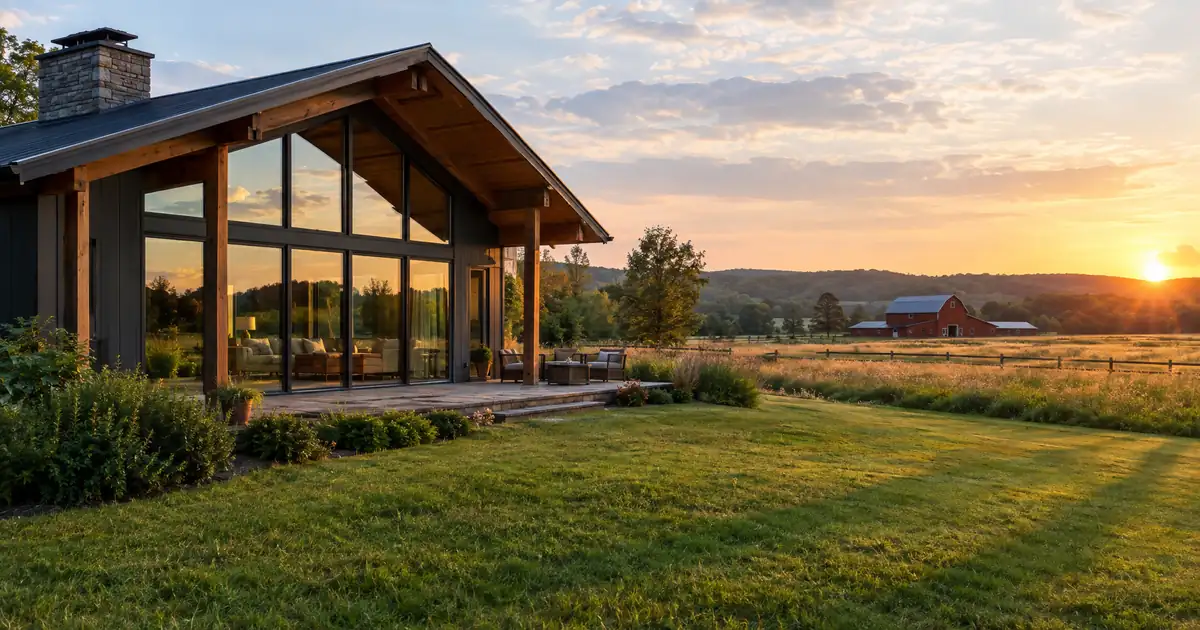
Acreage Properties And What A Bank Statement Loan — The Quick Read: Acreage doesn’t disqualify a bank statement loan by itself — but it changes how the appraisal gets built, and most wholesale programs cap the land at ten acres before rural overlays kick in. The income side of the file (deposits, expense ratios, months of statements) works the same whether the lot is a quarter-acre or eight acres. What actually breaks a deal is comp scarcity, agricultural use, or land that runs past a program’s acreage ceiling.
Here’s the split that trips people up: a bank statement loan is reviewed for the borrower off deposit history, not off the property. Acreage lives on the property side of the file. So the two questions — can I document my income, and will this land appraise cleanly — get answered by two different parts of underwriting, and they rarely fail for the same reason.
Key Takeaways
- Bank statement income math (12 or 24 months of deposits, an expense ratio applied) doesn’t change based on lot size.
- Acreage risk shows up almost entirely in the appraisal — comp scarcity, well/septic documentation, and road-access classification, not the borrower’s file.
- Most wholesale programs draw a hard line around ten acres before rural overlays apply; above that, financing gets harder to place, not impossible.
- Agricultural use — not acreage size — is the more common disqualifier across the industry.
- Above roughly $3.5 million to $4 million in loan size, acreage files typically move to case-by-case review before a program will even quote leverage.
What “Acreage” Actually Means to a Lender
A lender doesn’t just look at acreage as a number floating in isolation. It cares whether the land keeps the property “residential” in character, or tips it into farm, ranch, or commercial territory. Fannie Mae’s Selling Guide frames agency eligibility around unit count and residential use, not a specific acreage cap. This is a useful contrast point, even though DSCR and bank statement loans sit entirely outside agency purchase eligibility.
Non-QM programs, including the wholesale programs Lendmire places files with, set their own ceilings because these loans get sold into private-label pools, not to Fannie or Freddie. In our network, the practical line sits at ten acres for standard rural eligibility, and rural properties generally cap out at 80% loan-to-value and never exceed a $3 million loan amount on the portfolio program. Go past ten acres, and you’re not automatically shut out — you’re moving into a smaller pool of lenders willing to look at the file, subject to lender guidelines.
How the Appraisal Actually Handles a Large Lot
The appraisal, not the income documentation, is where acreage risk lives. On a single-family rental, appraisers lean on Form 1007 to support a market rent opinion; on 2-4 unit buildings, Form 1025 blends comparable sales with an income approach. Both forms depend on finding enough nearby comparables to support a number — and acreage properties often sit exactly where comps thin out.
HUD’s own valuation protocol acknowledges this directly. Rural properties often carry larger lot sizes in relatively undeveloped locations. This can leave an appraiser short on recent nearby sales. When that happens, the appraiser pulls comparables from farther away. They then have to explain why those distant sales are still the best available evidence of value. This written justification is standard practice, not a red flag. But it does mean acreage files often take more back-and-forth during underwriting than a subdivision lot.
Well and septic systems get their own checkpoint too. Appraisers confirm these systems meet local community standards, function properly, and are acceptable to area residents. Road access generally needs to reach the subject property directly, whether public or private. None of this touches the borrower’s income file. It’s purely a property-condition and valuation exercise.
Key Terms Defined
Bank statement loan — a mortgage that qualifies a borrower using deposit history from personal or business bank accounts instead of traditional personal-income documentation.
Acreage cap — the maximum lot size a lender’s program will finance under standard guidelines before rural overlays or case-by-case review apply.
Expense ratio — a percentage subtracted from gross business deposits to estimate real income, used because raw deposits overstate what a business owner actually earns.
Comparable sales (comps) — recently sold properties an appraiser uses to support the value of the subject property; fewer nearby comps make rural and acreage appraisals harder to complete.
Case-by-case review — an underwriting step, typically triggered above roughly $3.5 million to $4 million in loan size, where a lender evaluates the file individually rather than against a published leverage grid.
How a Bank Statement Loan Actually Works, Step by Step
The mechanics stay consistent, whether the property sits on a standard lot or eight acres of pasture. Across the wholesale network Lendmire works with, qualifying income comes from 12 or 24 consecutive months of statements, personal or business. The shorter window generally requires stronger reserves and credit.
Underwriters take the eligible deposits and divide by the number of statement months, then apply an expense ratio to strip out the cost of running the business. That ratio generally scales with staffing and business type — lower for a service business with no employees, higher as headcount grows, and higher still for businesses that sell a physical product — though exact figures vary by lender. A borrower’s accountant can supply a different ratio, or the file can run on a profit-and-loss basis capped at 80%. Transfers the borrower moves from their own business account into a personal account count in full — no discount applied.
Business statements require at least 25% ownership in the entity generating the deposits. Credit floors sit at 660 on the portfolio program and 680 on the bank program, moving to 700 once a loan crosses the super-jumbo threshold. Debt-to-income can run as high as 50%, and reserve requirements scale with loan size — typically three months of reserves to $500,000, six months to $1.5 million, and nine months above that, plus two additional months for each other financed property, up to a twelve-month ceiling. First-time investors are usually held to twelve months regardless of loan size.
None of that math changes because the collateral sits on ten acres instead of a standard lot. What changes is whether the appraiser can support the value and rent — and whether the acreage itself falls inside program guidelines.
What the Leverage Ladder Actually Allows
Loan size drives leverage more than almost anything else on an acreage file. That ladder runs differently depending on occupancy. On a primary residence, our wholesale programs generally allow up to 90% purchase financing to $1 million. That steps down to 85% through $2 million, 80% through $3.5 million, and 75% just above that with a stronger credit tier — all subject to lender guidelines. Second homes and investment properties run roughly five points lower at each of those size bands. Second-home financing is also limited to one-unit properties.
Above $4 million, every file moves to case-by-case review before a program will quote leverage at all — a point worth restating any time a number this large comes up. From there, loans carry through a separate size ladder on the bank program: 65% loan-to-value to $5 million, 60% to $10 million, and 55% to $30 million, with interest-only structuring available at 60% or the band’s ceiling, whichever is lower.
Rural and acreage properties face an extra layer of restriction once a file crosses into super-jumbo territory. This means loans above roughly $3.5 million on a primary residence, or $3 million on a second home or investment property. These overlays require a 700 credit floor. They also rule out non-occupant co-borrowers. Importantly for this topic, they exclude rural properties from the program entirely above that size threshold. Even below that threshold, ten acres is the outer limit. If you’re building estate financing that involves both a large lot and a large loan amount, read this closely alongside Lendmire’s complete guide to financing an acreage estate on a super jumbo.
Sometimes a property qualifies mainly on its own rental income, not on the borrower’s deposits. That’s a DSCR loan, not a bank statement loan. It’s worth understanding this difference fully. Lendmire’s complete DSCR loans guide explains it well. These two products solve different documentation problems, even on the same acreage.
Where the General Rule Breaks: Five Edge Cases
Most acreage questions resolve cleanly once you separate income documentation from property risk. A handful of situations don’t follow the general pattern.
That same logic runs through non-QM overlays informally: a ten-acre lot used residentially reads very differently to underwriting than the same ten acres generating farm income.
Excess acreage can sometimes be carved out of the appraisal. When a parcel exceeds a program’s cap, some appraisals exclude the extra acreage from the valuation rather than killing the file outright. This depends heavily on whether the land can be split for valuation purposes and whether the specific program allows the carve-out — it’s a workaround, not a guarantee.
Comp density matters more than the raw acre count on some files. Rather than a hard acreage number, some underwriting decisions come down to whether there are enough comparable sales and rentals nearby to support value — a functional test rather than a bright line.
Seasonal or cyclical deposits complicate the averaging math. A borrower whose business income swings seasonally still gets averaged across the full 12- or 24-month statement window. That averaging can understate income in a strong season and overstate it in a slow one, which is exactly why the profit-and-loss alternative or an accountant-supplied expense ratio exists as an option.
Above $4 million, the general rule doesn’t really exist. Every leverage figure above that size gets underwritten case by case rather than pulled off a published grid — true whether the collateral is a standard lot or acreage, but acreage adds another layer of scrutiny on top of the size review.
Where Bank Statement Loans Fit Against DSCR on Acreage Deals
A self-employed borrower buying an acreage property for personal use has one path — bank statement or asset-based qualification, since there’s no rental income to underwrite against. An investor buying the same property to rent out has two paths, and picking between them is a real decision, not a formality.
DSCR loans qualify primarily on the property’s own rental income covering the payment, subject to lender guidelines — no personal income documentation involved at all. That’s often the cleaner path on acreage held as a rental, because it sidesteps the deposit-averaging exercise entirely. Bank statement loans matter more when the acreage is a primary or second home, or when the rental income alone doesn’t clear the coverage a DSCR program wants and the borrower’s cash flow can carry the file instead. For a side-by-side on how these two documentation types actually compare, Lendmire’s DSCR loan vs. bank statement loan breakdown walks through the tradeoffs in more depth.
Across files like these, one pattern shows up consistently: acreage deals rarely die in the income column. They die — or get delayed — in the appraisal, when comps run thin or the well-and-septic paperwork isn’t in order before the file goes to underwriting. Getting that documentation lined up early is the single biggest lever a borrower has over how smoothly an acreage file moves.
Non-QM lending overall has grown into a meaningful share of the mortgage market, not a fringe corner of it. Non-QM originations rose to about 5% of total mortgage volume, up from 3% just a few years earlier, and Scotsman Guide reports the average non-QM borrower carried a 776 FICO score — on par with conventional borrowers, not below it. Investor-purpose loans made up roughly 28.5% of nonconforming originations in recent data, which tells you acreage and rural investment purchases aren’t a rare request inside this product category. Exact terms depend on the lender’s guidelines, property type, leverage, and a full review of the borrower’s file.
Frequently Asked Questions
Does a bank statement loan require a different expense ratio for acreage-based businesses like farming or ranching? No — the expense ratio applies to the business generating the deposits, not the property being purchased. A service business with no employees typically runs a lower ratio, while a business with employees runs a higher one, and an accountant-supplied ratio or profit-and-loss method are available alternatives. The acreage on the collateral doesn’t change which ratio applies to the borrower’s income.
Can I get a bank statement loan on a property with more than ten acres?
It gets harder, not automatic. Ten acres is the general ceiling for standard rural eligibility across most wholesale programs, and rural properties above that size fall outside super-jumbo overlays entirely once the loan crosses into that size tier. Some files work around this by excluding excess acreage from the appraisal, but that depends on the parcel and the specific program.
Does buying acreage under an LLC change how the bank statement income gets calculated?
The income calculation itself stays the same, but LLC-titled purchases typically shift the file toward business-purpose, non-owner-occupied programs, and eligibility depends on the specific lender’s guidelines for entity-titled borrowers. It’s worth confirming upfront whether the property and structure fit a given program before assuming personal-income documentation applies.
If my acreage property doesn’t appraise well because of thin comps, does that kill the loan? Not necessarily — it usually means the appraiser has to pull comparables from farther away and document why those sales are still reliable, a standard process on rural files. It can slow the file down and, depending on the result, affect the supported value or rent number, but comp scarcity alone doesn’t automatically disqualify the property.
Is a bank statement loan or a DSCR loan better for an acreage rental property?
It depends on whether the rental income covers the payment more comfortably than the borrower’s averaged deposits would qualify for. If the rent supports the coverage a DSCR program wants, that route skips personal income documentation entirely; if the rental math is tight, bank statement or asset-based qualification on the borrower’s side can be the stronger fit.
Are you weighing acreage financing on a purchase or refinance? Do you want to see how the deposit math, the leverage ladder, and the property’s rural status line up? Lendmire can help you compare options across its wholesale network. Call the team at 828-256-2183 to talk through where a specific property fits.
For current guidelines and terms, see Lendmire’s super jumbo bank statement loan programs page.
Self-employed borrowers can compare both super jumbo programs on Lendmire’s self-employed mortgages page.
About Lendmire
Lendmire, NMLS# 2371349, is a mortgage brokerage focused on investor financing, arranging DSCR loans in 39 states plus Washington, D.C. — 40 markets total. Qualification is based on the property’s income rather than personal income documentation, subject to lender guidelines, making it a fit for LLC-held rentals and scaling portfolios. Scotsman Guide named Lendmire a Top Mortgage Workplace in both 2025 and 2026.
Get Started
Ready to find the right loan for you?
In about 30 seconds you can review financing options available for your home or investment property. No commitment required.
Informational only. Not a Loan Estimate, approval, or commitment to lend. Program availability and eligibility are subject to lender guidelines, credit approval, property review, and underwriting.
References
1. Fannie Mae Selling Guide – General Property Eligibility
2. HUD Appraisal/Valuation Document
3. Scotsman Guide – Which Groups Are Driving Non-QM Lending
Brandon Miller
Founder & CEO, Mortgage Loan Originator, Lendmire LLC
- Mortgage Loan Originator · NMLS# 1129696 · Verify on NMLS Consumer Access
- North Carolina Real Estate Broker · License# 343312 · Verify on NCREC
- North Carolina Insurance Producer · License# 19053198 · Property, Casualty, Life, Health · Verify on NAIC SBS
- Lendmire LLC · Firm NMLS# 2371349 · Verify firm licensure
Compliance and disclosures. Lendmire (NMLS# 2371349) is a licensed mortgage broker and is not a direct lender, depository institution, financial advisor, or tax professional. Content in this article is general market analysis and educational information — not financial, legal, or tax advice for any specific situation. Lendmire does not guarantee loan approval; every transaction is subject to underwriting by the funding lender. Mortgage pricing and loan program guidelines are subject to change at any time without notice and vary by borrower characteristics, property type, and state regulations. Lendmire complies with Equal Housing Opportunity. Licensure verification: NMLS Consumer Access.