
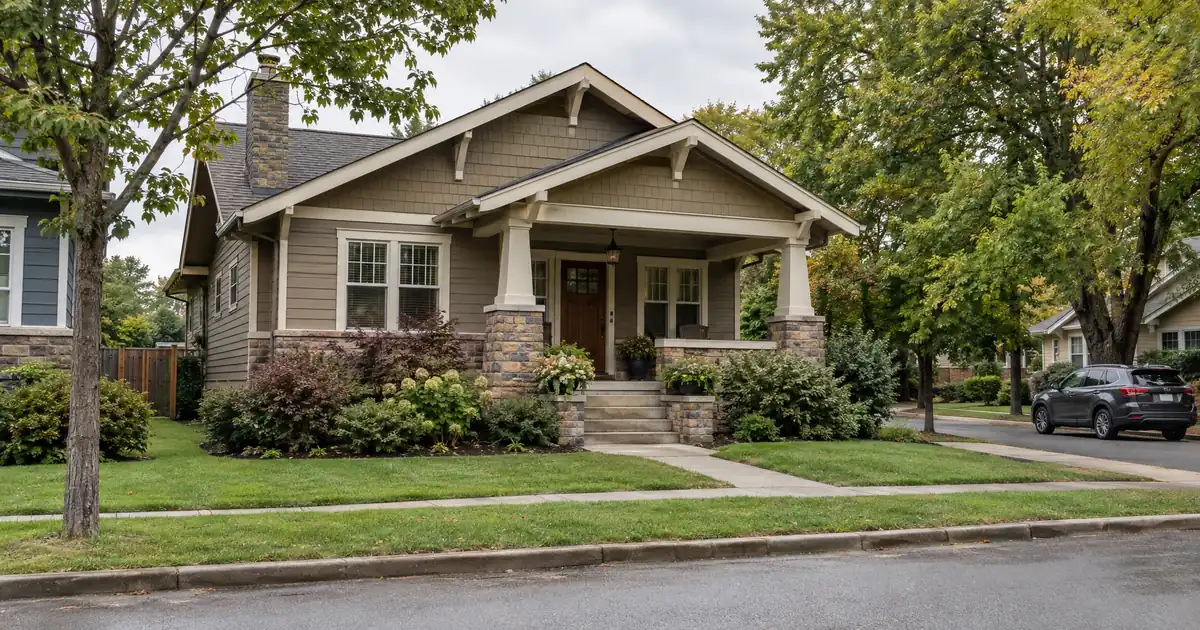
The Quick Read: A bank statement HELOC is a home equity line of credit that checks your deposit history instead of your traditional personal-income documentation. Self-employed investors use it when deductions make their taxable income look smaller than their cash flow. It is not “no documents.” The lender still verifies money coming in. On an investment property, the ceiling is 70% combined loan-to-value, and eligibility is subject to lender guidelines.
Key Takeaways
- Deposits replace traditional personal-income documentation, but the lender still reviews real financial records.
- Investment-property lines cap at 70% CLTV and $500,000 total on this network. Primary residences and second homes can reach higher.
- The borrower must hold title personally or in a revocable living trust. An LLC cannot.
- Lendmire arranges these lines in 16 states only, a narrower footprint than its DSCR lending.
- If the rental sits in an LLC, a DSCR cash-out refinance is usually the better lane.
What Is a Bank Statement HELOC?
A HELOC is a revolving line secured by your home. You borrow against equity and keep your first mortgage in place. The “bank statement” version changes only how you prove you can repay.
How large a line the equity supports in your market.
An equity line is sized by combined loan-to-value, occupancy, and credit — not by rental coverage. Switch the occupancy or the credit band and the ceiling moves with it.
Investment-property lines require a 700 minimum credit score. Second-home tiers reach 640; primary-residence tiers reach 600.
A debt-to-income ratio above 45% requires 680+ credit. Profiles under 640 are limited to single-family homes. At least 75% of the approved line is drawn at closing. Ceilings, floors, and caps update from Lendmire’s centralized guideline source.
Line estimate
Illustrative estimate only — not a quote, Loan Estimate, approval, or commitment to lend. The rate is an editable assumption; equity-line pricing is variable through both the draw and repayment periods and never converts to fixed. Occupancy and credit drive the ceiling together: investment property runs to 70% combined LTV with a 700 credit floor and a $500,000 cap; a second home runs to 90% at a 640 floor with a $500,000 cap; a primary residence reaches up to 90% at a 600 floor, and its $750,000 maximum line applies only at 75% combined LTV or below with 700+ credit and a full appraisal. Lines above $500,000 require a full appraisal. Credit, debt-to-income, property type, and full underwriting review all affect the final line.
Instead of two years of returns, you hand over personal or business deposit history. Finder describes these as non-QM products. Non-QM means the loan falls outside conventional agency underwriting standards. Finder also notes that big banks generally still require traditional income paperwork. This product lives with non-bank lenders and brokers.
Why does it exist? Many investors write off enough expenses that their tax return shows a modest income. Their bank account tells a different story. Deposit-based review reads the account.
Federal ability-to-repay rules also do not reach open-end credit plans. The CFPB says so on its rulemaking page. “Non-QM” here describes market usage, not a failed test.
How Does Underwriting Treat Your Bank Statements?
Underwriting converts deposits into a qualifying income figure in four steps. The lender collects statements, averages the deposits, applies an expense factor, then compares the result to your debts. Consistency matters more than any single big month.
Step 1: Pick a path. Options include personal statements, business statements, 1099s, or a CPA-prepared profit-and-loss statement. Finder lists these alongside asset-based and DSCR paths.
Step 2: Set the window. Market surveys report statement windows of 12 to 24 consecutive months. Lenders look for steady deposits, seasonal swings, and overdrafts.
Step 3: Apply the expense factor. Deposits are not income. RefiGuide reports that lenders average deposits and then subtract an expense factor. Business accounts take a heavier haircut than personal ones. Never assume every deposit counts.
Step 4: Run the debt-to-income test. On this network, debt-to-income (DTI) tops out at 50%. It drops to 45% for credit profiles from 600 to 679. Your application is qualified around the interest-only payment calculated on the maximum draw, not the amount you plan to use.
Commingled accounts slow this down. If personal and business money mix in one account, the analyst has to untangle it. Separate them before you apply.
How Much Can You Borrow? The Equity Test
Your maximum line comes from combined loan-to-value (CLTV). CLTV adds your existing first mortgage and the new line, then divides by the home’s value. The ceiling depends on how the property is used.
Market surveys report typical maximums of 70% to 80%. Here is what this network actually offers, which differs by occupancy:
| Occupancy | Max CLTV | Max line | Min credit |
|---|---|---|---|
| Investment property | 70% | $500,000 | 700 |
| Second home | 90% (720+ only) | $500,000 | 640 |
| Primary residence | 90% (720+ only) | $750,000 | 600 |
Those are ceilings, not promises. Lower credit tiers step down. A 640 score on a primary residence, for example, tops out at 80% CLTV up to $500,000. Lines above $500,000 are primary-residence only, require at least a 700 profile, cap at 75% CLTV, and need a full appraisal.
Investment lines carry no higher tier. Seventy percent is the top, period.
Valuation is usually light. Lines at or below $500,000 ordinarily run an automated valuation with no traditional appraisal, though a higher CLTV may trigger a second look. You can also request a full appraisal.
What Does the Structure Look Like?
The line is a standalone loan in first or second lien position, with an interest-only draw period and then a fully amortizing repayment period. Pricing floats throughout and never converts to fixed. At least 75% of the line is drawn at closing.
Two structures exist on primary residences and second homes. One runs a 3-year interest-only draw and a 17-year repayment. The other runs 5 years of draw and 25 years of repayment. Tennessee shortens both. Investment lines use the 5-year draw and 25-year repayment structure only.
Picture the payment shift. During the draw, you pay interest on the balance. When repayment starts, principal joins the payment. The monthly obligation steps up. Plan for that before you borrow, not after.
After closing, the minimum subsequent draw is $1,000 on the longer-runway program, except Texas at $4,000.
Who Gets Declined? (Where the General Rule Breaks)
Most denials come from title, property type, or credit history rather than the bank statements themselves. Check these before you spend time on paperwork.
LLC title. This is the sharpest difference from a DSCR loan. Title must sit with you personally or in an inter vivos revocable living trust. LLCs, corporations, partnerships, and irrevocable, blind, or land trusts cannot hold title. A property already deeded to an LLC needs a vesting change or a DSCR cash-out instead.
Property type. Single-family, 2-4 units, PUDs, townhomes, and condos (including non-warrantable) are eligible. Manufactured homes, co-ops, condotels, log homes, commercial, mixed-use, and agricultural zoning are not eligible. The 2-4 unit class carries a 640 minimum on the longer-runway program.
Credit history. A bankruptcy must be at least 4 years past its discharge or dismissal date. Foreclosure history splits by program. One requires 7 years of seasoning after a foreclosure and 4 years after a short sale or deed-in-lieu. The other declines that history regardless of age.
Exposure. A borrower is limited to three lines. Combined exposure caps at $2,000,000 on the higher-leverage program and $750,000 on the longer-runway program. Owning more than 15 financed properties makes you ineligible.
State quirks. Texas has a 12-day waiting period, a one-lien-at-a-time rule, and 12-month seasoning on primary residences only. Texas second homes and investment properties qualify as non-homestead transactions. New Mexico and Ohio set a CLTV cap that depends on credit. A property listed for sale, or listed within the past 60 days, is ineligible in Indiana, North Carolina, Pennsylvania, Tennessee, Texas, and Washington.
Where this rule breaks hardest, the honest answer is a different product. The complete DSCR loans guide walks through that lane.
Credit and Valuation Basics
The program floor is a 600 score. Pricing and available terms vary by lender, borrower profile, property type, and full underwriting review. The model uses a single-bureau score keyed to the primary wage earner. The report can be no more than 90 days old at closing, with no rescores.
The longer-runway program wants two tradelines seasoned 12 months or one seasoned 24. Housing history must run 0x30x6 and 1x30x12 at 640 and above. From 600 to 639, it must be 0x30x12. That standard applies across all financed properties.
Sub-640 borrowers are limited to single-family residences with a clean 12-month housing history.
Bank Statement HELOC vs. DSCR Cash-Out vs. Home Equity Loan
Each product answers a different question. Pick based on title, property, and what you want to protect.
| Factor | Bank Statement HELOC | DSCR Cash-Out Refi |
|---|---|---|
| Reviewed on | Deposit history | Property rent vs. payment |
| Your first mortgage | Stays in place | Replaced |
| LLC-titled rental | Not eligible | Subject to program eligibility |
| Investment ceiling | 70% CLTV | About 75% LTV |
DSCR, or debt service coverage ratio, compares a property’s rent to its full monthly payment: principal, interest, taxes, insurance, and any HOA dues. That payment is called PITIA. A DSCR loan is reviewed primarily on property-level rental income covering the payment, subject to lender guidelines. Clearing 1.00 does not mean the property cash flows. Repairs, vacancy, and management sit outside that math.
Coverage of 1.00 is the floor on select programs, meaning the property’s rent roughly equals its full PITIA payment. Coverage below 1.00 is available through select lenders in the network, with leverage and terms adjusted. A no-ratio path exists only through select lenders, generally for borrowers who already own a primary residence.
For a cash-out on a standard rental, expect the network to top out around 75% LTV with roughly 6 months of seasoning. Short-term rental cash-outs run at 70%. Our guide to investment-property HELOCs covers this in more depth. Exact terms depend on the lender’s guidelines, property type, leverage, and a full review of the borrower’s file.
How Investors Actually Use It
The most common play is funding the next down payment. Say you own your residence outright and plan to buy a fourplex. A line against the residence supplies the cash. A DSCR loan then buys the rental on the property’s rent. The two products qualify on different things, so the line does not count against rental coverage. The new debt still adds to your obligations, so keep the totals honest.
Other uses include renovation budgets and reserves. Tax treatment can depend on how the funds are used and how the property is held; investors should keep clear records and speak with a qualified tax professional before relying on any deduction.
Here’s the catch on leverage. A line on a rental tops out at 70% CLTV. A line on your primary residence can go higher with strong credit. Many investors borrow against the home and buy with the proceeds for exactly that reason.
A borrower with equity in both a residence and a LLC-held rental often does better pulling from the residence, since the rental cannot qualify at all. That approach also keeps the rental’s title untouched.
What a Broker Sees in These Files
Across the files that cross our desk, deposit patterns decide more than people expect. Steady monthly deposits with modest swings read well. A single large unexplained transfer reads badly, as do frequent overdrafts. Borrowers who move money between their own accounts should label those transfers so they aren’t counted as income. Prepping a clean 12 months before applying tends to help more than any other single step.
Availability matters too. Lendmire arranges these lines in 16 states only: AL, CA, CO, FL, GA, IN, MI, MT, NM, NC, OH, PA, TN, TX, VA, and WA. That is narrower than its DSCR investor loans, which run across 40 states plus Washington, D.C. Lendmire is a mortgage broker, not the lender, and every file goes through lender review.
Key Terms Defined
CLTV: Combined loan-to-value, meaning your first mortgage plus the new line, divided by the home’s value.
Non-QM: A loan outside conventional agency underwriting standards.
Draw period: The stretch when you can borrow and pay interest only.
Expense factor: A percentage lenders subtract from average deposits to estimate real income.
Vesting: How title to the property is held, such as individually or in a trust.
Frequently Asked Questions
Does a bank statement HELOC really need no documents?
No. It skips traditional personal-income documentation, W-2s, and pay stubs, but the lender still reviews deposit records and credit. Finder stresses that some financial verification is always required. Expect statements, a credit report, and property information.
Can I use one on a rental owned by my LLC?
No. Title must be held by you individually or in a revocable living trust. An LLC, corporation, or partnership cannot hold title. A property already in an LLC needs a vesting change or a DSCR cash-out refinance instead, subject to program eligibility.
How much can I borrow against an investment property?
Up to 70% CLTV and a $500,000 total line, with a 700 minimum credit score. There is no higher tier for investment lines. Primary residences and second homes can reach higher ceilings, but 90% requires a 720 score. Exact terms depend on lender and investor guidelines, credit profile, reserves, and property review.
Does the line affect my DSCR lender review later?
Not directly, since a DSCR loan is reviewed primarily on the property’s rent covering its payment. But the new payment adds to your overall obligations, and lenders review the full file. Each loan is underwritten individually, subject to lender guidelines.
What happens when the draw period ends?
Repayment begins and the balance amortizes fully over the remaining term, either 17 or 25 years depending on the program. Investment lines run 5 years of draw and 25 years of repayment. Your payment rises because principal joins interest, so budget for that step-up.
If you are buying or refinancing a rental property and want to see how the numbers work, Lendmire can help you compare DSCR loan options based on the property income, credit profile, leverage, and investor goals. Call 828-256-2183 or request a quote.
The best equity move is usually the one that matches how your title is actually held.
About Lendmire
A DSCR-focused mortgage broker, Lendmire (NMLS# 2371349) places investor financing across 41 markets — 40 states plus Washington, D.C. — with DSCR eligibility generally reviewed by the lender on property cash flow instead of tax returns, subject to lender guidelines. Scotsman Guide named Lendmire a Top Mortgage Workplace in 2025 and 2026.
Scotsman Guide’s Top Mortgage Workplace lists for 2025 and 2026 document Lendmire’s recognition.
Get Started
Ready to find the right loan for you?
In about 30 seconds you can review financing options available for your home or investment property. No commitment required.
Informational only. Not a Loan Estimate, approval, or commitment to lend. Program availability and eligibility are subject to lender guidelines, credit approval, property review, and underwriting.
References
1. Finder
3. RefiGuide
This article is part of Lendmire’s bank statement HELOC program — full qualification details, guidelines, and scenarios live on the program page.
Related reading: Second-home Financing In Sanibel For Business Owners · Asset Depletion Mortgages In Palm Springs: Assets, Not Income · Does Loan Size Change The Down Payment On A Bank Statement Resort Loan?
Brandon Miller
Founder & CEO, Mortgage Loan Originator, Lendmire LLC
- Mortgage Loan Originator · NMLS# 1129696 · Verify on NMLS Consumer Access
- North Carolina Real Estate Broker · License# 343312 · Verify on NCREC
- North Carolina Insurance Producer · License# 19053198 · Property, Casualty, Life, Health · Verify on NAIC SBS
- Lendmire LLC · Firm NMLS# 2371349 · Verify firm licensure
Legal disclosures. Lendmire (NMLS# 2371349) is a state-licensed mortgage brokerage that arranges financing through wholesale lender relationships. Lendmire is not a direct lender, depository institution, or registered financial advisor. The discussion above is general informational content about real estate financing — it is not financial, legal, or tax advice, and readers should consult licensed professionals for guidance on their individual circumstances. Loan inquiries are subject to lender underwriting; this article does not represent a commitment to lend. Loan terms, rates, and qualification standards vary by borrower, property, and state, and are subject to change at any time. Equal Housing Opportunity. NMLS Consumer Access: nmlsconsumeraccess.org.