
Introduction
DSCR loans in Greensboro serve investors in the Piedmont Triad—a region anchored by Greensboro and Winston-Salem with High Point completing the triangle—representing one of the Southeast’s most compelling and consistently undervalued real estate investment markets. Together, Greensboro and Winston-Salem form a metro area of nearly 1.7 million people with a diversified economic base that spans advanced manufacturing, logistics, healthcare, financial services, and one of the most concentrated collections of universities and colleges in the United States. Wake Forest University, the University of North Carolina at Greensboro, North Carolina A&T State University, Wake Forest Baptist Medical Center, Novant Health, and Cone Health collectively employ tens of thousands of professionals and support a vast rental ecosystem across both cities. The region’s cost of living remains substantially below the national median, and acquisition prices for investment-grade rental properties are a fraction of what comparable assets cost in Charlotte, Raleigh, or any coastal market — creating a price-to-rent relationship that produces the kind of DSCR ratios that genuinely work for investors.
For real estate investors, the Greensboro-Winston-Salem corridor delivers what the Triangle and Charlotte metro have largely outgrown: achievable cash flow at realistic leverage. DSCR loans are the financing tool of choice for active investors in this market — qualifying based entirely on the rental income generated by the property, not the investor’s personal W-2s, tax returns, or employment history. This structure is ideal for the LLC operators, self-employed professionals, and out-of-state investors who are discovering that the Piedmont Triad delivers better returns than competing Southeast markets at significantly lower entry costs. Lendmire provides DSCR investor loan programs in 41 markets, with the speed and flexibility the Triad market rewards.
What Is a DSCR Loan?
A DSCR loan — Debt Service Coverage Ratio loan — is an investment property mortgage that qualifies based entirely on whether the subject property’s rental income is sufficient to cover its monthly debt obligations. The borrower’s personal income, employment history, and tax documentation are not evaluated. The lender underwrites the asset — the mathematical relationship between what the property earns and what it costs to finance.
DSCR Calculator
Run the numbers in North Carolina
Rate source: Freddie Mac 30-yr average via FRED® — Federal Reserve Bank of St. Louis · effective Jul 30, 2026
Prefilled with starting assumptions — enter your own rent or nightly figures, taxes, insurance, and HOA for a more accurate picture.
Program parameters update from Lendmire’s centralized guideline source. Taxes and insurance are editable estimates.
As of Jul 30, 2026 · General Freddie Mac market benchmark, not a Lendmire loan offer. Rent, nightly rate, occupancy, taxes, and insurance are editable estimates. Short-term rental figures are estimates only and vary significantly by season, property type, management approach, and local short-term-rental rules — confirm local regulations before relying on them. Qualifying income for short-term rentals varies by program — some use appraisal market rent, others use documented STR history or projections — and is confirmed in underwriting. Not a Loan Estimate, approval, or commitment to lend. Program availability and eligibility are subject to lender guidelines, credit approval, property review, and underwriting.
DSCR Formula: Gross Monthly Rental Income ÷ Monthly PITIA (Principal, Interest, Taxes, Insurance, and Association dues)
A DSCR of 1.0 means rental income exactly covers debt service. Ratios above 1.0 indicate positive cash flow — the higher the ratio, the stronger the loan profile and the wider the program options available. Most DSCR lenders require a minimum ratio between 1.0 and 1.25, though some programs accommodate below-1.0 ratios for well-qualified borrowers with compensating factors. In Greensboro and Winston-Salem, the combination of lower acquisition prices and rising rents means that qualifying DSCR ratios are achievable across a wide range of property types and neighborhoods — a significant structural advantage over higher-cost Southeast metros. For a full explanation of how DSCR qualification works, read what is a DSCR loan. To understand how it compares structurally to conventional investment financing, see the DSCR vs conventional investment loans breakdown.
Why Greensboro / Winston-Salem Is Attractive for DSCR Investors
The Piedmont Triad’s investment case begins with a point that most national real estate commentary consistently misses: the region has been quietly absorbing domestic migration and economic diversification for years without the price appreciation that has compressed returns in more visible Southeast markets. While Raleigh, Charlotte, and Asheville have drawn headlines and institutional capital, Greensboro and Winston-Salem have continued building their economic foundations — expanding healthcare systems, growing university enrollments, attracting logistics and distribution operations along the I-85 and I-40 corridors — without the corresponding price run that makes cash flow difficult. That combination of economic growth and pricing restraint is exactly what DSCR investors should be looking for.
The university ecosystem is particularly noteworthy. Greensboro alone is home to UNCG, NC A&T, Guilford College, Greensboro College, and Bennett College — a concentration of higher education institutions that generates persistent, multi-income-tier rental demand across a wide geographic footprint. Winston-Salem adds Wake Forest University and Winston-Salem State University to the mix, along with the massive Wake Forest Baptist Medical Center academic medical campus that functions as both an employer and a generator of medical resident and visiting scholar rental demand. This density of higher education and academic medicine creates a rental market with structural demand across all seasons and economic cycles.
One insight specific to the Piedmont Triad that separates it from generic Southeast market analysis: the region’s furniture and textile manufacturing heritage has given way to an advanced manufacturing economy — Toyota Battery Manufacturing North America selected the Triad for a major battery plant investment, and the broader manufacturing sector continues to attract employers drawn by the workforce skills base, infrastructure, and land availability that coastal metros cannot offer. This manufacturing employment layer generates demand for workforce rental housing in the $1,100–$1,600 monthly range across both cities — a tier that produces some of the strongest DSCR ratios in the region and one that is structurally durable regardless of office work trends.
Key Benefits of DSCR Loans for Investors in Greensboro / Winston-Salem
- No personal income verification: Qualify entirely on the subject property’s rental income — W-2s, tax returns, and employment documentation are not part of the process.
- LLC and entity ownership fully supported: Purchase and hold through an LLC, LP, or corporation for liability protection and tax structuring flexibility.
- Short-term rental income eligible: Wake Forest home football weekends, ACC tournament events, and the Triad’s growing arts and cultural calendar generate measurable STR demand — explore DSCR loans for Airbnb and short-term rentals for full qualification details.
- Among the best DSCR ratios in the Southeast: The Triad’s acquisition prices relative to market rents produce DSCR ratios that regularly clear 1.20–1.35 across multiple submarkets — difficult to replicate in Charlotte or Raleigh at current prices.
- Portfolio scaling without DTI limits: Add multiple Greensboro and Winston-Salem properties without personal debt-to-income ratios capping your acquisition pace.
- Dual-market diversification: Investors can spread acquisitions across both cities within a single metro, diversifying employer and tenant base risk while maintaining geographic proximity for portfolio management.
Thinking about a rental property in Greensboro / Winston-Salem? Lendmire’s DSCR specialists work with investors in 41 markets — no W-2s, no tax returns, just the property’s numbers. Call or apply online to see what you qualify for.
DSCR Loan Requirements
Quick Reference: DSCR loans evaluate the property’s rental income performance. Investors with solid credit and a qualifying Greensboro or Winston-Salem property can access these programs regardless of personal income complexity or ownership structure.
- Credit Score: Most programs start at 620–640 minimum; best pricing available at 700+
- Down Payment: Typically 20–25% for purchases; some programs allow 15% with stronger DSCR ratios
- DSCR Ratio: Minimum 1.0–1.25 depending on program; below-1.0 options available for qualified borrowers with compensating factors
- Property Types: SFRs, 2–4 units, condos (warrantable and non-warrantable), small multifamily, STR properties, townhomes
- Loan Amounts: $100,000 to $3,000,000+; the Triad’s price range fits comfortably within standard DSCR program parameters
- Loan Terms: 30-year fixed most common; 5/1, 7/1, and 10/1 ARM options available
- LLC Ownership: Fully supported — no requirement to hold title in personal name
- Reserves: none at or below $1,500,000 and 70% LTV; 6 months PITIA above 70% LTV; 9 months above $1,500,000; 6 months on a cash-out (cash-out proceeds may satisfy)
DSCR vs. Conventional Investment Loans
Conventional investment loans create particular friction for the investors most active in the Piedmont Triad. Self-employed business owners in the manufacturing, logistics, and professional services sectors — a large share of the region’s investor community — carry tax structures with business expense deductions that reduce reportable income well below actual cash flow. LLC operators building multi-property portfolios hit conventional loan property count limits before they have achieved meaningful scale. And the speed of DSCR financing — closing on a timeline that varies by lender and file — is a decisive advantage in a market where well-priced properties in desirable neighborhoods attract multiple offers within days of listing.
The table below captures the key structural differences. For a complete breakdown, see the DSCR vs conventional investment loans comparison guide.
| Feature | DSCR Loan | Conventional Loan |
| Income Verification | Rental income only | W-2s and tax returns |
| Personal Tax Returns | Not required | Required (2 years) |
| LLC Ownership | Permitted | Typically not allowed |
| Portfolio Scaling | No DTI cap on properties | Limited by personal DTI |
| Qualification Basis | Property cash flow | Borrower income |
Best Investment Areas in Greensboro / Winston-Salem
Fisher Park — Greensboro’s Historic Urban Core with Premium Rental Demand
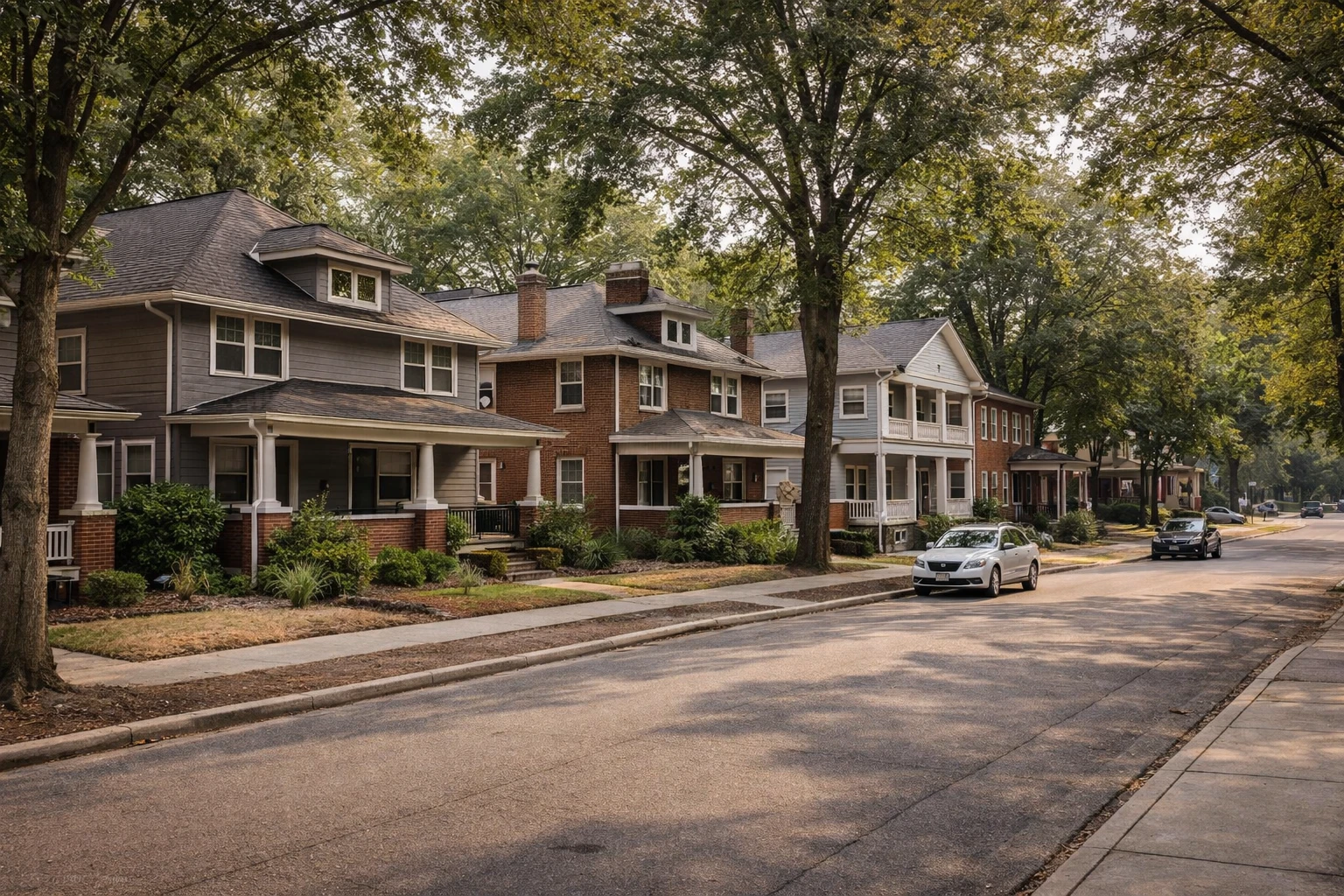
Fisher Park, Greensboro’s most architecturally significant historic neighborhood, wraps around the park of the same name just north of downtown and is home to a collection of craftsman bungalows, Tudor revival homes, and early twentieth-century residential architecture that has drawn significant renovation investment over the past decade. The neighborhood attracts UNCG faculty, healthcare professionals from the Cone Health system, attorneys, and the professional class tenants who pay a premium for walkability, neighborhood character, and proximity to downtown Greensboro’s growing dining and arts scene.
Rental properties in Fisher Park command monthly rents of $1,400–$2,100 for 2–3 bedroom units, with fully renovated historic homes at the upper end of the range. Acquisition prices in the $230,000–$380,000 range for SFRs and smaller multifamily produce DSCR ratios that regularly clear 1.20 with standard down payments — exceptional for a neighborhood with this level of architectural character and tenant quality. Value-add investors who can execute targeted renovations find that the Fisher Park rent premium over surrounding neighborhoods is meaningful and persistent.
College Hill — UNCG and NC A&T University Rental Market
College Hill, the neighborhood directly adjacent to the University of North Carolina at Greensboro’s campus, is Greensboro’s primary university rental market and one of the most consistently occupied rental corridors in the metro. UNCG’s 20,000-plus enrolled students and NC A&T State University’s additional 12,000 students — the two campuses are within two miles of each other — generate overlapping rental demand that keeps the College Hill corridor at near-zero vacancy during the academic year. The area’s housing stock includes a mix of older SFRs, duplexes, and small apartment buildings that have served the student market for decades.
SFRs and duplexes in College Hill and the surrounding university corridors acquire in the $150,000–$280,000 range — some of the most accessible entry points in the Greensboro market — and generate rents of $1,200–$1,800 for standard configurations, with higher effective yields available through room-by-room rental to student households. DSCR ratios in this submarket are among the strongest in the metro, often clearing 1.30–1.40, making College Hill one of the most reliably qualifying corridors for DSCR borrowers seeking maximum cash-on-cash return.
Ardmore — Winston-Salem’s Revitalizing Walkable Neighborhood
Ardmore, located immediately southwest of downtown Winston-Salem along the Reynolda Road and Stratford Road corridors, has undergone a sustained revitalization that has transformed it from an overlooked mid-century neighborhood into one of the city’s most desirable addresses for young professionals and creative class residents. The area’s proximity to Wake Forest University’s campus, Winston-Salem’s arts district, and the Reynolda Village retail and dining complex makes it the preferred rental neighborhood for Wake Forest graduate students, university professionals, and the growing cohort of remote workers who have chosen Winston-Salem for its quality of life and affordability.
Rental properties in Ardmore command monthly rents of $1,300–$1,950 for 2–3 bedroom SFRs and townhomes. Acquisition prices in the $200,000–$340,000 range for well-positioned properties produce DSCR ratios that work comfortably at 20–25% down. The revitalization trajectory in Ardmore suggests that current acquisition prices still reflect a discount relative to where the neighborhood’s fundamentals are heading — investors who enter now benefit from both current cash flow and forward appreciation.
East Winston-Salem / Wake Forest Medical Area — Healthcare Workforce Rental
The east Winston-Salem corridor surrounding the Wake Forest Baptist Medical Center — one of the nation’s leading academic medical centers and the city’s largest employer — constitutes one of the Triad’s most dependable rental markets for workforce and professional housing. The medical center employs thousands of physicians, researchers, nurses, medical residents, and support staff who generate layered rental demand across income tiers. Medical residents, in particular, represent an ideal tenant profile: high-income, rarely home, professionally responsible, and present for 3–7 year residency cycles that translate to long-tenured leases.
SFRs and condos in the east Winston-Salem medical corridor acquire in the $180,000–$310,000 range and generate monthly rents of $1,250–$1,800. DSCR ratios in this submarket are consistently strong, and the medical center’s continued expansion — Wake Forest Baptist has announced ongoing capital investment in its campus and research infrastructure — supports long-term demand growth. Investors focused on tenant quality and stability rather than maximum yield find this submarket particularly compelling.
Greensboro’s Proximity Suburbs — Summerfield and Oak Ridge
The northern Greensboro suburbs of Summerfield and Oak Ridge offer the Piedmont Triad’s most compelling family-oriented rental market for investors targeting long-term hold strategies with appreciation upside. These communities have attracted significant residential development driven by families relocating from Charlotte and the Research Triangle who seek excellent schools, larger lots, and a quieter lifestyle without sacrificing Greensboro’s employment and amenity access. The Guilford County Schools attendance zones covering Summerfield and Oak Ridge consistently rank among the county’s highest performers.
SFRs in Summerfield and Oak Ridge acquire in the $320,000–$480,000 range and generate monthly rents of $1,900–$2,600. DSCR ratios at this price tier are more compressed than in the urban core submarkets, but the tenant quality, lease renewal rates, and appreciation trajectory in these northern suburbs justify the premium for investors with a 7–10 year hold horizon. Properties in this tier attract families who maintain them carefully and typically renew leases for multiple cycles.
Downtown Greensboro / South Elm — Urban Revitalization and STR
Downtown Greensboro and the South Elm Street corridor have been the subject of sustained city investment over the past decade — new mixed-use development, the renovation of historic commercial buildings, a growing arts and restaurant scene anchored by Center City Park, and the expansion of the Greensboro Coliseum complex have collectively upgraded the downtown’s residential desirability. The area attracts urban lifestyle tenants who prioritize walkability and proximity to entertainment, and it hosts regular large-scale events — ACC basketball tournaments, concerts, and trade shows at the Coliseum — that generate short-term rental demand.
Condos and loft-style units in downtown Greensboro acquire in the $140,000–$280,000 range and generate rents of $950–$1,600. For STR investors, event-driven demand during ACC tournament weekends and Greensboro Coliseum events produces nightly rates of $120–$220 that substantially outperform long-term lease projections. The combination of accessible acquisition prices, improving neighborhood fundamentals, and event-driven STR income makes downtown Greensboro one of the Triad’s most interesting value-add and STR plays.
Using DSCR Loans for Short-Term Rentals in Greensboro / Winston-Salem
The Piedmont Triad’s short-term rental market is driven by a combination of major sporting and entertainment events, university athletics, medical travel, and a growing arts and cultural tourism segment that collectively produce more consistent year-round STR demand than the region’s modest national tourism profile suggests. The Greensboro Coliseum is one of the country’s largest arenas by capacity and a frequent host of major events including NCAA basketball tournaments, making it one of the most powerful STR demand generators in the Southeast.
- Greensboro Coliseum / Downtown: ACC and NCAA tournament events generate the region’s peak STR demand; nightly rates spike to $200–$400+ during tournament weekends; Coliseum concerts and major events produce 15–20 high-demand nights annually
- Wake Forest / Reynolda Area (Winston-Salem): Wake Forest home football and basketball weekends drive concentrated demand; nightly rates $130–$250 during game weeks; graduation weekends in May produce some of the year’s strongest booking rates
- Wake Forest Baptist Medical Center Area: Patient family and medical travel extended-stay segment; furnished monthly rentals $1,500–$2,200; consistent year-round demand from out-of-area patients accessing specialized care
- High Point Market / Furniture District: The High Point Market — the world’s largest home furnishings trade show, held twice annually — produces two concentrated spikes of extraordinary STR demand across the entire Triad; nightly rates of $250–$500+ during market weeks; investors who position properties near High Point generate substantial annual income from these two events alone
- Downtown Winston-Salem Arts District: Growing arts and cultural tourism segment; SECCA, the Southeastern Center for Contemporary Art, and the RiverRun International Film Festival draw visitors year-round; nightly rates $90–$160 for well-positioned urban units
DSCR lenders qualify STR income using actual trailing 12-month platform revenue or AirDNA market projections. For full STR program details applicable to Triad properties, see DSCR loans for Airbnb and short-term rentals.
Example DSCR Scenario in Greensboro / Winston-Salem
Property Type: Single-family rental, College Hill / UNCG corridor, Greensboro
Purchase Price: $215,000
Down Payment: $43,000 (20%)
Loan Amount: $172,000
Estimated Monthly Rent: $1,550
Estimated Monthly PITIA: $1,175 (principal, interest at approx. 7.5%, taxes, insurance)
DSCR Ratio: $1,550 ÷ $1,175 = 1.32 — strong qualifying ratio well above most program thresholds
This scenario illustrates one of the most compelling DSCR qualification profiles in the Southeast. A 3-bedroom SFR in Greensboro’s university rental corridor acquired at $215,000 generates a DSCR ratio of 1.32 — substantially above the 1.20 threshold that unlocks the widest program selection and rate tiers. At this ratio, the investor has meaningful cushion against vacancy periods, rate adjustments, or expense increases without falling below qualification minimums. The borrower in this example purchased through an LLC, provided zero personal income documentation, and closed on a timeline that varies by lender and file. The property was occupied within 12 days of closing by two UNCG graduate students at the projected rent with a 12-month lease. This is exactly how many investors scale using DSCR loans in Greensboro / Winston-Salem.
Ready to run the numbers on your next Greensboro / Winston-Salem property? Lendmire closes DSCR loans on a timeline that varies by lender and file — no income docs, no W-2s, and LLC ownership is welcome. Reach out today and let’s get started.
DSCR Refinance Options in Greensboro / Winston-Salem
The Piedmont Triad’s steady appreciation over the past several years has built real equity in properties acquired before the post-2020 migration and price adjustment cycle. Investors who used bridge financing or hard money to close offers quickly now have stabilized properties with rental histories that qualify cleanly for permanent DSCR financing at dramatically lower rates. Moving from high-rate short-term debt to a 30-year DSCR loan improves monthly cash flow immediately and eliminates the balloon payment risk inherent in bridge structures.
Explore DSCR refinance loan options for rate-and-term refinances that reduce carrying costs on Triad rentals, cash-out refinances that extract equity from appreciated Greensboro or Winston-Salem properties for redeployment into additional acquisitions, and post-rehab stabilization refinances for value-add projects that have been completed and are generating rental income. As with purchase DSCR loans, refinance qualification centers on the property’s current income — no personal income documentation required at any stage.
For investors who have built Triad portfolios spanning both cities — a College Hill university rental, a Fisher Park SFR, and a Winston-Salem medical corridor property — strategic refinancing creates a capital recycling mechanism that allows continuous portfolio growth across both Greensboro and Winston-Salem without returning to personal income qualification cycles.
Why Investors Choose Lendmire
- DSCR-only focus: Lendmire specializes exclusively in investor financing — no retail mortgage volume competing for team attention or processing time.
- 41-market broker access: Multiple DSCR investors and lenders allow Lendmire to source programs across the Triad’s price tiers, property types, and investor profiles.
- Speed: Lendmire closes DSCR loans on a timeline that varies by lender and file — a decisive advantage in Greensboro and Winston-Salem’s active market where well-priced properties move fast.
- University and medical market expertise: Deep understanding of UNCG, NC A&T, Wake Forest, and Wake Forest Baptist Medical Center rental dynamics and how DSCR qualification applies to each tenant segment.
- High Point Market positioning: Lendmire understands the STR income spike dynamics of High Point Market weeks and how to document and qualify that income for DSCR purposes.
- LLC and entity support: Full support for LLC, LP, and corporate title — build your Triad portfolio through your entity without complications.
- Lendmire works with real estate investors across 41 markets, including full program access in North Carolina.
Lendmire is a great option for DSCR loans, offering flexible solutions for real estate investors in 41 markets.
Frequently Asked Questions
What is the minimum credit score for a DSCR loan in Greensboro / Winston-Salem?
Most DSCR programs begin at a 620–640 minimum credit score. Borrowers with scores above 700 access the widest program selection and rate tiers. The Triad’s low acquisition prices mean that even at minimum credit tiers, the strong DSCR ratios achievable in neighborhoods like College Hill can partially offset credit score limitations at certain lenders.
Do I need tax returns or W-2s to qualify for a DSCR loan in the Piedmont Triad?
No. DSCR loans qualify entirely on the subject property’s rental income relative to its monthly debt service. Personal tax returns, W-2 employment verification, and income analysis are not part of the process. This structure is particularly valuable for the Triad’s self-employed manufacturing, logistics, and professional services business owners whose tax returns often understate available cash flow.
Can I purchase through an LLC in North Carolina?
Yes. LLC, LP, and corporate entity ownership are fully supported under Lendmire’s DSCR programs in North Carolina. LLC titling is standard practice for active investors building multi-property portfolios in the Triad and creates no complications in the DSCR qualification or closing process.
What DSCR ratio is required to qualify?
Most programs require a minimum ratio of 1.0 to 1.25. Ratios at 1.20 or higher qualify for the widest program selection and best pricing. Greensboro and Winston-Salem are among the Southeast markets where achieving a 1.25+ DSCR ratio with standard 20–25% down is genuinely realistic across multiple submarkets — particularly in the university and workforce rental corridors where acquisition prices remain accessible.
Can High Point Market or ACC tournament STR income be used to qualify?
Yes. Short-term rental income — including the significant revenue spikes generated during High Point Market weeks and ACC or NCAA tournament events at the Greensboro Coliseum — can be used in DSCR qualification. Lenders use actual trailing 12-month platform revenue or AirDNA projections to establish the qualifying income figure. The Triad’s STR market has sufficient operational history to support documentation-based qualification in its core demand segments.
How quickly can Lendmire close a DSCR loan in Greensboro or Winston-Salem?
Lendmire regularly closes DSCR loans on a timeline that varies by lender and file. In a market where well-priced investment properties in College Hill, Ardmore, and the medical corridors attract competing offers, closing speed is a meaningful differentiator. DSCR loans are designed to move quickly because income documentation requirements are minimal compared to conventional investment loan processing.
About Lendmire
Lendmire is a non-QM mortgage brokerage (NMLS# 2371349) arranging DSCR investor loans in 41 markets, including Washington, D.C. DSCR eligibility is generally reviewed around property-level rental income rather than personal income, subject to lender and program guidelines, making it a fit for self-employed investors and LLC-owned portfolios. Scotsman Guide named Lendmire a Top Mortgage Workplace in both 2025 and 2026.
Get Started
Ready to find the right loan for you?
In about 30 seconds you can review financing options available for your investment property. No commitment required.
Informational only. Not a Loan Estimate, approval, or commitment to lend. Program availability and eligibility are subject to lender guidelines, credit approval, property review, and underwriting.
This article is part of Lendmire’s DSCR loan program — full qualification details, guidelines, and scenarios live on the program page.
Related reading: DSCR Cash Out Refinance Winston-Salem North Carolina · DSCR Loans Raleigh-Durham: Investor Financing for Research Triangle, Duke, NC State & Real Estate Investors · Cash Out Refinance Investment Property in Chapel Hill NC
Guides: DSCR Loans in Winston-Salem, NC · DSCR Loans in North Carolina
References
1. Freddie Mac 30-yr average via FRED® — Federal Reserve Bank of St. Louis
Brandon Miller
Founder & CEO, Mortgage Loan Originator, Lendmire LLC
- Mortgage Loan Originator · NMLS# 1129696 · Verify on NMLS Consumer Access
- North Carolina Real Estate Broker · License# 343312 · Verify on NCREC
- North Carolina Insurance Producer · License# 19053198 · Property, Casualty, Life, Health · Verify on NAIC SBS
- Lendmire LLC · Firm NMLS# 2371349 · Verify firm licensure
Important disclosures. Lendmire (NMLS# 2371349) is a licensed mortgage brokerage. Lendmire is not a direct lender, depository institution, or financial advisor. All loan inquiries are subject to lender underwriting; this article does not constitute a commitment to lend. Rates, terms, and program guidelines are subject to change without notice and vary by borrower profile, property type, and state. Information in this article is general in nature and is not financial, legal, or tax advice. Equal Housing Opportunity. NMLS Consumer Access: nmlsconsumeraccess.org.