
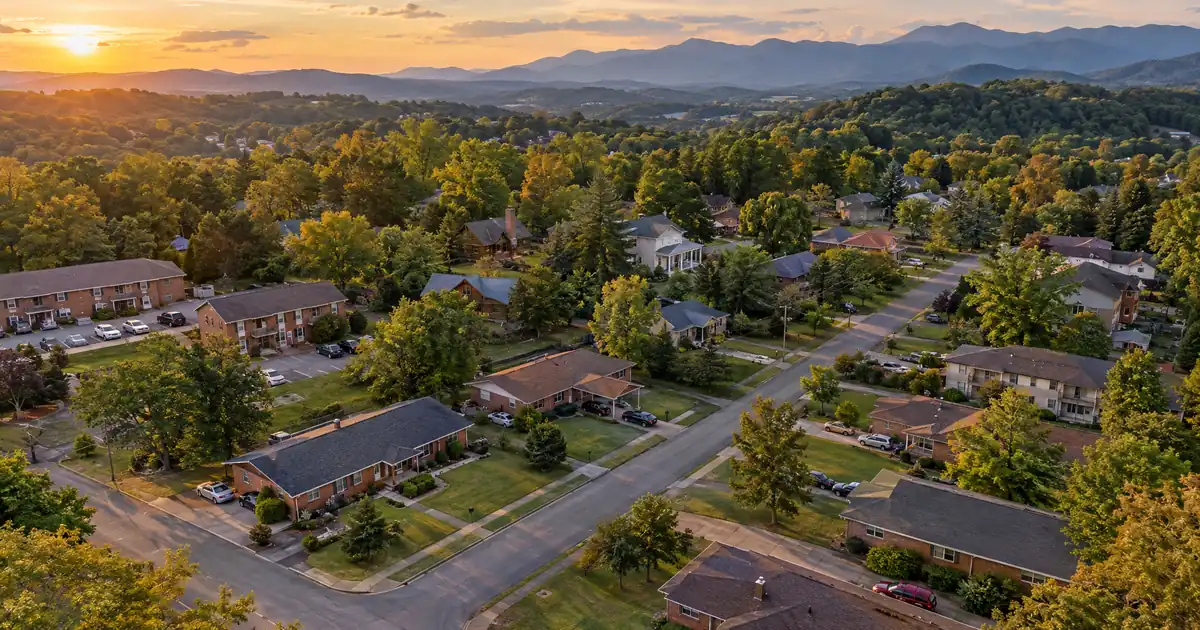
Picture an investor who bought a tired three-bedroom house near Uptown, put real money into the roof, kitchen and flooring, and has a tenant paying full rent on a signed lease. Six months have passed since the deed recorded. The investor’s numbers say the house is worth far more than the purchase price. The question now is whether an appraiser will agree, and how much of that equity can become capital for the next deal.
That question sits at the center of every cash-out refinance in a small, low-priced market. The answer depends less on the loan product than on three things: what the comps say, what the rent covers, and how the proceeds get redeployed. What follows covers those three for Martinsville, Virginia, written for the investor who already owns the property.
DSCR Cash-Out Calculator
Run the cash-out numbers in Martinsville, VA
Rate source: Freddie Mac 30-yr average via FRED® — Federal Reserve Bank of St. Louis · effective Oct 1, 2026
Prefilled with starting assumptions — enter your property’s value, balance, taxes, and insurance for a more accurate picture.
Program parameters update from Lendmire’s centralized guideline source. Taxes and insurance are editable estimates.
As of Oct 1, 2026 · General Freddie Mac market benchmark, not a Lendmire loan offer. Property value, balance, taxes, and insurance are editable estimates. Maximum loan-to-value varies by lender, program, property type, and seasoning. Not a Loan Estimate, approval, or commitment to lend. Program availability and eligibility are subject to lender guidelines, credit approval, property review, and underwriting.
Key Takeaways:
A cash-out refinance on a Martinsville, Virginia rental is underwritten primarily on the property’s rental income measured against its full monthly obligation, taxes and insurance included, then sized to a 75% loan-to-value ceiling on appraised value, so after about six months of seasoning the appraisal, not the renovation budget, sets how much equity comes out.
- Listing-based rents run about $1,000 on Zumper and $1,150 for a house on Trulia.
- Sold-price and list-price medians differ by tens of thousands of dollars, so comp selection drives proceeds.
- Cash-out sizing is capped at 75% LTV, subject to lender guidelines, with about six months of seasoning.
- Modeled coverage on typical local values clears 1.00 including taxes and insurance, but narrows fast at higher values.
Martinsville Market Snapshot
A quick read on the Martinsville investor landscape — figures come from the cited sources below. Confirm current property-level numbers before underwriting.
| Metric | Detail |
|---|---|
| Home prices | 23 sales (Redfin) |
| Employment | 700+ employees (Sovah Health) |
| Vacancy | 1.3% (2020 Housing Market Study) |
Uptown and the Central Core: Where Rehab Equity Is Made
Uptown and the surrounding central blocks are the strongest place to start for an equity-extraction thesis in Martinsville. Entry prices are low enough that a well-done rehab can move a house into a different value bracket. Rents on renovated units can hold close to the citywide house average, which makes the coverage ratio work on a refinance.
Uptown is the historic downtown, and the Uptown Revitalization Association describes its work as enhancing the central business district. Arts programming, a heritage museum in the old courthouse and a steady calendar of walks and strolls give the area a reason to keep residents nearby. Nobody has published a reliable neighborhood-level rent or price series for this part of town, and this article won’t invent one. What can be said is qualitative. The likely tenant pool is workforce households tied to health care, retail and manufacturing employment, and the Dick & Willie Passage, 4.5 miles of paved trail, is an amenity for rentals within walking distance.
The central and southern part of the city, covered by ZIP 24112, is where the price spread shows up. Recent sales on Redfin include a small two-bedroom house that sold for $38,000 and a three-bedroom, two-bath house that sold for $139,900. Those are anecdotes, not medians. They show that two properties a few blocks apart can sit in different universes, and that is the whole reason the appraisal is the main risk on a cash-out here.
The hospital area is a separate demand node. Sovah Health – Martinsville is the largest employer in the city, with more than 700 employees and more than 100 physicians and allied health professionals. Address-level rent data isn’t available for the blocks around it, but a rehabbed one- or two-bedroom house within a short commute of a 220-bed hospital has a tenant pool that doesn’t depend on the manufacturing cycle.
What an Appraiser Actually Sees
The appraiser works from a thin comp set, and the published value indicators disagree by a wide margin. Zillow’s typical home value is $116,601, up 4.0% over the past year. Redfin’s November median sale price was $138K, down 4.8% year over year, on only 23 sales. Movoto’s August median list price was $187K, with homes sitting a median of 89 days.
Three sources, three different stories. The Zillow figure is a modeled index of typical homes. The Redfin figure is what buyers actually paid. The Movoto figure is what sellers hoped to get. A cash-out appraisal lands somewhere between the first two, and almost never near the third.
Consider an investor who rehabbed a house with a renovation budget that implies a $175K value. If the nearby closed sales cluster in the $120K–$140K range, the appraisal can come in well under the budget math. The loan is still sized at a percentage of appraised value, so a low appraisal shrinks the equity pull proportionally. Size the refinance to conservative comps, not to the best sale on the street.
The market is also low-volume. Roughly 16–23 sales a month means one outlier sale can swing a comp set. That cuts both ways. A genuinely strong recent sale of a renovated house nearby helps the appraisal, but one distressed sale can drag it down just as easily. This is a case where pre-appraisal homework earns its keep: pull your own closed comps by bedroom count and condition before the order goes in.
The Coverage Math, Modeled
Debt coverage on a typical Martinsville rental clears 1.00 comfortably at low values and tightens as the property value rises. Rent is cheap here, but so is the price, and a cash-out loan is sized as a percentage of value.
The inputs below are modeled assumptions, not sourced market figures. The scenarios assume a 75% LTV cash-out on an appraised value equal to the listed anchor, with a 30-year amortization and full carrying costs including property taxes and insurance at typical Virginia averages. The bands are rounded down. Exact terms depend on the lender’s guidelines, property type, leverage, and a full review of the borrower’s file.
| Value anchor | Rent assumed | Modeled coverage |
|---|---|---|
| $116,601 (Zillow typical) | $1,000 | About 1.4x |
| $138,000 (Redfin median sale) | $1,150 | About 1.3x |
| $138,000 (Redfin median sale) | $875 | About 1.0x |
| $187,000 (Movoto list median) | $1,150 | About 1.0x |
Read the table as a sensitivity check, not a forecast. The rents come from different rent sources. Zumper’s average of about $1,000 is up 4% from last year, while Trulia puts a three-bedroom at $1,117 and a two-bedroom at $875. Those sources conflict because they measure different sets of listings. Underwrite your own property against its own lease or a rent opinion, not a city average.
The pattern matters more than any single row. A house at the median sale price with a good lease clears 1.00 with cushion. The same house with a weak lease sits right at the line. And a house priced at the median list value, even with a solid lease, has almost no room. In that last case, the lender may review other structures. A sub-1.00 program, an interest-only option or lower leverage could be on the table, though qualification remains subject to lender guidelines, credit approval and property review. Whether to use one is the question worth asking first. If the only way a deal works is sub-1.00, the property is probably priced above what its rent supports.
The simple version of the rent-to-price relationship: rent against a $138K sale price runs roughly 0.7% a month, and against the $187K list price about 0.5%. That is arithmetic on two different data sets, not a sourced ratio, so treat it as a rough gauge.
Seasoning, the 75% Cap, and Reserves
Cash-out on a DSCR file generally requires about six months of ownership measured from title recording, a hard 75% LTV ceiling and a minimum 1.00 DSCR on rent used for lender review against full PITIA. Credit tiers run from a 620 floor up through 660, 680 and 700, and better scores generally widen the options. Reserves are typically about six months of PITIA. All of this is subject to lender guidelines and varies by borrower, property and loan scenario.
Don’t borrow the 80% purchase figure for a refinance. Cash-out tops out at 75%, and that cap is the single biggest driver of how much equity comes out. A few practical implications for Martinsville:
- Seasoning clock. The six months run from the recording date, not from when the rehab finished. An investor who buys with cash and rehabs the property needs to plan the refinance date around the recording, not the paint drying.
- Loan size. Standard programs run up to $3,000,000, which is irrelevant here. The relevant question is the low end. Many Martinsville houses are small balances, and smaller loans route through select lenders in the network rather than the standard programs. A house valued under about $80K can be hard to place, so check minimums before ordering an appraisal.
- Reserves. Six months of PITIA is real money on a multi-property portfolio. Reserves need to be documented, and cash-out proceeds from the same refinance generally can’t be counted as the reserve you needed to get the refinance.
- Eligible properties. Manufactured homes, log homes and barndominiums fall outside these programs. Some older stock in the surrounding county may fit those descriptions, so confirm construction type before spending on a rehab you plan to refinance.
Equity available is not a guaranteed cash figure. It depends on rent used for lender review, PITIA, reserves and the 75% ceiling working together. For the longer walkthrough of how the proceeds are calculated, the equity-extraction mechanics page lays it out, and investor refinance options compares the rate-and-term path against cash-out.
Working DSCR brokers see a recurring pattern in small, low-price markets like this one: the rehab budget gets underwritten by the investor and the appraisal gets underwritten by the comps, and the two rarely match. Files that go smoothly usually have a documented before-and-after story, a signed lease at or near market rent, and conservative expectations on proceeds going in. Files that stall are typically the ones that planned the next purchase around a cash-out number nobody had stress-tested.
Why Conventional Might Still Win (and When It Doesn’t)
For a single rental owned personally by a borrower with strong traditional employment income, conventional financing may carry a lower cost and clean documentation, and it can beat DSCR on that one property. The flip point comes with portfolio growth or entity ownership. An investor holding properties in an LLC (subject to lender program eligibility), a self-employed borrower whose traditional personal-income documentation understates cash flow, or anyone running into the financed-property cap on conventional loans will often find DSCR is the more workable lane. A deeper comparison of conventional and DSCR tradeoffs walks through the break-even in more detail, and the guide “What Is a DSCR Loan” covers the basics.
Where Does the Money Go Next?
Proceeds from a Martinsville cash-out are best redeployed where the same coverage math still works, which usually means more small workforce houses in the same submarket. Redeploying into a pricier market where rent doesn’t scale with price is a different decision and one worth stress-testing before committing.
The local demand story supports staying put, with caveats. Per Data USA, the largest resident employment sectors are health care and social assistance at 970 people, retail trade at 826 and manufacturing at 778. The Virginia Economic Development Partnership notes that one in every five people employed in Martinsville-Henry County works in manufacturing. That concentration is the upside and the risk in one sentence.
On the upside, industrial investment is real. VEDP’s release on Press Glass cites a $155 million investment and 335 new jobs, and Crown Holdings announced a new facility and 126 jobs at the same park. Per the Harvest Foundation, Commonwealth Crossing is a 726-acre business park along the North Carolina border. It sits in Henry County outside the city limits, so an investor chasing that employment base may be buying in the county, not the city. Different jurisdiction, different comp set.
On the risk side, manufacturing concentration means a plant decision can move rental demand. The hospital offsets some of that, but it’s one employer. Honestly, this one’s a toss-up for investors deciding between concentrating in Martinsville and spreading across the Piedmont: concentration keeps the learning curve short and the entry prices low, while diversification protects against a single-employer shock.
New supply is a smaller but real factor. The Martinsville-Henry County EDC lists a mixed-use conversion of the former BB&T building in Uptown adding 63 residences, plus 23 apartments at the former Fieldale School. That’s modest in absolute terms and notable for a city of 13,658 residents. If you plan to buy and rent renovated one- or two-bedroom units near Uptown with the proceeds, those new units are your direct competition.
The Rehab Premium
Older single-family stock is the dominant product in Martinsville, and rehab is the realistic strategy. A dated local housing study reported that most housing is single-family detached and that 65.7% of units predate 1980. It also found that market-rate rents were achievable mainly with newly built, modern units. Translation: older units rent at a discount, and a good renovation closes part of that gap.
That is the opening for equity extraction. A rehab that brings an old house closer to modern-unit rent gains twice, once in the lease and once in the appraisal. The limit is the ceiling. A renovated house on a block of unrenovated ones will probably appraise against the block, not against your finish schedule. Rehab scope should be sized to what the neighborhood’s best closed sales support. Skip the luxury kitchen.
DSCR vs. conventional financing
There are two common ways to finance an investment property in Martinsville, VA, and they qualify you differently — here’s how investors weigh them.
Why investors choose it
- Qualifies on the property’s rental income — no personal tax returns, W-2s, or pay stubs needed to document income.
- No personal debt-to-income ceiling to clear, so existing mortgages and obligations don’t cap your borrowing the same way.
- Can be closed in an LLC, keeping the property inside a business entity.
- Built for scaling — not held to the limit on number of financed properties that conventional financing applies.
- Underwriting centers on the deal: generally qualifies when the rent covers the payment, a 1.00x coverage ratio being a common baseline (confirmed in underwriting).
- Designed specifically for investment property, including long-term and, where the program allows, short-term rentals.
Where it’s strong
- Often the lowest ongoing financing cost for a buyer who fully qualifies on personal income — a fit for a first property or a cost-first purchase.
Trade-offs for investors
- Requires full personal income documentation and must fit within a debt-to-income limit — salary, existing debts, and other mortgages all count.
- Typically held in your personal name rather than a business entity.
- Caps how many financed properties you can carry, which can become a ceiling as a portfolio grows.
- Evaluates you as a borrower as much as the property, which usually means more paperwork.
How investors usually choose: a first or single property often optimizes for the lowest financing cost; portfolio builders often optimize for leverage, vesting in an LLC, and scaling past conventional caps. The right answer depends on your goals, the property, and current guidelines — both paths run through select lenders in Lendmire’s wholesale network, with eligibility and terms confirmed in underwriting.
The same study found the strongest demand for one- and two-bedroom units, with some demand for three-bedrooms, and reported a rental vacancy of 1.3% with waiting lists. An aggregator shows a contradictory 9% rental vacancy. Both numbers can’t be right, and the study is dated. Assume moderate vacancy in your coverage math and confirm it locally. Small units look like the best-absorbed product, which makes a small renovated two-bedroom a cleaner cash-out candidate than a large three-bedroom that needs a bigger price to justify the rehab.
Duplexes and small multifamily are the other path, but published rent and inventory data for them is thin. Large-building data providers don’t cover them, so underwrite each property from its own leases.
Investors weighing whether Martinsville fits at all should also note what it isn’t. There’s no four-year residential university, so student rental demand is minimal. Patrick & Henry Community College and the New College Institute add some education-sector tenancy, but this is a workforce rental market, not a campus one.
For general guidance on local rental rules, taxes and insurance, verify current requirements with qualified local professionals before you underwrite.
Frequently Asked Questions
How do you qualify for a DSCR cash-out refinance in Martinsville, Virginia?
The property has to show rent that covers its full monthly obligation, with a minimum DSCR of 1.00 as the usual benchmark, plus about six months of seasoning and a 620 credit floor. Reserves of about six months of PITIA are typical. Final eligibility depends on lender guidelines, the appraisal and borrower credit.
What are the requirements for an investment property loan in Martinsville, Virginia?
Expect a documented lease or rent opinion, a credit score at or above the program floor, reserves and a property type the programs accept. Cash-out loans cap at 75% LTV, and very small balances route through select lenders rather than standard programs. Every figure here varies by lender and program — guidelines, property type, leverage, and credit profile all apply.
Will a low appraisal wipe out my cash-out in Martinsville?
It can shrink it. The market is thin, with about 23 sales in a recent month, and comps range from a $38,000 two-bedroom to a $139,900 three-bedroom. Because the loan is a percentage of appraised value, a conservative appraisal reduces proceeds directly. Pull your own closed comps by size and condition before ordering.
Does it make sense to cash out and buy in Henry County near the industrial park?
It can, but the comp set and the jurisdiction change, so underwrite it as a separate market. Commonwealth Crossing is outside city limits, and its 726 acres of industrial growth drive employment more than residential supply. Rents and values nearby may not match city figures.
Two Paths From Here
Most Martinsville owners with seasoned equity face a choice between two moves, and each carries a real cost. One option is to refinance now, but conservatively. The investor takes a smaller pull sized to the lower comps, keeps the coverage ratio comfortable and uses the proceeds to buy another low-priced workforce house in the same market. The tradeoff is less capital and a slower portfolio build. The other option is to hold the property, wait for a stronger comp or for the Uptown and Commonwealth Crossing demand to show up in closed sales, and refinance later against a higher value. That path risks the appraisal never improving in a market where Redfin shows prices down 4.8% even as Zillow’s index is up 4.0%.
Investors weighing the first path can connect with Lendmire or call 828-256-2183 to talk through a specific file. Those leaning toward the second can review Lendmire’s Virginia DSCR loan programs to see where the numbers would need to land first.
For current guidelines and terms, see Lendmire’s DSCR loan programs page.
About Lendmire
Lendmire, NMLS# 2371349, is a non-QM mortgage broker serving real estate investors in 41 markets, including Washington, D.C., through DSCR investor loan programs. Qualification is generally reviewed around the subject property’s rental income, not the borrower’s W-2 history, which makes it a practical fit for LLC-titled portfolios and self-employed investors. All scenarios remain subject to lender review and program guidelines. The brokerage has been recognized as a 2025 Scotsman Guide Top Mortgage Workplace and a 2026 Scotsman Guide Top Mortgage Workplace. More company news is available at Lendmire’s press newsroom.
Get Started
Ready to find the right loan for you?
In about 30 seconds you can review financing options available for your investment property. No commitment required.
Informational only. Not a Loan Estimate, approval, or commitment to lend. Program availability and eligibility are subject to lender guidelines, credit approval, property review, and underwriting.
References
2. $1,150 for a house on Trulia
3. Redfin – Martinsville housing market
4. Sovah Health – Martinsville
6. Zillow – Martinsville home values
7. $187K, with homes sitting a median of 89 days
8. Data USA – Martinsville, VA
9. Virginia Economic Development Partnership – Clear Choice case study
10. Virginia Economic Development Partnership – Press Glass
11. Harvest Foundation – Commonwealth Crossing
12. Martinsville-Henry County EDC – Housing
13. Census Reporter — Martinsville VA
14. a 2025 Scotsman Guide Top Mortgage Workplace
15. a 2026 Scotsman Guide Top Mortgage Workplace
This article is part of Lendmire’s investment property cash-out refinance program — full qualification details, guidelines, and scenarios live on the program page.
Related reading: Luxury Rental DSCR Loans In New Jersey · Jersey Shore Vacation Rental Loans: DSCR Financing In Ocean City, Cape May And Long Beach Island · DSCR Cash-out Refinance In New Jersey: Pulling Equity From A Rental
Guides: Investment Property Cash-Out Refinance in Virginia
Brandon Miller
Founder & CEO, Mortgage Loan Originator, Lendmire LLC
- Mortgage Loan Originator · NMLS# 1129696 · Verify on NMLS Consumer Access
- North Carolina Real Estate Broker · License# 343312 · Verify on NCREC
- North Carolina Insurance Producer · License# 19053198 · Property, Casualty, Life, Health · Verify on NAIC SBS
- Lendmire LLC · Firm NMLS# 2371349 · Verify firm licensure
Disclosures. The information presented in this article is general market commentary, not financial, legal, or tax advice. Lendmire is a mortgage brokerage (NMLS# 2371349) — not a direct lender or depository institution — and loan placement is subject to lender underwriting. Nothing in this content represents a commitment to lend. Loan terms, pricing, and program availability vary based on borrower qualifications, property characteristics, and state of subject property, and are subject to change at any time. Lendmire complies with Equal Housing Opportunity requirements. Consumer access: nmlsconsumeraccess.org.