
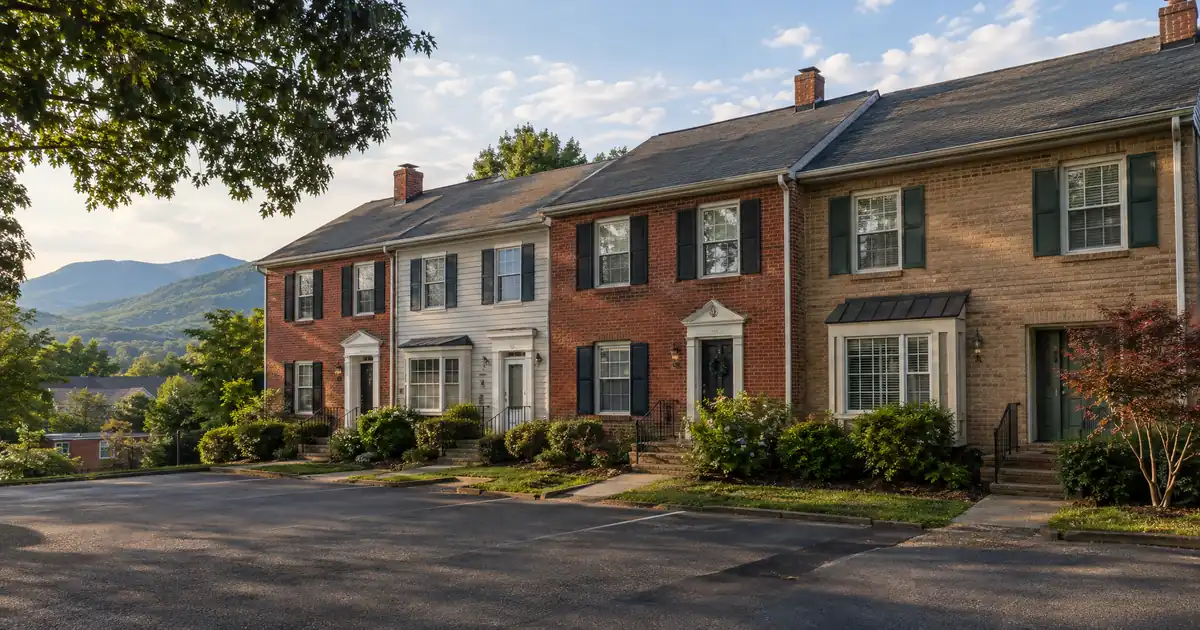
If you own a rental in Radford and you’re planning to pull equity out, here’s what most brokers won’t tell you: the appraisal is the file, not the rent. Radford is a small market where a handful of sales can move the median by double digits. Whether the cash-out works depends on what a lender’s appraiser can support, how clean your leases are, and how much of your rent roll depends on the school calendar.
Lendmire (NMLS# 2371349) is a multi-state mortgage brokerage that helps Radford, Virginia investors arrange DSCR financing across 41 markets, including Washington, D.C. This article covers the equity-extraction side only: what a cash-out refinance looks like on a property you already own, and where Radford’s numbers help or hurt.
DSCR Cash-Out Calculator
Run the cash-out numbers in Radford, VA
Rate source: Freddie Mac 30-yr average via FRED® — Federal Reserve Bank of St. Louis · effective Sep 24, 2026
Prefilled with starting assumptions — enter your property’s value, balance, taxes, and insurance for a more accurate picture.
Program parameters update from Lendmire’s centralized guideline source. Taxes and insurance are editable estimates.
As of Sep 24, 2026 · General Freddie Mac market benchmark, not a Lendmire loan offer. Property value, balance, taxes, and insurance are editable estimates. Maximum loan-to-value varies by lender, program, property type, and seasoning. Not a Loan Estimate, approval, or commitment to lend. Program availability and eligibility are subject to lender guidelines, credit approval, property review, and underwriting.
At a Glance: A DSCR cash-out refinance on a Radford, Virginia rental is underwritten primarily on the property’s rental income measured against its full monthly obligation, with proceeds limited by a 75 percent loan-to-value ceiling and the appraised value rather than the owner’s traditional personal-income documentation.
- Renters make up 57 percent of households, per RentCafe.
- Duplexes, converted homes, and small apartment buildings are 10.64 percent of units, per NeighborhoodScout. Redfin shows a $275K median sale price from just 13 sales in one month. Radford University enrolled 7,837 students in its latest fall count.
- Cash-out typically requires about six months of ownership, measured from title recording.
Radford Market Snapshot
A quick read on the Radford investor landscape — figures come from the cited sources below. Confirm current property-level numbers before underwriting.
| Metric | Detail |
|---|---|
| Home prices | 13 sales (Redfin: Radford housing market) |
| University enrollment | 7,837 students (Radford University enrollment) |
| Employment | ~3,000 employees/subcontractors (Virginia Business) |
The Appraisal Is the File
Radford’s sales data is too thin to trust, and that thinness is the main risk on a cash-out here. Redfin’s median sale price was $229K in one earlier snapshot, down 29.1 percent year over year, and $275K in the later one, down 6.8 percent. The later snapshot counted 13 sales in the month, up from 6 the year before. Those aren’t trends. They’re noise from a small sample, and Redfin’s Radford page shows the swing plainly.
Portal values make it worse. NeighborhoodScout’s modeled median sits at $304,963, well above the Redfin figure. Movoto shows asking prices up 19 percent year over year across only 14 listings, per Movoto. Asking strength is not appraised value. Anyone sizing a cash-out off a listing-site number is sizing off the wrong thing.
So the working assumption is today’s appraised value, not a rising one. Radford reads as a cash-flow market with unproven appreciation, and the equity you can pull depends on what the appraiser’s comps support. A regional title-company survey makes the same point: in small markets like this one, a few sales swing the numbers, per Prime Title of Virginia.
What the Housing Mix Says About Property Type
Duplexes and small converted buildings are the natural cash-out candidates in Radford, and workforce single-family homes are the lower-basis alternative. NeighborhoodScout puts single-family detached homes at 50.80 percent of roughly 5,500 units, large apartment complexes at 33.79 percent, and duplexes, conversions, and small buildings at 10.64 percent. It also describes the rental stock as dominated by one-, two-, and no-bedroom apartments.
Tenure points the same direction. RentCafe counts 3,153 renter-occupied households (57 percent) against 2,347 owner-occupied. Point2Homes, working from Census data, finds two-bedroom units are the largest share of rentals at 47 percent of 1,388 counted, per Point2Homes. Treat that one directionally, since the page carries stale disclaimers.
What that means for a file: two-bedroom-per-unit duplexes and triplexes sit where renter depth is. Large four-bedroom houses sit outside it. Student and roommate tenancy also means more turnover.
Supply is thin. Homes.com showed only two multi-family listings in an earlier snapshot, priced from $325,000 to $600,000. One was a three-unit property near campus advertising monthly income as the listing agent’s claim. That claim is not a rent schedule. On any small multi-unit cash-out, the lender looks at a documented rent roll or the appraiser’s rent schedule, not the brochure.
Large 50-plus unit complexes are institutional and outside typical DSCR scope. Skip them.
Rent Figures Disagree. Underwrite Off the 1007.
Radford rent sources contradict each other by wide margins, and none of them is a substitute for a lease or an appraiser’s rent schedule. RentCafe puts average rent at $1,367 but covers only buildings with 50 or more units. Its unit averages are $728 for a one-bedroom, $1,094 for a two-bedroom, and $1,575 for a three-bedroom. Rentometer shows $878, $887, and $973 for the same three sizes. Rent.com shows apartment rents from $890 to $1,205, with the average one-bedroom at $1,035.
That’s a gap of several hundred dollars on a three-bedroom depending on which tab you open. The larger-unit figures come from newer complexes and may not carry over to older small buildings. On long-term rentals, the lender generally works from the lower of the current lease or market rent on the appraiser’s Form 1007 schedule. That makes the lease the anchor. Portal averages don’t enter the math.
Here’s the practical read. If your actual leases run below the appraiser’s market rent, the lease governs. If they run above, expect the schedule to cap you. Either way, the coverage figure gets set by paper, not by a rent-estimate site.
Demand Anchors: University, Arsenal, Hospital
Radford has a student base and a defense-industrial workforce base, and the pairing is what separates it from nearby towns. Both matter to a lender reading a rent roll.
The university. Radford University enrolled 7,837 students in its latest fall count, up from 7,812 the prior year, according to its enrollment release. It also reported a record 796 new graduate students. Census Reporter’s ACS five-year figures put the city at 16,726 residents, per Census Bureau QuickFacts. Enrollment is nearly half that. Campus demand is the city’s clearest anchor, so lenders tend to look hard at student-dependent rent rolls. Document lease history.
The arsenal. The Radford Army Ammunition Plant is technically in neighboring counties, but the city’s housing grew up around it. Arsenal-era neighborhoods like Monroe Terrace, Radford Village, and Sunset Village still exist today, per Wikipedia’s Radford entry. An earlier-dated Virginia Business report put the plant at about 3,000 employees and subcontractors and ranked it seventh among New River Valley employers, behind employers including Virginia Tech, Volvo Group North America, Radford University, and Carilion New River Valley Medical Center. Operator and contract status have moved since, so treat the headcount as dated.
The hospital. Carilion New River Valley Medical Center sits just outside Radford in Christiansburg. It has 146 beds and a Level III trauma designation per Wikipedia. Nursing and allied-health students overlap with workforce tenants, which helps rent-roll diversity.
A Soft Spot Worth Sizing
Metro payrolls are the quiet risk. A published survey says payrolls in the Blacksburg–Christiansburg–Radford metro were down about 3.5 percent year over year at the time of its reading, while demand near Virginia Tech (38,995 students) stayed firm. That’s a title company’s read of labor data, not a direct government series. Still, it matters for workforce rentals outside the student core. A lender may look harder at rent-roll stability there.
Honestly, this one is a toss-up. Campus-adjacent units carry seasonal vacancy risk but deep renter demand. Workforce single-family rentals carry lower basis but more exposure to regional job softness. Neither wins outright.
Where the Cash-Out Candidates Sit
The strongest candidates cluster in a few specific pockets, though no source gives submarket-level rents or prices. What follows is qualitative.
East Radford Historic District. It sits near campus, with 302 contributing buildings in a mixed residential and commercial area, per Wikipedia. Older Queen Anne and Colonial Revival stock suggests converted and small multi-unit buildings, though that part is inference. Older buildings mean appraisal condition adjustments and a closer look at documented updates. Duplex owners here should expect the appraiser to ask questions.
Downtown and Main Street. The compact, walkable core mixes students, young professionals, and service workers. It is the most natural place for small mixed-use or converted buildings.
Tyler Avenue corridor. Chain restaurants sit closer to campus along this road, which is also the route to I-81 and the hospital, per Homes.com. It’s a convenience play for tenants working at the medical center or commuting toward Blacksburg, which is about 20 miles away, or Christiansburg at about 10.
Arsenal-era neighborhoods. Monroe Terrace, Radford Village, and Sunset Village are workforce-housing in origin. Single-family holdings here tend toward the lower-basis end, roughly in line with the individual sale prices Redfin lists in the $157,500 to $257,500 range for three- and four-bedroom homes. Those are single-family data points, not multi-unit comps.
Bisset Park and the riverfront. Radford is the only municipality along this stretch of the New River, per Virginia DWR. That’s amenity-driven demand. For a DSCR file, it supports a rent story but not a number.
A Modeled Cash-Out on a Campus-Area Duplex
Run the numbers on a duplex this way. These are modeled assumptions, not cited market data. Say the property appraises at $340,000, inside the listing band above. Assume two-bedroom units at $1,000 each on the appraiser’s rent schedule. The lender caps cash-out at 75 percent of appraised value, subtracts the existing payoff, and then the owner still has to show about six months of reserves.
Including taxes and insurance, that rent against the new obligation lands right around the 1.00 benchmark, possibly a hair under. One lower appraisal or one softer rent schedule tips it. That is exactly the situation where the structure matters.
If the number lands under 1.00 on long-term rent alone, the paths a lender may review include a sub-1.00 program, an interest-only structure, or a lower requested loan-to-value that shrinks the obligation. None of those is automatic. Eligibility depends on lender guidelines, credit profile, reserves, and property review. Stronger compensating factors usually come with lower leverage or different pricing.
The same math on a workforce single-family rental at a lower basis generally has more cushion, simply because the price is lower relative to rent. But cushion isn’t proceeds. A smaller property supports a smaller cash-out.
Where the Answer Flips
Whether a cash-out makes sense in Radford depends on what you plan to do with the proceeds and how much you believe the appraisal.
Pulling equity makes sense when your leases are documented, your appraisal has real comps behind it, and the proceeds fund a purchase with better coverage than the property you’re borrowing against. It gets shakier when the rent roll leans on one semester’s leases or the building’s condition is uneven. Then the equity you can reach shrinks, and a refinance that works on paper may not work after the appraiser’s adjustments.
The other flip point is holding cost. Taking cash out increases the obligation. If the property was barely covering itself before, the new loan may push it below the benchmark. In that case a rate-and-term structure, covered in Lendmire’s refinance overview, might fit better than a cash-out. And for investors weighing this against a conventional path, the guide “Where DSCR and Conventional Diverge” comes down mostly to documentation: rental income versus personal income.
One more tradeoff. A tight market with a thin sale history means fewer comps, and fewer comps mean more appraisal variance. Expect it. Don’t assume asking-price strength carries over.
The Documentation That Keeps the File Clean
On Radford-type files, the friction is rarely the ratio. It’s the paper around it. The cleaner files from a documentation standpoint tend to have the entity documents, the lease evidence, and the title information lined up before the appraisal is ordered. In markets structurally like this one, where a lot of rent comes from a single institution’s calendar, the common friction point is a rent roll that can’t be tied to lease terms. Lendmire’s deal desk sees that pattern often enough to treat lease history as the first thing to organize.
Work the file in this order:
1. Confirm seasoning from the settlement statement. Lenders typically measure about six months from title recording. If you bought recently, the settlement statement is the proof, and a recent purchase without it gets kicked back.
DSCR vs. conventional financing
Two common ways to finance an investment property in Radford, VA. They qualify you differently — here’s how investors weigh them.
Why investors choose it
- Qualifies on the property’s rental income — no personal tax returns, W-2s, or pay stubs needed to document income.
- No personal debt-to-income ceiling to clear, so existing mortgages and obligations don’t cap your borrowing the same way.
- Can be closed in an LLC, keeping the property inside a business entity.
- Built for scaling — not held to the limit on number of financed properties that conventional financing applies.
- Underwriting centers on the deal: generally qualifies when the rent covers the payment, a 1.00x coverage ratio being a common baseline (confirmed in underwriting).
- Designed specifically for investment property, including long-term and, where the program allows, short-term rentals.
Where it’s strong
- Often the lowest ongoing financing cost for a buyer who fully qualifies on personal income — a fit for a first property or a cost-first purchase.
Trade-offs for investors
- Requires full personal income documentation and must fit within a debt-to-income limit — salary, existing debts, and other mortgages all count.
- Typically held in your personal name rather than a business entity.
- Caps how many financed properties you can carry, which can become a ceiling as a portfolio grows.
- Evaluates you as a borrower as much as the property, which usually means more paperwork.
How investors usually choose: a first or single property often optimizes for the lowest financing cost; portfolio builders often optimize for leverage, vesting in an LLC, and scaling past conventional caps. The right answer depends on your goals, the property, and current guidelines — both paths run through select lenders in Lendmire’s wholesale network, with eligibility and terms confirmed in underwriting.
2. Gather every current lease and the prior lease history. For student-heavy units, show how leases have renewed across semesters. Lenders reviewing student-dependent rent rolls look for continuity.
3. Set the entity paperwork. If the property is titled in an LLC, have formation documents and operating agreement ready, subject to lender program eligibility.
4. Prepare reserves documentation. About six months of the full monthly obligation is typical, and more on larger balances. Bank or brokerage statements need to show the funds are seasoned and accessible.
5. Plan for the appraisal. Collect recent improvement records and any in-neighborhood sales you know about. If the value comes in light, a documented appraisal reconsideration packet with recent sales and condition adjustments is a routine step, not a crisis.
6. Confirm local rules before you commit. Verify current local rental rules, taxes, and insurance with qualified local professionals. Radford is an independent city, and requirements sit at that level.
Program details like loan size, credit tiers, and reserves vary by lender and borrower. Standard programs generally run up to $3,000,000, with smaller balances routed through select lenders in the network. Credit minimums start at a 620 floor with tiers up from there. Manufactured homes, log homes, and barndominiums fall outside these programs. Anyone ready to start can reach Lendmire at 828-256-2183, or read the guide “What Is a DSCR Loan” first. Investors comparing programs statewide can see DSCR loan options for Virginia investors, and the mechanics of pulling equity with a DSCR cash-out are covered separately.
Frequently Asked Questions
How do you qualify for a DSCR loan in Radford, Virginia?
Qualification centers on the property, not personal income. The lender compares rent used for lender review to the full monthly obligation (principal, interest, taxes, insurance, and any dues), and a 1.00 ratio is a common baseline. Credit tiers start at a 620 floor, reserves are typically about six months, and cash-out adds a seasoning period. Final eligibility depends on lender guidelines, credit, reserves, and property review.
What are the requirements for a cash-out refinance on an investment property in Radford, Virginia?
Expect a 75 percent maximum loan-to-value, about six months of ownership measured from title recording, and a qualifying DSCR of at least 1.00 on the appraiser’s rent schedule. Reserves of about six months are typical. Proceeds depend on appraised value, rent, and reserves, so the cash available is never a guaranteed figure.
How do DSCR lenders review rental income instead of tax-return income in Virginia?
The lender reviews the property’s leases or the appraiser’s market rent schedule against its monthly obligation rather than the owner’s traditional personal-income documentation. Lendmire places DSCR investor loans and its network reviews eligibility on property cash flow, subject to lender guidelines.
Will Radford’s swinging sale prices hurt a cash-out appraisal?
They can. Redfin’s median moved from $229K to $275K between snapshots on very few sales, so the appraiser may have few comps to lean on. Appraised value can come in below portal estimates or asking prices. A reconsideration packet with recent in-neighborhood sales is the standard response.
Can I refinance a student-heavy rental in Radford?
Yes, subject to lender program terms, but expect a closer look at the rent roll. Lenders tend to scrutinize rent that depends on the academic calendar, so documented lease history and renewal patterns strengthen the file. Units near campus carry seasonal vacancy risk that a stable workforce tenant base does not.
The Number to Underwrite Around
Radford’s rental demand is real: 57 percent renters, a university near 7,800 students, an arsenal workforce, and a hospital next door. The equity side is thinner. Thirteen sales in a single month is the figure that frames every cash-out here, because it means the appraisal, not the rent, is what sets how much you can pull.
About Lendmire
A DSCR-focused mortgage broker, Lendmire (NMLS# 2371349) places investor financing across 41 markets, meaning 40 states plus Washington, D.C. DSCR eligibility is generally reviewed by the lender on property cash flow rather than traditional personal-income documentation, subject to lender guidelines. The firm was recognized by Scotsman Guide in 2025 and recognized by Scotsman Guide as a 2026 Top Workplace among mortgage employers.
Get Started
Ready to find the right loan for you?
In about 30 seconds you can review financing options available for your investment property. No commitment required.
Informational only. Not a Loan Estimate, approval, or commitment to lend. Program availability and eligibility are subject to lender guidelines, credit approval, property review, and underwriting.
References
1. RentCafe: Radford rent trends
2. NeighborhoodScout: Radford real estate
3. Redfin: Radford housing market
4. Radford University enrollment release
5. Virginia Business: Radford Army Ammunition Plant
6. Movoto
7. Point2Homes
8. Homes.com
9. Rentometer
10. Rent.com
11. Radford University graduate enrollment release
12. Census Reporter: Radford, VA profile
14. Carilion New River Valley Medical Center
15. Wikipedia
16. Wikipedia
17. Homes.com
19. recognized by Scotsman Guide in 2025
20. recognized by Scotsman Guide as a 2026 Top Workplace
This article is part of Lendmire’s investment property cash-out refinance program — full qualification details, guidelines, and scenarios live on the program page.
Related reading: Luxury Rental DSCR Loans In New Jersey · Jersey Shore Vacation Rental Loans: DSCR Financing In Ocean City, Cape May And Long Beach Island · DSCR Cash-out Refinance In New Jersey: Pulling Equity From A Rental
Guides: Investment Property Cash-Out Refinance in Radford, VA · Investment Property Cash-Out Refinance in Virginia
Brandon Miller
Founder & CEO, Mortgage Loan Originator, Lendmire LLC
- Mortgage Loan Originator · NMLS# 1129696 · Verify on NMLS Consumer Access
- North Carolina Real Estate Broker · License# 343312 · Verify on NCREC
- North Carolina Insurance Producer · License# 19053198 · Property, Casualty, Life, Health · Verify on NAIC SBS
- Lendmire LLC · Firm NMLS# 2371349 · Verify firm licensure
Required disclosures. Lendmire (NMLS# 2371349) operates as a licensed mortgage broker, not a direct lender or depository. The discussion in this article is general in nature and should not be relied upon as financial, legal, or tax advice — every investment scenario is unique and should be reviewed by a qualified professional. Any loan inquiry is subject to lender underwriting, and this article is not a commitment to lend or a guarantee of approval. Mortgage rates, loan terms, and program guidelines vary by borrower, property, and state, and may change without notice. Equal Housing Opportunity. Verify licensure at NMLS Consumer Access.