
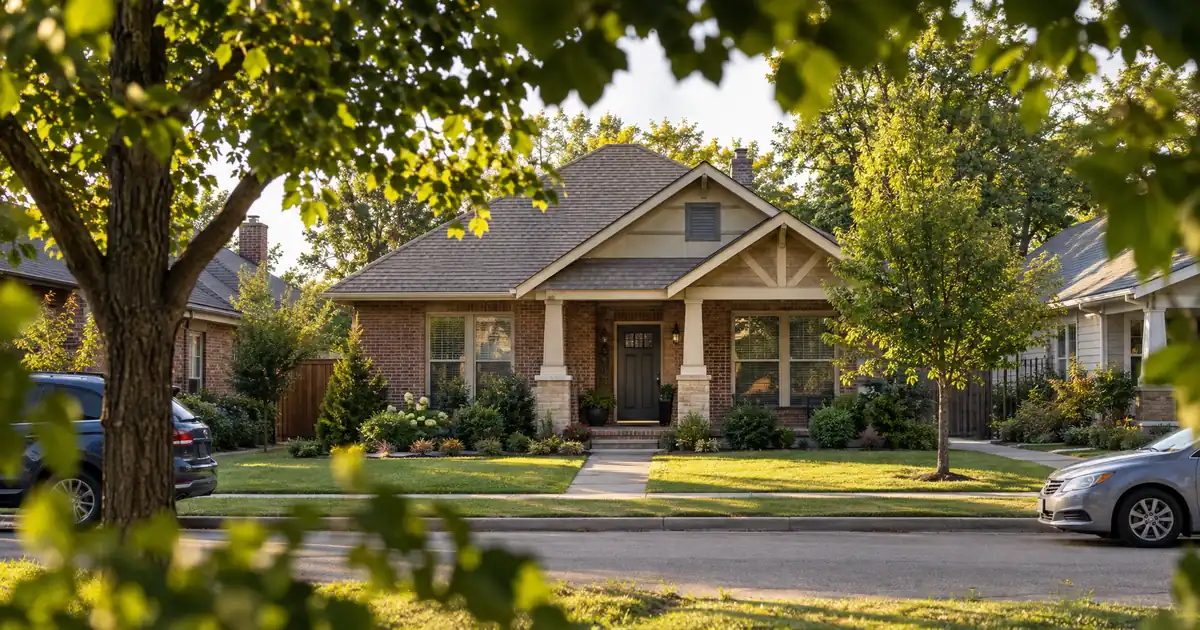
Most cash-out refinances stall on one friction point: the equity isn’t there yet. The paperwork is rarely the problem. Seasoning, an appraisal that lands under the hoped-for number, and a rent that doesn’t cover the new balance all come down to the same issue. A DSCR cash out refinance in Moore, Oklahoma, runs into all three, because this is a cash-flow suburb, not an appreciation story.
DSCR Cash-Out Calculator
Run the cash-out numbers in Moore, OK
Rate source: Freddie Mac 30-yr average via FRED® — Federal Reserve Bank of St. Louis · effective Sep 24, 2026
Prefilled with starting assumptions — enter your property’s value, balance, taxes, and insurance for a more accurate picture.
Program parameters update from Lendmire’s centralized guideline source. Taxes and insurance are editable estimates.
As of Sep 24, 2026 · General Freddie Mac market benchmark, not a Lendmire loan offer. Property value, balance, taxes, and insurance are editable estimates. Maximum loan-to-value varies by lender, program, property type, and seasoning. Not a Loan Estimate, approval, or commitment to lend. Program availability and eligibility are subject to lender guidelines, credit approval, property review, and underwriting.
The Short Version:
A DSCR cash-out refinance in Moore, Oklahoma is underwritten primarily on the property’s rental income measured against its full monthly obligation, so the path runs from confirming about six months of title seasoning, to an appraisal that sets value, to a loan sized at no more than 75 percent of that value, with reserves held back.
- Houses rent for a median of $1,565 versus $975 for apartments, per Zumper.
- Modeled coverage on a median-priced house at 75 percent LTV lands near 1.1x, taxes and insurance included.
- Single-family detached is 84.19 percent of units, per NeighborhoodScout, so duplex comps run thin.
- Median prices rose roughly 3 percent over twelve months, so equity comes from buying or rehab, not waiting.
What Moore Gives a Cash-Out Borrower
Moore sits on I-35 between Oklahoma City and Norman, with roughly 63,400 residents and a median household income of $80,420, per Data USA. About 67.9 percent of housing units are owner-occupied. The other third rent, and RentCafe counts 7,671 renter households, about 32 percent of the total. That is a real tenant pool, though not a deep one.
Resident employment is plain. Health care and social assistance leads at 4,499 people, then retail at 4,039 and educational services at 2,832. Some of those residents work outside Moore. Norman Regional runs an in-city ER and clinic campus, Norman Regional Moore. Moore Norman Technology Center reports more than 250 full-time staff. The wider metro adds aerospace: the Greater Oklahoma City Chamber reports $8.8 billion in goods and services and more than 80,200 jobs.
None of this is exciting. It is steady, and for a rental that already exists, steady is what a lender wants to see.
The Rent-to-Value Problem
Moore houses are priced near the middle of the metro and rent about the same way. The trailing-twelve-month median sale price is $232,398 per Homes.com. Zumper puts the house rent median at $1,565. That works out to gross rent of about 0.67 percent of price a month.
Sources disagree on price level. An earlier Redfin reading showed a $228,000 median with prices down 7.3 percent year over year, and U.S. News lists a median home value of $226,967. Treat the market as a band of roughly $205,000 to $232,000, depending on definition.
Run the numbers on a modeled median-priced house at the $1,565 rent. At 75 percent LTV, coverage including taxes and insurance comes out near 1.1x. That clears the standard 1.00x benchmark with thin cushion. Drop the rent to Regency Park’s $1,295 median on the same price and the ratio slips below 1.00x. These are modeled assumptions, not sourced market facts.
If the number lands under 1.00x, a few structures may be available. A sub-1.00 program, interest-only terms, or a lower loan amount are all options a lender would review. Each comes with tradeoffs: reduced leverage, stronger credit and reserves, or different pricing. All of it is subject to lender guidelines, credit approval, and property review. The more useful question is whether the property belongs in the cash-out plan at all.
Seasoning Meets a Slow Market
The program wants about six months of ownership, measured from title recording. Six months is the easy part. The harder part is that Moore adds value slowly. A roughly 3 percent twelve-month gain barely moves an appraisal in that window.
Zumper shows rents flat year over year. A Cushman & Wakefield listing for a Moore-submarket duplex product cites 6.9 percent rent growth, but that is broker marketing for a specific asset, not a market statistic. Moore reads as cash-flow-led. Nobody should plan to refinance out of an appreciation gain here.
So the equity has to be forced. Picture an investor who bought a dated house well under the local median, put money into the kitchen and floors, and now holds an appraisal near the median. That investor has a real cash-out file. An investor who bought at market and waited has seasoning and not much else. That is the flip point. If the plan depends on appreciation, a different submarket probably fits better. If the plan depends on a below-market buy and a rehab, Moore’s price band is workable.
Lender sizing runs on three variables: rent used for lender review, full obligation, and the 75 percent LTV ceiling. Reserves of about six months of PITIA also apply. The resulting cash is not a guaranteed figure. The cash-out qualification details walk through that sizing.
Where the Coverage Holds
Westmoore and the south side. Redfin’s rental page shows a $1,597 median for what it labels South Oklahoma City, the Westmoore side. Homes.com describes Westmoore as straddling OKC’s southern corridor and Moore’s small-town character, about 14 miles south of downtown OKC. Redfin’s date stamps on that page are inconsistent, so treat the figure as directional. It beats Regency Park by about $300 a month. That gap only helps coverage if the price gap is smaller than the rent gap, so compare price per rent dollar before picking a side.
Oakridge and Southmoore. This is the I-35 corridor in south Moore, with older homes mixed with newer construction, shopping, and Arbor Gardens park, per Homes.com. The tenant base is commuters. Mixed vintages help a refinance. Appraisers get more comp choices than they do in a single-vintage tract.
Old Town and central Moore. The city’s comprehensive plan names Old Town, Riverwalk, the Shops at Moore, and Warren Theatres as demand generators, along with a future commuter-rail stop. Housing is older and central. Older rentals here are the strongest candidates for the buy-low, rehab, refinance sequence. The 14-screen Warren Theatre anchors the amenity side. Rent data by neighborhood is thin, so any rehab budget deserves an independent rent check.
Regency Park and the Telephone Road corridor. Regency Park’s $1,295 median is the low end of the observed range. The Telephone Road corridor, home to Norman Regional Moore and Central Park, has no sourced rent figure at all. Describe it as proximity to a hospital campus and nothing more.
The Tornado Code Angle
Here is where Moore differs from most OKC-metro suburbs. It was the first U.S. city to adopt building rules aimed at extensive tornado damage, requiring new homes to withstand winds up to 135 mph, versus a 90 mph national standard, per NBC News. The council acted on the recommendation of OU structural engineers, per PBS. A NewHomeSource report on the added cost found “the risk of driving away new home construction did not materialize.” The same report notes that all 35 Moore Public Schools buildings will have FEMA-rated shelters once construction is complete.
For a lender, this is a durability story about newer-build rentals, not a pricing guarantee. An appraiser still values comps, not code. The code does give a newer rental a credible condition argument. Whether that becomes a measurable value premium is uncertain. The research found none. For the broader local picture, Oklahoma DSCR financing covers state-level context.
Verify current local rental rules, property taxes, and insurance with qualified local professionals before sizing any file.
Can a Duplex Do Better? (Maybe, If You Can Find One)
Single-family detached homes make up 84.19 percent of Moore’s 24,188 housing units. Small multifamily is a niche, and that cuts two ways. Duplexes and fourplexes are hard to find. On a cash-out, there are also fewer same-type comps for the appraiser.
The income math is tempting. Apartments.com puts a two-bedroom apartment near $1,167. Two duplex sides at roughly $1,000 to $1,200 each would gross about $2,000 to $2,400, against $1,565 for a house. That is a real lift, but only if the duplex doesn’t cost twice the house. Without verified duplex price data, that is a thought experiment, not a thesis. The honest answer is a toss-up that depends on the specific listing. The stronger play for most investors here is probably the house with a below-market basis. The duplex wins only when the price-to-rent ratio checks out on the actual building.
What the Deal Desk Tends to See
On files from markets like this one, the common friction is a gap between the owner’s value estimate and the appraisal. In thin-comp, single-family suburbs, the cleaner files from a documentation standpoint tend to show purchase records, a renovation scope, and a signed lease or rent survey from the start. The file gets awkward when the borrower plans around the appraisal they hoped for instead of the one they might get, then finds the 75 percent cap leaves little or nothing to pull. Running the coverage ratio at a value 5 to 10 percent below expectation before ordering anything is a habit worth building.
Turning Proceeds Into the Next Deal
The cash-out thesis depends on what happens next. Pulling equity to buy another below-market Moore house, where coverage clears at standard leverage, keeps the cycle going. Pulling it to chase a market where the math doesn’t pencil is a different decision. Lendmire’s DSCR guide covers the coverage calculation, and the program-to-program comparison shows when conventional financing might still fit. Conventional can cost less for a single, personally held rental with clean traditional employment income. DSCR tends to win for entity-held portfolios or when personal documentation is the bottleneck. LLC-held properties are subject to lender program eligibility. Lendmire’s refi programs cover the refinance options.
A DSCR-focused mortgage broker can price the numbers before the appraisal is ordered. Investors can get a DSCR quote or call 828-256-2183. Qualification remains subject to lender overlays and to borrower, property, and program guidelines.
Frequently Asked Questions
How do you qualify for a DSCR cash-out refinance in Moore, Oklahoma?
Qualification centers on the rental. Lenders divide rent used for lender review by the full monthly obligation of principal, interest, taxes, insurance, and any HOA dues, and 1.00x is a common baseline. The property also needs about six months of ownership from title recording and a loan of no more than 75 percent LTV. Credit, reserves of about six months, and the appraisal also matter. Eligibility is subject to lender guidelines.
DSCR vs. conventional financing
There are two common ways to finance an investment property in Moore, OK, and they qualify you differently — here’s how investors weigh them.
Why investors choose it
- Qualifies on the property’s rental income — no personal tax returns, W-2s, or pay stubs needed to document income.
- No personal debt-to-income ceiling to clear, so existing mortgages and obligations don’t cap your borrowing the same way.
- Can be closed in an LLC, keeping the property inside a business entity.
- Built for scaling — not held to the limit on number of financed properties that conventional financing applies.
- Underwriting centers on the deal: generally qualifies when the rent covers the payment, a 1.00x coverage ratio being a common baseline (confirmed in underwriting).
- Designed specifically for investment property, including long-term and, where the program allows, short-term rentals.
Where it’s strong
- Often the lowest ongoing financing cost for a buyer who fully qualifies on personal income — a fit for a first property or a cost-first purchase.
Trade-offs for investors
- Requires full personal income documentation and must fit within a debt-to-income limit — salary, existing debts, and other mortgages all count.
- Typically held in your personal name rather than a business entity.
- Caps how many financed properties you can carry, which can become a ceiling as a portfolio grows.
- Evaluates you as a borrower as much as the property, which usually means more paperwork.
How investors usually choose: a first or single property often optimizes for the lowest financing cost; portfolio builders often optimize for leverage, vesting in an LLC, and scaling past conventional caps. The right answer depends on your goals, the property, and current guidelines — both paths run through select lenders in Lendmire’s wholesale network, with eligibility and terms confirmed in underwriting.
What are the seasoning and LTV requirements for a cash-out refinance on a Moore rental?
Typical guidance is about six months of ownership, measured from title recording, and a cash-out ceiling of 75 percent LTV. That is lower than the 80 percent purchase cap, and the two shouldn’t be mixed up. In Moore’s slow-appreciation market, six months rarely builds much equity on its own. The cash-out amount depends on appraised value, rent used for lender review, and reserves, so it is never a guaranteed figure.
Does Moore’s tornado-resistant building code change how a rental appraises?
Not directly. Appraisers value comparable sales, not code history. Newer homes built to the 135 mph standard may offer a condition and durability argument, but the research found no sourced value premium. Treat it as a tenant-demand and condition point, and don’t build the cash-out on an assumed bump.
Can a Moore duplex support a larger cash-out than a single-family house?
Possibly, if the duplex’s combined rent is high relative to its price. Two sides at roughly $1,000 to $1,200 each beat a $1,565 house, but only when the price doesn’t double. Duplex stock is scarce, comps are thin, and the appraisal may take longer to support. Run both versions before choosing.
The Question for Your Moore Property
Moore’s housing stock was rebuilt under codes written for the worst day on the calendar, and the equity inside it builds slowly. So which is your Moore rental: equity you created with a below-market buy, or equity you are still waiting on?
For current guidelines and terms, see Lendmire’s DSCR loan programs page.
About Lendmire
Lendmire — NMLS# 2371349 — is a DSCR and non-QM mortgage brokerage with investor loan programs in 41 markets, including Washington, D.C. Lenders commonly review DSCR eligibility around property-level rent rather than personal income documentation, subject to lender guidelines. The brokerage helps arrange financing for LLC-owned portfolios that have outgrown conventional financed-property limits. Recognized as a 2025 Scotsman Guide Top Mortgage Workplace and a 2026 Scotsman Guide Top Mortgage Workplace.
Get Started
Ready to find the right loan for you?
In about 30 seconds you can review financing options available for your investment property. No commitment required.
Informational only. Not a Loan Estimate, approval, or commitment to lend. Program availability and eligibility are subject to lender guidelines, credit approval, property review, and underwriting.
References
1. Zumper, Moore rent research
5. Moore Norman Technology Center
6. mntc.edu — Employment Opportunities
7. Greater Oklahoma City Chamber
8. Homes.com
9. Redfin
10. Homes.com
11. cityofmooreok.gov — Envisionmoorefinal Plan Small
12. NBC News, Moore building codes
13. PBS, Moore building codes update
14. NewHomeSource, storm shelters in Oklahoma
15. Apartments.com
16. a 2025 Scotsman Guide Top Mortgage Workplace
17. a 2026 Scotsman Guide Top Mortgage Workplace
This article is part of Lendmire’s investment property cash-out refinance program — full qualification details, guidelines, and scenarios live on the program page.
Related reading: Cash Out Refinance Investment Property Moore Oklahoma · DSCR Loans in Oklahoma City, Oklahoma: Investor Financing for Midtown, Edmond, and Moore — Energy-Belt Cash Flow and Suburban Rental Growth · Blanket DSCR Loans In Oklahoma: How Multi-property Investors Qualify
Guides: Investment Property Cash-Out Refinance in Moore, OK · Investment Property Cash-Out Refinance in Oklahoma
Brandon Miller
Founder & CEO, Mortgage Loan Originator, Lendmire LLC
- Mortgage Loan Originator · NMLS# 1129696 · Verify on NMLS Consumer Access
- North Carolina Real Estate Broker · License# 343312 · Verify on NCREC
- North Carolina Insurance Producer · License# 19053198 · Property, Casualty, Life, Health · Verify on NAIC SBS
- Lendmire LLC · Firm NMLS# 2371349 · Verify firm licensure
Required disclosures. Lendmire (NMLS# 2371349) operates as a licensed mortgage broker, not a direct lender or depository. The discussion in this article is general in nature and should not be relied upon as financial, legal, or tax advice — every investment scenario is unique and should be reviewed by a qualified professional. Any loan inquiry is subject to lender underwriting, and this article is not a commitment to lend or a guarantee of approval. Mortgage rates, loan terms, and program guidelines vary by borrower, property, and state, and may change without notice. Equal Housing Opportunity. Verify licensure at NMLS Consumer Access.