
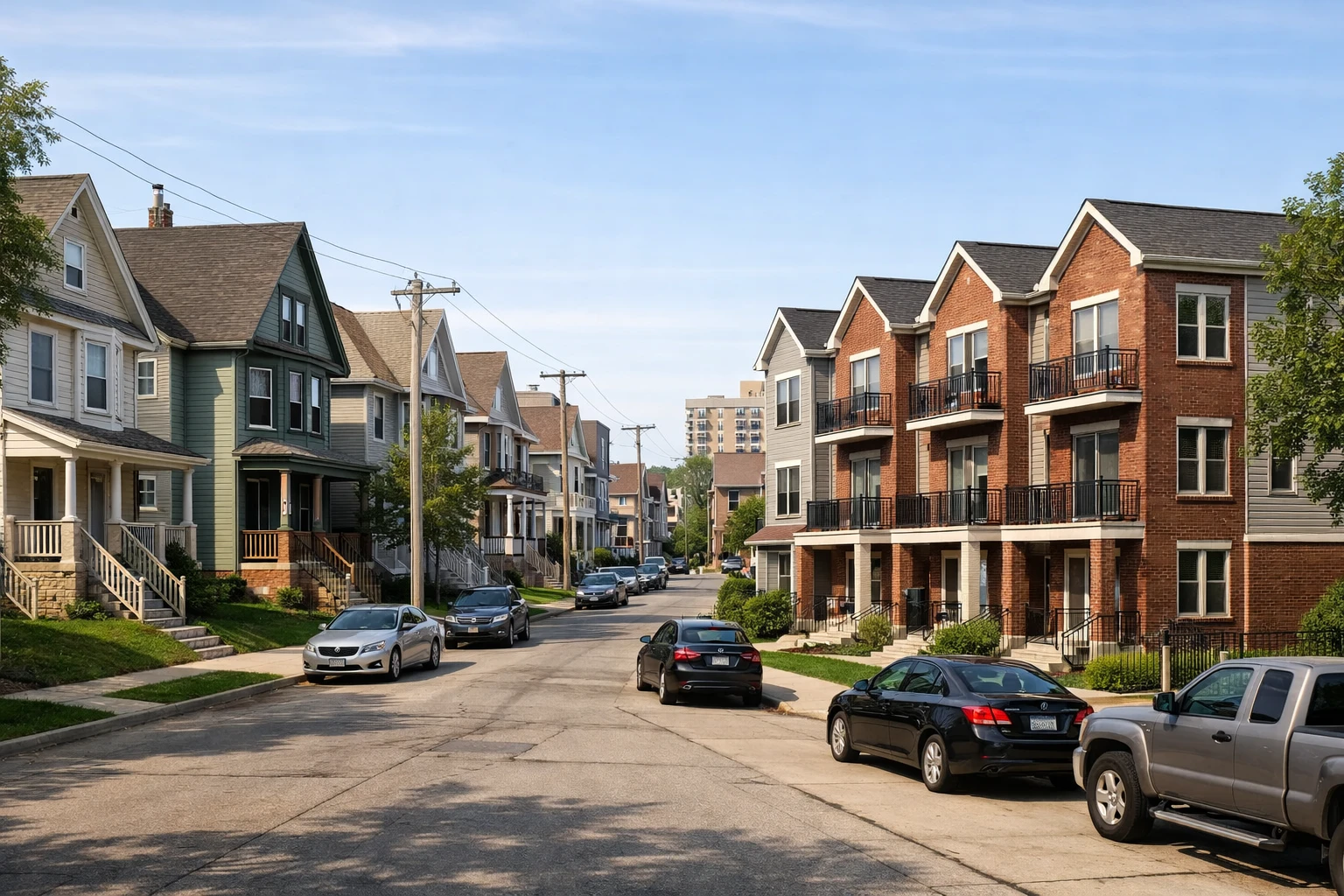
Introduction
Wisconsin is a steady, cash-flow-friendly market for real estate investors — anchored by a diverse economy, strong university presence, and affordable property prices relative to much of the Midwest. If you own rental property in the Badger State and have built equity over time, a cash-out refinance could be your most strategic next move. A DSCR cash-out refinance lets you tap that equity without W-2s, tax returns, or personal income verification — qualification is based entirely on what your rental generates. Lendmire offers DSCR investor loan programs to investors across 41 markets, including Wisconsin, and we’re ready to help you unlock your equity and scale your portfolio.
What Is a DSCR Loan?
A DSCR loan — Debt Service Coverage Ratio loan — qualifies investors based on the rental income a property produces, not the borrower’s personal income. The underwriting formula is: monthly gross rent divided by monthly PITIA (principal, interest, taxes, insurance, and association dues). A ratio of 1.00 means the property breaks even on debt service. Above 1.00 means positive cash flow; below 1.00 means the property runs at a deficit. For a comprehensive overview, read our full guide on what is a DSCR loan.
DSCR Cash-Out Calculator
Run the cash-out numbers in Wisconsin
Rate source: Freddie Mac 30-yr average via FRED® — Federal Reserve Bank of St. Louis · effective Jul 30, 2026
Prefilled with starting assumptions — enter your property’s value, balance, taxes, and insurance for a more accurate picture.
Program parameters update from Lendmire’s centralized guideline source. Taxes and insurance are editable estimates.
As of Jul 30, 2026 · General Freddie Mac market benchmark, not a Lendmire loan offer. Property value, balance, taxes, and insurance are editable estimates. Maximum loan-to-value varies by lender, program, property type, and seasoning. Not a Loan Estimate, approval, or commitment to lend. Program availability and eligibility are subject to lender guidelines, credit approval, property review, and underwriting.
DSCR Formula: Monthly Gross Rent / PITIA = DSCR Ratio. A DSCR of 1.20 means the property earns 20% more than its monthly debt obligations — a strong qualifier for most DSCR programs.
Sub-1.00 DSCR options are available with tighter program restrictions — a 640 FICO minimum, reduced LTV, and narrowed lender availability. No personal income documentation is required under any scenario.
Why Wisconsin Matters for Investment Property Cash-Out Refinancing
Wisconsin’s investment property market is built on durable fundamentals: a diversified manufacturing base, major university systems, a thriving healthcare sector, and affordable housing costs that allow investors to achieve strong gross yields. Cities like Milwaukee, Madison, Green Bay, and Eau Claire consistently attract renters across multiple tenant demographics — students, young professionals, healthcare workers, and families seeking workforce-grade housing.
The Madison market, anchored by the University of Wisconsin flagship campus and a fast-growing tech sector, has seen meaningful appreciation over the past decade. Investors who acquired properties in neighborhoods like Willy Street, Monona, or the near east side during the 2015–2019 window are sitting on significant equity positions today. A DSCR cash-out refinance offers a path to unlock that equity — without selling the asset, without triggering a taxable event, and without navigating the income documentation requirements of a conventional loan.
Milwaukee’s portfolio-landlord community has also benefited from appreciation in neighborhoods like Bay View, Walker’s Point, and the Near West Side, where rising rents have strengthened DSCR ratios on properties that traded at low prices. Meanwhile, secondary markets like Appleton, Oshkosh, Sheboygan, and La Crosse offer investors entry-level acquisitions funded by cash-out proceeds pulled from stronger-appreciating primary-market properties. Wisconsin’s geographic diversity makes it well-suited for a multi-market DSCR portfolio strategy.
Key Benefits of a DSCR Cash-Out Refinance in Wisconsin
- No income verification — qualify on the property’s rental income, not your W-2 or tax returns
- LLC and entity ownership supported — subject to lender program eligibility
- Up to 75% LTV on cash-out refinance (620+ FICO, DSCR ≥ 1.00, loans up to $3,000,000)
- Short-term rental properties eligible — DSCR calculated on 80% of gross STR income
- No cap on financed properties — scale your Wisconsin portfolio without conventional limits
- Closes on a timeline that varies by lender and file — faster than conventional refinance timelines
- Cash-out proceeds may satisfy reserve requirements on 1–4 unit properties
Thinking about investment properties in Wisconsin? Lendmire’s specialists work with investors in 41 markets — no W-2s, no tax returns, just the property’s numbers. Call us at 828-256-2183 or apply online to see what you qualify for.
DSCR Loan Requirements
Credit Score
- 640 FICO minimum — DSCR >= 1.00, loans up to $3,000,000 (reduced leverage below 660)
- 660 FICO — where most refinance and cash-out transactions close (program floor 620; reduced leverage below 660)
- 700 FICO minimum — first-time investors
- 680 FICO minimum — interest-only loans (1–4 units)
- Sub-1.00 DSCR: 640 FICO minimum; options narrow significantly below 680
LTV / Down Payment
- DSCR >= 1.00: up to 80% LTV purchase (620+ FICO, loans up to $3,000,000)
- DSCR < 1.00: up to 75% LTV purchase (640+ FICO, loans up to $2,000,000)
- Cash-out refinance: up to 75% LTV (620+ FICO, DSCR ≥ 1.00, loans up to $3,000,000)
DSCR Ratio
- Standard minimum: DSCR >= 1.00
- Sub-1.00 DSCR available with restrictions (640+ FICO, reduced LTV)
- Short-term rentals: gross rents reduced 20% before DSCR calculation
Loan Amounts
- 1–4 unit: $100,000 minimum / $3,000,000 maximum
- 2–4 unit mixed-use: $400,000 minimum / $2,000,000 maximum
Loan Terms
- 30-year fixed, 40-year fixed
- 5/6 ARM, 7/6 ARM, 10/6 ARM (30-day SOFR index)
- Interest-only available (10-year I/O period); 40-year term with I/O also available
Reserves
- At or below $1,500,000: none at 70% LTV or less, 6 months PITIA above 70% LTV
- Loans above $1,500,000: 9 months PITIA
- Cash-out proceeds may satisfy reserve requirements (1–4 unit only; not mixed-use)
DSCR vs. Conventional Investment Loans in Wisconsin
Wisconsin investors weighing refinance options should understand the structural differences between DSCR and conventional financing before choosing a path. Conventional loans operate under Fannie Mae guidelines — guidelines that create real friction for active portfolio investors. For a detailed comparison, read our resource on DSCR vs conventional investment loans.
- Conventional requires full income docs and DTI — DSCR does not
- Conventional prohibits LLC ownership — DSCR fully supports LLC closing
- Conventional seasoning: 12 months — DSCR seasoning: 6 months minimum
- Conventional caps at 10 financed properties — DSCR has no cap (program dependent)
- Both cap cash-out at 75% LTV for 1-unit (same on this point)
- Conventional: 6-month reserves on ALL financed properties — DSCR: reserves sized by leverage and loan size (none at or below $1,500,000 and 70% LTV; 6 months of PITIA above 70% LTV; 9 months above $1,500,000)
For Wisconsin investors who hold properties in LLCs — a common structure for asset protection among Milwaukee and Madison portfolio landlords — DSCR is often the only viable refinance path. Conventional lenders cannot accommodate entity ownership, and investors with more than 10 financed properties are shut out entirely from Fannie Mae-backed programs.
Wisconsin Investment Markets: A DSCR Cash-Out Refinance Deep Dive
Milwaukee: Portfolio Scale in the Midwest’s Rental Core
Milwaukee is Wisconsin’s largest city and its most active investment property market by transaction volume. The city’s diverse economy — anchored by healthcare systems including Froedtert Health and Aurora Health Care, manufacturing employers like Harley-Davidson, and financial institutions such as Northwestern Mutual — supports consistent rental demand across multiple tenant segments. Neighborhoods like Bay View, Walker’s Point, Riverwest, and the Near West Side have attracted investor attention for strong cash-on-cash returns and steady appreciation.
Milwaukee investors who purchased small multifamily and single-family rentals in the 2017–2021 window are frequently now positioned for a productive DSCR cash-out refinance. Pulling equity from a stabilized Milwaukee duplex — where gross rents may have grown 15–20% over the past five years — and redeploying into a new acquisition on the north or south side is exactly the kind of portfolio recycling DSCR cash-out refinancing enables. No W-2s, no DTI, just the property’s income carrying the loan.
Madison: University and Tech Demand Driving Appreciation
Madison is Wisconsin’s strongest appreciation market. The University of Wisconsin flagship campus, state government employment, and a growing technology and biotech sector — including companies like Epic Systems, CUNA Mutual, and American Family Insurance — have driven demand for rental housing in a city where supply has consistently lagged. Rental demand spans from student housing near campus to professional rentals in Willy Street, Monona, Middleton, and the east side corridor.
Investors who entered the Madison market at 2018–2020 prices are sitting on equity positions that can be meaningfully accessed through a DSCR cash-out refinance. The key advantage in Madison is that strong rents relative to property values translate to healthy DSCR ratios, often at 1.20 or above — well within standard program guidelines. Cash-out proceeds pulled from a Madison single-family can fund acquisitions in Milwaukee or secondary Wisconsin markets where entry prices are lower.
Green Bay: Industrial and Healthcare Stability
Green Bay anchors the Fox River Valley as a manufacturing and healthcare employment hub. Major employers include Bellin Health, HSHS St. Vincent Hospital, Georgia-Pacific, and a broad base of paper, packaging, and food processing companies. Rental demand in the city is driven by workforce housing seekers — long-term, reliable tenants who prioritize proximity to employment over urban amenities. Neighborhoods such as Allouez, Howard, and De Pere attract both single-family and small multifamily investors.
Green Bay properties frequently offer DSCR ratios well above 1.00 at acquisition — a function of affordable purchase prices relative to rent levels. Investors who stabilized Green Bay rentals three to five years ago and have since seen equity growth are prime candidates for DSCR cash-out refinancing. Proceeds can be used to acquire additional Green Bay units or to fund acquisitions in faster-appreciating markets like Madison, using low-cost equity from one market to enter another.
Eau Claire: University and Healthcare Rental Demand
Eau Claire has emerged as one of Wisconsin’s stronger secondary investment markets, driven by the University of Wisconsin–Eau Claire and the Marshfield Clinic Health System. The Banbury Place neighborhood, downtown corridor, and areas near the hospital campus attract steady tenant demand. Eau Claire’s relative affordability — where single-family rentals can still be acquired well below $200,000 in many areas — creates strong gross yield potential. Investors who entered the market early and have built equity through a combination of appreciation and mortgage paydown are positioned to execute a DSCR cash-out refinance and redeploy capital into additional Eau Claire acquisitions or across state lines into a higher-velocity market.
Appleton and the Fox Valley: Diversified Manufacturing Markets
Appleton, Oshkosh, Neenah, and the broader Fox Valley represent a cluster of industrial and manufacturing-driven rental markets with consistently low vacancy rates. Major employers including ThedaCare Regional Medical Center, Plexus Corp., and a dense network of paper and plastics manufacturers sustain workforce housing demand. These markets offer investors strong cash flow fundamentals with minimal competition from institutional buyers.
Portfolio investors in the Fox Valley often hold multiple properties across several of these municipalities. DSCR loans are particularly well-suited for these investors because there is no cap on financed properties and no requirement to document personal income. A cash-out refinance on an Appleton four-unit with stabilized DSCR above 1.00 can generate proceeds sufficient to close on another small multifamily in Oshkosh or Neenah — extending the portfolio without capital constraints.
Wisconsin Dells and Door County: Short-Term Rental Equity Markets
Wisconsin Dells — the self-proclaimed “Waterpark Capital of the World” — and Door County’s peninsula communities generate substantial short-term rental income during peak tourism seasons. Investors targeting Airbnb and VRBO properties in these corridors often achieve nightly rates that far exceed long-term rental equivalents. Door County in particular attracts a premium STR audience, with seasonal demand pushing occupancy and daily rates well above statewide averages.
DSCR loans apply a 20% reduction to gross STR income before calculating the qualifying ratio — investors in both markets should underwrite with this haircut in mind. Even with the reduction, strong STR properties in Wisconsin Dells and Door County often qualify at the 1.00 DSCR threshold. Investors who have accumulated equity in established STR properties can execute a DSCR cash-out refinance without converting to long-term rental status — preserving the income model while accessing the equity.
Short-Term Rental and Airbnb Applications in Wisconsin
Wisconsin’s STR market is concentrated in tourism destinations — Wisconsin Dells, Door County, Lake Geneva, and the Northwoods — but investor interest has expanded into urban STR strategies in Madison and Milwaukee. Key DSCR program considerations for Wisconsin STR investors:
- STR gross income is reduced 20% before DSCR calculation — plan your underwriting accordingly
- DSCR loans for Airbnb and short-term rentals are available for qualifying Wisconsin properties — no W-2s or personal income docs required
- LLC ownership of STR properties is supported — subject to lender program eligibility
- Cash-out refinancing on established STR properties allows equity recycling without converting to long-term rental status
Example DSCR Scenario: Milwaukee Duplex Cash-Out Refinance
Property Type: Duplex (2-unit residential)
Current Appraised Value: $260,000
Existing Loan Balance: $140,000
Cash-Out Refinance Loan Amount: $195,000 (75% LTV)
Cash-Out Proceeds: $55,000 (used to fund down payment on next acquisition)
Monthly Rent: Unit A ($1,050) + Unit B ($1,050) = $2,100 gross rent
Monthly PITIA Estimate: $1,680
DSCR Calculation: $2,100 / $1,680 = 1.25
Result: DSCR of 1.25 — exceeds the 1.00 standard minimum, qualifies for full program guidelines including LLC ownership (subject to lender program eligibility). No W-2s, no tax returns, no DTI calculation. The $55,000 in proceeds funds a 25% down payment on a $220,000 single-family rental in Appleton without requiring any out-of-pocket capital.
This is exactly how many investors scale using DSCR loans across Wisconsin.
Ready to run the numbers on your next Wisconsin investment property? Lendmire closes DSCR loans on a timeline that varies by lender and file — no income docs, no W-2s, and LLC ownership is welcome (subject to lender program eligibility). Reach out today at 828-256-2183 and let’s get started.
DSCR Refinance Options for Wisconsin Investors
Wisconsin’s combination of affordable acquisition costs and improving rents across its major metros has created meaningful equity positions for investors who entered the market over the past five-plus years. A DSCR refinance unlocks that equity and turns it into acquisition capital — without W-2s, without DTI, and without the 12-month seasoning requirement that conventional lenders impose. For a full overview of available refinance structures, visit our page on cash-out refinance options for investment properties.
Cash-out refinancing is the primary strategy for Wisconsin investors looking to scale. By refinancing a stabilized rental to 75% LTV, an investor can extract tens of thousands of dollars in equity and immediately redeploy it as a down payment on the next property — all while keeping the original rental in place and generating income. The DSCR loan’s income-based underwriting means the new loan is underwritten on the subject property’s cash flow, not the investor’s personal tax returns.
Rate-and-term refinancing is the right choice for Wisconsin investors whose goal is payment reduction or structure optimization — moving from an ARM to a fixed rate, extending the amortization, or reducing monthly PITIA to improve cash flow on an existing rental. On timing: DSCR programs require a minimum 6-month ownership period before cash-out refinancing — significantly shorter than the 12-month conventional seasoning requirement. Investors who acquired properties using all-cash may also qualify under delayed financing exceptions. Explore the full range of refinance structures through our investment property refinance options resource.
Why Investors Choose Lendmire for Wisconsin DSCR Loans
Lendmire works with investors across 41 markets and closes DSCR loans on a timeline that varies by lender and file. Wisconsin investors — whether they’re scaling a Milwaukee portfolio or pulling equity from a Madison single-family — need a lender who understands investment property underwriting and can execute without the delays that plague conventional loan processes.
- No income docs, no W-2s, no tax returns — DSCR underwriting only
- LLC and entity ownership supported — subject to lender program eligibility
- Closes on a timeline that varies by lender and file
- Cash-out and rate-and-term refinance options available
- Sub-1.00 DSCR programs available for qualifying scenarios
- No cap on financed properties — ideal for portfolio-scale Wisconsin investors
Lendmire is a great option for DSCR loans, offering flexible solutions for real estate investors in 41 markets.
Frequently Asked Questions
What is the minimum credit score for a DSCR loan?
The standard minimum is 620 FICO for purchase loans with a DSCR at or above 1.00 on loans up to $3,000,000 (reduced leverage below 660). Most refinance and cash-out transactions close at 660 FICO or higher; the program floor is 620, with reduced leverage below 660. First-time investors need a 700 FICO minimum. Interest-only loans on 1–4 unit properties require 680 FICO.
Do DSCR loans require tax returns or W-2s?
No. DSCR loans are underwritten entirely on the rental income of the subject property. No W-2s, tax returns, pay stubs, or personal income documentation are required at any stage of the process. Qualification is based on the DSCR ratio: monthly gross rent divided by monthly PITIA.
Can I use an LLC to get a DSCR loan?
Yes — DSCR loans support LLC and entity ownership, subject to lender program eligibility. This is one of the primary advantages DSCR holds over conventional financing, which prohibits entity ownership. Wisconsin investors who hold rentals in LLCs for liability protection can close DSCR loans without restructuring ownership.
Is Wisconsin a good market for a DSCR cash-out refinance?
Yes, particularly in Milwaukee, Madison, and the Fox Valley, where investors who entered the market in the past five to seven years have built meaningful equity positions. Strong rental demand from university populations, healthcare workers, and manufacturing employees produces healthy DSCR ratios, and the 6-month seasoning window for DSCR cash-out refinancing is shorter than the conventional 12-month requirement.
What types of investment properties qualify for DSCR loans in Wisconsin?
Eligible property types include single-family residences (attached and detached), PUDs, 2–4 unit residential properties, warrantable and non-warrantable condos, condotels, and modular or pre-fab homes. Mixed-use properties qualify if commercial space does not exceed 49.99% of total building area. Maximum lot size is 5 acres for 1–4 unit properties.
What is the maximum LTV for a DSCR cash-out refinance in Wisconsin?
For standard DSCR cash-out refinance scenarios, the maximum is 75% LTV — available to borrowers with 620+ FICO, a DSCR at or above 1.00, and loan amounts up to $3,000,000. 2–4 unit properties and condos are eligible at the same 75% cash-out LTV as single-family homes. Rural Wisconsin properties are also eligible at the same 75% cash-out LTV.
About Lendmire
Lendmire is a non-QM mortgage brokerage (NMLS# 2371349) arranging DSCR investor loans in 41 markets, including Washington, D.C. DSCR eligibility is generally reviewed around property-level rental income rather than personal income, subject to lender and program guidelines, making it a fit for self-employed investors and LLC-owned portfolios. Scotsman Guide named Lendmire a Top Mortgage Workplace in both 2025 and 2026.
Get Started
Ready to find the right loan for you?
In about 30 seconds you can review financing options available for your investment property. No commitment required.
Informational only. Not a Loan Estimate, approval, or commitment to lend. Program availability and eligibility are subject to lender guidelines, credit approval, property review, and underwriting.
This article is part of Lendmire’s investment property cash-out refinance program — full qualification details, guidelines, and scenarios live on the program page.
Related reading: DSCR Cash Out Refinance Stevens Point Wisconsin · Cash Out Refinance Investment Property Stevens Point Wisconsin · DSCR Cash Out Refinance Wausau Wisconsin
Guides: Investment Property Cash-Out Refinance in Wisconsin
References
1. Freddie Mac 30-yr average via FRED® — Federal Reserve Bank of St. Louis
Brandon Miller
Founder & CEO, Mortgage Loan Originator, Lendmire LLC
- Mortgage Loan Originator · NMLS# 1129696 · Verify on NMLS Consumer Access
- North Carolina Real Estate Broker · License# 343312 · Verify on NCREC
- North Carolina Insurance Producer · License# 19053198 · Property, Casualty, Life, Health · Verify on NAIC SBS
- Lendmire LLC · Firm NMLS# 2371349 · Verify firm licensure
Disclosure information. Lendmire is a state-licensed mortgage brokerage under NMLS# 2371349. Lendmire is not a depository institution, direct lender, or financial advisor — all loans referenced are placed through wholesale lender partners and are subject to each lender's underwriting standards. This article is provided for general informational purposes and is not a commitment to lend, nor does it constitute financial, legal, or tax advice. Loan programs, terms, rates, and qualification standards change without notice and depend on borrower profile, property type, and the state in which the subject property is located. Equal Housing Opportunity provider. NMLS Consumer Access: nmlsconsumeraccess.org.