
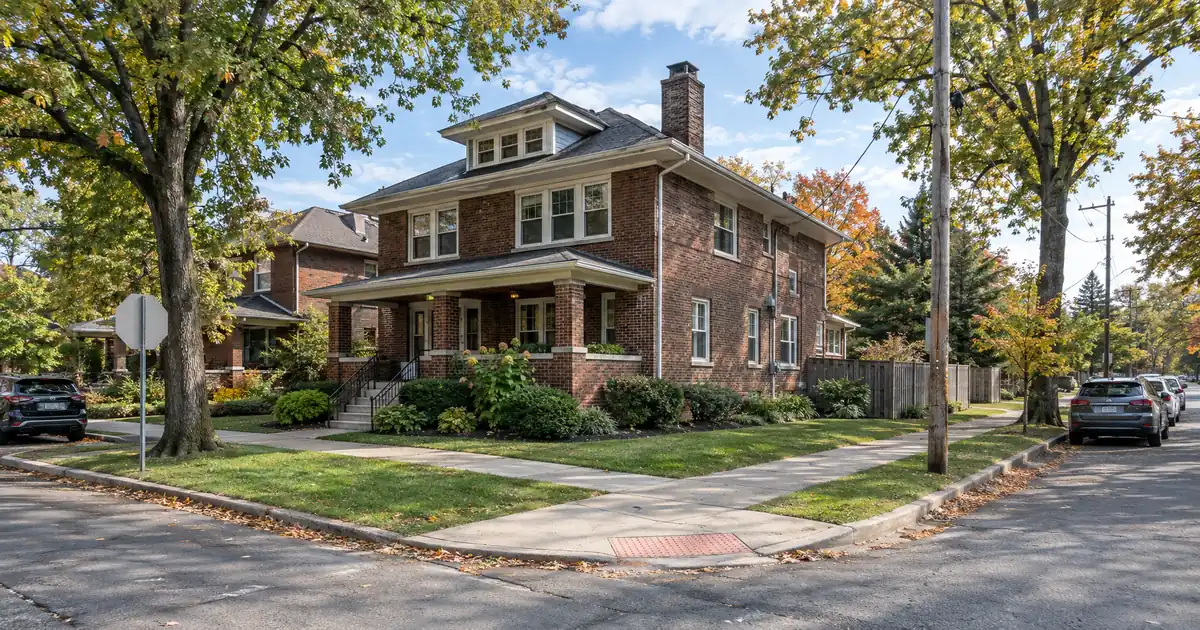
Cash-out math in Gahanna starts with one uncomfortable ratio: monthly rent on a typical single-family home covers less than half a percent of the property’s value. Once taxes and insurance go into the monthly obligation, coverage at the 75% LTV ceiling typically falls below 1.0x, so a full-leverage cash-out is unlikely to qualify on rent alone. That doesn’t kill the deal. It changes how the loan gets built, whether through lower leverage, a smaller cash-out amount, or a program that accepts coverage below 1.0x. Lendmire (NMLS# 2371349) is a non-QM DSCR mortgage broker that helps arrange DSCR financing for Gahanna, Ohio investors as part of a footprint reaching 41 markets, including D.C. Every scenario varies by lender and program, and guidelines, property type, leverage, and credit profile all apply.
DSCR Cash-Out Calculator
Run the cash-out numbers in Gahanna, OH
Rate source: Freddie Mac 30-yr average via FRED® — Federal Reserve Bank of St. Louis · effective Sep 24, 2026
Prefilled with starting assumptions — enter your property’s value, balance, taxes, and insurance for a more accurate picture.
Program parameters update from Lendmire’s centralized guideline source. Taxes and insurance are editable estimates.
As of Sep 24, 2026 · General Freddie Mac market benchmark, not a Lendmire loan offer. Property value, balance, taxes, and insurance are editable estimates. Maximum loan-to-value varies by lender, program, property type, and seasoning. Not a Loan Estimate, approval, or commitment to lend. Program availability and eligibility are subject to lender guidelines, credit approval, property review, and underwriting.
The Quick Read:
A cash-out refinance on an investment property in Gahanna, Ohio is underwritten primarily on the rental income the property earns measured against its full monthly obligation, then capped at a 75% loan-to-value ceiling on the appraised value once about six months of ownership are recorded.
- Values sit near $383K–$390K per Zillow and Redfin, roughly flat.
- Median single-family rent near $1,800 comes from a five-listing Homes.com sample.
- At full leverage, coverage including taxes and insurance runs in the 0.7x range.
- Lower leverage, not maximum leverage, is what pulls coverage toward 1.0x here.
Gahanna Market Snapshot
A quick read on the Gahanna investor landscape — figures come from the cited sources below. Confirm current property-level numbers before underwriting.
| Metric | Detail |
|---|---|
| Home prices | 115 sales (Redfin Gahanna Housing Market) |
| University enrollment | 7,500+ students (Gahanna CIC Workforce) |
| Employment | 18.5K jobs (Data USA Gahanna) |
Where the Coverage Math Lands
At maximum leverage, a typical Gahanna single-family rental does not clear 1.00x. The standard DSCR benchmark is 1.00x, meaning rent used for lender review covers principal, interest, taxes, and insurance (PITIA). Some lenders will review below that with compensating factors, but pricing and leverage usually shift.
Run the numbers on a modeled house valued at $385,000 renting for $1,800. These are assumptions for illustration, not sourced market facts. At the 75% cash-out ceiling, coverage including taxes and insurance comes out around 0.7x. Drop leverage to 50% and it improves to roughly 0.9x. Around 40% it moves just above 1.0x. That’s a lot of equity left in the property. Final terms depend on lender guidelines, property type, leverage, and the borrower’s complete credit picture.
Below 1.00x, a lender may review other structures: a sub-1.00 program, interest-only payments, or a lower balance. Each is subject to lender guidelines, credit approval, and property review. Nothing here is a promise that a file qualifies. The DSCR cash-out refi mechanics page walks through how these levers interact.
Take a $2,040 rent, the higher figure a local property manager cites. Coverage improves, but still lands around 0.8x at full leverage on the same modeled price. So the answer doesn’t flip on which rent source you believe.
Flat Prices Change What “Equity” Means
Gahanna prices are flat to slightly up, so cash-out proceeds come from the appraisal on refinance day and from principal paydown. They don’t come from a rising market. Zillow puts the average home value at $382,754, up 2.7% year over year, with homes going pending in about five days. Redfin reports a median sale price near $390K, down 1.6% year over year, with 37 days on market. Movoto shows a median list price of $385K, flat, at $207 per square foot. Three sources, three methods, one message: sideways.
An investor who bought several years ago at a lower basis may hold real equity. An investor who bought recently near today’s prices probably doesn’t. Seasoning and the 75% cap only matter if the appraisal supports a value well above the payoff. That’s the first thing to test.
Here’s the tension. The 2.7% Zillow gain says appreciation is alive; Redfin’s decline says it isn’t. Underwrite the lower number. If the appraisal comes in higher, that’s upside, not a plan.
Rent Evidence Is Thin (and Conflicting)
Nobody has a clean Gahanna rent number, so build the file on the lowest defensible rent and document it with actual leases. Homes.com shows a $1,800 median single-family rent, but the sample is five listings, and it cites a $1,567 overall median. Zumper reports a $1,379 median across all property types and says rents fell 7% over the past year, while flagging limited data.
Those figures measure different things. Zumper blends apartments and houses; Homes.com is mostly houses. A signed lease and payment history beat any aggregator. When the appraiser’s rent schedule and the lease disagree, the lender works from the lower supported number, and that’s where files stall.
Creekside and the Supply Question
New apartment supply is arriving downtown, and it competes for the same tenants as small landlords. Creekside, the mixed-use district along Big Walnut Creek, has 71 condos and 100,000 square feet of commercial space per Wikipedia. Columbus Navigator reports council approved a roughly $100M private redevelopment on a 6–1 vote. Columbus Underground says phase one would add 263 apartments and a 55–70 room hotel, with townhomes in phase two.
Add existing institutional stock. Dietz Property Group lists Arbors of Gahanna at 232 units and Alder Park at 83. A local manager, RL Property Management, says leasing is slowest from November through February. It cites Ohio’s statewide rental vacancy near 7.2% and says Gahanna likely runs tighter. That last part is the manager’s judgment, not a measured figure. No sourced Gahanna vacancy rate exists.
So model a winter vacancy allowance. Don’t assume a tight market because the manager says so.
Reserves, Seasoning, and the Appraisal Packet
Cash-out eligibility hinges on three items, and each one has a documentation trail. Seasoning is about six months of ownership, measured from title recording, so the settlement statement or recorded deed is the proof. Reserves run about six months of PITIA on most files (higher above $1,500,000), and they need bank or brokerage statements, not a promise. Credit tiers start at a 620 floor and step through 660, 680, and 700, all subject to lender guidelines.
Loan size isn’t the constraint in Gahanna. Standard programs go up to $3,000,000, far above anything a $385K house needs. Smaller balances route through select lenders in the network.
The appraisal is where flat markets bite. Comps come in tight, and there’s no run-up to lean on. If value lands below expectation, an appraisal reconsideration request with recent in-neighborhood sales and condition adjustments is routine. It won’t manufacture equity that isn’t there.
The rate-and-term and cash-out refi details page covers the refinance paths side by side.
Reserves documentation and rent-roll clarity are the usual friction. On files from suburban Midwest markets like this one, the cleaner submissions tend to have the lease, proof of deposit, and entity documents assembled before the appraisal is ordered. The common problem is a lease signed at one number, an appraiser’s rent schedule at another, and no explanation bridging the two. LLC-owned properties add entity paperwork, and eligibility is subject to lender program requirements.
Which Product Pencils in Gahanna
Single-family and attached homes dominate, and the cash-out thesis should assume that income, not stacked units. RL Property Management describes stock as mostly single-family and two-story attached homes built from the 1970s through the 1990s, with newer townhome developments closer to I-270.
Homes.com names Havens Corners, The Preserve, East Broad, and Eastmoor as popular single-family rental areas. No sourced price or rent figures exist by neighborhood, so treat those as demand indicators only. Blacklick, the small unincorporated village next door, sits outside the city limits anyway.
What about duplexes? Duplex listings near Gahanna show per-unit rents around $925 to $1,075, per Homes.com, though those examples are in a neighboring school district area, not Gahanna. Two units at about $1,000 each gross roughly $2,000. That’s only modestly above a single-family rent. A duplex helps coverage only if its purchase price sits materially below Gahanna’s roughly $385K median, and no data confirms that. It’s a genuine toss-up: better income diversification, unproven price advantage.
Manufactured homes, log homes, and barndominiums fall outside these programs. Skip them.
Why the Employment Base Steadies the Case
Demand here is professional and commuter-driven, which supports long lease terms but doesn’t add growth. Data USA shows the local economy employing 18.5k people, led by health care and social assistance (2,633), retail (2,150), and finance and insurance (2,128). Employment fell 1.62% year over year. Point2Homes, citing Census data, gives a median household income of $109,061, unemployment of 2.6%, and a 20-minute average commute.
Population is stable at roughly 35,986 per the latest estimate. Regional demand comes from the wider Columbus job base, including Ohio State, OhioHealth, and large national banks, though no headcounts were verified. The city’s economic development office lists JobsOhio and One Columbus among its partners. The principal-employer table sits in the city’s annual financial report, on the Financial Publications page. Read it before quoting employer numbers.
Steady, not booming. A stable tenant pool helps a lease hold, but it won’t rescue thin coverage.
What the Proceeds Do Next
Cash-out only makes sense here if the next deal covers itself better than the property it comes from. Pulling 75% of a flat-value, sub-1.0x rental to buy another sub-1.0x rental stacks the same problem twice. Better uses are paying down higher-cost debt, or buying where rent-to-price is stronger. That could mean Columbus-area stock priced below Gahanna, or a Gahanna townhome at a lower entry. Reserves stay ring-fenced either way.
Compare the tradeoffs against a conventional refinance, if personal income documents are an option. Lendmire’s comparison of conventional and DSCR loans offers a walkthrough of how rental-income qualification works, so start there. Investors can also see what the numbers look like on their own property, or call 828-256-2183. Terms are subject to change and to lender guidelines. Verify current local rental rules, taxes, and insurance with qualified local professionals. Creek flooding is a live local issue, so ask about it early.
Lendmire’s Ohio DSCR platform covers statewide program details.
DSCR vs. conventional financing
Two common ways to finance an investment property in Gahanna, OH. They qualify you differently — here’s how investors weigh them.
Why investors choose it
- Qualifies on the property’s rental income — no personal tax returns, W-2s, or pay stubs needed to document income.
- No personal debt-to-income ceiling to clear, so existing mortgages and obligations don’t cap your borrowing the same way.
- Can be closed in an LLC, keeping the property inside a business entity.
- Built for scaling — not held to the limit on number of financed properties that conventional financing applies.
- Underwriting centers on the deal: generally qualifies when the rent covers the payment, a 1.00x coverage ratio being a common baseline (confirmed in underwriting).
- Designed specifically for investment property, including long-term and, where the program allows, short-term rentals.
Where it’s strong
- Often the lowest ongoing financing cost for a buyer who fully qualifies on personal income — a fit for a first property or a cost-first purchase.
Trade-offs for investors
- Requires full personal income documentation and must fit within a debt-to-income limit — salary, existing debts, and other mortgages all count.
- Typically held in your personal name rather than a business entity.
- Caps how many financed properties you can carry, which can become a ceiling as a portfolio grows.
- Evaluates you as a borrower as much as the property, which usually means more paperwork.
How investors usually choose: a first or single property often optimizes for the lowest financing cost; portfolio builders often optimize for leverage, vesting in an LLC, and scaling past conventional caps. The right answer depends on your goals, the property, and current guidelines — both paths run through select lenders in Lendmire’s wholesale network, with eligibility and terms confirmed in underwriting.
Frequently Asked Questions
How long before I can cash out on a Gahanna rental I just bought?
Seasoning is about six months of ownership, measured from title recording. The recorded deed or settlement statement documents it. Buying below market and expecting immediate cash-out is the assumption that gets files kicked back.
Will a $1,800 rent support a cash-out at 75% LTV on a Gahanna house?
Not on the modeled numbers. At a roughly $385K value, coverage including taxes and insurance runs around 0.7x at 75% LTV. Lower leverage, a sub-1.00 program, or interest-only structuring may be reviewed, all subject to lender guidelines.
Do Creekside’s new apartments hurt small-landlord coverage?
They can pressure lease-up. Phase one alone proposes 263 apartments, and existing complexes like Arbors of Gahanna add 232 units. Model a longer winter vacancy allowance, since a local manager says leasing slows from November through February.
Which rent figure should I use on the file?
Use the signed lease, backed by payment history. Aggregators conflict, from $1,379 all-property medians at Zumper to about $1,800 for single-family at Homes.com. Lenders work from the lower supported number when the lease and appraiser’s schedule differ.
Are duplexes a better cash-out candidate in Gahanna?
Possibly, but not proven. Nearby duplex units list around $925–$1,075 each, so a duplex only helps if its price sits well below the roughly $385K median. No Gahanna data confirms that yet.
If You Only Take One Thing
If you only take one thing from this piece, it’s this: in a flat-priced Gahanna market where a roughly $1,800 rent cannot carry a 75% loan once taxes and insurance are counted, the cash-out you can actually pull is set by rent coverage, not by the LTV cap.
About Lendmire
Lendmire (NMLS# 2371349) is a mortgage brokerage built around DSCR investor lending, with programs available in 41 markets, including Washington, D.C. DSCR lenders commonly evaluate rental-income coverage instead of personal income paperwork, a practical fit for LLC-owned and multi-property investors. Terms vary by lender, property, leverage, and program. Lendmire was named a top-ranked workplace in 2026 and a top-ranked workplace in 2025 by Scotsman Guide.
Get Started
Ready to find the right loan for you?
In about 30 seconds you can review financing options available for your investment property. No commitment required.
Informational only. Not a Loan Estimate, approval, or commitment to lend. Program availability and eligibility are subject to lender guidelines, credit approval, property review, and underwriting.
References
1. Zillow Home Value Index, Gahanna
2. Redfin, Gahanna Housing Market
7. Zumper, Gahanna Rent Research
8. Wikipedia
9. Columbus Navigator, Creekside redevelopment
10. Columbus Underground, Creekside proposals
13. Homes.com
14. Point2Homes, Gahanna Demographics
16. gahanna.gov — City’s economic development office
17. Financial Publications page
18. Scotsman Guide — Top Workplaces 2026
19. Scotsman Guide — Top Workplaces 2025
This article is part of Lendmire’s investment property cash-out refinance program — full qualification details, guidelines, and scenarios live on the program page.
Related reading: DSCR Cash Out Refinance in Gahanna, Ohio: Flat Prices and a Creekside Supply Test · DSCR Cash Out Refinance Ohio · DSCR Cash Out Refinance in Mentor, Ohio: Pulling Equity From a Thin Rental Base
Guides: Investment Property Cash-Out Refinance in Ohio
Brandon Miller
Founder & CEO, Mortgage Loan Originator, Lendmire LLC
- Mortgage Loan Originator · NMLS# 1129696 · Verify on NMLS Consumer Access
- North Carolina Real Estate Broker · License# 343312 · Verify on NCREC
- North Carolina Insurance Producer · License# 19053198 · Property, Casualty, Life, Health · Verify on NAIC SBS
- Lendmire LLC · Firm NMLS# 2371349 · Verify firm licensure
Legal disclosures. Lendmire (NMLS# 2371349) is a state-licensed mortgage brokerage that arranges financing through wholesale lender relationships. Lendmire is not a direct lender, depository institution, or registered financial advisor. The discussion above is general informational content about real estate financing — it is not financial, legal, or tax advice, and readers should consult licensed professionals for guidance on their individual circumstances. Loan inquiries are subject to lender underwriting; this article does not represent a commitment to lend. Loan terms, rates, and qualification standards vary by borrower, property, and state, and are subject to change at any time. Equal Housing Opportunity. NMLS Consumer Access: nmlsconsumeraccess.org.