
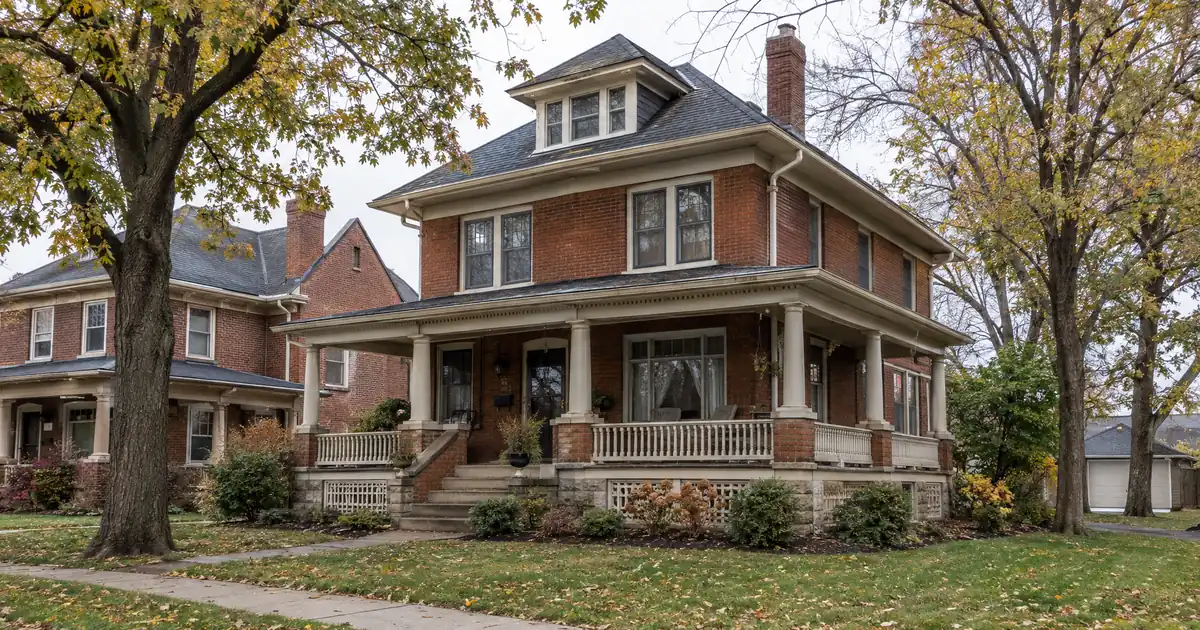
Picture an investor in another state scrolling Columbus-area suburbs. Hilliard jumps out: a Zumper median rent of $1,850, a data-center cluster on the west side, and a housing market that keeps appreciating. What that investor misses is the ratio. Prices have run well ahead of rents, so a Hilliard cash-out is a leverage-management exercise, not a free-money event. The equity is real, but the coverage has to be built deliberately.
This piece is for owners who already hold a Hilliard rental and want to pull capital out of it. It does not cover purchase mechanics.
DSCR Cash-Out Calculator
Run the cash-out numbers in Hilliard, OH
Rate source: Freddie Mac 30-yr average via FRED® — Federal Reserve Bank of St. Louis · effective Sep 24, 2026
Prefilled with starting assumptions — enter your property’s value, balance, taxes, and insurance for a more accurate picture.
Program parameters update from Lendmire’s centralized guideline source. Taxes and insurance are editable estimates.
As of Sep 24, 2026 · General Freddie Mac market benchmark, not a Lendmire loan offer. Property value, balance, taxes, and insurance are editable estimates. Maximum loan-to-value varies by lender, program, property type, and seasoning. Not a Loan Estimate, approval, or commitment to lend. Program availability and eligibility are subject to lender guidelines, credit approval, property review, and underwriting.
The Short Version:
A DSCR cash-out refinance on a Hilliard, Ohio investment property is underwritten primarily on the property’s rental income measured against its full monthly obligation, with a capped loan-to-value and a seasoning period standing in for personal income documentation, subject to lender guidelines.
- The median closing price is $455,500, while the median rent is $1,850. That is roughly 0.4 percent rent-to-price.
- Hilliard holds 16.54 percent of the Columbus development pipeline, so new-build competition is real.
- Small multifamily is scarce, so most files are single-family or townhome cash-outs.
- Lower leverage, not higher rents, is usually what gets a Hilliard file over 1.00x.
The Equity Is There. The Rent Isn’t Keeping Pace.
Hilliard’s price appreciation has outrun its rent growth, which makes it a strong equity market and a thin cash-flow market. Resideline puts the six-month median closing price at $455,500, with the middle half of sales between $339,900 and $580,090. Zillow’s smoothed value index sits lower, at $350,707, because it measures typical value rather than closed sales. Use the sales-based figure for equity math.
On the rent side, Zumper’s all-property median of $1,850 is the best single anchor, with rents up 6 percent over the past year. RentCafe shows a slower 2.35 percent gain on its apartment average of $1,447, and its three-bedroom average is $2,010. RentCafe only covers buildings with 50 or more units, so treat it as a floor for houses. Apartment List reads the market flatter still, with a median of $1,826, down 1.7 percent year over year.
Divide $1,850 by $455,500 and you get roughly 0.4 percent monthly rent-to-price. That is thin. Only about 31 percent of households rent, and the tenant pool is deep enough for a well-priced home but not deep enough to rescue an overpriced one.
Bottom line: don’t underwrite a Hilliard cash-out on the assumption that rent growth will fix coverage later. Metro-wide, effective rent growth is essentially flat at 0.1 percent.
Running the Cash-Out Math
At the program’s 75 percent LTV ceiling, most Hilliard single-family rentals land below 1.00x once taxes and insurance are counted, so the working lever is a lower LTV, not a higher rent. Standard files require about six months of seasoning from title recording, a 1.00 minimum DSCR, and reserves of about six months of PITIA. Credit tiers run from a 620 floor up through 700, and loan amounts go up to $3,000,000 on standard programs. All of it is subject to lender guidelines and varies by borrower, property, and loan scenario.
Run the numbers on a modeled example. These are assumptions, not sourced market data. Take a three-bedroom home valued at $340,000, near the bottom of Resideline’s middle-half band, and assume $2,010 in rent, borrowing RentCafe’s three-bedroom average as the input. The coverage math uses full PITIA, including taxes and insurance at Ohio-average loads. At 75 percent LTV, coverage lands around 0.9x. Cut leverage to 60 percent and coverage moves to roughly 1.0x, right at the benchmark.
Now use the median instead. Run $1,850 in modeled rent against a $455,500 property at 75 percent LTV and coverage falls to roughly 0.7x including taxes and insurance. That file is not clearing 1.00x on long-term rent alone.
When a file sits below 1.00x, the paths a lender may review include a sub-1.00 program, an interest-only structure, or reduced leverage with stronger credit and additional reserves. Each carries tradeoffs in pricing and proceeds, and eligibility depends on lender guidelines, credit approval, and property review. The size of the cash-out check is set by rent used for lender review, PITIA, reserves, and the LTV cap, never by the appraised value alone. For how the ratio is built, see the guide “What Is a DSCR Loan”. For how this differs from a bank refi, see the guide “Where DSCR and Conventional Diverge”.
Working DSCR brokers see a recurring pattern in higher-priced suburban markets like this one: the appraisal supports a big cash-out number, and the coverage ratio trims it back. The stronger files usually arrive with a rent comp already in hand, a lower target LTV chosen up front, and a plan for the reserve requirement. The weaker ones start from the appraisal and work backward.
Where Coverage Holds Up (and Where It Doesn’t)
The best DSCR candidates in Hilliard are workforce-grade single-family homes and townhomes near the lower end of the price range, because that is where rent-to-price is least stretched. The city’s rental stock is mostly newer apartments, with 54 percent built between 2010 and 2019, and small multifamily is scarce. NeighborhoodScout puts single-family detached at 64.86 percent of housing units and duplexes, converted homes, and small buildings at just 5.77 percent.
Old Hilliard is the most interesting submarket for an owner-investor. The historic district around Main Street and the former rail corridor holds older, smaller homes from different periods, and the Heritage Rail-Trail runs seven miles from the district out toward farmland. Smaller footprints mean lower price points, and lower price points mean better coverage. Be aware that older housing stock brings condition questions that show up in appraisals. There is no reliable neighborhood-level rent data, so test everything against live comps.
The Cemetery Road and I-270 corridor works for a commuter tenant. The Hilliard Community Plan frames the area around the Cemetery Road interchange, including the Mill Run development, as the city’s economic engine, and calls for infill and mixed-use. Listing sites describe a COTA park-and-ride and drives of 15 to 25 minutes to downtown, Ohio State, and Dublin’s corporate campuses. Treat that as qualitative support for renter demand, not a rent figure.
Skip Heritage Preserve for DSCR. It is a higher-end, owner-occupier subdivision on the west side, and the price band makes rent-to-value hard to defend. The same goes for the Big Darby edge, where watershed planning limits density and there is no multi-unit angle.
Be cautious around the Trabue Road corridor. That is where new apartment product is concentrated, and it is the direct competitor for your tenants. More on that below.
The Supply Wave: What Changes Over the Next 6 to 24 Months
Hilliard is Columbus’ most active new-apartment submarket, and the lease-up competition suppresses rents for existing owners. Colliers attributes Hilliard’s 16.54 percent share of the metro development pipeline to the Trabue Road corridor, and an earlier Colliers report found 27.89 percent of the submarket’s units were under construction, the highest concentration comparatively. Metro-wide, more than 68 percent of recently delivered properties are offering concessions.
Two things temper that picture. First, the older, lower-tier product behaves differently: Realist Capital reports workforce housing was the only segment with real pricing power, at 8.8 percent vacancy with zero units under construction. That is metro-wide data, not Hilliard-specific, but it favors older single-family and small-property owners over new-build competition. Second, Colliers expects new starts to fall about 55 percent, and Realist Capital forecasts deliveries down 30 percent the following year, to about 5,200 units.
This is a genuine timing question. A cash-out closed now is underwritten against soft rents. An owner who can wait may face firmer rents when the pipeline thins, but appreciation-driven equity can also shift. The stronger play is usually to underwrite at in-place rents, choose leverage that clears 1.00x on today’s numbers, and treat any later rent lift as upside, not a requirement.
Demand Anchors: Data Centers, Headquarters, and the I-270 Commute
Hilliard’s demand base rests on a diversified white-collar and technical employment set, not on any single employer. The city’s Economic Development page counts 1,200 companies and names Amazon Web Services, Advanced Drainage Systems, and Foresee Power among its global businesses. The city’s Q4 top-20 employer list also includes Honda, Cardinal Health, large national banks, Nationwide, Nationwide Children’s Hospital, OhioHealth Physician Group, and The Ohio State University. That list is based on withholding and carries no headcounts, so use it as evidence of breadth, not scale.
The AWS cluster is the headline. DatacenterDynamics reports five buildings at the Hayden Run site, and Amazon has announced a $10 billion Ohio investment. Be realistic about it, though: Axios Columbus reported that Amazon’s Franklin and Licking county data centers employ nearly 1,000 workers. That makes it a tax-base and skilled-trades story, not a mass-tenant story. Advanced Drainage Systems’ new headquarters at the TruePointe development, 98,350 square feet of office space, adds a concrete corporate anchor, but no headcount is published.
The city reports roughly 38,832 residents per Data Commons, with a median age of 35.8. Demand is steady and commuter-driven. Just don’t confuse steady demand with rising rents.
Turning the Proceeds Into the Next Deal
Cash-out proceeds are only useful if the next property carries its own coverage. Owners typically use them in one of three ways: a down payment on a higher-yield property, reserves that satisfy the six-month requirement on a larger portfolio, or paydown of higher-cost debt. Hilliard’s low rent-to-price is exactly why many owners here redeploy equity into properties with stronger cash flow rather than stacking another Hilliard house.
That is a real trade-off, not a rule. A Hilliard owner who wants to stay local can pair the cash-out with a duplex or townhome purchase, but comps for small multifamily are thin and appraisals get harder. For the program mechanics, see the refi options and the broader rate-and-term and cash-out refi details.
Frequently Asked Questions
Can a Hilliard rental at the median price clear 1.00x on a cash-out?
Usually not at the 75 percent LTV ceiling. Modeled at $1,850 rent against a price near $455,500, coverage including taxes and insurance lands around 0.7x. Lower leverage, a sub-1.00 program, or an interest-only structure are the paths a lender may review, subject to credit approval and property review.
How long do I have to own a Hilliard property before a cash-out?
Plan on roughly six months of ownership, measured from title recording. That matters for owners who bought a property from a builder or through a recent flip, because the clock starts at recording, not at contract or rehab completion.
Does the Trabue Road apartment pipeline hurt my house’s rent comps?
It can pressure them. New product is offering concessions, and appraisers and lenders may lean on in-place rents rather than new-build asking rents. Underwrite against what your tenant pays now, and keep the property’s condition and lease documentation clean.
DSCR vs. conventional financing
Two common ways to finance an investment property in Hilliard, OH. They qualify you differently — here’s how investors weigh them.
Why investors choose it
- Qualifies on the property’s rental income — no personal tax returns, W-2s, or pay stubs needed to document income.
- No personal debt-to-income ceiling to clear, so existing mortgages and obligations don’t cap your borrowing the same way.
- Can be closed in an LLC, keeping the property inside a business entity.
- Built for scaling — not held to the limit on number of financed properties that conventional financing applies.
- Underwriting centers on the deal: generally qualifies when the rent covers the payment, a 1.00x coverage ratio being a common baseline (confirmed in underwriting).
- Designed specifically for investment property, including long-term and, where the program allows, short-term rentals.
Where it’s strong
- Often the lowest ongoing financing cost for a buyer who fully qualifies on personal income — a fit for a first property or a cost-first purchase.
Trade-offs for investors
- Requires full personal income documentation and must fit within a debt-to-income limit — salary, existing debts, and other mortgages all count.
- Typically held in your personal name rather than a business entity.
- Caps how many financed properties you can carry, which can become a ceiling as a portfolio grows.
- Evaluates you as a borrower as much as the property, which usually means more paperwork.
How investors usually choose: a first or single property often optimizes for the lowest financing cost; portfolio builders often optimize for leverage, vesting in an LLC, and scaling past conventional caps. The right answer depends on your goals, the property, and current guidelines — both paths run through select lenders in Lendmire’s wholesale network, with eligibility and terms confirmed in underwriting.
Is there enough small multifamily in Hilliard to build a cash-out strategy around it?
Not really. Duplexes and small buildings make up under 6 percent of housing units, so comps are thin and appraisals can be harder. Most Hilliard cash-outs are single-family or townhome files.
Does the AWS data-center cluster mean a wave of new tenants?
Not in volume. Reporting puts Amazon’s nearby data-center employment near 1,000 workers across two counties, so it supports the tax base and skilled-trades demand more than it fills rental homes. The broader employer mix and I-270 commute access carry more of the tenant demand.
What to Watch This Quarter
Three indicators tell an owner whether to pull equity now or hold:
- Concession trends in Trabue Road and Quarry Trails lease-ups. If the metro’s 68 percent concession share starts falling, in-place rents get firmer.
- Sales-based medians versus value indexes. A widening gap between closed-sale prices and Zillow’s smoothed index would signal appraisals running ahead of the market.
- New construction starts. A sustained drop toward the forecast 55 percent decline would confirm the supply wave is cresting, and it would strengthen the case for a refinance later.
For current guidelines and terms, see Lendmire’s DSCR loan programs page.
About Lendmire
A DSCR-focused mortgage broker, Lendmire (NMLS# 2371349) places investor financing across 41 markets, 40 states plus Washington, D.C., with DSCR eligibility generally reviewed by the lender on property cash flow instead of traditional personal-income documentation, subject to lender guidelines. Scotsman Guide recognized Lendmire as a 2025 Scotsman Guide Top Mortgage Workplace and a 2026 Scotsman Guide Top Mortgage Workplace.
For broader investor-financing rules and property-type coverage across the state, see Ohio DSCR loans.
Get Started
Ready to find the right loan for you?
In about 30 seconds you can review financing options available for your investment property. No commitment required.
Informational only. Not a Loan Estimate, approval, or commitment to lend. Program availability and eligibility are subject to lender guidelines, credit approval, property review, and underwriting.
References
2. Resideline
3. yourresearchresource.com — 2026 Multifamily Market Update
4. $350,707
5. RentCafe
8. Point2Homes — Average Rent Hilliard
11. Hilliard Community Plan Focus Areas
12. Colliers Q1 Multifamily Trends
13. Colliers report
14. City of Hilliard Economic Development
15. City of Hilliard Q4 Financial Overview
17. $10 billion Ohio investment
18. Axios Columbus
19. Colliers — Columbus 2026 Office Trends Colliers Columbus
20. Data Commons
21. a 2025 Scotsman Guide Top Mortgage Workplace
22. a 2026 Scotsman Guide Top Mortgage Workplace
This article is part of Lendmire’s investment property cash-out refinance program — full qualification details, guidelines, and scenarios live on the program page.
Related reading: Cash Out Refinance Investment Property in Hilliard, Ohio: The 2026 DSCR Guide to Old Hilliard · DSCR Cash Out Refinance in Columbus, Ohio: Franklinton Duplex Equity Strategy · Cash Out Refinance Investment Property in Columbus OH
Guides: Investment Property Cash-Out Refinance in Ohio
Brandon Miller
Founder & CEO, Mortgage Loan Originator, Lendmire LLC
- Mortgage Loan Originator · NMLS# 1129696 · Verify on NMLS Consumer Access
- North Carolina Real Estate Broker · License# 343312 · Verify on NCREC
- North Carolina Insurance Producer · License# 19053198 · Property, Casualty, Life, Health · Verify on NAIC SBS
- Lendmire LLC · Firm NMLS# 2371349 · Verify firm licensure
Compliance and disclosures. Lendmire (NMLS# 2371349) is a licensed mortgage broker and is not a direct lender, depository institution, financial advisor, or tax professional. Content in this article is general market analysis and educational information — not financial, legal, or tax advice for any specific situation. Lendmire does not guarantee loan approval; every transaction is subject to underwriting by the funding lender. Mortgage pricing and loan program guidelines are subject to change at any time without notice and vary by borrower characteristics, property type, and state regulations. Lendmire complies with Equal Housing Opportunity. Licensure verification: NMLS Consumer Access.