
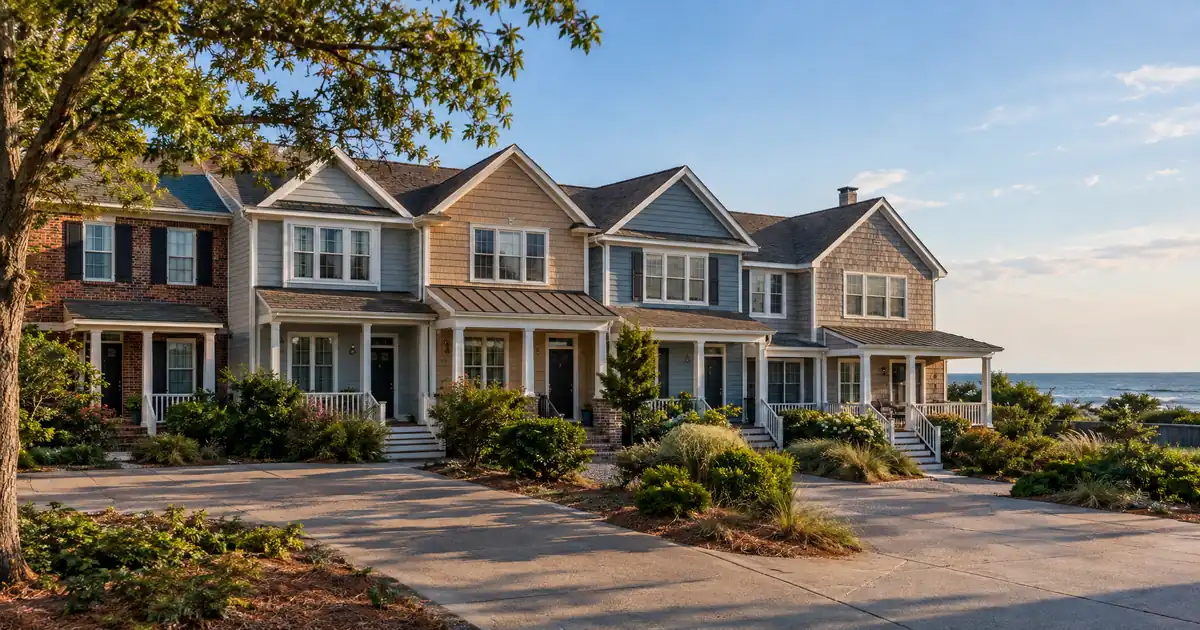
Most investors sizing up a cash-out refinance in Nags Head, North Carolina start with the equity, and that’s the wrong end of the file. Equity on this island is rarely the shortage. Rent is. A house valued near the $719,037 Zillow average home value sits beside a $2,650 median rent, and a 75% LTV ceiling can’t close a coverage gap that size. Exact terms depend on the lender’s guidelines, property type, leverage, and a full review of the borrower’s file.
Lendmire (NMLS# 2371349) is a DSCR-focused mortgage broker. Investors underwriting deals in Nags Head, North Carolina can use DSCR programs Lendmire arranges — available across 41 markets, including D.C. The rest of this piece covers which Nags Head properties can support an equity pull, and which ones only look like they can.
DSCR Cash-Out Calculator
Run the cash-out numbers in Nags Head, NC
Rate source: Freddie Mac 30-yr average via FRED® — Federal Reserve Bank of St. Louis · effective Sep 24, 2026
Prefilled with starting assumptions — enter your property’s value, balance, taxes, and insurance for a more accurate picture.
Program parameters update from Lendmire’s centralized guideline source. Taxes and insurance are editable estimates.
As of Sep 24, 2026 · General Freddie Mac market benchmark, not a Lendmire loan offer. Property value, balance, taxes, and insurance are editable estimates. Maximum loan-to-value varies by lender, program, property type, and seasoning. Not a Loan Estimate, approval, or commitment to lend. Program availability and eligibility are subject to lender guidelines, credit approval, property review, and underwriting.
TL;DR: A cash-out refinance on a Nags Head, North Carolina rental is underwritten primarily on the property’s rental income measured against its full monthly obligation, with taxes and insurance included, so the lender’s review turns on documented rent, a 75% LTV ceiling, and roughly six months of ownership rather than on appraised value alone. Every figure here varies by lender and program — guidelines, property type, leverage, and credit profile all apply.
- Zillow shows a $2,650 median rent against a $719,037 average home value, so coverage runs thin at 75% LTV.
- Comp depth is shallow: Redfin logged just 9 sales in one recent March.
- The hospital anchors year-round demand, with 630+ team members on staff.
- Sub-$500K cottages away from oceanfront are likelier to clear 1.00x than resort product.
- Lower LTV can rescue thin coverage. Sub-1.00 files get harder, not impossible. Final terms depend on lender guidelines, property type, leverage, and the borrower’s complete credit picture.
Nags Head Market Snapshot
A quick read on the Nags Head investor landscape — figures come from the cited sources below. Confirm current property-level numbers before underwriting.
| Metric | Detail |
|---|---|
| Home prices | $730,000 median (Homes.com – Nags Head houses) |
| Typical rents | $2,650 median (Zillow Rental Manager – Nags) |
| University enrollment | ~2,100 students systemwide (College of The Albemarle) |
| Employment | ~800 full/part-time employees (Dare County HR) |
Equity Isn’t the Problem. Coverage Is.
Nags Head has plenty of equity and not enough rent. At town-wide numbers, gross annual rent runs roughly 4.4% of home value (a $2,650 median rent against a $719,037 average value). That leaves single-family coverage well short of 1.00x on a full-leverage cash-out. The properties that work sit lower on the price curve.
The coverage number is monthly rent divided by the full monthly obligation: principal, interest, taxes, insurance, and any HOA dues. What DSCR qualification actually looks like is simple in principle, and Nags Head shows where it gets punishing. Run the numbers on a few modeled cases. The prices and rents below are assumptions for illustration, not sourced listings, and coverage is computed on full PITIA with taxes and insurance included.
Say you own a house valued at the town average, with the loan sized at the 75% ceiling and rent modeled at $2,650. Coverage lands around 0.6x. To reach 1.00x on that same house, rent would need to climb well above the median, far beyond what a typical listing commands. That puts it deep into the top half of Zillow’s $1,500 to $5,950 rent range, and plenty of houses at that value never see that rent on a twelve-month lease.
Now consider a modeled $500,000 cottage away from the oceanfront, still renting at $2,650. At 75% LTV, coverage sits in the mid-0.8s. Cut the LTV to about 65% and the same cottage approaches 1.0x. Rent near $3,000 to $3,100 gets it over the line at the full 75%. These specifics are subject to lender guidelines and a full review of property, leverage, and credit.
That’s the pattern. The ceiling is 75%, but on much of the island’s housing stock, the number you can actually use is lower. A sub-1.00 file isn’t dead. A lender may review lower-leverage structures, interest-only options, or select sub-1.00 programs, but each brings tighter terms, and qualification stays subject to lender guidelines, credit approval, and property review. Anyone building a plan around pulling maximum proceeds from a $700,000-plus house should test the coverage first. Where DSCR and conventional diverge matters here too, because a conventional cash-out would look at the borrower’s income instead of the house’s rent. The income side is where a retiree-heavy town’s investors often can’t or won’t go.
Thin Comps Cut Both Ways
Nags Head trades on very low sales volume, so any single-month price headline is close to meaningless for a refinance. Redfin reported a town median of $1.1 million in one recent March, up 50.9% year over year, but that median rested on only 9 homes sold, down from 24 a year earlier. Homes were selling after 56 days on the market versus 78 the year before.
Nobody should build an equity thesis on that. A median from nine sales can swing 50% in either direction and give it all back the next month. Zillow’s average value, by contrast, is basically flat at $719,037, down 0.1% over the past year. Those two readings don’t describe the same market (different methodology, different sample), and the flat one is the sturdier planning figure.
The Village at Nags Head is where this gets sharpest. Homes.com shows an average sale price of $748,813 over twelve months, up 3%. But Redfin’s neighborhood page recorded a $510,000 median in one February, down 37.2%, from a sample of a single sale. One home. Anyone telling you the Village “always appreciates” is quoting a data set too small to support the claim.
What does that mean for a cash-out? The refinance is priced off an appraisal, and appraisers in thin markets lean on whichever comps exist, near or far, old or new. The lender’s value conclusion may land below the number you’ve been carrying in your head. Six months of ownership, measured from title recording, is the typical seasoning benchmark. Six months of ownership doesn’t guarantee six months of supportive comps, though. Pull a longer trailing window than one month, gather several sales, and go in expecting the appraisal to be the weakest link in the file rather than the strongest.
Where the Coverage Holds Up (and Where It Doesn’t)
Coverage holds up in the lower-priced, residential, non-oceanfront pockets, and it fails in the resort and estate product. Clean per-neighborhood rents aren’t available, so this section is qualitative on submarkets and quantitative only where a source supports it.
South Nags Head is entirely residential apart from the Outer Banks Pier, with a paved multi-use trail running the four-mile length of Old Oregon Inlet Road, per local brokerage descriptions. It’s the submarket most often pointed to for large single-family homes with established rental histories. Those large homes are the dominant DSCR-fit asset on the island, because income tracks bedroom count more than unit count. The catch is price. Big homes mean big loan balances, and a rent-to-value ratio that looks fine on a five-bedroom can still fall short once taxes and insurance land in the obligation. Underwrite each house on its own documented rent.
Old Nags Head Cove is the quieter canal-front and soundside community on the west side of Highway 158, popular with boaters and anglers. It’s a plausible fit for the lower-priced cottage scenario above, where coverage sits within reach of 1.00x at moderate leverage. Keep the strategy simple here: a documented twelve-month lease, a modest loan, and a property that doesn’t depend on a top-of-range rent.
Bonnet Street and the Gallery Row area gets a specific mention from a local brokerage as a pocket of newer rental homes with good cash flow. That’s one brokerage’s read, not an audited figure, so treat it as a lead to research rather than a conclusion. But it’s the sort of area where the rent-to-value ratio has a chance of beating the town-wide 4.4%.
Old Nags Head Place, the cottage-style subdivision near Jockey’s Ridge State Park, appeals to design-conscious buyers and prices accordingly. The architecture is charming and the coverage math is probably not. Treat it as an equity-preservation hold, not a cash-flow play.
The Village at Nags Head is the one to be most careful about. The resort-and-golf product trades on razor-thin volume, prices swing on one or two sales, and the average sale price near $748,813 sets a loan balance that ordinary long-term rents will struggle to cover. Skip it for a coverage-driven cash-out unless the property carries genuinely exceptional documented rent.
The Nags Head Beach Cottages Historic District covers 41 contributing buildings. It’s a preservation-driven niche with little DSCR relevance. Historic-property constraints and tiny inventory make it a poor fit for a refinance thesis.
Who Actually Signs a Twelve-Month Lease Here?
Long-term demand in Nags Head comes from the people who staff the island, and the hospital is the clearest anchor. There is no university, military base, or corporate campus in town. Demand is tourism and healthcare, and the second half is where a DSCR investor’s lease comes from.
Outer Banks Health, the island’s only hospital, employs 630+ team members across 204 licensed beds and handles 50,000+ total visits a year. Dare County government adds roughly 800 full-time and part-time employees. Broader tourism is the largest sector by far: 12,260 jobs, or 45.5% of all Dare County jobs, and Dare County drew $2.1 billion in visitor spending, fourth-highest among North Carolina counties. Nags Head itself holds only 3,160 residents, but the surrounding township holds 12,376. That larger pool is the real labor market.
Here’s the demand signal that matters for a twelve-month lease. The Coastland Times reported that the hospital and medical group had 75 open positions, about 14% of its workforce, with housing cited as a key reason candidates turned down offers. Staff have also publicly appealed for rental units after losing long-term rentals. Year-round housing supply is tight, and a tenant who needs a place near a hospital shift isn’t shopping for a bargain.
That supports tenant depth and low vacancy risk for genuine twelve-month product. It does not change the arithmetic. Strong tenant demand doesn’t lift a $2,650 median rent to what a $719,037 house needs. Demand justifies the hold. Leverage still has to fit the rent.
There’s also a practical execution point. The island has property managers who run year-round rentals, not just weekly bookings. Village Realty manages over 950 rentals up and down the Outer Banks, and OBX Housing operates a dedicated long-term rental channel. A DSCR file leans on a lease and a property manager, so those channels matter.
What the Lender Checks on a Nags Head Cash-Out
A cash-out on an investment property in this market is reviewed on four things: leverage, seasoning, coverage, and reserves. On most files, the program guidance is a 75% maximum LTV, ownership seasoning of about six months from title recording, and a 1.00 minimum DSCR benchmark on rent against full PITIA. Credit tiers typically start at a 620 floor and step up through 660, 680, and 700. Reserves generally run about six months of PITIA, moving to about nine months above $1,500,000. Standard programs go up to $3,000,000, with smaller balances routed through select lenders in the network. All of it is subject to lender guidelines and program eligibility.
A few notes on how those bite in Nags Head specifically:
- The 75% ceiling is a maximum, not a target. Proceeds depend on rent used for lender review, PITIA, reserves, and the ceiling together. On thin-coverage houses the coverage test binds first, so the usable LTV may be well under 75%.
- Reserves scale with the balance. Large-house loans are exactly where the higher reserve tier appears. An investor holding a $1.6 million estate needs about nine months of PITIA in the bank, and that surprises people who only looked at the equity.
- LLC-held rentals are common with DSCR files, subject to lender program eligibility, so the vesting question is worth settling before the appraisal is ordered.
- Local rules matter. Verify current local rental rules, taxes, and insurance with qualified local professionals before underwriting any barrier-island acquisition or refinance.
In markets like this one, a common friction point is the gap between the value the borrower expects and the value an appraiser can support with three or four comps. The cleaner files tend to arrive with a signed twelve-month lease, a written management agreement, and a reserve statement that already covers the higher tier. Files that arrive with a lease still being negotiated and a valuation built on one hot listing tend to need the most rework. Getting a fresh insurance quote in early also prevents surprises, because coastal coverage changes the obligation line more than almost anything else on the file.
For a walk through the cash-out side, see Lendmire’s DSCR cash-out refinance page, or the refinance side for the broader options. Investors can talk through the numbers at 828-256-2183 before ordering an appraisal.
Skip the Estates
Skip the oceanfront estates and the resort product for coverage-driven cash-outs. Zillow’s listings run all the way up to eight-bedroom homes and a sixteen-bedroom oceanfront estate, and the island’s price spread is wide, with Homes.com showing houses from $79,000 to $4,750,000. The upper end can hold enormous equity and still fail the rent test, because the balance you’d be borrowing against sits far above what a long-term lease can carry.
Here’s a piece of thinking out loud. The stronger play might be a smaller, lower-priced cottage over a bigger, prettier house, since the cash-on-cash and the coverage number are both usually better. The tradeoff is exit liquidity, because with 9 sales in a month, a buyer pool for anything unusual can be small. Investors banking on appreciation could argue the other way, but appreciation is a poor thing to bet on when the reported medians move 50% on a handful of deals.
What the Proceeds Actually Do
The goal of a cash-out is capital for the next deal, and on this island the next deal is probably not another beach house. If a Nags Head refinance produces proceeds, the disciplined use is a property with better rent-to-value than the one you pulled equity from. That could mean a Dare County property with stronger coverage or a deal in a different market altogether.
Duplex and triplex product does trade in Nags Head, but it’s a minority of inventory, per Zillow’s listing categories. Scarcity cuts both ways: fewer units to buy, but small multifamily generally carries better coverage than a single large house because two rents service one obligation. If one turns up at a workable price, that’s worth more attention than another large single-family home.
DSCR vs. conventional financing
Two common ways to finance an investment property in Nags Head, NC. They qualify you differently — here’s how investors weigh them.
Why investors choose it
- Qualifies on the property’s rental income — no personal tax returns, W-2s, or pay stubs needed to document income.
- No personal debt-to-income ceiling to clear, so existing mortgages and obligations don’t cap your borrowing the same way.
- Can be closed in an LLC, keeping the property inside a business entity.
- Built for scaling — not held to the limit on number of financed properties that conventional financing applies.
- Underwriting centers on the deal: generally qualifies when the rent covers the payment, a 1.00x coverage ratio being a common baseline (confirmed in underwriting).
- Designed specifically for investment property, including long-term and, where the program allows, short-term rentals.
Where it’s strong
- Often the lowest ongoing financing cost for a buyer who fully qualifies on personal income — a fit for a first property or a cost-first purchase.
Trade-offs for investors
- Requires full personal income documentation and must fit within a debt-to-income limit — salary, existing debts, and other mortgages all count.
- Typically held in your personal name rather than a business entity.
- Caps how many financed properties you can carry, which can become a ceiling as a portfolio grows.
- Evaluates you as a borrower as much as the property, which usually means more paperwork.
How investors usually choose: a first or single property often optimizes for the lowest financing cost; portfolio builders often optimize for leverage, vesting in an LLC, and scaling past conventional caps. The right answer depends on your goals, the property, and current guidelines — both paths run through select lenders in Lendmire’s wholesale network, with eligibility and terms confirmed in underwriting.
Remember the seasoning clock resets on whatever you buy next. A property acquired with refinance proceeds can’t itself be cashed out until it’s been owned for roughly six months from title recording. Sequence the portfolio accordingly, and don’t count proceeds from a property you haven’t held long enough.
The Choice Most Nags Head Owners Actually Face
Nags Head owners with real equity end up choosing between two paths, and each costs something. Pull less, at a lower LTV that lands near 1.0x coverage, and accept smaller proceeds for a cleaner file and a calmer appraisal. Or reach for the full 75% on a house whose rent doesn’t cover it, and accept a harder sub-1.00 review, tighter terms, and an outcome that depends on a thin comp set going your way.
Frequently Asked Questions
Can a Nags Head house valued around $700,000 support a cash-out at 75% LTV?
Only if its documented rent is high enough, and at the town median it usually isn’t. A modeled house at that value needs rent well above what typical Nags Head listings show to reach 1.00x at full leverage, and the gap is wide. Lower LTV or a stronger rent can change that. Qualification stays subject to lender guidelines.
How does the thin sales volume in Nags Head affect an appraisal?
It leaves the appraiser fewer comps, so the value conclusion can land below what the owner expects. Redfin’s town data showed a median based on only 9 sales in one month, and the Village at Nags Head showed a median based on a single sale. Bring several comparable sales and a longer trailing window rather than relying on one month’s headline.
Does the hospital make long-term rental demand reliable here?
It makes demand durable, though not automatically profitable. Outer Banks Health employs 630+ team members, and the hospital reported 75 open positions tied partly to housing shortages. That supports tenant depth for genuine twelve-month leases, but coverage still depends on rent versus the full obligation on the specific property.
How soon after buying can I pull equity from a Nags Head rental?
The typical program benchmark is about six months of ownership, measured from title recording. That’s the minimum seasoning, not a promise of value. Whether the appraisal supports the amount you want is a separate question, and it’s the one that tends to decide the file in a market this thin.
Is a Nags Head duplex a better cash-out candidate than a beach house?
Often yes on coverage, since two rents carry one obligation, but duplexes and triplexes are a minority of Nags Head inventory. Verify the property type is eligible, since certain types such as manufactured homes, log homes, and barndominiums fall outside these DSCR programs.
For current guidelines and terms, see Lendmire’s DSCR loan programs page.
About Lendmire
Lendmire, NMLS# 2371349, is a mortgage brokerage that focuses on investor financing and arranges DSCR loans in 40 states plus Washington, D.C., for 41 markets in total. Qualification centers on the property’s income instead of personal income documentation, subject to lender guidelines, which suits LLC-held rentals and portfolios that are still scaling. The firm was named a top-ranked workplace in 2026 and a 2025 Scotsman Guide Top Workplace, and its Lendmire press releases and announcements are archived on EIN Presswire.
Get Started
Ready to find the right loan for you?
In about 30 seconds you can review financing options available for your investment property. No commitment required.
Informational only. Not a Loan Estimate, approval, or commitment to lend. Program availability and eligibility are subject to lender guidelines, credit approval, property review, and underwriting.
References
1. Zillow Home Value Index: Nags Head
2. Zillow Rental Manager: Nags Head
3. Redfin: Nags Head housing market
4. ECU Health: Outer Banks Health careers
5. Homes.com
8. Homes.com
10. Wikipedia — Nags Head Beach Cottages Historic District
11. Outer Banks Visitors Bureau: Dare County tourism facts
12. Island Free Press: visitor spending
13. Census Reporter — Nags Head NC
14. 12,376
15. The Coastland Times: hospital staffing and housing
16. outerbankschamber.com — Jobs Board
17. OBX Housing
18. Scotsman Guide — Top Workplaces 2026
19. a 2025 Scotsman Guide Top Workplace
This article is part of Lendmire’s investment property cash-out refinance program — full qualification details, guidelines, and scenarios live on the program page.
Related reading: DSCR Cash Out Refinance in Nags Head, North Carolina: Equity Extraction in a Thin Market · Investment Property Loans in Nags Head, NC: Can the Rent Carry the Loan on a Beach Cottage? · DSCR Cash Out Refinance in Harrisburg, North Carolina: Pulling Equity From a Thin-Rental Suburb
Guides: Investment Property Cash-Out Refinance in Nags Head, NC · Investment Property Cash-Out Refinance in North Carolina
Brandon Miller
Founder & CEO, Mortgage Loan Originator, Lendmire LLC
- Mortgage Loan Originator · NMLS# 1129696 · Verify on NMLS Consumer Access
- North Carolina Real Estate Broker · License# 343312 · Verify on NCREC
- North Carolina Insurance Producer · License# 19053198 · Property, Casualty, Life, Health · Verify on NAIC SBS
- Lendmire LLC · Firm NMLS# 2371349 · Verify firm licensure
Required disclosures. Lendmire (NMLS# 2371349) operates as a licensed mortgage broker, not a direct lender or depository. The discussion in this article is general in nature and should not be relied upon as financial, legal, or tax advice — every investment scenario is unique and should be reviewed by a qualified professional. Any loan inquiry is subject to lender underwriting, and this article is not a commitment to lend or a guarantee of approval. Mortgage rates, loan terms, and program guidelines vary by borrower, property, and state, and may change without notice. Equal Housing Opportunity. Verify licensure at NMLS Consumer Access.