
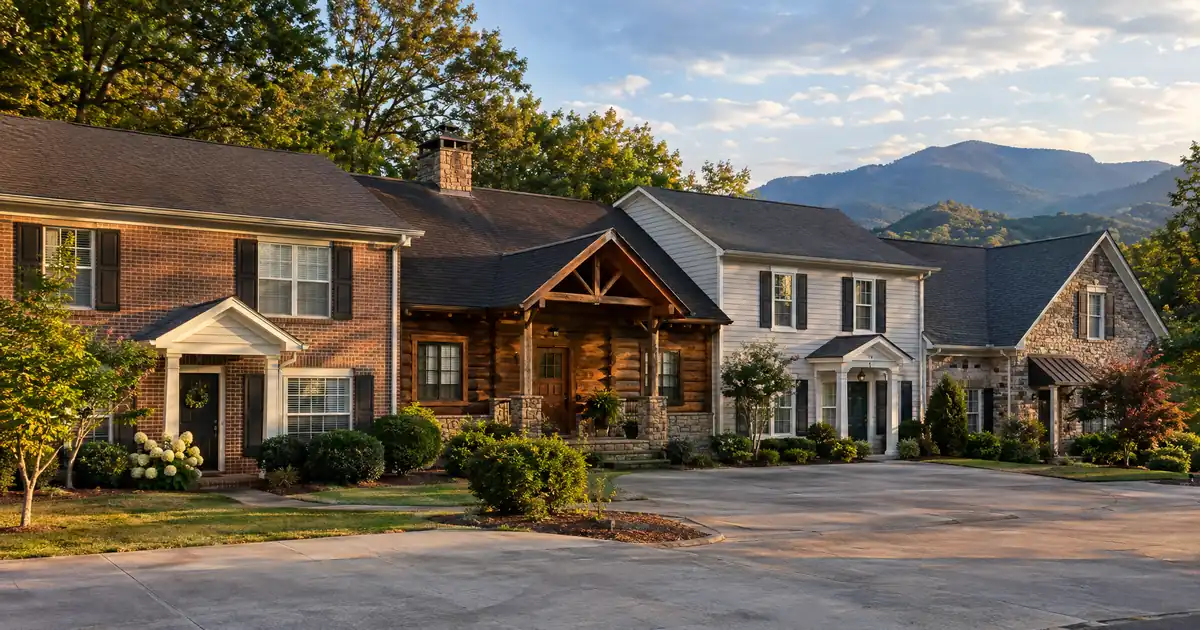
North Chattanooga’s median sale price is $625K, against $205K in East Chattanooga, per Redfin’s neighborhood pages. Price per square foot runs $290 against $197. Rents don’t scale nearly that steeply. Zumper puts Brainerd at $1,100 a month and Bushtown/Highland Park at $1,295, so the rent gap between these neighborhoods is a small fraction of the price gap. For an owner sitting on a rental and thinking about a cash-out refinance, that mismatch decides which properties can carry a new loan and which can’t.
TL;DR: A DSCR cash-out refinance in Chattanooga, Tennessee is underwritten primarily on the property’s rental income measured against its full monthly obligation, with the appraisal setting how much equity can be accessed and lender review confirming the file.
DSCR Cash-Out Calculator
Run the cash-out numbers in Chattanooga, TN
Rate source: Freddie Mac 30-yr average via FRED® — Federal Reserve Bank of St. Louis · effective Sep 24, 2026
Prefilled with starting assumptions — enter your property’s value, balance, taxes, and insurance for a more accurate picture.
Program parameters update from Lendmire’s centralized guideline source. Taxes and insurance are editable estimates.
As of Sep 24, 2026 · General Freddie Mac market benchmark, not a Lendmire loan offer. Property value, balance, taxes, and insurance are editable estimates. Maximum loan-to-value varies by lender, program, property type, and seasoning. Not a Loan Estimate, approval, or commitment to lend. Program availability and eligibility are subject to lender guidelines, credit approval, property review, and underwriting.
- Redfin’s citywide median is $335K, down 3.0 percent year over year. Don’t underwrite on appreciation.
- Cash-out is capped at 75 percent LTV, with about six months of seasoning typical.
- Low-priced workforce rentals model strongest on coverage. Duplexes at market rent are the middle path.
- Under-market in-place leases are the most common reason a Chattanooga duplex misses 1.00.
This piece is about the owner who already holds the property, not the buyer. It covers how appraisal, seasoning, leverage limits and rent combine to determine what a Chattanooga rental can release, and where that capital is best redeployed.
Chattanooga Market Snapshot
A quick read on the Chattanooga investor landscape — figures come from the cited sources below. Confirm current property-level numbers before underwriting.
| Metric | Detail |
|---|---|
| Recent appreciation | +1.4% (Dignity Properties blog) |
| University enrollment | 12,060 total (UT Chattanooga News) |
Where Chattanooga Equity Actually Sits
Equity in Chattanooga is uneven, and the citywide numbers understate how uneven. The Data Commons profile puts the city at 194,144 residents, a median age of 36.3 and unemployment of 3.8 percent. RentCafe reports 47 percent of households rent, so the tenant pool is deep. The price side is softer than the growth story suggests.
Redfin’s citywide median sits at $335K, down 3.0 percent year over year. Zillow’s average home value comes in lower, at $319,185, down 1.2 percent. Different methodologies, same direction: flat to slightly negative. A broker-blog summary citing Redfin frames the market as one that stabilized after several years of double-digit appreciation and a flat stretch, with inventory rising.
The practical read is that equity here was built earlier in the cycle. An owner who bought during the double-digit run likely has real room between the loan balance and a 75 percent LTV ceiling. An owner who bought recently in a softening submarket may appraise close to cost, which leaves little to pull. It’s a two-speed market, so it makes sense to sort your holdings before deciding anything.
The Submarket Sort
| Submarket | Median sale price | Rent datapoint | Refi read |
|---|---|---|---|
| North Chattanooga | Highest of the four, trending up | No reliable source | Equity-rich, coverage-thin |
| Downtown / Southside | Mid-range, trending down | Highest of the four | Softening, appraise cautiously |
| Highland Park / Bushtown | Not sourced | Mid-range | Multi-unit candidate |
| East Chattanooga / Brainerd | Lowest of the four, trending down sharply | Lowest of the four | Best rent per dollar of value |
Price direction and rank are drawn from Redfin neighborhood pages, and rent rank from Zumper, which covers all unit types.
Sources: Redfin neighborhood pages for prices; Zumper for rents. Rent figures cover all unit types.
North Chattanooga: Strong Equity, Weak Coverage
North Chattanooga is the appreciation-led submarket. Homes there sell in an average of 26 days versus 61 the year before, and the median is up 4.1 percent. Owners here probably hold the most appraisal-driven equity in the city.
The trouble is the ratio. At a $625K price point, a 75 percent LTV loan carries a debt load that rents in a walkable, riverfront neighborhood rarely cover. I couldn’t find a reliable neighborhood rent source, so the case rests on inference: Downtown’s all-unit average is $1,395, and North Shore rents would need to sit far above that to clear 1.00 on a full-PITIA basis. Skip it for pure cash-flow refinancing unless the property is multi-unit or the owner is willing to take a lower-leverage structure.
Downtown and Southside: Read the Softness Honestly
Redfin’s Downtown page shows a $379K median, down 6.9 percent, with days on market rising to 74 from 50. Condos and townhomes near the Innovation District appeal to professionals who want low-maintenance living. But a falling median and a lengthening sales cycle is exactly the setup where an appraiser leans conservative. If you bought here recently, expect the value to land near your basis.
Highland Park, Orchard Knob and Bushtown: The Multi-Unit Lane
Highland Park sits east of downtown near the University of Tennessee at Chattanooga, and local broker sources describe it as an accessible entry point with growth potential. Zumper’s $1,295 rent for Bushtown/Highland Park is the figure to anchor on. Broker sources single out duplexes and small apartment buildings here and in Ridgedale as the income-stacking product. That is qualitative evidence, so treat it as directional.
East Chattanooga and Brainerd: Rent Per Dollar of Value
East Chattanooga’s median is $205K, down 14.6 percent, with 65 days on market. That is a small sample (13 sales in the month cited), so don’t build a portfolio thesis on it. But it frames the low-price end. Brainerd rents at $1,100 sit alongside a housing stock of mid-century homes and everyday retail along Brainerd Road. Red Bank, East Ridge and East Brainerd also still have entry-level homes under $300,000, per a Redfin-based agent note.
This is where rent-to-value is most plausible. It’s also where a soft appraisal is most likely, which brings the next issue.
Modeled Coverage: Three Chattanooga Cases
The math below uses modeled inputs, not sourced yields. No source in the research gives Chattanooga cap rates or rent-to-value ratios, so these are illustrations. Every coverage figure is rent divided by full PITIA, including taxes and insurance, at 75 percent LTV, and rounded down.
Case one: a workforce three-bedroom. Say a house in the East Chattanooga/Brainerd band appraises at $205K. Zumper shows three-bedroom rents around $1,900, and Trulia’s three-bedroom figure sits near $2,000. At $1,900 of rent used for lender review, coverage models at roughly 1.4 to 1.5x. That comfortably clears the standard 1.00 benchmark, though a 75 percent LTV on a $205K appraisal leaves a modest absolute cash-out. Strong ratio, small check.
Case two: a duplex at market rent. Consider a duplex appraising near the $380K median multi-family listing price. One marketed renovated duplex in the 37421 area lists at $1,700 per unit, or $3,400 gross. At that rent, coverage models near 1.5x. Drop to Highland Park’s $1,295 per unit and it falls to roughly 1.1x. Still passing, with less cushion.
Case three: the under-market lease trap. A Redfin duplex listing shows in-place month-to-month leases of $716 and $1,072, roughly $1,788 combined. On the same $380K value, coverage falls below 0.9. That property doesn’t clear on in-place rent.
Here’s the catch on case three. When coverage lands under 1.00, there are paths a lender may review: a sub-1.00 program at reduced leverage, an interest-only structure, or re-leasing to market with an appraiser-supported rent schedule. Whether any of those works depends on lender guidelines, credit profile, reserves and property review. Marketed rents are asking rents, not lease data, so underwrite what’s signed or what an appraiser will support.
DSCR files in markets like this one typically split into two groups. Files where the borrower has already re-leased to market and holds a current lease schedule move through review smoothly. Files where legacy tenants sit at below-market rents tend to stall on the rent figure, not the credit or the equity. The owners who prepare best are the ones who sort out rent documentation and an insurance quote before the appraisal is ordered, so the number the lender sees is the number that will hold.
Seasoning, LTV and the Real Ceiling
Three parameters shape cash-out proceeds, and they interact. Guidelines typically cap cash-out at 75 percent LTV. That’s tighter than the 80 percent purchase ceiling, so an investor who read the purchase numbers shouldn’t carry them over. Seasoning of about six months from title recording is typical before a cash-out is reviewed. Reserves of about six months of PITIA are typical, moving to about nine months above $1,500,000. Credit tiers run 620, 660, 680 and 700, with 620 as the floor. Loan amounts go up to $3,000,000 on standard programs, with smaller balances routed through select lenders in the network. All of this is guidance subject to lender guidelines, not a commitment.
The arithmetic of equity extraction is simple. If a property appraises at some value and the existing loan is 50 percent of it, 25 points of LTV sit between the balance and the ceiling. If the existing loan is already at 65 percent, only 10 points remain. And if the appraisal comes in lower than expected, every point of shortfall comes straight out of proceeds. Whatever survives after reserves and the coverage test is what becomes capital for the next deal.
A market that is flat to down citywide makes this a conservative exercise. A recent buyer in a submarket with rising supply, such as East Brainerd, where one broker blog citing Realtor.com reports 4.4 months of supply, should plan on a conservative value. Buyers from the double-digit appreciation years likely hold the most usable equity.
Why Rents Hold Up (and Where They Might Not)
Demand here doesn’t rest on a single employer. Per 6AM City’s list drawing on Chattanooga Chamber data, Erlanger Health leads at 7,081 employees, followed by Hamilton County Schools at 6,503 and BlueCross BlueShield of Tennessee at 6,333. CommonSpirit-Memorial employs 4,583 and Volkswagen Chattanooga 4,500. The ten largest employers together account for more than 43,000 jobs. Health care, education, manufacturing and government are the major industries, per the Chattanooga Area Chamber of Commerce. A headquarters insurer in a mid-size market adds depth.
The University of Tennessee at Chattanooga reached a record enrollment of 12,060, and the chancellor calls it a milestone toward 15,000. Choose Chattanooga reports an 81,000-square-foot business school expansion and a new 794-bed residence hall. Chattanooga State Community College adds 7,623 students, per Data USA. Demand near Highland Park is anchored by an institution that keeps growing.
There is a forward-looking angle too, though it shouldn’t be overclaimed. EPB, the city-owned utility behind the Gig City fiber network, launched a $22M quantum computer, and an UTC-EPB study projects up to $1.1 billion in economic impact. That is a projection, not realized income, and it shouldn’t change your rent assumptions. It does suggest the tenant base is more diversified than a Volkswagen-and-insurers story implies.
What About Vacancy?
I found no reliable vacancy source for houses or small multifamily, so no figure appears here. Apartments are a different story. Matthews, citing CoStar, reports apartment vacancy hit a record 12 percent and improved only to 11 percent, with the construction pipeline down 70.8 percent to 576 units underway. Rent direction is mixed too: Apartment List shows a median of $1,227, up 1.2 percent year over year, while Zumper’s $1,434 median is down 1.1 percent. Model current rent with no growth. Newer Class A apartment competition can cap what a renovated duplex or single-family rental commands, though the thinning pipeline supports a stable rent story.
What the Broker Adds to a Chattanooga Cash-Out
Owners weighing a DSCR loan against a conventional refinance can use the side-by-side comparison, and rate-and-term or other refinance paths are outlined under investor refinance options. Owners who want a file reviewed can talk through the numbers or call 828-256-2183.
One reminder: verify current local rental rules, taxes and insurance with qualified local professionals before committing to a plan.
Frequently Asked Questions
How do you qualify for a DSCR cash-out refinance in Chattanooga?
Qualification centers on the property’s rent compared with its full monthly obligation, with 1.00 as the common benchmark. Lenders also review credit (620 is the typical floor), reserves of about six months of PITIA, and the appraised value against a 75 percent LTV ceiling. Terms vary by borrower, property and lender.
DSCR vs. conventional financing
Two common ways to finance an investment property in Chattanooga, TN. They qualify you differently — here’s how investors weigh them.
Why investors choose it
- Qualifies on the property’s rental income — no personal tax returns, W-2s, or pay stubs needed to document income.
- No personal debt-to-income ceiling to clear, so existing mortgages and obligations don’t cap your borrowing the same way.
- Can be closed in an LLC, keeping the property inside a business entity.
- Built for scaling — not held to the limit on number of financed properties that conventional financing applies.
- Underwriting centers on the deal: generally qualifies when the rent covers the payment, a 1.00x coverage ratio being a common baseline (confirmed in underwriting).
- Designed specifically for investment property, including long-term and, where the program allows, short-term rentals.
Where it’s strong
- Often the lowest ongoing financing cost for a buyer who fully qualifies on personal income — a fit for a first property or a cost-first purchase.
Trade-offs for investors
- Requires full personal income documentation and must fit within a debt-to-income limit — salary, existing debts, and other mortgages all count.
- Typically held in your personal name rather than a business entity.
- Caps how many financed properties you can carry, which can become a ceiling as a portfolio grows.
- Evaluates you as a borrower as much as the property, which usually means more paperwork.
How investors usually choose: a first or single property often optimizes for the lowest financing cost; portfolio builders often optimize for leverage, vesting in an LLC, and scaling past conventional caps. The right answer depends on your goals, the property, and current guidelines — both paths run through select lenders in Lendmire’s wholesale network, with eligibility and terms confirmed in underwriting.
What are the requirements for an investment property refinance in Chattanooga, Tennessee?
Expect about six months of ownership from title recording, an appraisal that supports the value, and documented rent through leases or an appraiser’s rent schedule. Loans up to $3,000,000 are typical on standard programs. LLC-titled ownership may be possible, subject to lender program eligibility.
How much equity can a Chattanooga investor pull out?
It depends on the appraisal, not the purchase price. Redfin shows a citywide median down 3.0 percent, so owners who bought recently may find little room. Owners who bought earlier in the appreciation run generally have more, though rent used for lender review and reserves still cap the result.
Can a duplex with below-market leases still work?
Sometimes, but not on in-place rent alone. A duplex with combined leases near $1,788 models under 0.9 coverage on a $380K value. A lender may review a sub-1.00 program at reduced leverage, an interest-only structure, or a re-lease to market rent supported by an appraiser.
What can limit DSCR cash-out proceeds in Chattanooga?
Lendmire arranges DSCR investor loans, and the binding limit on a Chattanooga file is usually the 75 percent LTV ceiling applied to a conservative appraisal. Weak coverage, thin reserves and recent purchase timing can each reduce or delay proceeds.
For current guidelines and terms, see Lendmire’s DSCR loan programs page.
About Lendmire
A DSCR-focused mortgage broker, Lendmire (NMLS# 2371349) places investor financing across 41 markets — 40 states plus Washington, D.C. — with DSCR eligibility generally reviewed by the lender on property cash flow instead of traditional personal-income documentation, subject to lender guidelines. Scotsman Guide named Lendmire a Top Mortgage Workplace in 2025 and 2026; see the Top Workplace press announcement.
For broader investor-financing rules and property-type coverage across the state, see Tennessee DSCR loans.
For the mechanics of pulling equity out of a rental property, see cash-out refinance on an investment property.
Get Started
Ready to find the right loan for you?
In about 30 seconds you can review financing options available for your investment property. No commitment required.
Informational only. Not a Loan Estimate, approval, or commitment to lend. Program availability and eligibility are subject to lender guidelines, credit approval, property review, and underwriting.
References
2. Zumper, Chattanooga rent research
3. $335K, down 3.0 percent year over year
4. Dignityproperties.com — Chattanooga TN Housing Market
5. UT Chattanooga enrollment announcement
7. RentCafe — Average Rent Market Trends Chattanooga
8. $379K median, down 6.9 percent, with days on market rising to 74 from 50
10. $380K median multi-family listing price
11. 6AM City: 10 biggest employers in Chattanooga
12. Chattanooga Area Chamber of Commerce
14. Data USA
15. timesfreepress.com — Epb Launches 22m Quantum Computer to Solve Grid
16. Matthews multifamily market report
17. Apartment List, Chattanooga rent report
18. 2025
19. 2026
20. the Top Workplace press announcement
This article is part of Lendmire’s investment property cash-out refinance program — full qualification details, guidelines, and scenarios live on the program page.
Related reading: Cash Out Refinance Investment Property in Chattanooga TN · DSCR Loans Chattanooga: Investor Financing for Lookout Mountain, Northshore, Downtown, Signal Mountain & Real Estate Investors · Cash Out Refinance Investment Property in Highland, Indiana: Will My Rent Cover a Cash-Out Loan?
Guides: Investment Property Cash-Out Refinance in Chattanooga, TN · Investment Property Cash-Out Refinance in Tennessee
Brandon Miller
Founder & CEO, Mortgage Loan Originator, Lendmire LLC
- Mortgage Loan Originator · NMLS# 1129696 · Verify on NMLS Consumer Access
- North Carolina Real Estate Broker · License# 343312 · Verify on NCREC
- North Carolina Insurance Producer · License# 19053198 · Property, Casualty, Life, Health · Verify on NAIC SBS
- Lendmire LLC · Firm NMLS# 2371349 · Verify firm licensure
Compliance and disclosures. Lendmire (NMLS# 2371349) is a licensed mortgage broker and is not a direct lender, depository institution, financial advisor, or tax professional. Content in this article is general market analysis and educational information — not financial, legal, or tax advice for any specific situation. Lendmire does not guarantee loan approval; every transaction is subject to underwriting by the funding lender. Mortgage pricing and loan program guidelines are subject to change at any time without notice and vary by borrower characteristics, property type, and state regulations. Lendmire complies with Equal Housing Opportunity. Licensure verification: NMLS Consumer Access.