
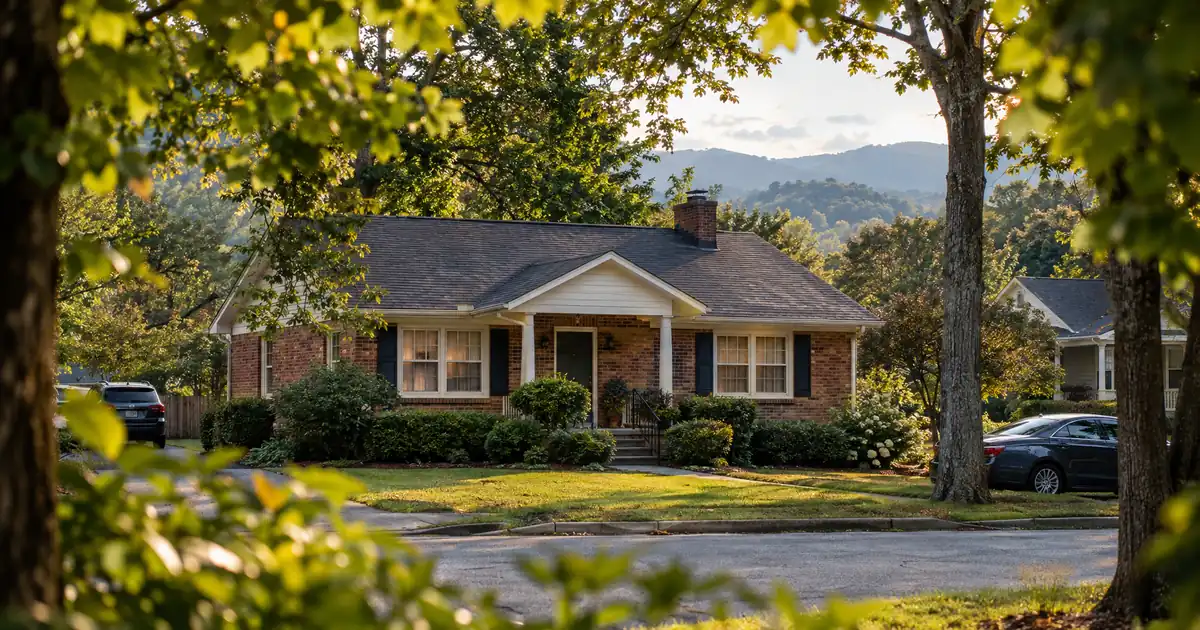
Picture an investor holding a three-bedroom rental bought at $165,000 near the Sewell Drive corridor. It has been rented steadily to a hospital worker, then a plant employee. A local agent now says it would appraise closer to $230,000, and the investor wants that equity working on the next property. Then comes the uncomfortable part. At $1,200 a month in rent, the cash-out math doesn’t automatically clear.
That tension is the whole story of pulling equity out of a Sparta rental. Values have moved, but rents haven’t moved with them. For real estate investors in Sparta, Tennessee, Lendmire (NMLS# 2371349) helps structure and place DSCR financing through wholesale lenders operating in 41 markets, including D.C. What follows is a straight read on where the cash-out math holds up in White County, and where it doesn’t. Lendmire is a mortgage broker (NMLS# 2371349), not a lender — it places DSCR investment-property loans with wholesale lenders and does not fund, underwrite, or approve loans itself.
DSCR Cash-Out Calculator
Run the cash-out numbers in Sparta, TN
Rate source: Freddie Mac 30-yr average via FRED® — Federal Reserve Bank of St. Louis · effective Sep 24, 2026
Prefilled with starting assumptions — enter your property’s value, balance, taxes, and insurance for a more accurate picture.
Program parameters update from Lendmire’s centralized guideline source. Taxes and insurance are editable estimates.
As of Sep 24, 2026 · General Freddie Mac market benchmark, not a Lendmire loan offer. Property value, balance, taxes, and insurance are editable estimates. Maximum loan-to-value varies by lender, program, property type, and seasoning. Not a Loan Estimate, approval, or commitment to lend. Program availability and eligibility are subject to lender guidelines, credit approval, property review, and underwriting.
The Short Version:
A DSCR cash-out refinance in Sparta, Tennessee fits investors who already own a low-basis rental or small multi-unit and can live with modest proceeds. The loan is underwritten primarily on the property’s rental income measured against its full monthly obligation, with leverage capped at 75% LTV and roughly six months of seasoning. Every figure here varies by lender and program — guidelines, property type, leverage, and credit profile all apply.
- ZIP 38583 shows a median rent of $861 against a $207,800 median value, per ZIP-Codes.com.
- Single-family rent sits near a $1,200 median per Homes.com, which strains coverage at full leverage.
- Two 2BR units at the HUD fair market benchmark of $965 gross far more than one house.
- Plants employing 200-400 workers each anchor the long-term tenant pool.
- Multi-family comps are scarce, so plan appraisals and leverage conservatively.
Sparta Market Snapshot
A quick read on the Sparta investor landscape — figures come from the cited sources below. Confirm current property-level numbers before underwriting.
| Metric | Detail |
|---|---|
| Home prices | $207,800 median value (ZIP-Codes.com) |
| Typical rents | $861 median (ZIP-Codes.com) |
| Recent appreciation | 3–4% annual (USDA Properties White County) |
| Employment | 1,968 mfg jobs (MTIDA Sparta-White County 2024) |
| Vacancy | 9.20% (ZIP-Codes.com) |
Start With the Ratio, Not the Equity
Sparta cash-out files are decided by rent-to-value, not by how much equity a property has. The ZIP-level figures work out to roughly 0.41% of value per month in rent, a thin ratio that leaves little room at 75% LTV. Equity can be large on paper and still fail the coverage test.
Here’s the arithmetic. DSCR is monthly rent divided by the full monthly obligation: principal, interest, taxes, insurance, and any HOA dues. Most standard programs are built around a 1.00x benchmark because rent covers the obligation at that level. Some lenders review lower-ratio files, but those usually need lower leverage, stronger credit, deeper reserves, or different pricing. Exact eligibility turns on lender guidelines, credit profile, and property review. For a plain-language walk-through, see the guide “What Is a DSCR Loan”.
Now run the numbers on the investor above. Assume a modeled appraisal of $230,000 and rent of $1,200. Include taxes and insurance at typical Tennessee levels, and take the full 75% LTV. Coverage lands around 0.90. Not a pass on rent alone. Final terms depend on lender guidelines, property type, leverage, and the borrower’s complete credit picture.
Drop the requested leverage toward 60% LTV and the same file moves to slightly above 1.05. That’s the pattern in a market like this: the file often works, but only with less cash pulled out than the investor hoped for. Proceeds depend on rent used for lender review, the full obligation, reserves, and the 75% ceiling, and they are never a guaranteed figure.
How Much Value Are You Actually Sitting On?
Sparta’s price data disagrees with itself, and the disagreement matters for a cash-out. The ACS median home value for ZIP 38583 is $207,800, which is up about 114% since 2011 per ZIP-Codes.com. That figure is a survey of owner-reported values and it lags the market. Redfin shows a recent median sale price of $277,000, up 15.9% year over year, on thin sales volume. Treat the jump as volatile. Movoto’s higher list-price median skews toward lake and acreage listings that have nothing to do with workforce rentals.
So which number does the appraiser see? Neither, exactly. The appraiser uses comparable sales, and in a town of about 5,000 residents (Census Bureau QuickFacts puts it at 4,939), comps are sparse. One aggregator, USDA Properties, describes rural White County appreciation as a modest 3-4% a year. It is a weak source, so hold it loosely, but it suggests the Redfin spike shouldn’t be underwritten as a trend.
The thinking-out-loud version: an investor who bought years ago at a low basis may have real equity, while one who bought recently at a full price probably doesn’t. The first is a strong refinance candidate. The second is better served waiting.
Depth of the comp pool is also a factor. Redfin’s White County new-homes data shows a $335,000 median list price on new construction, homes sitting around 94 days, and just one multi-family property for sale countywide. New-build pricing far above the older-stock medians won’t help an older rental’s appraisal. It can also pull an appraiser toward the wrong comps.
What Rents Support, and What They Don’t
Single-family rent in Sparta tops out near $1,200. Homes.com puts the single-family median at $1,200, while ApartmentHomeLiving lists three-bedroom homes, condos, and townhomes ranging from $1,199 to $3,000. That upper range is a listing spread, not a market median. Pricing a cash-out on the top of it is how deals get stress-tested into the ground.
Against a $230,000 value, $1,200 doesn’t clear 1.00 at full leverage, as the earlier scenario showed. What are the options for a file below 1.00? A lender might review a lower-leverage structure, an interest-only period, or a sub-1.00 program. Each comes with tradeoffs in proceeds, pricing, reserves, and credit requirements, and qualification remains subject to lender guidelines and property review. None is a promise.
The better play in this market, in my read of the data, is stacking units. HUD fair market rents for White County are $965 for a 2BR and $1,167 for a 3BR, per Affordable Housing Hub. Two 2BR units gross about $1,930, roughly 60% more than a single-family house at the median. Fair market rent is a subsidy benchmark, not proof of achievable market rent, so haircut it.
Model it this way, using assumed inputs and not sourced prices. Say a duplex is valued at $250,000 and each unit rents at $965. At 75% LTV, coverage including taxes and insurance comes out around 1.30. That’s a different conversation than the single-family file. The catch: there is no sourced duplex price data here, so treat the $250,000 as a modeled input only. These specifics are subject to lender guidelines and a full review of property, leverage, and credit.
Where the Files Pencil: Sparta by Corridor
Sparta is too small for reliable neighborhood-level rent or price data, and none exists in a form worth quoting. What follows is qualitative, built from geography and employment.
The Sewell Drive and North Spring Street corridor is the strongest tenant story. It connects residential streets and industrial sites to Ascension Saint Thomas Highlands Hospital, which provides 24/7 emergency and specialty care. Healthcare and plant workers are the likely tenant pool here. That’s inference from geography, not a surveyed fact, but the employment logic holds. Long-term leases to steady wage earners are what a coverage file wants to see.
The downtown and Liberty Square core has older stock around the courthouse square. Older housing means the appraisal condition adjustments deserve attention, and it’s where a small duplex or converted multi-unit is most likely to turn up. Comps are thin. If a property here has been rented at a documented rate for a year or more, the file is cleaner.
The US-70 and West Bockman Way strip is retail and service-worker territory just across the Calfkiller River from downtown. It works as a tenant source for retail employment, though it is not a place to hunt for equity. Value support is harder to argue there.
Skip the lake and rural-fringe pockets around Center Hill Lake and Doe Creek for this thesis. They are land-heavy and second-home-oriented, priced well above workforce rental economics, and the rent-to-value math is worse than in town. Cash-out coverage won’t get better out there.
Tenant Demand Comes From the Plants
Manufacturing carries the local rental base. The MTIDA Sparta-White County profile shows manufacturing at 24.0% of employed county residents, with 1,968 manufacturing jobs and a $969 average weekly wage. County unemployment was 5.1% in the profile’s reference year. That’s not a hot labor market, but it is a steady one.
Named employers include Industrial Rhythm North America at 402 workers, Tri-State Distribution at 331, Moeller Marine Products at 241, and Ltd Parts at 212. The City of Sparta says the area has 15 industries with a combined workforce above 2,200. None is a mega-employer. That’s a mixed blessing: no single closure guts the market, but no single expansion lifts it either.
Household income context matters for rent ceilings. Median household income is $50,080 against $69,595 statewide per Census Bureau QuickFacts. Rents can’t stretch far past what local wages carry, which is why the coverage problem is structural and not a temporary quirk.
Seasoning and the Six-Month Clock
The seasoning requirement is about six months of ownership, measured from title recording. For an investor who bought a Sparta rental and did light work on it, the clock matters mostly for timing the appraisal. A value bump from renovation or from the recent price run only counts once the file is seasoned and appraised.
Basic parameters worth knowing for a cash-out, all subject to lender guidelines and property review:
- Cash-out leverage tops out at 75% LTV, lower than the purchase cap.
- Credit tiers run 620, 660, 680, and 700, with 620 as the floor.
- Reserves are typically about six months of the full obligation.
- Standard programs go up to $3,000,000, but most Sparta balances are far smaller. Smaller loans route through select lenders in the network.
For a wider look at the structure, see pulling equity with a DSCR cash-out and the investment property refinance options. Lendmire’s broader Tennessee coverage is on its page for DSCR loans in Tennessee.
What the Deal Desk Sees in Markets Like This
In small rural-plateau markets, the common friction point is comp depth, not borrower quality. Files with a documented lease, clean rent history, and a recent appraisal-ready property tend to move more smoothly. The files that stall usually lean on a rent figure pulled from a listing site with a wide spread, or on an assumed value the appraiser can’t support. Investors who get a realistic rent read first, before deciding how much cash to request, usually set the leverage more sensibly.
Competing Supply Caps the Bottom of the Market
Sparta has a meaningful amount of subsidized housing for a town its size. HUD Housing Network lists 7 affordable complexes, including 104 Section 8 apartments, 118 public housing buildings, and 98 low-income units, plus 162 units managed by the Sparta Housing Authority. That is competing supply, and it sets a rent floor-and-ceiling dynamic at the low end. A rental priced far above nearby subsidized alternatives will have to justify itself with condition and location.
Vacancy needs care too. The ACS shows a 9.20% vacancy rate for ZIP 38583, but that covers all housing, not just rentals (ZIP-Codes.com). Renters make up 23.02% of occupied units in the ZIP, so the rental pool is small. One useful supply signal: RentCafe says apartment buildings average around 51 years old, with none built since 2000. Little recent multifamily supply is a mild positive for existing landlords. It also means older-stock condition issues are a real appraisal variable.
Newly built manufactured-home rentals also exist at the low end. Those property types fall outside the network’s DSCR programs, so they can’t serve as collateral here, but they do compete for the same tenants.
DSCR vs. conventional financing
Two common ways to finance an investment property in Sparta, TN. They qualify you differently — here’s how investors weigh them.
Why investors choose it
- Qualifies on the property’s rental income — no personal tax returns, W-2s, or pay stubs needed to document income.
- No personal debt-to-income ceiling to clear, so existing mortgages and obligations don’t cap your borrowing the same way.
- Can be closed in an LLC, keeping the property inside a business entity.
- Built for scaling — not held to the limit on number of financed properties that conventional financing applies.
- Underwriting centers on the deal: generally qualifies when the rent covers the payment, a 1.00x coverage ratio being a common baseline (confirmed in underwriting).
- Designed specifically for investment property, including long-term and, where the program allows, short-term rentals.
Where it’s strong
- Often the lowest ongoing financing cost for a buyer who fully qualifies on personal income — a fit for a first property or a cost-first purchase.
Trade-offs for investors
- Requires full personal income documentation and must fit within a debt-to-income limit — salary, existing debts, and other mortgages all count.
- Typically held in your personal name rather than a business entity.
- Caps how many financed properties you can carry, which can become a ceiling as a portfolio grows.
- Evaluates you as a borrower as much as the property, which usually means more paperwork.
How investors usually choose: a first or single property often optimizes for the lowest financing cost; portfolio builders often optimize for leverage, vesting in an LLC, and scaling past conventional caps. The right answer depends on your goals, the property, and current guidelines — both paths run through select lenders in Lendmire’s wholesale network, with eligibility and terms confirmed in underwriting.
Short-term rental doesn’t change the picture. Average occupancy is low, so the long-term lease is the thesis. Investors should verify current local rules, taxes, and insurance with qualified local professionals before underwriting anything.
Two Scenarios, Side by Side
Run the numbers on two owners, both using modeled assumptions and coverage including taxes and insurance.
| Scenario | Modeled value | Rent | Coverage at 75% LTV |
|---|---|---|---|
| Single-family, one unit | $230,000 | $1,200 | About 0.90 |
| Duplex, two 2BR units | $250,000 | $1,930 gross | About 1.30 |
The duplex clears the benchmark with room. The house doesn’t. Same town, same tenant pool, opposite outcomes.
Which is the better use of a Sparta cash-out? Honestly, it’s a toss-up that turns on the basis. An investor with a very low basis in a single-family home may still pull useful proceeds at reduced leverage. An investor with a duplex has more headroom to take the full 75%. The extra units cost more to buy, though, and duplex comps are scarce, so the appraisal is the risk to watch.
Where the proceeds go matters as much as how much you take. Cash from a Sparta refinance has a job: a down payment on a stacked-unit property, either locally or elsewhere. Pulling equity to fund another thin single-family deal just repeats the coverage problem. Compare the mechanics in the program-to-program comparison, and a scenario review can show what a particular file would look like.
Frequently Asked Questions
How do you qualify for a DSCR cash-out refinance in Sparta, Tennessee?
The property has to be seasoned for about six months, sit at or below 75% LTV, and show rent that covers its full monthly obligation, typically at a 1.00x benchmark. Credit starts at a 620 floor, and reserves of about six months are common. Eligibility depends on lender guidelines, credit profile, and property review. Single-family rents near $1,200 often force lower leverage.
What are the requirements for an investment property loan in Sparta, Tennessee?
Expect a rental-income-based review of the property, a credit score at or above the program floor, and reserves. Property types matter: manufactured homes, log homes, and barndominiums fall outside these programs. Small balances route through select lenders in the network. Lender program requirements and state overlays apply.
Does Sparta’s low rent-to-value ratio mean a cash-out won’t work?
Not necessarily, but it changes the structure. At ZIP-level medians, monthly rent runs about 0.41% of value, so a full-leverage single-family refinance often lands below 1.00. Lower leverage, interest-only structures, or a multi-unit property can move the number. Each option carries tradeoffs and is subject to lender review.
Why are duplex comps a concern for a Sparta appraisal?
Only one multi-family property was listed for sale across White County in the Redfin data, so appraisers may have to reach for comps. That can pull value below an investor’s expectation. Planning for conservative LTV, and having a documented rent history ready, helps.
How does DSCR lender review differ from a bank’s approach in Sparta?
Lendmire arranges DSCR investor loans, and the file is reviewed primarily on the property’s rental income against its full obligation, not on personal income documents. That suits self-employed and multi-property owners whose traditional personal-income documentation understates cash flow. Program terms vary by lender.
The Number That Reframes the Market
Everything above comes back to one comparison: Sparta’s two-bedroom fair market rent of $965 versus a single-family median of $1,200. Two small units gross about $1,930, and that gap, more than any appreciation headline, decides who can pull cash out and who has to wait.
About Lendmire
Lendmire (NMLS# 2371349), a non-QM mortgage broker serving investors in 41 markets including Washington, D.C., helps structure DSCR scenarios commonly evaluated around a property’s rental income rather than personal income paperwork, subject to lender guidelines. A Scotsman Guide Top Mortgage Workplace in 2025 and 2026, Lendmire places loans through wholesale investor lenders and is not a direct lender.
Get Started
Ready to find the right loan for you?
In about 30 seconds you can review financing options available for your investment property. No commitment required.
Informational only. Not a Loan Estimate, approval, or commitment to lend. Program availability and eligibility are subject to lender guidelines, credit approval, property review, and underwriting.
References
2. Homes.com
4. MTIDA, Sparta-White County profile
5. Redfin, Sparta housing market
6. Census Reporter, Sparta profile
7. Redfin’s White County new-homes data
10. Ascension Saint Thomas Highlands Hospital
11. City of Sparta
12. HUD Housing Network, Sparta
13. RentCafe
14. Scotsman Guide 2025 Top Mortgage Workplace
15. Scotsman Guide 2026 Top Mortgage Workplace
This article is part of Lendmire’s investment property cash-out refinance program — full qualification details, guidelines, and scenarios live on the program page.
Related reading: Cash Out Refinance Investment Property Sparta Tennessee · Cash Out Refinance Investment Property Newport Tennessee · DSCR Cash Out Refinance Wears Valley Tennessee
Guides: Investment Property Cash-Out Refinance in Tennessee
Brandon Miller
Founder & CEO, Mortgage Loan Originator, Lendmire LLC
- Mortgage Loan Originator · NMLS# 1129696 · Verify on NMLS Consumer Access
- North Carolina Real Estate Broker · License# 343312 · Verify on NCREC
- North Carolina Insurance Producer · License# 19053198 · Property, Casualty, Life, Health · Verify on NAIC SBS
- Lendmire LLC · Firm NMLS# 2371349 · Verify firm licensure
Disclosures. The information presented in this article is general market commentary, not financial, legal, or tax advice. Lendmire is a mortgage brokerage (NMLS# 2371349) — not a direct lender or depository institution — and loan placement is subject to lender underwriting. Nothing in this content represents a commitment to lend. Loan terms, pricing, and program availability vary based on borrower qualifications, property characteristics, and state of subject property, and are subject to change at any time. Lendmire complies with Equal Housing Opportunity requirements. Consumer access: nmlsconsumeraccess.org.