
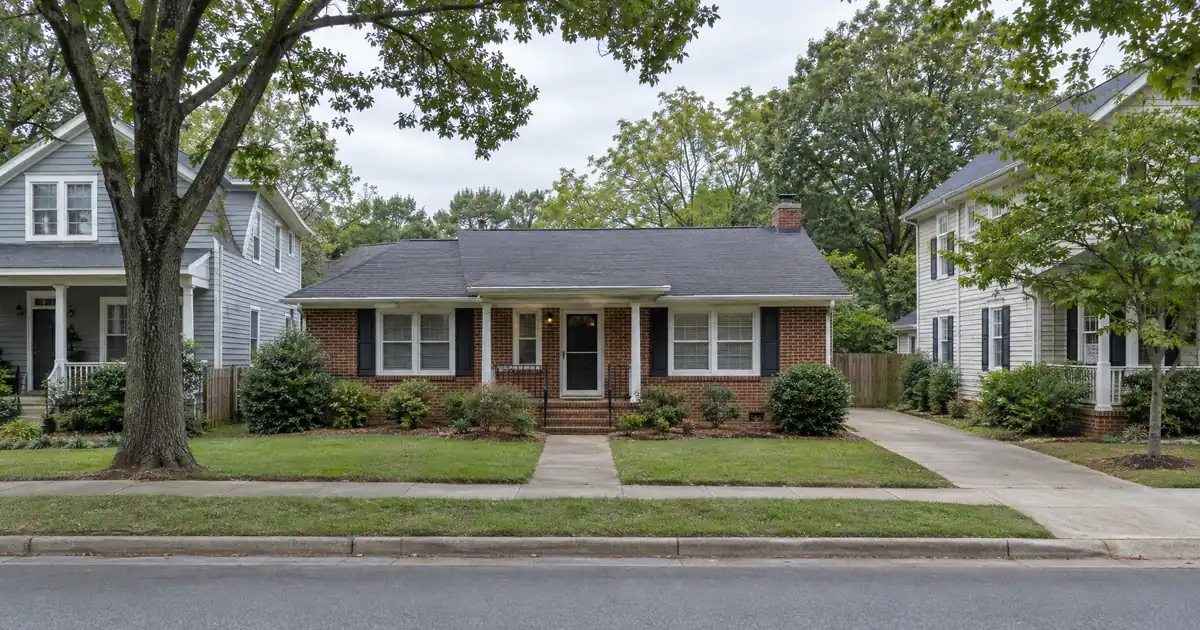
Zillow puts the typical Wake Forest home value at $513,720, down 1.2 percent year over year, while Zumper’s median rent across all unit types is $2,095. Put those side by side and the cash-out story here changes. A DSCR cash out refinance in Wake Forest, North Carolina is less about how much equity has piled up and more about whether the rent can carry a bigger loan. Lendmire, a DSCR-focused mortgage broker, sees this pattern often in suburbs where prices have flattened after a long run.
DSCR Cash-Out Calculator
Run the cash-out numbers in Wake Forest, NC
Rate source: Freddie Mac 30-yr average via FRED® — Federal Reserve Bank of St. Louis · effective Sep 24, 2026
Prefilled with starting assumptions — enter your property’s value, balance, taxes, and insurance for a more accurate picture.
Program parameters update from Lendmire’s centralized guideline source. Taxes and insurance are editable estimates.
As of Sep 24, 2026 · General Freddie Mac market benchmark, not a Lendmire loan offer. Property value, balance, taxes, and insurance are editable estimates. Maximum loan-to-value varies by lender, program, property type, and seasoning. Not a Loan Estimate, approval, or commitment to lend. Program availability and eligibility are subject to lender guidelines, credit approval, property review, and underwriting.
Key Takeaways:
A DSCR cash-out refinance in Wake Forest, North Carolina is underwritten primarily on the property’s rental income measured against its full monthly obligation, and with flat prices and median rents near $2,095, the coverage ratio, not the loan-to-value cap, usually sets the ceiling on proceeds.
- Townhome and entry-level tiers pencil better than the town-wide median home.
- Flat values mean the refinance rests on your purchase basis, not new appreciation.
- Small multifamily is scarce, so most deals are townhomes or single-family.
- Cash-out is typically capped at 75 percent LTV after about six months of ownership.
Wake Forest Market Snapshot
A quick read on the Wake Forest investor landscape — figures come from the cited sources below. Confirm current property-level numbers before underwriting.
| Metric | Detail |
|---|---|
| University enrollment | 3,220 students (2024) (Data USA, SEBTS) |
| Population | “over 50,000” residents (Wake County Economic) |
| Employment | 279,000 workers within 10 miles (Wake Forest Business & Industry) |
The Townhome Tier Along Rogers Road and Gateway Commons
The best-fitting DSCR cash-out candidates in Wake Forest sit in the lower price tier, mostly townhomes and entry-level product around the Traditions, Gateway Commons and Rogers Road corridor. Coverage improves as the price drops, and this is where the price-to-rent relationship is least stretched.
Resideline’s recent housing market data shows a wide spread in Wake Forest sale prices. The median sits well above the entry level, and the middle half of sales covers a broad range from lower-priced townhomes to much higher-priced homes. That spread is the whole thesis. The lower end of the range is townhome and starter-home territory. The upper end is golf-course and pond-lot product where rent can’t keep up with price.
The corridor draws commuting workers heading to Raleigh and the Research Triangle, with newer apartments and everyday shopping along the way. The Wake Forest Business & Industry Partnership counts more than 279,000 workers available within a 10-mile radius. Wake Forest is a bedroom suburb, so that regional job base drives tenant demand more than any single local employer does.
Capital Boulevard and Stadium Drive along US-1 are the other workforce-priced option. That corridor is the most commuter-oriented part of town. Listing-site descriptions support the character but not submarket-level rent or price figures, so treat that as directional.
Run the Refinance in Order
A cash-out refinance moves through five gates in sequence, and the loan only works if the file clears each one. Understanding the order tells you where a given Wake Forest property will stall.
1. Seasoning. Most programs look for about six months of ownership, measured from title recording.
2. Value. An appraisal sets the number, and the appraiser works from recent closed sales, not from what you hope the place is worth.
3. Leverage cap. Cash-out tops out at 75 percent LTV (the purchase cap is higher, and the two shouldn’t be confused).
4. Coverage. Rent used for lender review divided by full PITIA (principal, interest, taxes, insurance and any HOA dues) has to clear roughly 1.00, the common baseline. Some lenders review lower ratios with stronger credit, lower leverage or more cash in reserve, but those files carry different pricing and terms.
5. Reserves. About six months of PITIA is typical, and it rises above $1,500,000 in loan size.
Now run the numbers on a townhome bought near a $356,221 lower-quartile price, using a modeled rent of $1,990, which is Zumper’s median 3-bedroom figure. Coverage below includes taxes and insurance and is rounded down.
| Cash-out LTV | Modeled coverage | Read |
|---|---|---|
| 75 percent | Low 0.9s | Just under the baseline |
| 65 percent | About 1.05 | Clears with thin cushion |
| 60 percent | About 1.10 | Comfortable |
Look at what that says. The 75 percent cap isn’t the constraint here. Coverage is. A borrower who asks for the maximum may find the file lands below 1.00 and has to step down in leverage. Sub-1.00 options may exist, such as a sub-1.00 program, an interest-only structure or a lower loan amount. Each is reviewed subject to lender guidelines, credit approval and property review. It’s worth asking whether the extra proceeds justify the added cost and the thin margin, or whether a 65 percent structure that clears cleanly is the better trade.
The same math on the town median looks worse. At Redfin’s $490,000 three-month median and a $2,135 house rent (Zumper’s figure for houses), coverage falls to roughly 0.7 at 75 percent LTV and stays under 1.00 even at 60 percent. Those are modeled assumptions, not market yields. Still, a median-priced single-family rental in this town is a hard fit for DSCR cash-out, and that’s the honest read.
Flat Prices Change What “Equity” Means
Wake Forest values have stopped climbing, so the proceeds on a refinance come mostly from your purchase basis and any improvements you made, not from market appreciation. Sources disagree on direction, which is the point. Redfin shows the median up about 1 percent, while Zillow’s index is down 1.2 percent. Movoto reports that homes are sitting longer than a year earlier.
With signals that mixed, underwrite the refinance at today’s value and assume zero price growth. If an appraisal comes in higher, treat that as upside. An investor who bought below the lower-quartile line, or who added real value through renovation, has room to pull capital. An investor who bought at peak-market pricing may find the 75 percent cap leaves little or nothing to extract. That’s the flip point: the strategy suits owners with basis advantage, and it disappoints owners counting on the market to hand them equity.
Rents don’t offer a rescue either. RentCafe’s average of $1,625 is up just 0.05 percent year over year, and Zumper reports rents flat. A cash-out pitch built on rent growth would be building on air.
Heritage: Appreciation on Top, Cash Flow Only at the Bottom
Heritage is a master-planned community with greenways, a golf club and the Shoppes at Heritage Village. It’s the clearest example of a submarket where the top and bottom behave like different markets. Local agent commentary describes homes ranging from low-to-mid townhomes to golf-and-pond lots priced far higher, and monthly medians there swing hard on small sales counts. Treat those figures as qualitative. They’re too thin to use as appraisal comps.
The practical read: Heritage townhomes can support a DSCR cash-out if bought at the right basis. The larger detached homes are appreciation plays, and their coverage will be tight. A Duke Health primary-care clinic sits inside Heritage, which supports steady commuter and resident demand, but demand doesn’t fix a rent-to-price gap.
Holding Village, another master-planned community with lakeside views near Holding Park Aquatic Center, and Wakefield Plantation fall into similar territory. The rent data I have for neighborhoods like these comes from thin samples that swing wildly month to month, so the article doesn’t lean on them. Underwrite each property separately.
Duplexes and Fourplexes? Good Luck.
Small multifamily is rare in Wake Forest. RentCafe reports that 71 percent of rentals sit in complexes under 50 units, 20 percent are single-family rentals and 9 percent are large complexes, and only 26 percent of households rent at all. In a town where roughly three of four households own, 2-to-4 unit properties are scarce, opportunistic buys.
That matters for cash-out because multi-unit properties usually clear coverage more easily than single-family homes. Here that lever is mostly unavailable, so most files will be townhomes or single-family rentals, and the coverage math above is the realistic frame. An investor who finds a duplex near downtown may have an advantage on ratio, but shouldn’t build a portfolio strategy around finding a second one.
What the Deal Desk Sees in Markets Like This
In suburban commuter markets with flat prices, the cleaner files tend to be the ones where the borrower arrives already knowing the coverage number at two or three leverage levels. The common friction point is a borrower who assumes the maximum LTV will work, then discovers taxes, insurance and any HOA dues push the ratio under 1.00. Files that go smoothly usually come with a current lease, recent comps for the specific community and reserves already sitting in an account.
Three Anchors That Keep Tenants Coming
Demand in Wake Forest rests on regional commuting, a seminary and a planned rail station, not on one big local employer. Wake County Economic Development lists Southeastern Baptist Theological Seminary at 280 employees, The Body Shop at 225 and Hillside Nursing and Rehabilitation Center at 167. Those are modest counts. The seminary sits on the historic original Wake Forest College campus, and the college itself moved to Winston-Salem long ago.
Data USA reports 3,220 students at the seminary, while the accreditor lists 2,389. Many are online or part-time, so only some live nearby. Count it as a modest downtown demand source, not a dorm-driven rental engine.
The bigger story is regional. The Partnership’s demographics page ranks Wake Forest 8th fastest-growing of 550 North Carolina municipalities and puts it 22 miles from Raleigh-Durham International Airport. A commuter rail station is planned at downtown’s South White Street on the S-Line. Timelines can slip, so it’s an upside, not a base-case assumption. The town also has no acute-care hospital, and a proposed one was rejected, so healthcare demand comes from the Raleigh-area systems nearby.
DSCR vs. conventional financing
Two common ways to finance an investment property in Wake Forest, NC. They qualify you differently — here’s how investors weigh them.
Why investors choose it
- Qualifies on the property’s rental income — no personal tax returns, W-2s, or pay stubs needed to document income.
- No personal debt-to-income ceiling to clear, so existing mortgages and obligations don’t cap your borrowing the same way.
- Can be closed in an LLC, keeping the property inside a business entity.
- Built for scaling — not held to the limit on number of financed properties that conventional financing applies.
- Underwriting centers on the deal: generally qualifies when the rent covers the payment, a 1.00x coverage ratio being a common baseline (confirmed in underwriting).
- Designed specifically for investment property, including long-term and, where the program allows, short-term rentals.
Where it’s strong
- Often the lowest ongoing financing cost for a buyer who fully qualifies on personal income — a fit for a first property or a cost-first purchase.
Trade-offs for investors
- Requires full personal income documentation and must fit within a debt-to-income limit — salary, existing debts, and other mortgages all count.
- Typically held in your personal name rather than a business entity.
- Caps how many financed properties you can carry, which can become a ceiling as a portfolio grows.
- Evaluates you as a borrower as much as the property, which usually means more paperwork.
How investors usually choose: a first or single property often optimizes for the lowest financing cost; portfolio builders often optimize for leverage, vesting in an LLC, and scaling past conventional caps. The right answer depends on your goals, the property, and current guidelines — both paths run through select lenders in Lendmire’s wholesale network, with eligibility and terms confirmed in underwriting.
Watch the New Supply
Vacancy data isn’t published in any source I found, so there’s no market figure to quote. New apartments are still coming, though. Downtown development plans include a 110-apartment mixed-use project at the former SunTrust site, and RentCafe puts the average rental building age at 9 years, with 86 percent of buildings built since 2000. Project status should be verified. New apartments and build-to-rent product compete directly with investor-owned townhomes, so underwrite with a conservative vacancy and concession assumption rather than assuming full occupancy.
Where This Beats Conventional (and Where It Doesn’t)
For an LLC-held portfolio, subject to lender program eligibility, DSCR may be a practical path once conventional financing limits are reached. For a W-2 borrower with one or two rentals and a clean tax return, conventional vs DSCR on investor loans can favor the conventional lane on cost. The break-even usually arrives when the borrower has several financed properties, self-employment income that’s hard to document or rentals held in an entity.
Wake Forest tilts the calculation a bit. Because coverage is thin at median prices, a DSCR cash-out that requires a sub-1.00 exception is a weaker fit than a conventional refinance for a borrower who is reviewed on personal income. For self-employed investors and entity owners, DSCR remains the workable structure. Lendmire’s DSCR guide and the cash-out refinance walkthrough cover the mechanics, and Lendmire’s overview of refinancing options compares the rate-and-term route. For state-specific programs, see Lendmire’s North Carolina DSCR loan programs. To test a specific property, see how the math pencils or call 828-256-2183.
Program details, including credit tiers starting at a 620 floor, reserves and LTV caps, vary by borrower, property and lender and are subject to lender guidelines. Verify current local rental rules, taxes and insurance with qualified local professionals.
Frequently Asked Questions
How do you qualify for a DSCR cash-out refinance in Wake Forest?
The property has to show rent used for lender review that covers its full monthly obligation, typically at or near a 1.00 ratio, and it generally needs about six months of ownership from title recording. Most programs cap cash-out at 75 percent LTV, look at credit tiers starting around 620 and expect about six months of reserves. Because Wake Forest’s median home is expensive relative to rent, the coverage test is usually what limits proceeds.
What are the requirements for an investment property loan in Wake Forest, North Carolina?
Expect a lender to review the property’s rent, the borrower’s credit, reserves and the property type. Manufactured homes, log homes and barndominiums fall outside these DSCR programs. Loan amounts, leverage and eligibility depend on the specific lender, and none of it is a commitment to lend.
Will flat home prices in Wake Forest limit how much cash I can pull out?
Often, yes. Redfin shows the median up about 1 percent while Zillow shows it down 1.2 percent, so appraisers are unlikely to add appreciation between purchase and refinance. Proceeds depend mostly on your purchase basis and any renovation value. Underwrite at today’s value with no growth.
Is a townhome or a single-family house the better cash-out candidate here?
Townhomes at or near the lower-quartile price usually cover better. At the town median, single-family rents don’t clear the baseline without lower leverage, so the flip point is price: below roughly the mid-$300s the ratio works, and above the median it strains. Check each property’s own numbers.
For current guidelines and terms, see Lendmire’s page on investment-property DSCR cash-out refinance programs.
About Lendmire
Lendmire (NMLS# 2371349) is a mortgage brokerage focused on DSCR investor financing, helping arrange programs through wholesale and investor-lending channels in 41 markets, including Washington, D.C. DSCR loans are evaluated by the lender on property cash flow rather than personal income, subject to lender guidelines, supporting LLC closings and accommodating investors with four or more financed properties. Lendmire was named a Scotsman Guide Top Mortgage Workplace in both 2025 and 2026.
Get Started
Ready to find the right loan for you?
In about 30 seconds you can review financing options available for your investment property. No commitment required.
Informational only. Not a Loan Estimate, approval, or commitment to lend. Program availability and eligibility are subject to lender guidelines, credit approval, property review, and underwriting.
References
1. Zillow Home Values, Wake Forest
2. Zumper Rent Research, Wake Forest
3. Data USA reports 3,220 students at the seminary
5. Wake Forest Business & Industry Partnership, 2026 Snapshot
6. Resideline, Wake Forest Housing Market
7. Redfin’s $490,000 three-month median
8. RentCafe, Wake Forest Average Rent
10. Wake County Economic Development, Municipality Highlight
11. ats.edu — Member Schools Southeastern Baptist Theological Seminary
12. The Partnership’s demographics page
13. Downtown development plans
14. 2025
15. 2026
This article is part of Lendmire’s investment property cash-out refinance program — full qualification details, guidelines, and scenarios live on the program page.
Related reading: Cash Out Refinance Investment Property in Wake Forest NC · DSCR Cash Out Refinance in Indian Trail, North Carolina: Townhome Equity on the US-74 Corridor · DSCR Cash Out Refinance in Goldsboro, North Carolina: The 2026 DSCR Guide to Berkeley Blvd
Guides: Investment Property Cash-Out Refinance in Wake Forest, NC · Investment Property Cash-Out Refinance in North Carolina
Brandon Miller
Founder & CEO, Mortgage Loan Originator, Lendmire LLC
- Mortgage Loan Originator · NMLS# 1129696 · Verify on NMLS Consumer Access
- North Carolina Real Estate Broker · License# 343312 · Verify on NCREC
- North Carolina Insurance Producer · License# 19053198 · Property, Casualty, Life, Health · Verify on NAIC SBS
- Lendmire LLC · Firm NMLS# 2371349 · Verify firm licensure
Disclosures. The information presented in this article is general market commentary, not financial, legal, or tax advice. Lendmire is a mortgage brokerage (NMLS# 2371349) — not a direct lender or depository institution — and loan placement is subject to lender underwriting. Nothing in this content represents a commitment to lend. Loan terms, pricing, and program availability vary based on borrower qualifications, property characteristics, and state of subject property, and are subject to change at any time. Lendmire complies with Equal Housing Opportunity requirements. Consumer access: nmlsconsumeraccess.org.