
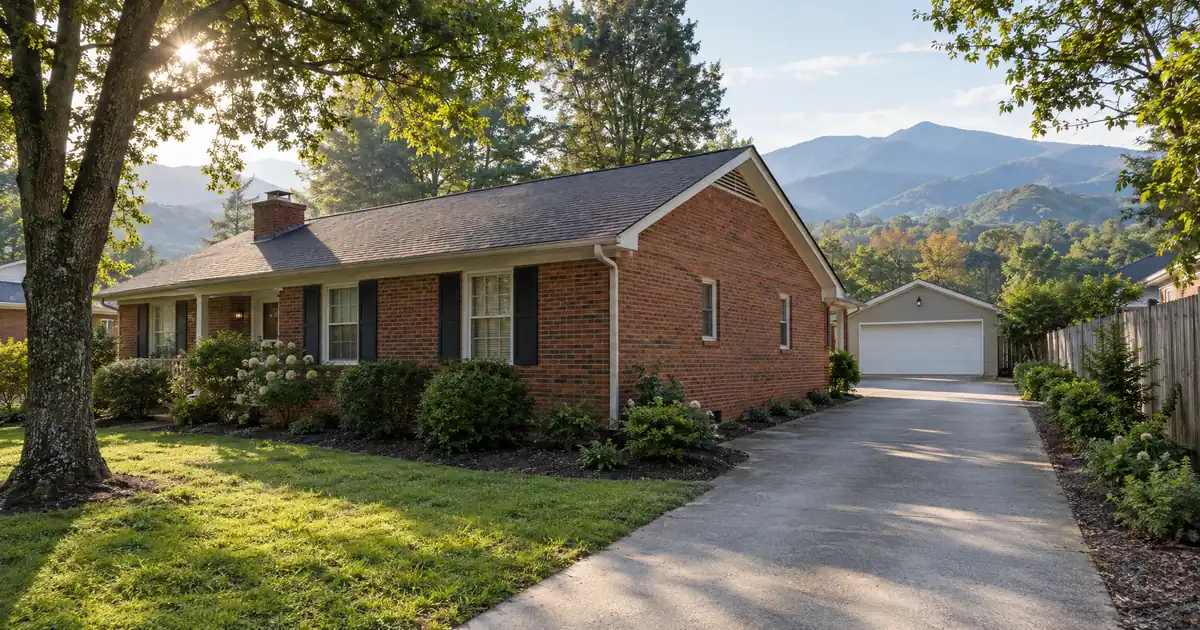
If you own a rental in Martin that you bought somewhere between the mid-$90,000s and $150,000, here’s what most brokers skip: your cash-out outcome will be decided by the appraisal and the lease file, not by how the market “feels.” The coverage math is usually the easy part. Thin comps, mixed rent evidence, and property-type eligibility are where files slow down. This piece is about the plumbing.
TL;DR: A cash-out refinance on a Martin, Tennessee rental is underwritten primarily on the property’s rental income measured against its full monthly obligation, which fits low-basis workforce houses far better than newer, higher-priced ones. Investors holding a house bought near $95,930 tend to clear coverage with room to spare.
DSCR Cash-Out Calculator
Run the cash-out numbers in Martin, TN
Rate source: Freddie Mac 30-yr average via FRED® — Federal Reserve Bank of St. Louis · effective Sep 24, 2026
Prefilled with starting assumptions — enter your property’s value, balance, taxes, and insurance for a more accurate picture.
Program parameters update from Lendmire’s centralized guideline source. Taxes and insurance are editable estimates.
As of Sep 24, 2026 · General Freddie Mac market benchmark, not a Lendmire loan offer. Property value, balance, taxes, and insurance are editable estimates. Maximum loan-to-value varies by lender, program, property type, and seasoning. Not a Loan Estimate, approval, or commitment to lend. Program availability and eligibility are subject to lender guidelines, credit approval, property review, and underwriting.
- Cash-out LTV tops out at 75 percent, with about six months of seasoning from title recording.
- Rent-to-price runs near 1.25 percent on sub-$100,000 houses and about 0.8 percent at $150,000. – Homes.com shows 127 sales in 12 months, so appraisal comps are thin.
- UT Martin’s 8,253 total enrollment includes online and dual-enrollment students.
Martin Market Snapshot
A quick read on the Martin investor landscape — figures come from the cited sources below. Confirm current property-level numbers before underwriting.
| Metric | Detail |
|---|---|
| Home prices | $279,900 median list (Homes.com Martin) |
| Typical rents | Rent $927 (City-Data) |
| University enrollment | 8,253 students (UT Martin News) |
| Employment | 305 hospital employees (Weakley County EDB) |
| Vacancy | Rental 8.8% (2020) (Wikipedia) |
The Appraisal Is the Whole Game
In Martin, the appraisal is the single biggest variable in a cash-out refinance, because the comp pool is shallow and the price signals conflict. Homes.com shows roughly 127 sales over 12 months, with homes averaging 72 days on market against 56 nationally. A cash-out appraisal can swing on one or two sales.
The price direction depends on whom you ask. Redfin puts the median sale price at $248,865, up 15.8 percent year over year, and warns itself, in effect, that small samples bounce around. Zillow’s index shows two figures: $190,295 at the city level and $221,049 for ZIP 38238. Homes.com, meanwhile, shows one price-change measure pointing down about 4 percent and another pointing up about 5 percent. Same town, same period, four stories.
So don’t underwrite a refinance on assumed appreciation. Market drift is a weak reason to expect a higher value, and a slow-moving market makes a distressed comp more likely to land in the appraiser’s grid. Value created by buying below market and renovating is more defensible than value expected from the tide. That’s the first flip point: an investor whose basis already sits well under market can lean on the refinance. An investor counting on the market to bail out a full-price purchase should wait or rethink.
Program mechanics frame everything else. Cash-out on these programs tops out at 75 percent LTV, a hard ceiling that doesn’t borrow from the 80 percent purchase figure. Seasoning runs about six months, measured from title recording. Qualification starts at a 1.00 coverage baseline: rent used for lender review against full PITIA (principal, interest, taxes, insurance, and any HOA dues). Pricing and available terms vary by lender, borrower profile, property type, and full underwriting review. Reserves run about six months of PITIA. All of this is subject to lender guidelines, and none of it is a commitment to lend. How the qualification works is covered in more depth on the site.
Coverage at Three Price Points
The coverage cushion in Martin collapses as price rises, and that’s the most useful thing to know before ordering an appraisal. Rent evidence is consistent across Zillow’s house rentals, where three-bedroom, one-bath houses ask around $1,200. Sale listings are more spread out: a roughly 1,086-square-foot three-bedroom near downtown listed at $95,930, and a comparable three-bedroom listed at $150,000. Those are different properties, so the ratios below illustrate the pattern and are not same-address comps.
The gross rent-to-price ratio is about 1.25 percent at the lower price and about 0.8 percent at $150,000. Zillow’s blended market figures give a ratio near 0.58 percent: a $1,275 average rent against the $221,049 ZIP value.
Run the numbers this way. These are modeled assumptions, not sourced rents or quotes. Each one assumes a 75 percent LTV cash-out, a typical investor-pricing assumption, and full PITIA including taxes and insurance, with the band rounded down:
| Appraised value | Modeled rent | Modeled coverage |
|---|---|---|
| Under $100,000 house | $1,200 | roughly 2.0x |
| $150,000 house | $1,200 | roughly 1.3x |
| $221,000 ZIP average | $1,275 | just under 1.0x |
The $150,000 and ZIP-average rows tell you where the cash-out thesis narrows. A $150,000 house still clears comfortably. At the blended ZIP value, with the same loan percentage and rent near the market average, the number slips under the 1.00 baseline. Investors who bought a newer or larger house at a full-market price may find the coverage doesn’t support a standard cash-out.
If the number lands below 1.00, a lender might review a sub-1.00 program, an interest-only structure, or a lower LTV, and a documented rent increase might close the gap. None of those is automatic. Eligibility depends on credit, reserves, and the property review. And if the only way to hit the number is a stretch structure, that’s a signal to re-examine the purchase price, not the loan type.
One more catch at the bottom of the range: smaller balances route through select lenders in the network, not the standard programs, and cash-out proceeds on a house valued under $100,000 will be modest in absolute terms. Whether a modest pull justifies the closing costs is a separate question worth asking before ordering anything.
DSCR files in markets like this one typically look the same from the file side: strong coverage on paper, a thin appraisal grid, and a lease that needs to match the rent used for qualification. The friction is rarely the ratio. It’s usually a lease that has expired, a vacant unit with no signed lease, a rent figure the appraiser’s market-rent schedule doesn’t support, or a property whose description raises a question about eligibility. Investors who assemble the lease, a recent rent schedule, and an insurance quote up front tend to see fewer conditions at review.
Where Equity Sits: Three Pockets Worth Knowing
Martin has no published neighborhood-level price or rent datasets, so the submarkets below are qualitative, and each has its own refinance character.
The campus corridor. Hannings Lane and Peach Street hold student-oriented properties within about 0.1 to 0.6 miles of campus, per RoomChoice, which lists per-bedroom pricing of $400 to $800 per month. That’s per-bed pricing, not whole-unit rent. University Town at Martin is a renovated enclave that its owner describes as very close to full occupancy, with three- and four-bedroom units. Whether per-bed leasing fits a DSCR file depends on the lender’s lease and market-rent treatment. A single lease for the whole unit is simpler to document than four separate bedroom leases, and academic-year turnover is real. This is the strongest tenant pool in town and the messiest file.
Downtown, around Lindell and Main. Older stock sits near local shops, coffee, and restaurants. Sage Flats markets two-bedrooms to students and staff, and Zillow shows a two-bedroom, one-bath at $950 (about 750 square feet) and a two-bedroom, two-bath at $900. That sets a ceiling: an older two-bedroom house has to compete with purpose-built product at that rent. For an owner with a downtown rental, those listings are also useful evidence for a market-rent schedule.
Established workforce streets. Brick two- and three-bedroom houses, many minutes from campus and downtown, are the core DSCR-fit product. Tenant demand here comes from employment rather than enrollment: MTD, the university itself, hospital staff, and school workers. This is where the sub-$100,000 entry points and the strongest coverage show up. It’s also where rural-edge properties appear, and a note on those follows below.
Duplexes and Triplexes: Scarce, Old, and Condition-Sensitive
Small multifamily exists in Martin, but inventory is thin, and what’s listed tends to be old. Homes.com’s multifamily listings near downtown include a triplex of one-bedroom units with a detached garage and window air units, a duplex with both sides rented and a newer roof, and a duplex where one side was described as unlivable. No sale prices were captured, so there’s no per-unit coverage math to publish.
The structural logic still holds. One-bedroom rents sit well below house rents (Zillow’s average one-bedroom is $794), but three of them can beat one $1,200 house. A vacant or unlivable side won’t carry rent used for lender review in most DSCR reviews, since lenders generally want units rentable and leased. Window units and thin mechanicals can also draw condition requests. Honestly, an owner with a stabilized, fully leased duplex has the cleanest cash-out profile in town. An owner planning to refinance before stabilizing the second unit should expect to wait. Confirm unit count and legal status with a local professional before assuming either.
A broker-listed LoopNet portfolio describes stabilized multifamily near campus with below-market rents. That’s a broker’s claim and needs a rent roll to confirm. If true, it points to rent upside, and upside shows up in coverage only after leases reflect it.
Demand Anchors, Read Honestly
UT Martin is the demand story, but the headline number needs a caveat. The university reported 8,253 students in its final fall count, up 1.9 percent from 8,101 and the sixth consecutive annual increase, the highest in over a decade. That total includes regional centers, online students, and dual enrollment (the university reported 2,111 dual-enrollment students in the prior fall). Data USA’s IPEDS-based view shows about 4,503 full-time students. Demand for housing near campus follows main-campus students, not the headline.
Employment is the steadier support for long-term leases. The City of Martin’s employer list shows MTD (Cub Cadet and Troy-Bilt) at about 1,250 employees and the university at 1,100, with West Tennessee Healthcare at 222. That page is dated, so treat the counts as approximate. Data USA shows manufacturing, educational services, and health care as the largest resident employment sectors across the broader Martin micro area. The city’s population was 10,825 in the 2020 count, and Point2Homes reports 57.6 percent of occupied units are renter-occupied. That’s a rental-heavy town for its size.
Two risk notes. Martin’s population declined between the last two decennial counts, so demand rests on the university and manufacturers rather than population growth. And vacancy data is thin: the only county-level figure, Weakley County’s 8.8 percent rental vacancy, is dated, and the city-level figure Point2Homes shows (10.2 percent) covers all housing units, owner and renter alike.
The Plumbing: What Reviewers Actually Check
Operationally, a Martin cash-out file comes down to a short list.
- Seasoning clock. Roughly six months from title recording. A purchase that closed recently is not yet in the window, however much work went into it.
- Lease and rent evidence. A current lease, or a market-rent schedule if the unit is vacant, and an explanation for any gap between the two. Published rent ranges for the area are wide, and an appraiser will pick a point inside them.
- Property type. Rural-edge houses are part of Weakley County’s character, and some may be manufactured homes, log homes, or barndominiums. Those fall outside these DSCR programs. If the structure is unconventional, sort that out before paying for an appraisal. Housing stock also skews older, so condition items are a reasonable expectation.
- Reserves and credit. Expect about six months of PITIA in reserves, while credit tiers vary by scenario. Higher tiers generally widen the options.
- Entity vesting. LLC-held properties are common for investors, subject to lender program eligibility, and the vesting should match the title and insurance documents.
For the comparison with traditional financing, the guide “Where DSCR and Conventional Diverge” lays out the tradeoffs. In short: a W-2 borrower with one or two rentals may find conventional financing cheaper, while an entity-owned or multi-property investor often finds property income the cleaner basis. The mechanics for rate-and-term and cash-out refi details are on a separate page, and the refi options page covers the structure. Investors weighing state-level choices can start with DSCR loan options for Tennessee investors. Verify current local rental rules, taxes, and insurance with qualified local professionals before underwriting.
What the Proceeds Should Do
Proceeds do their best work when redeployed into the same kind of Martin product that produced the equity. Pulling capital out of a sub-$100,000 house and buying another sub-$150,000 workforce house keeps coverage in the strong band. Redeploying into a pricier property that sits near the blended average puts the next file near 1.0 or below. (Math that works on the first property doesn’t automatically transfer to the second.)
Thinking it through: the stronger play might be a small balance from a more affordable house funding a down payment on a second, similar house, which compounds coverage cushion. The counterargument is that small cash-out amounts may not justify the costs, and an investor with a single low-basis house might do better to hold it and save. The decision turns on how much equity the appraisal actually supports, and Martin’s thin comps make that a real unknown until the report comes back.
Anyone considering a refinance should also consider the reverse risk: a lower-than-expected appraisal can cap proceeds well below the plan. Building the plan around the conservative case, rather than the Redfin or Zillow headline, is the defensible approach. Talk to a broker about it before ordering by calling 828-256-2183.
Frequently Asked Questions
How do you qualify for a DSCR cash-out refinance in Martin, Tennessee?
Qualification centers on the property’s rent compared with its full PITIA, with 1.00 as the standard baseline. Exact eligibility depends on the lender, credit profile, and property review.
What are the requirements for an investment property loan in Martin, Tennessee?
Expect a lease or market-rent evidence, an appraisal, proof of reserves, insurance documentation, and clean entity paperwork if an LLC holds title, depending on program guidelines. Smaller loan balances route through select lenders in the network, and the standard programs reach up to $3,000,000.
DSCR vs. conventional financing
There are two common ways to finance an investment property in Martin, TN, and they qualify you differently — here’s how investors weigh them.
Why investors choose it
- Qualifies on the property’s rental income — no personal tax returns, W-2s, or pay stubs needed to document income.
- No personal debt-to-income ceiling to clear, so existing mortgages and obligations don’t cap your borrowing the same way.
- Can be closed in an LLC, keeping the property inside a business entity.
- Built for scaling — not held to the limit on number of financed properties that conventional financing applies.
- Underwriting centers on the deal: generally qualifies when the rent covers the payment, a 1.00x coverage ratio being a common baseline (confirmed in underwriting).
- Designed specifically for investment property, including long-term and, where the program allows, short-term rentals.
Where it’s strong
- Often the lowest ongoing financing cost for a buyer who fully qualifies on personal income — a fit for a first property or a cost-first purchase.
Trade-offs for investors
- Requires full personal income documentation and must fit within a debt-to-income limit — salary, existing debts, and other mortgages all count.
- Typically held in your personal name rather than a business entity.
- Caps how many financed properties you can carry, which can become a ceiling as a portfolio grows.
- Evaluates you as a borrower as much as the property, which usually means more paperwork.
How investors usually choose: a first or single property often optimizes for the lowest financing cost; portfolio builders often optimize for leverage, vesting in an LLC, and scaling past conventional caps. The right answer depends on your goals, the property, and current guidelines — both paths run through select lenders in Lendmire’s wholesale network, with eligibility and terms confirmed in underwriting.
Can a campus-corridor student rental qualify for cash-out?
Possibly, but per-bedroom leasing is harder to document than a single lease for the whole unit. Rent-by-the-bed pricing in the area runs roughly $400 to $800 per month, and a lender will decide how to treat that rent. Ask before relying on per-bed totals.
Is Martin’s appreciation enough to count on for a cash-out?
No. Sources disagree on direction, and with about 127 sales a year, one or two comps can move the value. Buy-below-market and renovation value hold up better in an appraisal than assumed market drift.
Martin Versus Jackson
Jackson sits about 49 miles south and offers deeper comp pools and a bigger buyer base, which makes appraisals easier to defend. Martin offers lower basis and more coverage cushion, especially on sub-$150,000 houses. For a cash-out where coverage is the constraint, the math favors Martin right now, provided the appraisal supports the value.
For current guidelines and terms, see Lendmire’s DSCR loan programs page.
About Lendmire
Lendmire, NMLS# 2371349, is a mortgage brokerage specializing in DSCR investor loans, helping arrange financing across 41 markets, including Washington, D.C., through wholesale and investor-lending channels. The model centers on property-level rental income reviewed by the lender rather than W-2 documentation, subject to lender guidelines, which suits entity-owned and multi-property investors. Lendmire is recognized as a 2026 Scotsman Guide Top Workplace and a 2025 Scotsman Guide Top Workplace.
Get Started
Ready to find the right loan for you?
In about 30 seconds you can review financing options available for your investment property. No commitment required.
Informational only. Not a Loan Estimate, approval, or commitment to lend. Program availability and eligibility are subject to lender guidelines, credit approval, property review, and underwriting.
References
1. $95,930
2. Homes.com
3. UT Martin News: enrollment growth
4. City-Data
6. Weakley County’s 8.8 percent rental vacancy
8. Zillow — Home Values Martin TN
9. Zillow: ZIP 38238 home values
11. Zillow: Martin rental market trends
12. RoomChoice
14. Sage Flats
15. Homes.com’s multifamily listings
17. UT Martin News: dual enrollment
18. Data USA’s IPEDS-based view
19. City of Martin: leading employers
21. Wikipedia — Martin, Tennessee
22. Point2Homes: Martin demographics
23. a 2026 Scotsman Guide Top Workplace
24. a 2025 Scotsman Guide Top Workplace
This article is part of Lendmire’s investment property cash-out refinance program — full qualification details, guidelines, and scenarios live on the program page.
Related reading: DSCR Cash Out Refinance in Martin, Tennessee: How Campus-Town Rent Math Clears at 75% LTV · DSCR Cash Out Refinance in Jackson, Tennessee: How the Rent Math Clears at 75% LTV · DSCR Cash Out Refinance in Newport, Tennessee: The 2026 DSCR Financing Guide to Broadway Street
Guides: Investment Property Cash-Out Refinance in Tennessee
Brandon Miller
Founder & CEO, Mortgage Loan Originator, Lendmire LLC
- Mortgage Loan Originator · NMLS# 1129696 · Verify on NMLS Consumer Access
- North Carolina Real Estate Broker · License# 343312 · Verify on NCREC
- North Carolina Insurance Producer · License# 19053198 · Property, Casualty, Life, Health · Verify on NAIC SBS
- Lendmire LLC · Firm NMLS# 2371349 · Verify firm licensure
Disclosure information. Lendmire is a state-licensed mortgage brokerage under NMLS# 2371349. Lendmire is not a depository institution, direct lender, or financial advisor — all loans referenced are placed through wholesale lender partners and are subject to each lender's underwriting standards. This article is provided for general informational purposes and is not a commitment to lend, nor does it constitute financial, legal, or tax advice. Loan programs, terms, rates, and qualification standards change without notice and depend on borrower profile, property type, and the state in which the subject property is located. Equal Housing Opportunity provider. NMLS Consumer Access: nmlsconsumeraccess.org.