
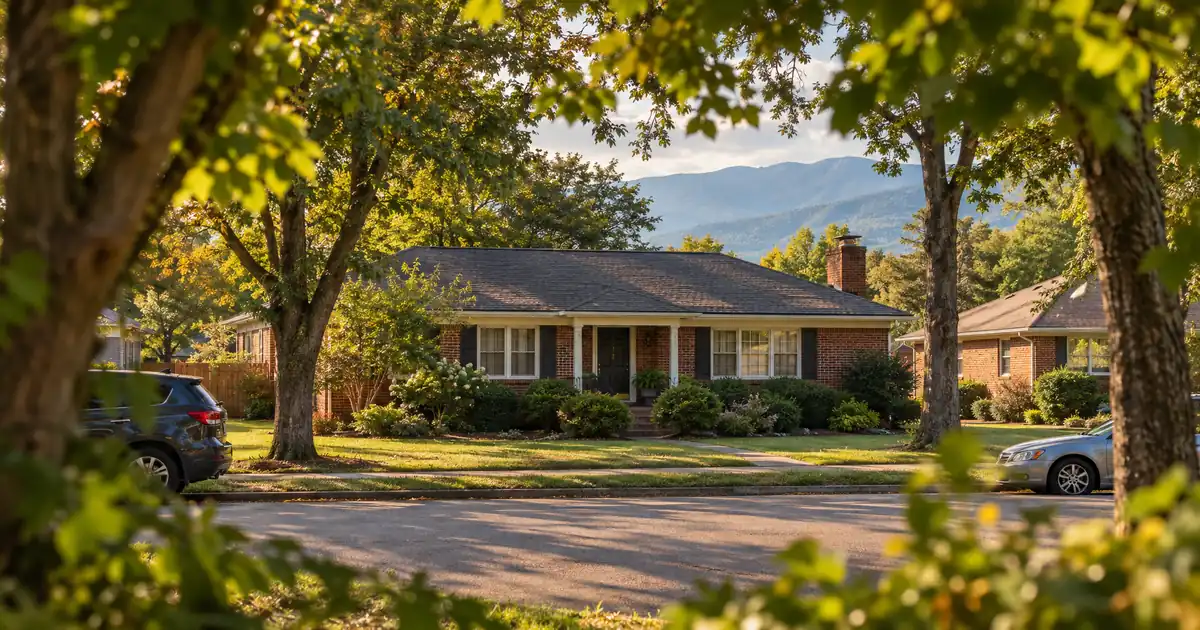
If you own a rental in Martin and plan to pull equity out because prices “keep going up,” here’s what most brokers skip: the coverage ratio usually isn’t what stops the file. The appraisal is. A DSCR cash out refinance in Martin, Tennessee lives or dies on how many credible comps the appraiser can find in a town where only 127 homes sold over the last twelve months, and on whether the rent actually covers the full monthly obligation once taxes and insurance are in.
TL;DR: A DSCR cash-out refinance in Martin, Tennessee suits the investor who already owns a low-basis workforce house or a small campus-area rental and wants capital for the next deal. It is underwritten primarily on the property’s rental income measured against its full monthly obligation, with leverage capped at 75 percent of value.
DSCR Cash-Out Calculator
Run the cash-out numbers in Martin, TN
Rate source: Freddie Mac 30-yr average via FRED® — Federal Reserve Bank of St. Louis · effective Sep 24, 2026
Prefilled with starting assumptions — enter your property’s value, balance, taxes, and insurance for a more accurate picture.
Program parameters update from Lendmire’s centralized guideline source. Taxes and insurance are editable estimates.
As of Sep 24, 2026 · General Freddie Mac market benchmark, not a Lendmire loan offer. Property value, balance, taxes, and insurance are editable estimates. Maximum loan-to-value varies by lender, program, property type, and seasoning. Not a Loan Estimate, approval, or commitment to lend. Program availability and eligibility are subject to lender guidelines, credit approval, property review, and underwriting.
- Cheap older three-bedroom houses clear coverage comfortably; blended market averages sit near or below 1.00x.
- Seasoning runs about six months from title recording.
- UT Martin’s 8,253-student enrollment includes online and dual-enrollment students, so not every head needs a bed.
- Thin comps, not the ratio, are the main appraisal risk.
Martin Market Snapshot
A quick read on the Martin investor landscape — figures come from the cited sources below. Confirm current property-level numbers before underwriting.
| Metric | Detail |
|---|---|
| Home prices | $279,900 median list (Homes.com Martin) |
| University enrollment | 8,253 students (UT Martin News) |
| Employment | 305 hospital employees (Weakley County EDB) |
| Vacancy | Rental 8.8% (2020) (Wikipedia) |
The Appraisal Is the Real Gatekeeper
Appraisal risk is the biggest variable in a Martin cash-out. Price signals conflict, the sales pool is small, and a loan sized at 75 percent of value moves with every comp the appraiser picks.
Start with the conflict. Zillow’s city-level value index sits at $190,295, up 7.4 percent over the past year. Its ZIP-level figure for 38238 reads $221,049, up 6.2 percent, which reflects a different geography. Redfin reports a median sale price of $248,865, up 15.8 percent, but that is a different metric (median sale, not a value index), and small samples swing hard. Homes.com shows a $250,000 median sale and an average of 72 days on market versus 56 nationally, while also showing prices down 4 percent over twelve months. Four readings, four stories.
So how should an investor underwrite? Don’t build the refinance on an assumed appreciation bump. Value created by buying below market and improving the house holds up better under a skeptical appraiser than value from market drift. Thin comps plus slower days on market also raise the odds that a distressed sale becomes your comparable. Not ideal, but manageable if you plan for it.
The flip point: if you bought several years ago at a clearly low basis and have documented improvements, the appraisal risk shrinks. If you bought near today’s asking levels and expect the refinance to “unlock” appreciation, treat the proceeds as uncertain until the appraisal is back.
Where Coverage Holds (and Where It Doesn’t)
Coverage in Martin depends more on price point than on neighborhood. More affordable older three-bedroom houses produce strong ratios, and the number falls quickly as the price climbs. This is arithmetic, not a market call.
Zillow shows a three-bedroom, one-bath house listed for $95,930, while comparable three-bedroom houses are asking about $1,200 a month. That is a gross rent-to-price ratio near 1.25 percent. A similar house listed at $150,000 drops to about 0.8 percent. Zillow’s blended average rent of $1,275 against the $221,049 ZIP value index works out near 0.58 percent. These are asking figures on different properties, so read them as illustration, not a same-address comp.
Here is how modeled cash-out coverage shakes out. All inputs are assumptions, not sourced market data. Each case assumes leverage at the 75 percent ceiling, a 30-year fully amortizing structure, and full debt service including taxes and insurance.
| Modeled scenario | Value assumed | Rent assumed | Coverage incl. Taxes and insurance |
|---|---|---|---|
| Older 3-bed, sub-$100K basis | About $96K | $1,200 | Above 1.8x |
| Mid-priced 3-bed | $150K | $1,200 | About 1.3x |
| Blended, city-level value | About $190K | $1,275 | About 1.1x |
| Blended, ZIP-level value | About $221K | $1,275 | Just under 1.00x |
The bottom row is the lesson. Same rent, slightly different value geography, and the file slides under the 1.00x benchmark that most standard DSCR programs are built around. If you land there, some options may exist: a sub-1.00 program, an interest-only structure, or a lower loan amount. Those come with tradeoffs such as reduced leverage, stronger credit requirements, or different pricing, and eligibility depends on lender guidelines, credit approval, and property review. Whether to use them is a separate question. If the ratio only works by stretching structure, that usually points to the wrong property, not the wrong loan.
The top row has its own catch. A very low value means a small loan, and smaller balances route through select lenders in the network rather than the standard programs. Coverage looks wonderful, but the cash you can pull is modest. It’s a genuine toss-up between a high-ratio, low-proceeds refinance and a moderate-ratio file with more capital to redeploy.
DSCR files in markets like this one typically look a lot alike. The rent is fine and the credit is fine, but the file stalls on small things: a lease that expired and went month-to-month, an insurance declarations page that doesn’t match the vesting, or an appraisal rent schedule that comes in under the asking rents the investor assumed. Brokers who work these files tend to ask for the current lease, the declarations page, and a realistic market-rent estimate before anything is submitted, because each of those moves the coverage number more than the loan terms do.
Submarkets, Briefly
The rental demand in Martin follows the university and the factories, and each corridor behaves differently for a cash-out refinance.
Campus-adjacent corridors (Hannings Lane, Peach Street, University Town). These carry the strongest tenant pool. RoomChoice lists student housing within 0.1 to 0.6 miles of campus at roughly $400 to $800 per month, mostly priced per bedroom. The owner of University Town at Martin says it renovated a formerly derelict neighborhood and reports being close to full occupancy (an owner claim, not an independent figure). Here’s the catch for refinancing: per-bed leases and academic-year turnover complicate how a lender reads rent. A whole-unit lease on a three- or four-bedroom is a cleaner file than four separate bed leases, and investors should expect the rent schedule to need more explanation.
Downtown (Lindell and Main Street). This pocket draws young professionals, university staff, and students near local shops and restaurants. Sage Flats markets two-bedroom apartments to that mix, and Zillow shows $950 for a 750-square-foot two-bedroom. That sets a practical ceiling: an older two-bedroom house has to price against a purpose-built apartment.
Established residential streets. Brick two- and three-bedroom houses, many a short drive from campus and downtown, draw manufacturing workers, hospital employees, and university staff. This is where the sub-$100K-to-$150K coverage math above applies. Some listings sit at the rural edge of town. A quick eligibility note: manufactured homes, log homes, and barndominiums fall outside these DSCR programs, so a rural-edge property needs a clear property-type check before anyone orders an appraisal.
Subsidized supply. The Martin Housing Authority manages 503 public-housing apartments across Dyer, Obion, and Weakley counties and the City of Martin. It is not an investor target, but it is competing supply at the bottom of the rent range.
Why Small Multifamily Is the Quiet Play
Duplexes and triplexes in Martin are scarce and old, but the math is better than the single-family numbers suggest. Stack three one-bedroom units priced in the sub-$800 range (Zillow’s average one-bedroom is $794) and the combined rent can beat one $1,200 house, often with the land basis spread across three doors.
The inventory is thin and sometimes rough. Listings on Homes.com show a triplex near downtown with window air units, a duplex with a newer roof and both sides rented, and a duplex where one side is unlivable. Those differ enormously for a cash-out. A fully leased duplex reads as income. A vacant, unlivable side is a lease-up project first, and a DSCR lender will typically want every unit rentable and leased before it counts the rent. Window units and ventless heat also flag mechanical condition items that may draw extra review.
A broker’s listing for a stabilized portfolio with below-market rents deserves the same skepticism. Below-market rent means upside, but only a rent roll confirms it. Unit count and legal status are worth confirming with a local professional before underwriting.
The Demand Case, With Honest Limits
Martin’s rental demand is real but concentrated, and the anchors behind it are two very different institutions. The University of Tennessee at Martin reported 8,253 students in its latest fall count, up 1.9 percent from 8,101, the highest total in years and the sixth straight increase. The university has also set a long-range target of 10,000 students.
Read that headline carefully. It includes regional centers, online learners, and dual-enrollment students (dual enrollment alone was sizable the prior fall). Data USA’s IPEDS-based profile shows a much smaller full-time student count than the headline total. Off-campus housing demand follows main-campus students, not the headline total.
The second anchor is manufacturing. The City of Martin’s employer list shows MTD at about 1,250 employees and UT Martin at 1,100 (the page is older, so treat counts as approximate). West Tennessee Healthcare runs Volunteer Community Hospital locally, and the county’s economic development board and the city’s own page give employee counts that conflict, so “roughly 200 to 300” is the honest range. Across the broader Martin micro area, Data USA counts 2,504 residents working in manufacturing, 2,197 in educational services, and 1,956 in health care.
Now the other side. Martin’s population fell from 11,473 to 10,825 between the last two censuses, a 5.6 percent decline. Point2Homes puts the renter-occupied share at 57.6 percent and shows 10.2 percent of all housing units vacant (owner and rental combined). Weakley County’s rental vacancy was 8.8 percent at the last census count, which is county-level and dated. No clean current city rental-vacancy figure exists. One large private employer and one university make for a narrower base than a diversified metro, so stress-test a file with a vacancy month or two built in.
What the File Actually Needs
Plumbing first, strategy second. For a Martin cash-out refinance, the documents and dates matter as much as the rent.
- Seasoning. Programs here typically require about six months of ownership, measured from title recording. Buyers who closed recently should count from recording, not from contract.
- Leverage. The ceiling on a cash-out is 75 percent of value. That is lower than the purchase cap, so don’t carry an 80 percent assumption over from your acquisition.
- Credit. Tiers typically run at 620, 660, 680, and 700, with 620 as the floor. Higher tiers generally support better leverage and pricing, subject to lender guidelines.
- Reserves. Expect about six months of full debt service in reserves (about nine months above $1,500,000). Proceeds from the refinance itself generally don’t count the way seasoned liquid funds do.
- Coverage. The baseline is 1.00x, meaning rent covers the full monthly obligation. Some lenders review lower ratios with compensating factors, but those cases typically need lower leverage, stronger credit, or other trade-offs.
- Entity and condition items. If the property sits in an LLC, the file needs entity documents, subject to lender program eligibility. Appraisers flag deferred maintenance, non-functioning systems, and unpermitted conversions, and any of those can pend a file.
Loan size matters too. Standard programs go up to $3,000,000, and in a town where typical values are well under $300,000, many Martin loans are small enough to route through select lenders. Program details change, and everything above is guidance, not a commitment to lend. Qualification is subject to lender overlays, credit approval, and property review. A look at “What Is a DSCR Loan” covers the mechanics in general terms.
What to Do With the Proceeds
The best use of cash-out proceeds in Martin is another property where the coverage number still clears at the buy price, and that usually means the sub-$150K workforce tier or small multifamily, not the newest house on the market.
Picture an investor who owns a paid-down brick three-bedroom near downtown. Pulling capital out to buy a second older house at a similar price point is straightforward: same submarket, same rent logic, same appraisal risk but diversified across two assets. Pulling the same capital to chase a higher-priced house that only reaches 1.00x by stretching structure is a different decision, and worth stress-testing before committing.
Also know when DSCR isn’t the right lane. For a W-2 borrower with one or two rentals and clean traditional personal-income documentation, a conventional cash-out may carry a lower cost and fit fine, though the right choice depends on your portfolio size and how your returns show rental income, as covered in the guide “Where DSCR and Conventional Diverge”. If you own several financed properties, hold them in an LLC, or find that your traditional personal-income documentation doesn’t reflect the property’s income cleanly, the DSCR path often becomes the practical one. The break-even tends to show up around the third or fourth financed rental.
For the general mechanics of rate-and-term and cash-out refinances, see the refi options. Investors who want to model their own property can see what the numbers look like. Before underwriting anything in Martin, verify current local rental rules, taxes, and insurance with qualified local professionals.
Frequently Asked Questions
How do you qualify for a DSCR cash-out refinance in Martin, Tennessee?
Qualification centers on the property, not your paycheck. The lender compares the rent used for lender review (a lease or an appraiser’s market-rent estimate) against the full monthly obligation, including taxes and insurance, and looks for a ratio of at least 1.00x on most standard programs. Pricing and available terms vary by lender, borrower profile, property type, and full underwriting review. Final eligibility is subject to lender guidelines and property review.
What are the requirements for an investment property refinance in Martin, Tennessee?
Typical guidance is a 75 percent LTV ceiling on cash-out, roughly six months of title seasoning, a 620 minimum credit score, and about six months of reserves. The property must be an eligible type, so manufactured homes, log homes, and barndominiums fall outside these programs. Smaller balances, common in Martin, may route through select lenders in the network.
DSCR vs. conventional financing
There are two common ways to finance an investment property in Martin, TN, and they qualify you differently — here’s how investors weigh them.
Why investors choose it
- Qualifies on the property’s rental income — no personal tax returns, W-2s, or pay stubs needed to document income.
- No personal debt-to-income ceiling to clear, so existing mortgages and obligations don’t cap your borrowing the same way.
- Can be closed in an LLC, keeping the property inside a business entity.
- Built for scaling — not held to the limit on number of financed properties that conventional financing applies.
- Underwriting centers on the deal: generally qualifies when the rent covers the payment, a 1.00x coverage ratio being a common baseline (confirmed in underwriting).
- Designed specifically for investment property, including long-term and, where the program allows, short-term rentals.
Where it’s strong
- Often the lowest ongoing financing cost for a buyer who fully qualifies on personal income — a fit for a first property or a cost-first purchase.
Trade-offs for investors
- Requires full personal income documentation and must fit within a debt-to-income limit — salary, existing debts, and other mortgages all count.
- Typically held in your personal name rather than a business entity.
- Caps how many financed properties you can carry, which can become a ceiling as a portfolio grows.
- Evaluates you as a borrower as much as the property, which usually means more paperwork.
How investors usually choose: a first or single property often optimizes for the lowest financing cost; portfolio builders often optimize for leverage, vesting in an LLC, and scaling past conventional caps. The right answer depends on your goals, the property, and current guidelines — both paths run through select lenders in Lendmire’s wholesale network, with eligibility and terms confirmed in underwriting.
Does UT Martin’s enrollment growth raise my appraised value?
Not directly. Enrollment supports rental demand near campus, but an appraiser values your house from comparable sales and, for a DSCR file, market rent. With a thin sales pool and conflicting price indicators, demand growth is better treated as support for your rent assumption than as a reason to expect a higher valuation. The headline total also includes online and dual-enrollment students who don’t need local beds.
Can a duplex with one vacant side work for a DSCR cash-out in Martin?
It’s difficult. Lenders generally want every unit rentable and leased, because vacant or uninhabitable space contributes no rent used for lender review. If one side needs work, finishing the repairs and signing a lease before applying typically produces a cleaner file. Confirm unit count and legal status with a local professional first.
Martin Versus the Bigger West Tennessee Markets
Martin’s entry prices sit far below Tennessee’s statewide median of $393,767, which is exactly why a sub-$150K house can clear coverage when a typical Tennessee house often can’t. Jackson, about 49 miles away, offers a deeper pool of comps and easier appraisals, but its higher basis means tighter ratios. Investors who want to talk through a specific Martin property can reach Lendmire at 828-256-2183. For a seasoned, low-basis, leased house near campus or downtown, the math favors Martin right now. For anything bought near asking on appreciation hopes, the larger market’s better comps are the safer refinance.
For current guidelines and terms, see Lendmire’s DSCR loan programs page.
About Lendmire
Lendmire — NMLS# 2371349 — is a mortgage brokerage specializing in DSCR investor loans, arranging financing across 41 markets, including Washington, D.C., through wholesale and investor-lending channels. The model centers on property-level rental income reviewed by the lender rather than W-2 documentation, subject to lender guidelines, which suits entity-owned and multi-property investors. Lendmire holds Scotsman Guide Top Mortgage Workplace recognition, including a 2026 Scotsman Guide Top Workplace and a 2025 Scotsman Guide Top Workplace designation.
For broader investor-financing rules and property-type coverage across the state, see Tennessee DSCR loans.
Get Started
Ready to find the right loan for you?
In about 30 seconds you can review financing options available for your investment property. No commitment required.
Informational only. Not a Loan Estimate, approval, or commitment to lend. Program availability and eligibility are subject to lender guidelines, credit approval, property review, and underwriting.
References
2. UT Martin News: enrollment growth
3. Weakley County Economic Development Board: healthcare
4. Wikipedia
6. Zillow — Home Values Martin TN
7. Redfin: Martin housing market
8. $95,930
9. Zillow — Martin TN Rent Houses
10. $1,275
11. roomchoice.com — Cities Martin
13. Sage Flats
14. Zillow — Martin TN Rentals
16. Homes.com
17. news.utm.edu — Enrollment News Highlights Advisory Board Meeting
18. news.utm.edu — UT Martin Announces Second Highest Enrollment Ever
19. Data USA’s IPEDS-based profile
20. City of Martin: leading employers
22. U.S. Census Bureau (census.gov) — QuickFacts
23. Point2Homes — Martin Demographics
24. Tennessee’s statewide median of $393,767
25. a 2026 Scotsman Guide Top Workplace
26. a 2025 Scotsman Guide Top Workplace
This article is part of Lendmire’s investment property cash-out refinance program — full qualification details, guidelines, and scenarios live on the program page.
Related reading: Cash Out Refinance Investment Property in Martin, Tennessee: How 75% LTV Rent Math Clears Here · DSCR Cash Out Refinance in Knoxville, Tennessee: Lab-and-Campus Demand Behind the Equity Pull · Cash Out Refinance Investment Property in Greeneville, Tennessee: The 2026 DSCR Guide to Main Street
Guides: Investment Property Cash-Out Refinance in Tennessee
Brandon Miller
Founder & CEO, Mortgage Loan Originator, Lendmire LLC
- Mortgage Loan Originator · NMLS# 1129696 · Verify on NMLS Consumer Access
- North Carolina Real Estate Broker · License# 343312 · Verify on NCREC
- North Carolina Insurance Producer · License# 19053198 · Property, Casualty, Life, Health · Verify on NAIC SBS
- Lendmire LLC · Firm NMLS# 2371349 · Verify firm licensure
Disclosures. The information presented in this article is general market commentary, not financial, legal, or tax advice. Lendmire is a mortgage brokerage (NMLS# 2371349) — not a direct lender or depository institution — and loan placement is subject to lender underwriting. Nothing in this content represents a commitment to lend. Loan terms, pricing, and program availability vary based on borrower qualifications, property characteristics, and state of subject property, and are subject to change at any time. Lendmire complies with Equal Housing Opportunity requirements. Consumer access: nmlsconsumeraccess.org.