
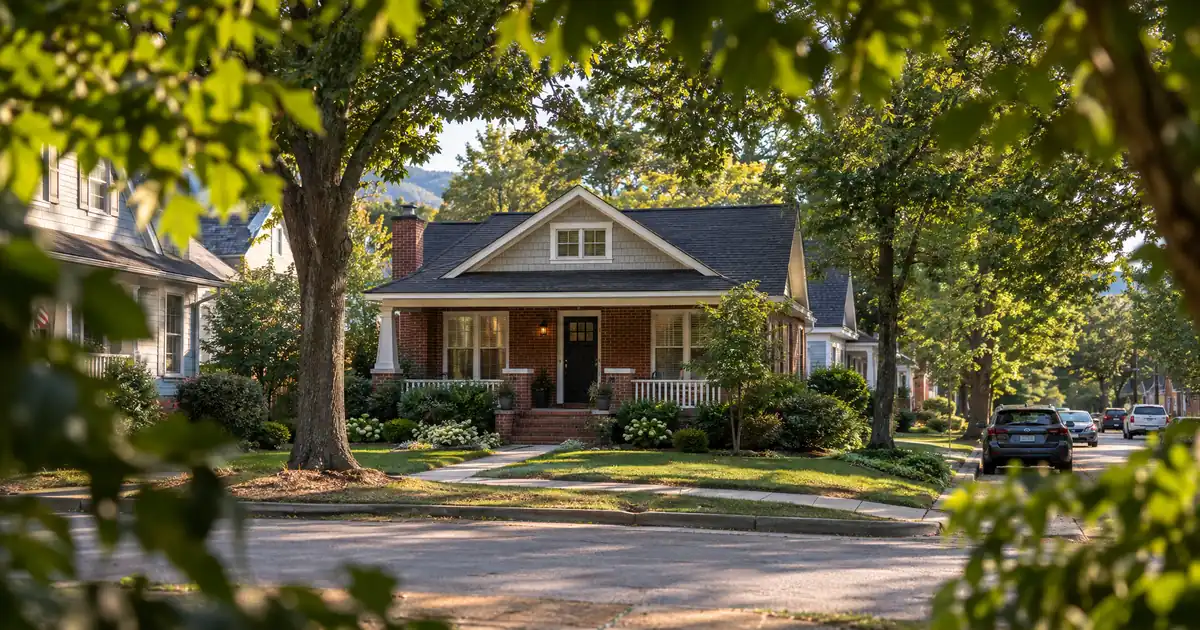
The median sale price in Indian Trail sits near $435K per Redfin, while Homes.com puts the median house rent at $2,250 a month. That is roughly half a percent of value in monthly rent (a writer-derived ratio built from two sources with different dates and methods, so illustrative only). On a cash-out refinance at the 75% LTV ceiling, that ratio decides how much equity an owner can actually pull, and in this market it often decides it against the owner.
DSCR Cash-Out Calculator
Run the cash-out numbers in Indian Trail, NC
Rate source: Freddie Mac 30-yr average via FRED® — Federal Reserve Bank of St. Louis · effective Sep 24, 2026
Prefilled with starting assumptions — enter your property’s value, balance, taxes, and insurance for a more accurate picture.
Program parameters update from Lendmire’s centralized guideline source. Taxes and insurance are editable estimates.
As of Sep 24, 2026 · General Freddie Mac market benchmark, not a Lendmire loan offer. Property value, balance, taxes, and insurance are editable estimates. Maximum loan-to-value varies by lender, program, property type, and seasoning. Not a Loan Estimate, approval, or commitment to lend. Program availability and eligibility are subject to lender guidelines, credit approval, property review, and underwriting.
Key Takeaways:
A cash-out refinance on an Indian Trail rental is underwritten primarily on the property’s rental income measured against its full monthly obligation, so the loan amount is capped by coverage as much as by the 75% LTV ceiling. Equity alone doesn’t set the proceeds. Every figure here varies by lender and program — guidelines, property type, leverage, and credit profile all apply.
- Modeled single-family coverage at the median price lands below 1.00 at maximum leverage, including taxes and insurance.
- Townhomes near a $356K median listing price (Redfin) sit closest to the 1.00 benchmark.
- Recent price trends are flat to soft, so size the cash-out on today’s value.
- Small multifamily is a rounding error here, so most files are single-rent.
Indian Trail Market Snapshot
A quick read on the Indian Trail investor landscape — figures come from the cited sources below. Confirm current property-level numbers before underwriting.
| Metric | Detail |
|---|---|
| Home prices | $356K median listing price (Redfin, Indian Trail townhouses) |
| University enrollment | 39,880 students (Union County Public Schools) |
| Employment | About 5,000 staff (Union County Public Schools) |
The Coverage Math on a Cash-Out
Single-family at the median price doesn’t clear 1.00 at the 75% ceiling. Run the numbers on a $435K house renting for $2,250 (modeled assumptions, not a sourced comp). With principal, interest, taxes, and insurance all counted, coverage lands below 0.90 at 75% LTV. Pull leverage back toward 60% and the number moves to roughly 1.00. Same house, same rent. Only the loan size changed. Final terms depend on lender guidelines, property type, leverage, and the borrower’s complete credit picture.
Now a townhome. Assume a $356K purchase-era value (the Redfin median listing price) and a modeled rent of $2,100, since no townhome rent figure was captured in the research. At 75% LTV, coverage runs just under 1.00 including taxes and insurance. Closer, and the gap is narrow enough that a modest rent bump or lower leverage tips it over. These specifics are subject to lender guidelines and a full review of property, leverage, and credit.
Most standard programs are built around a 1.00x benchmark because the rent covers the full payment at that level. Some lenders review sub-1.00 files, but those typically need lower leverage, stronger credit, more reserves, or different pricing. Eligibility depends on lender guidelines, credit profile, reserves, and property review. For sub-1.00 files, the structures a lender may review include a sub-1.00 program, an interest-only structure, or a smaller cash-out. Whether any of them applies is the lender’s call. The guide “What Is a DSCR Loan” is worth a read before sizing a request.
Equity Is Real, but Appreciation Is Stalling
Owners who bought years ago are sitting on substantial embedded equity. NeighborhoodScout reports roughly 134% appreciation over ten years. The recent picture is different. Redfin shows the median price down 0.62% year over year, price per square foot at $194 (down 3.7%), and days on market up to 52 from 46. Zillow’s home value index sits at $416,183, down 2.2% over the past year, and it measures a different basket than Redfin does.
Sources disagree on the level. A local broker report shows a slightly positive year over year figure, and another portal shows a higher median. The honest read is a stabilizing market, not a surging one. The practical consequence: underwrite the cash-out on today’s appraised value, not on a bet that the next appraisal comes in higher.
This is a genuine tension. The ten-year gain argues for pulling equity now. The flat recent trend argues for pulling less than the maximum. An investor holding a paid-down property with a big cushion has room either way, but one who bought near the recent peak has far less than the headline appreciation suggests.
Seasoning and Appraisal Support
The seasoning clock on the network’s cash-out programs runs about 6 months of ownership, measured from title recording. Sales depth helps the appraisal side. Redfin counted 258 homes sold in June against 169 a year earlier, with an average of 3 offers per home, so comparable-sale support exists. The softer price per square foot means an appraiser may not credit the top of the range.
Credit tiers run 620, 660, 680, and 700, with a 620 floor, and reserves are typically about 6 months of PITIA. Higher tiers generally improve pricing and leverage options. Loan sizes go up to $3,000,000 on standard programs. All of this is subject to lender guidelines and borrower profile, and an LLC-titled rental can qualify subject to lender program eligibility. The refinance pathway for investor properties lays out the sequence, and the refi options cover structure differences.
Which Property Types Pencil (and Which Don’t)
Townhomes and newer three-bedroom single-family rentals are the workable core. NeighborhoodScout puts single-family detached at 89.37% of housing units, large apartment complexes at 4.71%, and attached homes at 2.08%. There’s no meaningful small-multifamily share.
That matters for the cash-out thesis. Duplex and fourplex income stacking, the usual way to lift coverage on a refinance, isn’t a realistic strategy here. Apartment rents give a reference floor for unit-level income: Apartment List shows $1,508+ for a 1BR and $1,852+ for a 2BR. But the research found no inventory data on duplexes or fourplexes, so treat multi-unit as theoretical. Most files will carry one rent stream against one payment.
Manufactured homes, log homes, and barndominiums fall outside these DSCR programs entirely. Much of Indian Trail’s newer stock is builder-grade single-family and townhomes, which sit in the eligible category.
Submarkets: Where the Rent Comps Look Cleanest
Neighborhood-level price and rent data wasn’t available in the research, so the profiles below describe character and tenant base only, not dollar figures.
Silver Star Boulevard townhomes. Newly built three-story townhomes are leasing here, and listings on Homes.com advertise a free month of rent and an included washer and dryer. That is a concession signal. Anyone refinancing a townhome in this pocket should expect the appraiser’s rent schedule to be scrutinized against effective rent, not asking rent.
Lake Park and the I-485 side. Townhomes sit near I-485 and between the 74 Bypass and Independence Boulevard. Commuter access is the whole story. Tenants here are trading drive time for space.
US-74 and Independence Boulevard corridor. This is the main artery toward Charlotte, and the CATS 74X Union County Express Bus runs along it, per the Homes.com city guide. Development along the corridor keeps adding supply, which supports demand but also competes with existing owners for tenants.
Sun Valley area and Colton Ridge. Sun Valley is a retail and dining hub, and Colton Ridge is a single-family community with a pool, trails, and a playground. These are family-sized rental products, which fits the three- and four-bedroom demand profile.
Institutional landlords are present as well. Listings show FirstKey Homes and AMH-managed properties, so a small investor competes with professionally managed rentals for the same tenants. That tends to hold rent comps in a tight band and leaves little room to push above the market.
Why Tenant Demand Holds Up
Indian Trail is a commuter town. Homes.com’s city guide cites Census data showing only about 10% of employees live and work within town, and the figure is dated. The demand story is about Charlotte access and the Monroe Bypass, not local job creation.
The resident workforce is still diversified. Data USA reports about 23,400 employed residents, led by Health Care and Social Assistance (2,663), Retail Trade (2,564), and Finance and Insurance (2,430). These are residents’ jobs, not jobs located in town.
Local anchors add stability. Union County Public Schools serves 39,880 students across 52 schools with roughly 5,000 staff. Atrium Health Union West in neighboring Stallings has 40 licensed beds and a 24/7 emergency department, and it serves Indian Trail among other communities. Union County itself grew from 238,267 to an estimated 267,674 residents per Wikipedia’s county profile, which keeps the tenant pool expanding.
What Files Like These Usually Look Like
The common friction point on cash-out files in newer-build suburbs is the rent schedule, not the equity. Lender-side reviews tend to lean on the lower of the lease rent and the appraiser’s market rent, so a lease signed with a concession or a below-market first-year rent can drag coverage down. The cleaner files from a documentation standpoint usually have a seasoned lease at or near market and a clear title-recording date to satisfy seasoning. Lendmire’s deal desk sees the same pattern in commuter markets with heavy new construction: pull the concession detail before quoting a loan amount, because it moves the answer.
The Vacancy Cushion
The last decennial Census, as cited on Wikipedia, showed a 6.3% rental vacancy rate against 0.9% for owner-occupied homes across 13,712 housing units. It’s dated, and no current vacancy figure turned up in the research. Still, the gap is meaningful. Apartments.com shows 22 newly built apartment listings and an average rent of $1,462, and the townhome concessions above point the same direction.
Underwrite with a vacancy and concession cushion, not asking rents. If a file only works at full asking rent with zero downtime, it doesn’t really work.
When the Answer Flips
Consider two owners. One holds a paid-down townhome bought years ago, with rent near market and a long lease in place. A cash-out here can be sized close to the ceiling, and the coverage number gets closer to 1.00 because the property is modest in value. The other holds a recently purchased single-family home near the median price. That owner is likely looking at a smaller draw or a sub-1.00 review, because coverage at maximum leverage falls short.
DSCR vs. conventional financing
Two common ways to finance an investment property in Indian Trail, NC. They qualify you differently — here’s how investors weigh them.
Why investors choose it
- Qualifies on the property’s rental income — no personal tax returns, W-2s, or pay stubs needed to document income.
- No personal debt-to-income ceiling to clear, so existing mortgages and obligations don’t cap your borrowing the same way.
- Can be closed in an LLC, keeping the property inside a business entity.
- Built for scaling — not held to the limit on number of financed properties that conventional financing applies.
- Underwriting centers on the deal: generally qualifies when the rent covers the payment, a 1.00x coverage ratio being a common baseline (confirmed in underwriting).
- Designed specifically for investment property, including long-term and, where the program allows, short-term rentals.
Where it’s strong
- Often the lowest ongoing financing cost for a buyer who fully qualifies on personal income — a fit for a first property or a cost-first purchase.
Trade-offs for investors
- Requires full personal income documentation and must fit within a debt-to-income limit — salary, existing debts, and other mortgages all count.
- Typically held in your personal name rather than a business entity.
- Caps how many financed properties you can carry, which can become a ceiling as a portfolio grows.
- Evaluates you as a borrower as much as the property, which usually means more paperwork.
How investors usually choose: a first or single property often optimizes for the lowest financing cost; portfolio builders often optimize for leverage, vesting in an LLC, and scaling past conventional caps. The right answer depends on your goals, the property, and current guidelines — both paths run through select lenders in Lendmire’s wholesale network, with eligibility and terms confirmed in underwriting.
The stronger play for equity extraction may be the townhome, even though single-family carries more absolute equity. The reverse holds if an owner has a single-family house well below the median, bought early. Cash-out proceeds then become down-payment capital for the next acquisition, and that deal has to clear its own coverage test. The proceeds aren’t free money. They are the seed for a second file, and the second file faces the same thin rent-to-value math.
A conventional refinance comparison is worth running too. The guide “Where DSCR and Conventional Diverge” covers the tradeoffs. Investors with strong traditional employment income sometimes find the conventional path fits better, while those scaling through LLCs usually don’t.
The Blind Spot
The biggest risk for DSCR-financed investors here is thin rent-to-value on a flat-to-soft price base. At the median price, coverage is already marginal at max leverage. If prices slide another few points while rent comps soften under new supply and concessions, the cash-out available on a given property shrinks from both sides at once. Investors who plan a chain of refinances around continued appreciation are exposed. Plan around today’s coverage number, and treat any appreciation as a bonus.
Investors should also verify current local rental rules, taxes, and insurance with qualified local professionals. For this state’s program details, see Lendmire’s North Carolina DSCR loan programs. Reach the team at 828-256-2183 to discuss a specific property.
Frequently Asked Questions
How do you qualify for a DSCR loan in Indian Trail?
The file is reviewed on rent versus full PITIA, with 1.00 as the common benchmark. Credit tiers run from a 620 floor upward, and reserves are typically about 6 months of PITIA. Lender guidelines and property review make the final call. Townhomes and three-bedroom single-family rentals are the usual product types.
What are the requirements for an investment property loan in Indian Trail, North Carolina?
Expect a seasoned property (about 6 months from title recording on a cash-out), a cash-out LTV at or below 75%, reserves, and a rent schedule that supports coverage. Manufactured homes, log homes, and barndominiums are not eligible. Requirements vary by borrower, property, and lender.
Does the flat price trend hurt a cash-out in Indian Trail?
It limits upside, not eligibility. Redfin shows the median down 0.62% year over year, and Zillow shows a 2.2% dip, so the appraisal has to stand on current comps. Owners with long-held equity still have room, but sizing on today’s value is the safer approach.
Can a small multifamily property boost coverage in Indian Trail?
Only in theory. Single-family detached homes make up about 89% of units, and no reliable duplex or fourplex inventory turned up. Most investors will be underwriting a single rent stream.
For current guidelines and terms, see Lendmire’s DSCR loan programs page.
About Lendmire
Lendmire, NMLS# 2371349, is a mortgage brokerage focused on investor financing, arranging DSCR loans in 40 states plus Washington, D.C. — 41 markets total. Qualification is based on the property’s income rather than personal income documentation, subject to lender guidelines, making it a fit for LLC-held rentals and scaling portfolios. Lendmire is a 2026 Scotsman Guide Top Workplace and was recognized by Scotsman Guide in 2025.
Get Started
Ready to find the right loan for you?
In about 30 seconds you can review financing options available for your investment property. No commitment required.
Informational only. Not a Loan Estimate, approval, or commitment to lend. Program availability and eligibility are subject to lender guidelines, credit approval, property review, and underwriting.
References
1. Redfin, Indian Trail housing market
2. Homes.com, Indian Trail rentals
3. Redfin, Indian Trail townhouses
4. Union County Public Schools
5. NeighborhoodScout, Indian Trail
6. Apartment List, Indian Trail
7. Homes.com
10. Atrium Health, Union West opening
11. Wikipedia’s county profile
12. Wikipedia
13. Apartments.com
14. a 2026 Scotsman Guide Top Workplace
15. recognized by Scotsman Guide in 2025
This article is part of Lendmire’s investment property cash-out refinance program — full qualification details, guidelines, and scenarios live on the program page.
Related reading: DSCR Cash Out Refinance Indian Trail North Carolina · Cash Out Refinance Investment Property Hendersonville North Carolina · DSCR Loans Palm Springs: Investor Financing for Coachella Valley, Indian Wells, La Quinta, Desert Hot Springs & Real Estate Investors
Guides: Investment Property Cash-Out Refinance in North Carolina
Brandon Miller
Founder & CEO, Mortgage Loan Originator, Lendmire LLC
- Mortgage Loan Originator · NMLS# 1129696 · Verify on NMLS Consumer Access
- North Carolina Real Estate Broker · License# 343312 · Verify on NCREC
- North Carolina Insurance Producer · License# 19053198 · Property, Casualty, Life, Health · Verify on NAIC SBS
- Lendmire LLC · Firm NMLS# 2371349 · Verify firm licensure
Compliance and disclosures. Lendmire (NMLS# 2371349) is a licensed mortgage broker and is not a direct lender, depository institution, financial advisor, or tax professional. Content in this article is general market analysis and educational information — not financial, legal, or tax advice for any specific situation. Lendmire does not guarantee loan approval; every transaction is subject to underwriting by the funding lender. Mortgage pricing and loan program guidelines are subject to change at any time without notice and vary by borrower characteristics, property type, and state regulations. Lendmire complies with Equal Housing Opportunity. Licensure verification: NMLS Consumer Access.