
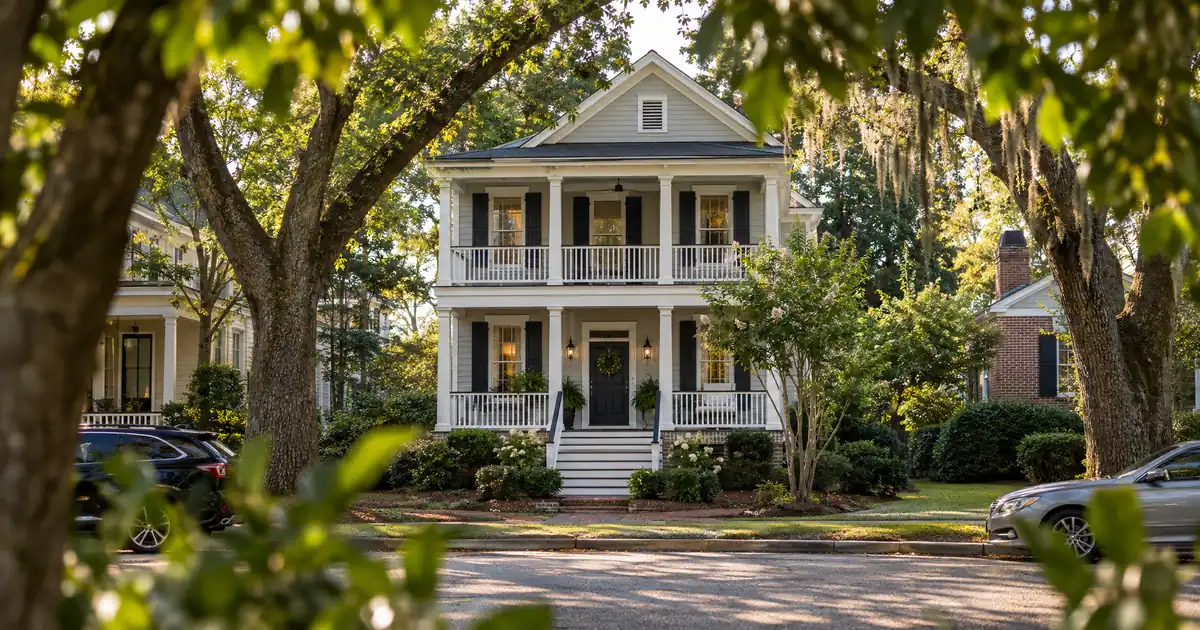
An investor owns a Simpsonville house that has appreciated, a lender’s appraisal says there’s equity to pull, and then the rent schedule comes back too thin to support the loan at the leverage the investor expected. That collision, equity on paper versus coverage on the rent roll, is the friction point in this market. A DSCR cash out refinance on a Simpsonville investment property is entirely doable, but the equity you can actually extract is set by rent coverage and the 75 percent LTV ceiling, not by how much the house has gained.
Investors in Simpsonville, South Carolina work with Lendmire (NMLS# 2371349) to place DSCR financing through wholesale lenders reaching 41 markets, including D.C. This article assumes the purchase is already behind you and focuses on what comes next: seasoning, coverage, and whether pulling capital out makes sense here at all.
DSCR Cash-Out Calculator
Run the cash-out numbers in Simpsonville, SC
Rate source: Freddie Mac 30-yr average via FRED® — Federal Reserve Bank of St. Louis · effective Sep 24, 2026
Prefilled with starting assumptions — enter your property’s value, balance, taxes, and insurance for a more accurate picture.
Program parameters update from Lendmire’s centralized guideline source. Taxes and insurance are editable estimates.
As of Sep 24, 2026 · General Freddie Mac market benchmark, not a Lendmire loan offer. Property value, balance, taxes, and insurance are editable estimates. Maximum loan-to-value varies by lender, program, property type, and seasoning. Not a Loan Estimate, approval, or commitment to lend. Program availability and eligibility are subject to lender guidelines, credit approval, property review, and underwriting.
The Short Version: A cash-out refinance on a Simpsonville rental is underwritten primarily on the property’s rental income measured against its full monthly obligation, with proceeds capped by a 75 percent LTV ceiling and roughly six months of ownership, so coverage determines the loan size more than appreciation does.
- Median asking rent sits near $1,985 per Zumper, against a typical home value near $356,392 per Zillow.
- That roughly 0.56 percent rent-to-value ratio makes full-leverage coverage tight on median-priced houses.
- Appreciation is modest, about 3.7 percent over the past year, so proceeds depend on basis.
- Lower-basis product and lower LTV refinances pencil better than Five Forks-style executive housing.
Why the Rent-to-Value Math Is the Whole Story
Simpsonville’s cash-out case rests on rent coverage rather than appreciation, and the coverage is thinner than most investors assume. Zumper’s listing-based median asking rent is $1,985 across property types, while Zillow’s typical home value is $356,392. The ratio works out to about 0.56 percent a month, a figure derived from those two sources, not a published statistic.
Bedroom count matters. Zumper shows 2-bedrooms at $1,380, 3-bedrooms at $1,895, and 4-plus-bedrooms at $2,395, from a small sample of 93 listings. Small samples swing. Treat those numbers as a reasonable center, not a precise point.
Prices depend on who you ask. Data USA reports a lower owner-reported median property value of $299,300, up 11.9 percent between its two most recent readings, reflecting a Census-derived methodology. Zillow’s index tracks what typical homes are worth today. This article uses Zillow’s figure for the modeled math because refinance appraisals reflect current market value, not owner estimates.
Run the Numbers on a Median House
Run the numbers on an investor who owns a 3-bedroom valued near the Zillow typical figure and rents it for the Zumper 3-bedroom median of $1,895. These are modeled assumptions, not sourced deal data. The debt side uses a standard 30-year structure with taxes and insurance included, since coverage computed on principal and interest alone would overstate the result.
At 75 percent LTV, the modeled coverage lands around 0.9x. Below the standard 1.00x benchmark. Even at the higher median rent of $1,985, the number improves only to the mid-0.9s. In this model, a 3-bedroom at that rent gets to 1.00x at full leverage only when value sits somewhere around $325,000 or lower.
So what does an investor do with a sub-1.00 file? Several paths exist, and each is something a lender would review, not a promise:
- A lower-LTV refinance. Dropping toward roughly 65 percent LTV moves the same house to just above 1.0x in the model. The tradeoff is less cash out.
- An interest-only structure or a sub-1.00 program. Select lenders review these, usually with stronger credit, more reserves, or reduced leverage as compensating factors.
- Cash-out on a lower-basis asset. More on that below.
Here’s the catch. If the only way a property clears is by reaching for the most aggressive structure, that’s a signal about the property, not a signal to find a cleverer loan. DSCR programs are built around a 1.00x baseline because rent covers the obligation at that level. Eligibility review depends on lender guidelines, credit, reserves, and property review.
The Seasoning Reality (Don’t Count on Appreciation)
Cash-out proceeds in Simpsonville will come mostly from the purchase discount and any renovation value-add, not from market gains during the seasoning period. Most programs look for about six months of ownership measured from title recording before a cash-out refinance is available. That clock is easy to plan around. What’s harder is assuming the value on day 181 will be meaningfully above the value on day one.
Zillow shows roughly 3.7 percent appreciation over the past year, and Redfin shows the average price up 4.6 percent, with homes averaging 87 days on market versus 39 a year earlier. Longer marketing times suggest a slower market, and slower markets mean appraisers lean on comps that may not support a big jump.
The ZIP-level picture is a bit firmer. In 29681, Redfin shows a $420,000 median, up 3.6 percent, with days on market of 57 versus 46 a year earlier and a sale-to-list ratio of 98.8 percent. That’s a market where sellers still get close to asking. But it’s also a higher-priced ZIP, which loops back to the coverage problem.
The practical takeaway: a cash-out plan that requires the appraisal to come in 10 percent above the purchase price is a plan built on hope. One that works if the appraisal lands roughly where the purchase did is sturdier.
Where the Coverage Actually Works
The lower-priced slice of Simpsonville, and the property types priced beneath the citywide median, offer the best chance of clearing 1.00x at a workable LTV. Two areas stand out, along with one that doesn’t.
Entry-Level Townhomes and Condos
Sub-$200,000 product is the lowest-basis entry point in the market. Simpsonville is also owner-heavy: RentCafe shows about 32 percent of households (3,199) are renter-occupied and 68 percent are owner-occupied, so rental supply skews toward single-family and townhome stock.
No published rent data covers these products specifically. Compare their achievable rent to the 2-bedroom benchmark of $1,380, and then check HOA dues, which come out of the coverage figure. A townhome that rents for the 2-bedroom median but carries meaningful dues may cover worse than it looks.
The Fairview Road and Harrison Bridge Road Corridor
This is retail-driven territory. A local publication, Town Square Publications, describes many national retailers and shopping destinations along Fairview Road and Harrison Bridge Road, which suits workforce renters. The question mark is supply. Greenville Journal reported that council approved the 320-unit Cottage Green mixed-use development on Harrison Bridge Road. Delivery status is unverified, but new apartments are a plausible drag on nearby single-family rents.
Rent direction is contested, which is a reason to underwrite conservatively. RentCafe shows apartment rents falling 3.28 percent year over year, from $1,505 to $1,456 (50-plus-unit buildings only). Zumper shows the median rising 4.5 percent. The two measure different things. Underwrite at flat rents and don’t stack assumed increases into the rent estimate.
Five Forks (Skip It for Cash Flow)
Five Forks is the wrong place to build a cash-out thesis on coverage. America’s Best Moving describes it as executive single-family homes, modern subdivisions, and luxury rentals. Redfin’s nearby-area listing averages put Five Forks at $626,500 versus $359,942 for Simpsonville overall. Rents don’t scale with that gap. Even Zumper’s 4-plus-bedroom median is $2,395.
Five Forks is appreciation-led. It may suit an investor with a long horizon and low leverage, but the coverage math will likely force a much lower LTV, shrinking any cash-out. Honestly, this is a genuine toss-up for the appreciation-minded investor: strong long-run demand, weak current yield. A cash-flow investor should look elsewhere.
Downtown: The Upside Case (With a Timing Question)
Downtown Simpsonville is a possible upside area, though the timing of that upside is unconfirmed. A local civics podcast, Simple Civics Greenville County, describes a $23 million downtown streetscape underway, replacing 120-year-old underground infrastructure, with connections to the Swamp Rabbit Trail planned. Heritage Park sits nearby with the CCNB Amphitheatre, described as the largest outdoor performing arts facility in South Carolina, and a baseball and softball tournament complex.
Public reinvestment can lift values. It can also take longer than expected, and construction disruption can weigh on a street before it helps it. An investor who owns near the streetscape should confirm project status with the City of Simpsonville’s Planning & Economic Development Department before building a cash-out plan around a value bump. Treat the streetscape as upside, not as underwriting.
The Demand Side: Three Employment Centers, No Single Anchor
Simpsonville rental demand rests on a commuter-belt job base tied to three separate employment centers, which is steadier than one anchor but harder to summarize. Data USA reports that the largest industries among residents are Manufacturing (2,505 people), Health Care and Social Assistance (1,778), and Retail Trade (1,699). Resident employment grew 2.62 percent, from 13.1k to 13.4k, and the average commute is 22.4 minutes. These are residents’ jobs, not jobs located in the city.
Move Upstate SC lists Cryovac/Sealed Air Corp. and KEMET Electronics Corp. among Simpsonville’s major employers, and calls the city the economic hub of eastern Greenville County. Prisma Health includes Hillcrest Hospital, located in Simpsonville, among its seven acute-care community hospitals across the Upstate. The Greenville Area Development Corporation lists Michelin North America, Lockheed Martin, and General Electric among the metro’s major employers, all within commuting range along the I-385 corridor that locals call the Golden Strip.
What does this mean for a cash-out borrower? Tenant demand looks durable. The population is roughly 26,100 per Data USA (a local civics podcast says closer to 29,000, a spoken non-Census figure), and the city covers less than nine square miles. Durable demand doesn’t fix a thin coverage ratio, though. It just lowers the odds that vacancy becomes the second problem.
What Deal Desks See in Markets Like This
In suburban markets where rent-to-value ratios run under 0.6 percent, the common friction point is a mismatch between the borrower’s expected proceeds and the coverage-constrained loan size. Lendmire’s deal desk tends to see the cleaner files come from investors who ran full-obligation coverage, including taxes, insurance, and any HOA dues, before ordering the appraisal, not after. The files that stall usually rely on a rent estimate built for a different bedroom count or a stale insurance quote. Getting a current insurance figure and a realistic rent comp in early prevents the sort of surprises that force a restructure late.
Who Should Actually Do This (and Who Shouldn’t)
For an entity-owned or multi-property investor, a DSCR cash-out refinance often works cleanly because qualification rests on the property’s income rather than traditional personal-income documentation, subject to lender program eligibility for LLC-titled borrowers. For a W-2 borrower with one or two rentals and strong personal income, a conventional cash-out or a home equity line may carry a lower cost and skip the non-QM friction. The comparison sorts out where the break-even sits. It tips toward DSCR earlier if the investor’s traditional personal-income documentation doesn’t cleanly show rental income, or if the portfolio has grown past what conventional guidelines comfortably allow.
There’s also the question of what the proceeds are for. Pulling equity to buy another Simpsonville-area rental where coverage clears at current pricing is a coherent plan. Pulling equity to fund a deal in a market where the math doesn’t pencil is a different decision, and one worth stress-testing before committing. And if the property barely covers at 65 percent LTV, the honest answer might be to hold it and not refinance yet.
DSCR vs. conventional financing
Two common ways to finance an investment property in Simpsonville, SC. They qualify you differently — here’s how investors weigh them.
Why investors choose it
- Qualifies on the property’s rental income — no personal tax returns, W-2s, or pay stubs needed to document income.
- No personal debt-to-income ceiling to clear, so existing mortgages and obligations don’t cap your borrowing the same way.
- Can be closed in an LLC, keeping the property inside a business entity.
- Built for scaling — not held to the limit on number of financed properties that conventional financing applies.
- Underwriting centers on the deal: generally qualifies when the rent covers the payment, a 1.00x coverage ratio being a common baseline (confirmed in underwriting).
- Designed specifically for investment property, including long-term and, where the program allows, short-term rentals.
Where it’s strong
- Often the lowest ongoing financing cost for a buyer who fully qualifies on personal income — a fit for a first property or a cost-first purchase.
Trade-offs for investors
- Requires full personal income documentation and must fit within a debt-to-income limit — salary, existing debts, and other mortgages all count.
- Typically held in your personal name rather than a business entity.
- Caps how many financed properties you can carry, which can become a ceiling as a portfolio grows.
- Evaluates you as a borrower as much as the property, which usually means more paperwork.
How investors usually choose: a first or single property often optimizes for the lowest financing cost; portfolio builders often optimize for leverage, vesting in an LLC, and scaling past conventional caps. The right answer depends on your goals, the property, and current guidelines — both paths run through select lenders in Lendmire’s wholesale network, with eligibility and terms confirmed in underwriting.
The mechanics matter too. Program guidance typically runs a 75 percent LTV ceiling on cash-out, about six months of seasoning, a 620 credit floor with better tiers at 660, 680, and 700, and reserves of about six months of PITIA on most files. Standard programs generally reach up to $3,000,000. Lendmire’s guide to DSCR cash-out refi mechanics covers the mechanics in more depth. Investors should also verify local rental rules, taxes, and insurance with qualified local professionals.
Where the Asymmetry Sits
The underpriced opportunity in Simpsonville is likely the sub-$200,000 townhome and condo tier, and lower-priced 3-bedroom houses toward the edges of the city and in adjacent Fountain Inn. Redfin’s nearby-area listing averages show Fountain Inn at $345,000 and Mauldin at $364,900. Those figures sit well below Five Forks, yet Zumper’s 3-bedroom rent of $1,895 doesn’t shrink proportionally with price. The gap between basis and rent is where coverage improves.
Nothing here is guaranteed. Rent direction is contested, new supply may weigh on rents, and no vacancy or cap-rate data turned up for Simpsonville. But an investor who buys low in the entry tier, seasons the loan, and refinances at a moderate LTV gets a defensible structure. The alternative is buying at the median and hoping the appraisal does the work.
Frequently Asked Questions
How do you qualify for a DSCR loan in Simpsonville, South Carolina?
Qualification centers on the property’s rent measured against its full monthly obligation, with 1.00x the common baseline. Lenders also review credit (620 is the floor, with better tiers at 660 to 700), reserves of about six months of PITIA, and the property itself. In Simpsonville, where median rent-to-value is thin, expect the coverage number to be the deciding variable. Eligibility depends on lender guidelines, credit approval, and property review.
What are the requirements for a cash-out refinance on an investment property in Simpsonville, South Carolina?
Typical guidance is a 75 percent LTV ceiling, about six months of ownership from title recording, and coverage at or near 1.00x. The property must be an eligible type; manufactured homes, log homes, and barndominiums fall outside these programs. Equity available depends on rent used for lender review, PITIA, reserves, and the LTV ceiling, so it is not a guaranteed cash figure.
Will a median-priced Simpsonville house cover at 75 percent LTV?
Usually not on modeled numbers. A house near Zillow’s $356,392 typical value renting at the Zumper 3-bedroom median of $1,895 models around 0.9x with taxes and insurance included. Lower LTV, a lower basis, or a sub-1.00 or interest-only structure a lender would review are the paths that may apply. Each is subject to lender guidelines.
Is Five Forks a good place to plan a cash-out refinance?
Only for appreciation-focused investors willing to accept a much lower LTV. Redfin listing averages put Five Forks at $626,500 versus $359,942 for Simpsonville overall, while rents don’t scale with that gap. Coverage will likely be weak, so proceeds would be modest. Cash-flow-led refinances are more realistic in lower-priced areas.
What loan-amount ranges may DSCR lenders review for Simpsonville rental properties?
Lendmire arranges DSCR investor loans and standard programs generally run up to $3,000,000. Smaller balances route through select lenders in the network. Most Simpsonville houses fall well inside that range, so coverage, not loan size, is the binding constraint.
About Lendmire
Lendmire, NMLS# 2371349, is a mortgage brokerage focused on DSCR investor loans, arranging financing across 41 markets, Washington, D.C. included, through wholesale and investor-lending channels. Lenders review property-level rental income instead of leaning on W-2 documentation, subject to lender guidelines, which tends to suit entity-owned and multi-property investors. The brokerage was recognized by Scotsman Guide as a 2026 Top Workplace and is also a 2025 Scotsman Guide Top Workplace. For a file review, call 828-256-2183 or see Lendmire’s South Carolina DSCR loan programs.
Get Started
Ready to find the right loan for you?
In about 30 seconds you can review financing options available for your investment property. No commitment required.
Informational only. Not a Loan Estimate, approval, or commitment to lend. Program availability and eligibility are subject to lender guidelines, credit approval, property review, and underwriting.
References
1. Zumper
2. Zillow
3. Data USA
4. Redfin
5. 29681
6. RentCafe
8. 320-unit Cottage Green mixed-use development
9. Five Forks at $626,500 versus $359,942 for Simpsonville overall
10. Simple Civics Greenville County
11. City of Simpsonville’s Planning & Economic Development Department
12. Move Upstate SC
13. Prisma Health
14. Greenville Area Development Corporation
15. recognized by Scotsman Guide as a 2026 Top Workplace
16. a 2025 Scotsman Guide Top Workplace
This article is part of Lendmire’s investment property cash-out refinance program — full qualification details, guidelines, and scenarios live on the program page.
Related reading: Cash Out Refinance Investment Property in Simpsonville, South Carolina: The 2026 DSCR Guide to Five Forks · DSCR Cash Out Refinance in Mauldin, South Carolina: Flat Comps and Duplex Math · DSCR Cash Out Refinance in Walterboro, South Carolina: The 2026 Guide to Downtown Walterboro
Guides: Investment Property Cash-Out Refinance in South Carolina
Brandon Miller
Founder & CEO, Mortgage Loan Originator, Lendmire LLC
- Mortgage Loan Originator · NMLS# 1129696 · Verify on NMLS Consumer Access
- North Carolina Real Estate Broker · License# 343312 · Verify on NCREC
- North Carolina Insurance Producer · License# 19053198 · Property, Casualty, Life, Health · Verify on NAIC SBS
- Lendmire LLC · Firm NMLS# 2371349 · Verify firm licensure
Disclosures. The information presented in this article is general market commentary, not financial, legal, or tax advice. Lendmire is a mortgage brokerage (NMLS# 2371349) — not a direct lender or depository institution — and loan placement is subject to lender underwriting. Nothing in this content represents a commitment to lend. Loan terms, pricing, and program availability vary based on borrower qualifications, property characteristics, and state of subject property, and are subject to change at any time. Lendmire complies with Equal Housing Opportunity requirements. Consumer access: nmlsconsumeraccess.org.