
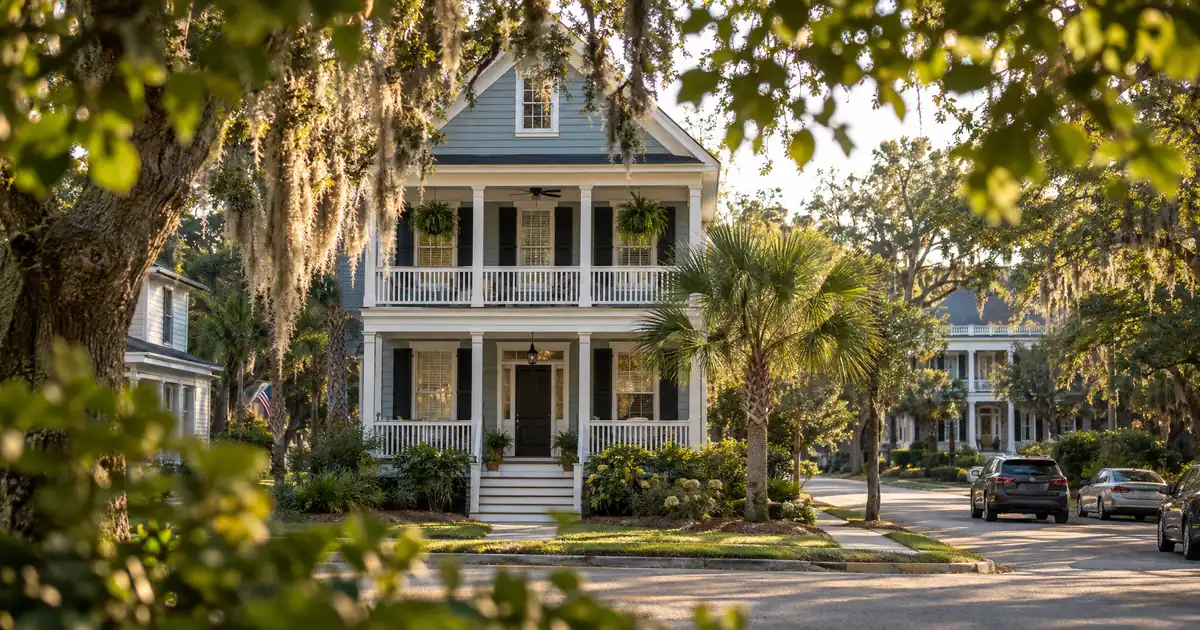
An out-of-state investor scrolling Charleston-area listings sees Hanahan and reads it as a quieter, cheaper cousin of the peninsula. The median home price is about $450,000 per Redfin, the suburb sits next to a naval weapons station, and Boeing and the port are a short drive away. What the investor tends to miss is the other side of the ledger. Only 32% of households rent, per RentCafe, and average rents sit around $1,407. That gap decides what a cash-out refinance can do here.
This piece is about pulling equity out of a Hanahan rental you already own. It is not about buying one. The mechanics are the 6-month seasoning clock, the 75% LTV ceiling, and rent that has to carry the full monthly obligation. The local question is which properties can carry that obligation once the new balance is in place. These specifics are subject to lender guidelines and a full review of property, leverage, and credit.
DSCR Cash-Out Calculator
Run the cash-out numbers in Hanahan, SC
Rate source: Freddie Mac 30-yr average via FRED® — Federal Reserve Bank of St. Louis · effective Sep 24, 2026
Prefilled with starting assumptions — enter your property’s value, balance, taxes, and insurance for a more accurate picture.
Program parameters update from Lendmire’s centralized guideline source. Taxes and insurance are editable estimates.
As of Sep 24, 2026 · General Freddie Mac market benchmark, not a Lendmire loan offer. Property value, balance, taxes, and insurance are editable estimates. Maximum loan-to-value varies by lender, program, property type, and seasoning. Not a Loan Estimate, approval, or commitment to lend. Program availability and eligibility are subject to lender guidelines, credit approval, property review, and underwriting.
TL;DR: A DSCR cash-out refinance on a Hanahan investment property is underwritten primarily on the rental income the property produces measured against its full monthly obligation, with cash-out capped at 75% of appraised value, subject to lender guidelines and property review.
- Redfin’s median sale price is about $450,000, so single-family coverage runs thin on apartment-average rents.
- Two- to four-unit properties and 3-bedroom layouts move the coverage ratio the most.
- Portal rent averages disagree by hundreds of dollars, so the appraiser’s rent schedule sets the number.
- Cash-out generally needs about 6 months of ownership measured from title recording.
What the Median Sale Price Does to Coverage
Hanahan’s price-to-rent gap is wide. A single-family property valued near the median produces a coverage ratio of roughly 0.5x on apartment-average rents, once taxes and insurance are included. Cash-out on that kind of property works only with much higher rent, much lower leverage, or a program built for sub-1.00 files.
The DSCR calculation is monthly rent used for lender review divided by the full monthly obligation: principal, interest, taxes, insurance, and any HOA dues. Most standard programs are built around a 1.00x benchmark, meaning rent covers the payment at that level. Some lenders review lower ratios, but those files usually come with lower leverage, different pricing, more reserves, or all three.
Run the numbers on a Hanahan house appraising at the $450,000 Redfin median, refinanced at the 75% cash-out ceiling. Assume it rents at the RentCafe average of $1,407 (a modeled assumption, not a single-family comp). Including taxes and insurance, coverage lands around 0.5x. Dropping leverage helps but does not close the gap on those rents. Terms vary by lender guidelines, property type, leverage, credit profile, and full file review.
Redfin’s figure comes with a caution. It counted only 17 sales in the month it measured, down from 24 a year earlier, so the median is noisy. Movoto shows a higher asking-price median of $525,000, or $261 per square foot. Asking prices run above sold prices, so that is a different number, not a contradiction. The appraisal is what matters for a refinance, and a thin sales sample means the appraiser will lean on a small set of comps.
Redfin puts appreciation at +2.4% year over year, with homes selling after 58 days on the market versus 68 the year before. That is modest growth and a market that is firming. Equity built through paydown and a lower original basis is real. But the appraisal alone will not create a cash-out that the rent can support.
Small Multifamily Is Where the Ratio Moves
Duplexes and larger workforce layouts pencil better than single-family in Hanahan because rent stacks by unit while price does not. The cash-out case is strongest on two- to four-unit properties and on layouts with 3-bedroom units, and weakest on median-priced single-family.
Homes.com showed only three multi-family listings in Hanahan, priced between $595,000 and $775,000. Thin inventory means few comps and slow appraisals. It also means owners of small multifamily here hold something scarce, which helps at refinance.
Model a duplex at the low end of that band, with two 2-bedroom units at the Apartments.com average asking rent of $1,369 each. At 75% LTV, including taxes and insurance, coverage comes out in the high-0.7s. Still under 1.00x. Exact terms depend on the lender’s guidelines, property type, leverage, and a full review of the borrower’s file.
Now change the layout. That same source shows $1,804 for a 3-bedroom, about $435 more per month than a 2-bedroom, or roughly 32% more rent. ApartmentFinder shows nearly identical figures ($1,368 and $1,804). Model the duplex with two 3-bedroom units and the same 75% LTV, and coverage moves close to 1.0x, again including taxes and insurance. That is the layout that puts a Hanahan file near the benchmark. Every figure here varies by lender and program — guidelines, property type, leverage, and credit profile all apply.
These are apartment-listing averages, not comps for small buildings, so treat them as modeled inputs. Below 1.00x on long-term rent, the paths a lender might review include a sub-1.00 program, interest-only structuring, or lower leverage. Each is subject to lender guidelines, credit approval, and property review. None is a given.
There is a market-rate angle too. RentCafe describes Hanahan’s rental buildings as averaging 42 years old, with only 25% built since 2000, all in 2-story garden-style form. Its sample covers large communities of 50 or more units. A renovated small property competes against dated complexes, but the data leaves out single-family rentals, so it is not proof of low vacancy. No sourced vacancy figure exists for Hanahan, and this article does not offer one.
Skip the Portal Averages
Hanahan rent figures vary by hundreds of dollars depending on the portal, so a DSCR file here should never rest on a published average. The appraiser’s rent schedule or actual lease evidence decides the coverage number.
Consider the range. RentCafe’s market-trends page shows $1,407, with rents down 0.43% year over year. Point2Homes shows $1,420 and notes 53% of rentals are two-bedroom. RentCafe’s apartment-listings page shows $1,536 on a different day. The Apartments.com market page shows $1,248. One aggregator shows $1,894, but that source is unreliable, so ignore it.
Most of these draw on large-complex data, and Point2Homes says its sample covers buildings of 50 or more units. That is not a small-multifamily or single-family rent source.
The gap between the low and high figures is several hundred dollars a month. On a file sitting near 1.00x, that spread decides whether coverage clears. The working rules:
- Single-family rentals: the appraiser’s Form 1007 rent schedule, or an executed lease.
- Two- to four-unit properties: Form 1025, or leases for each unit.
- Portal averages: context only. Never put them in the qualifying-rent line.
Lease evidence is where files stall. A month-to-month tenant with no written lease, or leases with mismatched dates, gives the lender little to reconcile against the appraiser’s number. Clean leases and a rent roll that match the appraisal keep the review narrow.
Who Actually Rents Here
Hanahan’s tenant base tracks employment: defense and naval installations, aerospace, port and logistics, and healthcare. The supported demand drivers sit inside and around the city, and the tenant pool is real but small..
Wikipedia notes that portions of Naval Weapons Station Charleston, including the Naval Consolidated Brig, are located in Hanahan. The city covers 11.5 square miles at the south end of Berkeley County. The Charleston Regional Development Alliance lists Boeing with more than 9,000 employees supporting 787 production, MUSC at about 17,000, and Joint Base Charleston supporting nearly 25,000 military and civilian jobs.
Locally, Data USA shows the largest industries among residents as manufacturing (1,318 people), professional, scientific, and technical services (1,243), and construction (1,135). The state’s Trident-area workforce profile, published by the SC Department of Employment and Workforce, lists Berkeley County Schools, Booz Allen Hamilton, Volvo Car USA, Robert Bosch, SAIC, and the regional hospital systems among the largest employers. Trident Medical Center in North Charleston is the nearest major hospital, and Trident Technical College is the regional community college.
Population is roughly 22,000 to 23,000. World Population Review puts it at 22,812, growing about 1.77% a year. Point2Homes reports a median household income of $84,061. The suburb is 68% owner-occupied, so the rental pool is thin. That cuts both ways. Tenants are stable and employer-linked, but a vacant unit has fewer nearby applicants than in a bigger rental market.
Neighborhood-level rent and price data for Hanahan does not exist in a reliable form, so this article does not rank subdivisions. If a property sits in a master-planned community with an HOA, get the HOA rental rules and the questionnaire in the file early. Feeder submarkets such as Goose Creek, North Charleston, and Summerville compete for the same tenants, and lower-priced housing there is often cited as producing stronger coverage. That is a broker observation, not market data. It is worth remembering when a Hanahan cash-out is meant to fund the next purchase.
Seasoning, LTV, and What “Equity” Means on Paper
A DSCR cash-out on a Hanahan rental generally requires about 6 months of ownership measured from title recording, a 75% maximum LTV, and rent that covers the full monthly obligation at the new balance. Available cash is what remains after all three constraints, and it is not a guaranteed figure.
Take the mechanics one at a time.
1. Seasoning. The clock generally starts at title recording, not the contract date or the closing appointment. The settlement statement documents it. A file that counts from the wrong date gets sent back.
2. The 75% ceiling. Cash-out LTV is capped at 75% of appraised value. That is a different cap from the purchase figure. Every dollar of value the appraiser misses is 75 cents less of potential cash. With a thin sales sample, this is where Hanahan files are most exposed.
3. Coverage at the new balance. Cash-out raises the balance, and the ratio is measured at that higher balance. A property that covered comfortably at its original loan can fall short after the refinance. Pulling less cash, or refinancing a lower-basis property, is often the fix.
4. Reserves and credit. Reserves are typically about 6 months of PITIA, rising to about 9 months above $1,500,000. Credit tiers run 620, 660, 680, and 700, with 620 as the floor. Loan amounts run up to $3,000,000 on standard programs, and smaller balances route through select lenders. These are guidelines, and they vary by borrower, property, and scenario.
Reserves documentation gets skipped on cash-out files because the borrower assumes the proceeds count. Usually the lender wants reserves from accounts that exist before the refinance funds. Show statements early.
Say you bought a Hanahan duplex well below today’s appraised value and the appraiser now supports a much higher figure. The equity is real. Whether it turns into usable cash depends on the 75% cap and on whether rent covers the payment on the larger loan. Both can be checked before the file goes anywhere, and the cash-out refinance details page walks through the structure. For a broader view, see the investment property refinance options. Investors comparing this with a bank product can read the guide “Where DSCR and Conventional Diverge”. Ineligible property types (manufactured homes, log homes, and barndominiums) fall outside these programs entirely.
Then there is the upside that shouldn’t be underwritten. The City of Hanahan has a Town Center revitalization effort backed by its comprehensive plan and town center master plan, and it intends to issue a developer RFP after acquiring a parcel. It is unbuilt. Treat it as possible appreciation for a later refinance, not as rent support today.
Verify current local rental rules, taxes, and insurance with qualified local professionals before running any of this.
DSCR vs. conventional financing
Two common ways to finance an investment property in Hanahan, SC. They qualify you differently — here’s how investors weigh them.
Why investors choose it
- Qualifies on the property’s rental income — no personal tax returns, W-2s, or pay stubs needed to document income.
- No personal debt-to-income ceiling to clear, so existing mortgages and obligations don’t cap your borrowing the same way.
- Can be closed in an LLC, keeping the property inside a business entity.
- Built for scaling — not held to the limit on number of financed properties that conventional financing applies.
- Underwriting centers on the deal: generally qualifies when the rent covers the payment, a 1.00x coverage ratio being a common baseline (confirmed in underwriting).
- Designed specifically for investment property, including long-term and, where the program allows, short-term rentals.
Where it’s strong
- Often the lowest ongoing financing cost for a buyer who fully qualifies on personal income — a fit for a first property or a cost-first purchase.
Trade-offs for investors
- Requires full personal income documentation and must fit within a debt-to-income limit — salary, existing debts, and other mortgages all count.
- Typically held in your personal name rather than a business entity.
- Caps how many financed properties you can carry, which can become a ceiling as a portfolio grows.
- Evaluates you as a borrower as much as the property, which usually means more paperwork.
How investors usually choose: a first or single property often optimizes for the lowest financing cost; portfolio builders often optimize for leverage, vesting in an LLC, and scaling past conventional caps. The right answer depends on your goals, the property, and current guidelines — both paths run through select lenders in Lendmire’s wholesale network, with eligibility and terms confirmed in underwriting.
How These Files Typically Look
DSCR files in markets like this one typically look like a fight between a healthy appraisal and a middling rent number. The value comes in fine, the seasoning is satisfied, and then the coverage ratio lands just under 1.00x because taxes and insurance were left out of the borrower’s own math. The files that go through cleanly are the ones where the rent schedule, the leases, and a full PITIA estimate were lined up before the appraisal was ordered.
Where the Proceeds Go
The reason to extract equity is the next deal, and Hanahan itself is not always the best place to redeploy it. Given the 0.31% monthly rent-to-price ratio implied by $1,407 rent against a $450,000 price (this is the article’s own arithmetic, not a published figure), pulling cash from a Hanahan property and buying in a lower-priced feeder market is a common pattern. Goose Creek and North Charleston sit within the same employment corridor.
The alternative is to keep the money in Hanahan, in a small multifamily property with 3-bedroom units. Inventory is scarce, so that path depends on availability. Either way, the refinance should be sized to the next property’s coverage, not just to the largest cash figure the 75% cap allows.
What a Local Appraiser Would Tell You
Hanahan is a small owner-occupied suburb squeezed between the base, the rail lines, and the Boeing corridor. Buyers and renters here mostly work nearby. That keeps demand steady, but it does not produce big rent jumps. A house that appraises well will not necessarily rent well, and a duplex with 3-bedroom units on both sides will get more attention from tenants and from underwriters than a median-priced single-family house. Plan the refinance around the rent, not the appraisal.
Frequently Asked Questions
How do you qualify for a DSCR cash-out refinance in Hanahan, South Carolina?
Qualification centers on the property’s rent covering its full monthly obligation, typically at a 1.00x benchmark, with about 6 months of ownership from title recording and a 75% LTV maximum. Credit tiers run from a 620 floor upward, and reserves are typically about 6 months of PITIA. All of it is subject to lender guidelines, credit approval, and property review.
What are the requirements for an investment property loan in Hanahan, SC?
Expect an appraisal with a rent schedule, a written lease or leases, proof of reserves, an insurance quote, and entity documents if the property is held in an LLC. Single-family and two- to four-unit properties are the usual fits. Manufactured homes, log homes, and barndominiums are not eligible. Guidelines vary by lender and scenario.
Why does a median-priced Hanahan house struggle to clear 1.00x?
Redfin’s median price is about $450,000, while average apartment rents sit near $1,407. Once taxes and insurance are included, that produces coverage around 0.5x at the 75% cash-out ceiling. Small multifamily and 3-bedroom layouts narrow the gap, though inventory is limited and rent figures need an appraiser’s schedule to confirm. Final terms depend on lender guidelines, property type, leverage, and the borrower’s complete credit picture.
Should I use portal rent averages for a Hanahan DSCR file?
No. Averages for Hanahan range from about $1,248 to $1,536 across major portals, and most reflect large apartment complexes rather than small rentals. Lenders generally rely on the appraiser’s Form 1007 (single-family) or Form 1025 (multi-unit) rent schedule, or on actual leases.
Can an LLC-owned Hanahan rental be reviewed for DSCR financing?
Yes, subject to lender program eligibility. Lendmire arranges DSCR investor loans and the programs qualify primarily on the property’s rental income. Entity documents and the operating agreement should be ready before the file goes in.
For current guidelines and terms, see Lendmire’s DSCR loan programs page.
About Lendmire
Lendmire (NMLS# 2371349), a non-QM mortgage broker serving investors in 41 markets including Washington, D.C., helps structure DSCR scenarios commonly evaluated around a property’s rental income rather than personal income paperwork, subject to lender guidelines. The firm was recognized by Scotsman Guide as a 2026 Top Workplace and recognized by Scotsman Guide in 2025. Lendmire places loans through wholesale investor lenders and is not a direct lender.
For broader investor-financing rules and property-type coverage across the state, see South Carolina DSCR loans.
Get Started
Ready to find the right loan for you?
In about 30 seconds you can review financing options available for your investment property. No commitment required.
Informational only. Not a Loan Estimate, approval, or commitment to lend. Program availability and eligibility are subject to lender guidelines, credit approval, property review, and underwriting.
References
1. Redfin: Hanahan Housing Market
2. RentCafe: Hanahan Average Rent
3. Movoto
4. Homes.com
7. RentCafe
8. Point2Homes
9. Wikipedia
10. Charleston Regional Development Alliance: Employers and Industry
12. SC Department of Employment and Workforce
13. World Population Review: Hanahan
14. Point2Homes
15. City of Hanahan: Town Center Project
16. recognized by Scotsman Guide as a 2026 Top Workplace
17. recognized by Scotsman Guide in 2025
This article is part of Lendmire’s investment property cash-out refinance program — full qualification details, guidelines, and scenarios live on the program page.
Related reading: DSCR Cash Out Refinance in Hanahan, South Carolina: Pulling Equity From a Thin Rental Pool · Cash Out Refinance Investment Property North Charleston South Carolina · DSCR Cash Out Refinance in Gaffney, South Carolina: Pulling Equity From a Thin-Rent Market
Guides: Investment Property Cash-Out Refinance in South Carolina
Brandon Miller
Founder & CEO, Mortgage Loan Originator, Lendmire LLC
- Mortgage Loan Originator · NMLS# 1129696 · Verify on NMLS Consumer Access
- North Carolina Real Estate Broker · License# 343312 · Verify on NCREC
- North Carolina Insurance Producer · License# 19053198 · Property, Casualty, Life, Health · Verify on NAIC SBS
- Lendmire LLC · Firm NMLS# 2371349 · Verify firm licensure
Disclosure information. Lendmire is a state-licensed mortgage brokerage under NMLS# 2371349. Lendmire is not a depository institution, direct lender, or financial advisor — all loans referenced are placed through wholesale lender partners and are subject to each lender's underwriting standards. This article is provided for general informational purposes and is not a commitment to lend, nor does it constitute financial, legal, or tax advice. Loan programs, terms, rates, and qualification standards change without notice and depend on borrower profile, property type, and the state in which the subject property is located. Equal Housing Opportunity provider. NMLS Consumer Access: nmlsconsumeraccess.org.