
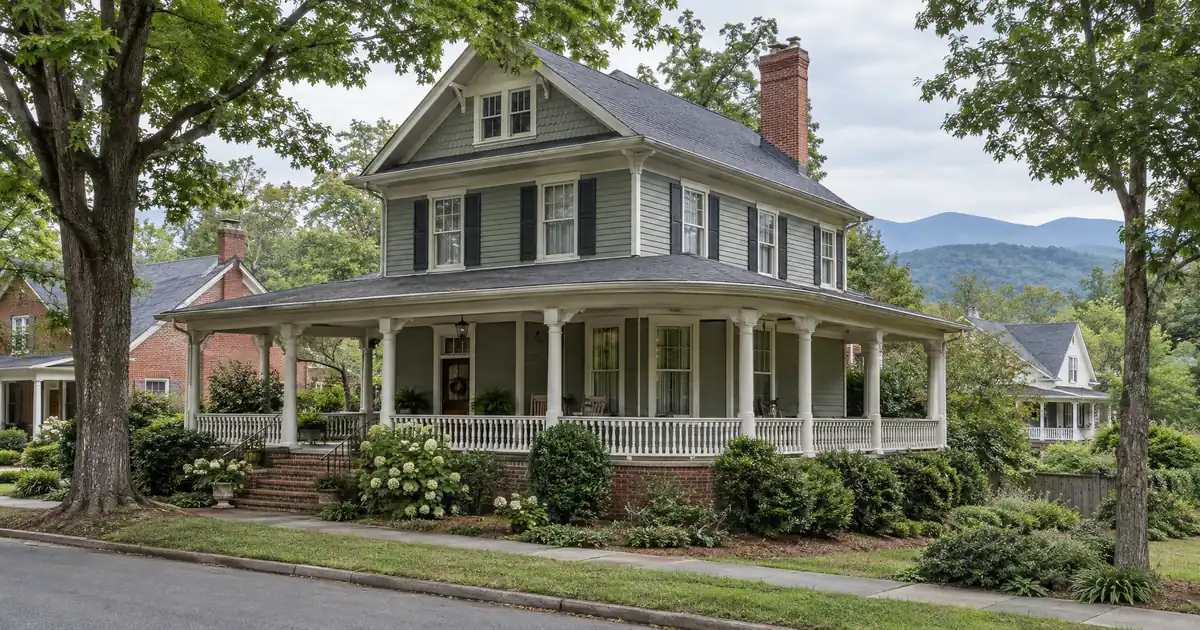
Most cash-out files don’t stall on equity. They stall on coverage, when an investor who has watched a property appreciate learns that the rent can’t carry the bigger balance. A DSCR cash out refinance in Hendersonville, North Carolina, is a test of how much debt the rent supports, and the maximum LTV ceiling is only the outer fence. Exact terms depend on the lender’s guidelines, property type, leverage, and a full review of the borrower’s file.
DSCR Cash-Out Calculator
Run the cash-out numbers in Hendersonville, NC
Rate source: Freddie Mac 30-yr average via FRED® — Federal Reserve Bank of St. Louis · effective Sep 24, 2026
Prefilled with starting assumptions — enter your property’s value, balance, taxes, and insurance for a more accurate picture.
Program parameters update from Lendmire’s centralized guideline source. Taxes and insurance are editable estimates.
As of Sep 24, 2026 · General Freddie Mac market benchmark, not a Lendmire loan offer. Property value, balance, taxes, and insurance are editable estimates. Maximum loan-to-value varies by lender, program, property type, and seasoning. Not a Loan Estimate, approval, or commitment to lend. Program availability and eligibility are subject to lender guidelines, credit approval, property review, and underwriting.
Key Takeaways:
In Hendersonville, North Carolina, a cash-out refinance is underwritten primarily on the property’s rental income measured against its full monthly obligation, which means coverage, not the 75% LTV ceiling, is usually the binding limit on single-family homes, while two-unit buildings clear the test with more room.
- Average home value: $412,994 per Zillow, down 1.9% year over year.
- Median single-family rent: $1,850 per Zillow Rental Manager.
- Renters make up 54% of households, so tenant depth isn’t the problem.
- Duplexes list from about $375,000, roughly the price of a median house with two rent streams.
- Cash-out requires about 6 months of seasoning and a 75% LTV cap, subject to lender guidelines.
Hendersonville Market Snapshot
A quick read on the Hendersonville investor landscape — figures come from the cited sources below. Confirm current property-level numbers before underwriting.
| Metric | Detail |
|---|---|
| Home prices | $425,495 median (Homes.com Hendersonville) |
| Typical rents | $1,614 avg (RentCafe – Average Rent) |
| University enrollment | 2,723 students (Data USA – Blue Ridge CC) |
| Population | 1,249 population (2020) (Wikipedia – Barker Heights) |
| Employment | 1,800+ employees (UNC Health Pardee – About Us) |
Start Near Pardee: Where the Coverage Holds
The strongest place to hold a cash-out candidate in Hendersonville is the close-in corridor around UNC Health Pardee and the downtown Health Sciences Center. Tenant demand there is tied to fixed, non-relocatable jobs, and that stability is what a lender wants to see behind a larger balance.
Pardee is the second-largest employer in Henderson County. Per its About Us page, it has 222 licensed acute care beds and more than 1,800 employees. Growth is still coming. Pardee is building three medical office buildings and an ambulatory surgery center, and a $30 million, 33-bed adolescent behavioral health facility is part of the expansion. According to WLOS, a 40,000-square-foot medical office building broke ground on Spartanburg Highway. That is close-in hiring, on a corridor rather than out in the county.
The demand mix supports the thesis. Data USA puts 1,039 Hendersonville residents in health care and social assistance, the largest single sector, ahead of retail trade at 1,014. Blue Ridge Community College’s downtown Health Sciences Center, which shares space with Pardee and Wingate University, feeds allied-health students and clinicians into the same neighborhood. The college enrolls 2,723 students. That isn’t a student-housing engine. It is a pipeline into the hospital workforce, which is the tenant profile that renews leases.
Skip the assumption that a premium exists for being near the hospital. The research found no neighborhood-level rent data for Hendersonville, so the case here is durability of demand, not a proven rent uplift. Treat it as a tenant-retention story and underwrite the rent at market.
Why Duplexes Beat Houses on the Coverage Test
Two-unit buildings are the cleanest way to extract equity in Hendersonville because they cost about what a median house costs and produce twice the rent. Single-family homes at median values struggle to clear 1.00x on a full-payment basis.
Start with the house. Zillow places the average value at $412,994; Redfin’s city-level median sits lower, at $400,000, reflecting a different methodology and measurement window. Against a $1,850 median house rent, gross rent-to-value works out to roughly 0.46% a month. Run the numbers on a modeled $400,000 house renting at that median, refinanced at the 75% LTV ceiling. Coverage, calculated as rent divided by full PITIA (principal, interest, taxes, and insurance), lands in the high-0.7x range. That is an illustrative model, not a sourced market figure. Every figure here varies by lender and program — guidelines, property type, leverage, and credit profile all apply.
Below 1.00x on long-term rent, the paths a lender may review include a lower-leverage cash-out, a sub-1.00 program, or an interest-only structure. Qualification stays subject to lender guidelines, credit approval, and property review. The practical effect is that the investor’s cash-out proceeds shrink well below what 75% of value would suggest. Coverage sets the loan size, and equity only sets the ceiling.
Now the duplex. Per Homes.com, Hendersonville had 15 multi-family listings priced from $375,000 to $1,900,000. The entry point is close to the single-family median. Assume two 2-bedroom units at a modeled $1,495 each, which matches Zumper’s 2-bedroom median. At 75% LTV including taxes and insurance, coverage lands around 1.3x. That’s a different loan file entirely, and it is the same appreciation and the same leverage. Rent roll is the whole difference. Final terms depend on lender guidelines, property type, leverage, and the borrower’s complete credit picture.
There is a structural detail worth knowing. Redfin’s Henderson County multi-family listings show a 20-unit duplex community selling with each duplex on its own parcel. Separate parcels mean an investor can own, refinance, or sell one building at a time, without a blanket lien. For a cash-out strategy, that flexibility is a real advantage over scattered single-family rentals.
The comparison in one place (modeled, at 75% LTV, full PITIA):
| Property type | Modeled rent | Coverage read |
|---|---|---|
| Single-family, ~$400K | $1,850 | Roughly 0.75x-0.80x |
| Duplex, ~$375K | 2 × $1,495 | Around 1.3x |
These specifics are subject to lender guidelines and a full review of property, leverage, and credit.
Those bands round down on purpose. A borrower who uses the model as a starting point and then gets an appraiser’s rent schedule will know quickly which side of 1.00 the file sits on.
What Does Seasoning Actually Measure?
Seasoning is a clock, not a test of appreciation. Most DSCR cash-out programs look for about six months of ownership measured from the date the deed was recorded, and that date, not the closing-table date, is the one that counts.
Here are the mechanics, in order:
1. Ownership clock. Roughly six months from title recording, on most files. Renovation timelines don’t reset it, but a recorded transfer between entities can.
2. Value. An appraisal sets the current value. The new loan can’t exceed 75% of it on a cash-out.
3. Rent. The appraiser’s rent schedule (or the in-place lease, where the program allows) is divided by full PITIA. The standard benchmark is 1.00x, though some lenders review lower ratios with compensating factors such as lower leverage, stronger credit, or more reserves.
4. Reserves and credit. About six months of PITIA in reserves is typical, rising for balances above $1,500,000. Credit tiers commonly run from a 620 floor up through 660, 680, and 700, with better tiers generally improving terms.
5. Payoff. The existing lien is paid first. Whatever is left after costs is the proceeds, and it is not a guaranteed cash figure.
Loan sizes go up to $3,000,000 on standard programs. Smaller balances route through select lenders in the network. Investors comparing structures can read the DSCR qualification mechanics and the conventional-vs-DSCR tradeoffs for the general framework. Every parameter above is a typical range, not a commitment, and exact eligibility depends on lender guidelines, credit profile, reserves, and property review.
The experience note here is a pattern one. On files from markets structurally like this one, small mountain-adjacent towns with high home values relative to rents, the common friction point is a borrower who priced the refinance off appraised value and never modeled the coverage. The cleaner files, documentation-wise, tend to arrive with a lease or a rent survey already in hand and a reserve balance seasoned in the account. Those two items settle most conversations before they start.
Trail-Adjacent and Fringe Submarkets
Outside the hospital core, the equity story turns on appreciation and entry price rather than rent. These submarkets can work for a cash-out, but they call for conservative assumptions.
Laurel Park and the Ecusta Trail. According to Conserving Carolina, the first six-mile section of the Ecusta Trail, from Hendersonville to Horse Shoe, is open. A 2012 feasibility study cited by Pilot Cove projected $42 million in community impact and $9.4 million a year in benefits, including higher property values along the corridor. Homes near Ecusta Crossing start in the $330Ks, per Howard Hanna, below the citywide average. That points to a purchase-side discount and a possible appreciation catalyst. It does not point to a rent premium, which hasn’t been shown. An investor already holding here is betting on a value step-up, and a cash-out only works if the appraisal shows it.
Barker Heights and East Flat Rock. Barker Heights had 1,249 residents at the last census, per Wikipedia’s Census-sourced entry, and borders East Flat Rock, where the auto-parts manufacturer Elkamet is based. Entry prices likely sit below the city core, though no sourced figure was found. The tenant story is industrial. Made In Henderson County counts 130 local manufacturers employing more than 5,700 people at an average wage of $67,000. Jabil’s announced expansion adds $102 million of investment and 148 jobs at wages above $62,000, per the Henderson County Partnership for Economic Development. Those are steady, above-service-sector paychecks supporting workforce houses.
Dana. With a population of 3,683 at the last census, Dana is the exurban option. Larger parcels can mean rural stock, and some rural building types are simply outside the network’s DSCR programs. Manufactured homes, log homes, and barndominiums fall outside these programs, and an investor holding one can’t count it as cash-out collateral.
Reading the Price Data Without Fooling Yourself
Hendersonville’s price data contradicts itself, and that matters for equity extraction because the appraisal, not a website, decides the loan. Investors should treat $370K to $413K as the working band for the city and underwrite to the low end.
Zillow shows values down 1.9% over the year. Redfin’s city snapshot showed an 8.4% gain. Redfin’s county data shows Henderson County’s median at $409K, down 4.7%. Days on market disagree too: about 49 days to pending on Zillow, 67 on Homes.com, and 108 on Redfin. The direction depends on the window and the source.
This is the appreciation-versus-cash-flow tension in a single market. An investor who bought before the peak may hold a lot of paper equity, but a flat appraisal means the 75% ceiling produces little new cash. The stronger play might be a smaller, better-covered building over a larger, equity-rich house, though an investor who expects the trail and hospital growth to keep lifting values could argue the other way. It’s a genuine toss-up, and the honest stress test uses flat values.
Rents complicate the picture in a useful way. RentCafe reports an average rent of $1,614, up 10.65% over the past year. Other providers land higher, with Zumper at $1,737. Rents rising against flat prices is exactly what improves coverage over time, and it explains why holding and re-testing a property can beat forcing a refinance early. The demographic backdrop is steady. Census Reporter shows 15,408 residents, a median age of 53.2, and a median household income of $53,449, while Henderson County has grown to about 122,375 residents, up 5.24% since the last census.
Where the Proceeds Go
Cash-out proceeds are acquisition capital, and the best use in this market is another two-unit building rather than another house. Redeploying equity into a duplex near the hospital corridor resets the coverage math in the investor’s favor.
Picture an investor holding a seasoned house with a bit more than 25 points of equity against current value. A cash-out to 75% LTV, sized to a coverage the lender accepts, could fund the down payment on a duplex. The new property carries its own rent roll, so the combined portfolio’s coverage improves even though total debt rises. Lendmire’s guide to pulling equity out covers the mechanics in more detail. Terms vary by lender guidelines, property type, leverage, credit profile, and full file review.
The Blind Spot: Slow Absorption
The biggest risk for DSCR-financed investors in Hendersonville is not tenant demand. It is an appraisal that comes in flat while coverage sits near 1.00x. Homes sell more slowly than the national average, and the citywide median over the trailing twelve months was down about 3%. An investor who plans a cash-out on the assumption of recent appreciation may find that both constraints bind at once. Verify current local rental rules, taxes, and insurance with qualified local professionals, and stress-test every file at flat value.
DSCR vs. conventional financing
Two common ways to finance an investment property in Hendersonville, NC. They qualify you differently — here’s how investors weigh them.
Why investors choose it
- Qualifies on the property’s rental income — no personal tax returns, W-2s, or pay stubs needed to document income.
- No personal debt-to-income ceiling to clear, so existing mortgages and obligations don’t cap your borrowing the same way.
- Can be closed in an LLC, keeping the property inside a business entity.
- Built for scaling — not held to the limit on number of financed properties that conventional financing applies.
- Underwriting centers on the deal: generally qualifies when the rent covers the payment, a 1.00x coverage ratio being a common baseline (confirmed in underwriting).
- Designed specifically for investment property, including long-term and, where the program allows, short-term rentals.
Where it’s strong
- Often the lowest ongoing financing cost for a buyer who fully qualifies on personal income — a fit for a first property or a cost-first purchase.
Trade-offs for investors
- Requires full personal income documentation and must fit within a debt-to-income limit — salary, existing debts, and other mortgages all count.
- Typically held in your personal name rather than a business entity.
- Caps how many financed properties you can carry, which can become a ceiling as a portfolio grows.
- Evaluates you as a borrower as much as the property, which usually means more paperwork.
How investors usually choose: a first or single property often optimizes for the lowest financing cost; portfolio builders often optimize for leverage, vesting in an LLC, and scaling past conventional caps. The right answer depends on your goals, the property, and current guidelines — both paths run through select lenders in Lendmire’s wholesale network, with eligibility and terms confirmed in underwriting.
Frequently Asked Questions
How do you qualify for a DSCR loan in Hendersonville, North Carolina?
Qualification centers on the property’s rent versus its full monthly obligation, with 1.00x as the common benchmark. Lenders also review credit (typically a 620 floor), reserves of about six months, and the appraisal. Because median house rents run close to 0.46% of value, duplexes and lower-leverage refinances tend to clear more easily than single-family homes. Final eligibility depends on lender guidelines and property review.
What are the requirements for an investment property cash-out refinance in Hendersonville, NC?
Expect about six months of ownership from title recording, a maximum 75% LTV, coverage of at least 1.00x on most programs, and around six months of PITIA in reserves. Loan amounts go up to $3,000,000 on standard programs. Manufactured homes, log homes, and barndominiums fall outside the programs. Terms vary by borrower, property, and lender.
Can an LLC-owned Hendersonville rental be reviewed for DSCR financing?
Yes, subject to lender program eligibility. Lendmire arranges DSCR investor loans and the review centers on the property’s rental income rather than W-2 documentation. Entity vesting rules differ by lender, so the LLC’s structure should be reviewed before the file goes out.
Does the Pardee expansion make single-family rentals near downtown safer to refinance?
It supports tenant demand, not appraised value. The hospital’s building program suggests steady hiring, which helps retention and lease renewals. But an appraiser values the house on comparable sales, and those have been flat to down. The expansion helps coverage stability more than it helps proceeds.
Should a Hendersonville investor wait for rents to rise before refinancing?
Often, yes, if coverage sits below 1.00x. RentCafe shows rents up more than 10% year over year, while values have been flat. Waiting can improve coverage without adding any equity, and the six-month seasoning clock keeps running in the meantime.
For current guidelines and terms, see Lendmire’s DSCR loan programs page.
About Lendmire
Lendmire, NMLS# 2371349, is a mortgage brokerage specializing in DSCR investor loans, helping arrange financing across 41 markets, including Washington, D.C., through wholesale and investor-lending channels. Its model centers on property-level rental income reviewed by the lender rather than W-2 documentation, subject to lender guidelines, which suits entity-owned and multi-property investors. Lendmire is recognized as a 2025 Scotsman Guide Top Mortgage Workplace and a 2026 Scotsman Guide Top Workplace.
For broader investor-financing rules and property-type coverage across the state, see North Carolina DSCR loans.
Get Started
Ready to find the right loan for you?
See your offer in seconds. No credit pull, no obligation.
Informational only. Not a Loan Estimate, approval, or commitment to lend. Program availability and eligibility are subject to lender guidelines, credit approval, property review, and underwriting.
References
2. $1,850 per Zillow Rental Manager
3. RentCafe — Average Rent Market Trends Hendersonville
4. Homes.com
9. WLOS
10. Data USA
11. Redfin’s city-level median
12. Zumper’s
13. Redfin’s Henderson County multi-family listings
15. Pilot Cove
16. Howard Hanna
18. Henderson County Partnership for Economic Development
20. Census Reporter — Hendersonville NC
21. a 2025 Scotsman Guide Top Mortgage Workplace
22. a 2026 Scotsman Guide Top Workplace
This article is part of Lendmire’s investment property cash-out refinance program — full qualification details, guidelines, and scenarios live on the program page.
Related reading: Cash Out Refinance Investment Property in Hendersonville, North Carolina · Cash Out Refinance Investment Property Hendersonville Tennessee · Cash Out Refinance Investment Property in Indian Trail, North Carolina: Commuter Rental Equity
Guides: Investment Property Cash-Out Refinance in North Carolina
Brandon Miller
Founder & CEO, Mortgage Loan Originator, Lendmire LLC
- Mortgage Loan Originator · NMLS# 1129696 · Verify on NMLS Consumer Access
- North Carolina Real Estate Broker · License# 343312 · Verify on NCREC
- North Carolina Insurance Producer · License# 19053198 · Property, Casualty, Life, Health · Verify on NAIC SBS
- Lendmire LLC · Firm NMLS# 2371349 · Verify firm licensure
Important disclosures. Lendmire (NMLS# 2371349) is a licensed mortgage brokerage. Lendmire is not a direct lender, depository institution, or financial advisor. All loan inquiries are subject to lender underwriting; this article does not constitute a commitment to lend. Rates, terms, and program guidelines are subject to change without notice and vary by borrower profile, property type, and state. Information in this article is general in nature and is not financial, legal, or tax advice. Equal Housing Opportunity. NMLS Consumer Access: nmlsconsumeraccess.org.