
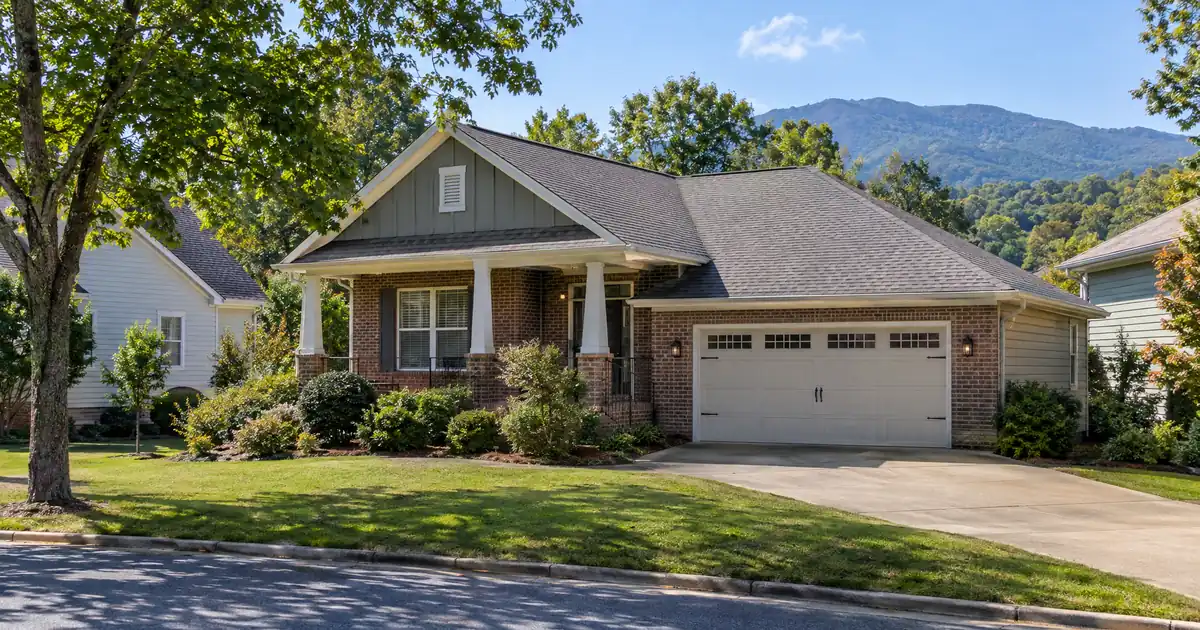
Picture an investor holding a three-bedroom rental bought for $290,000 (a modeled figure, not a market quote) in the residential streets near Ashe County High School. The tenant is stable and the lease renews on schedule. The investor wants that trapped equity for a second property, and the question is how much of it the loan-to-value ceiling and the rent-to-debt ratio will actually release. In West Jefferson the answer depends more on the ratio than on the equity.
The Short Version: A DSCR cash-out refinance on a West Jefferson, North Carolina rental is underwritten primarily on the property’s rental income measured against its full monthly obligation. Proceeds are capped by a 75 percent loan-to-value ceiling and a seasoning window of roughly six months from title recording, subject to lender guidelines.
DSCR Cash-Out Calculator
Run the cash-out numbers in West Jefferson, NC
Rate source: Freddie Mac 30-yr average via FRED® — Federal Reserve Bank of St. Louis · effective Sep 24, 2026
Prefilled with starting assumptions — enter your property’s value, balance, taxes, and insurance for a more accurate picture.
Program parameters update from Lendmire’s centralized guideline source. Taxes and insurance are editable estimates.
As of Sep 24, 2026 · General Freddie Mac market benchmark, not a Lendmire loan offer. Property value, balance, taxes, and insurance are editable estimates. Maximum loan-to-value varies by lender, program, property type, and seasoning. Not a Loan Estimate, approval, or commitment to lend. Program availability and eligibility are subject to lender guidelines, credit approval, property review, and underwriting.
- Zillow’s value index puts the average local home at $365,129, up 4.0 percent over the past year.
- Redfin’s $461K median rests on six August sales. Treat it as noise.
- Single-family rent-to-value runs thin, so duplexes and fourplexes stack income better.
- Hospital and manufacturing payrolls anchor long-term renter demand.
West Jefferson Market Snapshot
A quick read on the West Jefferson investor landscape — figures come from the cited sources below. Confirm current property-level numbers before underwriting.
| Metric | Detail |
|---|---|
| Home prices | $461K median (Redfin) |
| University enrollment | 2,610 students (Ashe County Schools) |
| Employment | ~12,000 high country manufacturing workers (Grow Ashe) |
The Streets Near Campus Drive Are Where the Ratio Behaves
Older in-town single-family houses near Ashe County High School are the strongest cash-out candidates in West Jefferson. They are the stock most likely to have been bought below today’s mountain-view prices, which leaves the widest equity gap. They also sit in the family and workforce pocket of the town, where lease demand comes from payroll rather than second-home buyers.
Rents here are modest against values. Asking rents for three-bedroom houses near town range from roughly $1,300 to $1,875 a month, according to sample listings on Zillow rentals and Apartments.com. Against a value index in the mid-$300,000s, that puts gross rent near 0.4 to 0.6 percent of value per month. That is Lendmire Research’s arithmetic on listing samples, not a published statistic.
The modeled consequence is blunt. Including taxes and insurance at a 75 percent cash-out LTV, a house in that band lands somewhere between the low 0.7s and about 1.0. The standard benchmark for most DSCR programs is 1.00, the level where rent covers the full obligation. Some lenders review lower ratios, but those files usually need lower leverage, stronger reserves or different pricing.
Not ideal. But a thin single-family ratio doesn’t end the conversation. It points toward specific structures, covered further down.
Hospital Corridor: Payroll Demand Without the Mountain Premium
The Jefferson corridor, about three to four miles east between the two towns, holds Ashe Memorial Hospital and county government. The Town of Jefferson calls the hospital the area’s single-largest employer, and its LinkedIn profile lists a self-reported staff of 201 to 500 people, or several hundred. Nurses, medical assistants and elder-care workers form a natural long-term tenant pool. Nearby employers include Ashe Services for Aging and two nursing facilities.
Resident-employment data shows why healthcare renters matter. Per Data USA, West Jefferson residents held 562 jobs in the latest reading, down from 649 the year before. Retail led with 116 people, health care and social assistance followed with 82, and accommodation and food service had 62. It is small-sample ACS data, so read it directionally. The direction has two sides: payroll is concentrated in a few sectors, and the town’s job count is soft.
The county backdrop is steadier. Ashe County Economic Development puts the county at about 27,500 residents and roughly 30 miles from Appalachian State University. Grow Ashe reports an average county salary of $47,000 and almost 12,000 manufacturing workers across the High Country region. The county’s Work in Ashe page describes American Emergency Vehicles and GE Aviation as experiencing tremendous growth. No employer headcounts were published for either.
Downtown Arts District: Small Units, Loud Demand
Downtown along North and South Jefferson Avenue is walkable and historic, with galleries, breweries and restaurants. EdNC notes the first of the town’s 17 murals went up in 1996. Per the Blue Ridge Parkway partner site, Christmas in July regularly draws more than 20,000 visitors to a town of about 1,300 residents.
Visitors don’t sign twelve-month leases. The tenants here are service and retail workers and artists, and the demand shows up in one-bedroom rents. A one-bedroom apartment in Jefferson lists near $1,550, and a one-bedroom house in Warrensville near $1,000, per the same listing portals. That is a high share of three-bedroom rents, and it changes the small-multifamily math.
Run the numbers on a modeled duplex valued near $400,000 with each unit renting at $1,300. Gross rent of $2,600 is about 0.65 percent of value, which lands near 1.0 to 1.05 including taxes and insurance at 75 percent LTV. Those rents are assumptions drawn from listing samples, not confirmed leases. The extra unit adds income without adding a second full-priced structure, and that is the lever. Whether it holds depends on the rents surviving an appraiser’s rent schedule.
What Are the Mount Jefferson and Paddy Mountain Flanks Worth to a Lender?
Mount Jefferson to the east and Paddy Mountain to the west hold view-property and second-home stock. These homes inflate the town’s headline prices without producing proportionate rent. They also introduce a property-type screen that catches many mountain buyers. Manufactured homes (single- and double-wide), log homes and barndominiums fall outside the network’s DSCR programs, and log construction is common in these hills.
Appraisals here carry extra variance. Redfin shows a median sale price of $461K, up 51.2 percent year over year. But only six homes sold in August, down from 13 a year earlier, and days on market stretched to about 60 from 48. Movoto lists a median asking price near $484K, essentially flat year over year. The Zillow index at $365,129 and 4.0 percent growth is the steadier trend read, and the one to underwrite against. (Older Census-based values in the low-to-mid $200,000s lag far behind current sales and shouldn’t guide anything.)
Thin comps cut both ways. An appraiser may pull from across Ashe County and adjust for acreage, views or second-home sales. That can push value, and the cash-out amount, either direction. The conservative play is to assume the lower appraisal and treat any upside as a bonus.
The Equity Math: LTV Ceiling, Seasoning and Reserves
The cash-out ceiling is 75 percent of appraised value, and the program generally looks for about six months of ownership measured from title recording. Credit tiers run from a 620 floor up through 660, 680 and 700, with better tiers generally improving leverage and pricing options. Reserves are typically around six months of PITIA. Qualification remains subject to lender overlays, and equity available depends on rent used for lender review, the full obligation, reserves and that 75 percent cap. It is not a guaranteed cash figure. Investors can size a file with Lendmire’s DSCR cash-out refinance overview before ordering an appraisal.
Appreciation is the first driver. If the original payoff sits high against the purchase price, a 75 percent cap on a modest appraisal can leave little or nothing to pull. Consider a scenario where the house appreciated at the Zillow index’s pace for a couple of years. The equity gap opens gradually, and only if the original leverage was conservative. That is why the article’s opening scenario matters. Buying below market and holding through even mid-single-digit growth is the setup that works.
Rent is the second driver, and it can veto the first. When a single-family file falls below 1.00 on long-term rent, the paths a lender may review include a sub-1.00 program, interest-only structuring or a lower LTV. All remain subject to credit approval and property review. The investor should also base rent on a signed lease or an appraiser’s rent schedule, not portal averages. Sources here conflict badly: Zumper’s stale listing-based median is $1,800 for all rentals, while Census-lagged aggregators show figures barely a third of that. Lenders use current lease-based rents.
The deal desk sees a repeating pattern in small rural markets like this one. Rent-to-value is the friction point, and appraisal comp depth is the second. The cleaner files usually arrive with a signed lease already in hand, a rent schedule ordered early and a realistic view of which comps an appraiser will reach for. Smaller balances can also route to select lenders in the network, so loan size is worth checking at the start. For LLC-titled properties, eligibility is subject to lender program eligibility.
Renter Demand Rests on a Supply Gap
A supply gap supports renter demand. Per an NC Chamber analysis reported by The Reflector, Ashe County had a rental gap of 312 units and a for-sale gap of 965 units. Owning is out of reach for many households, and a regional study reported by the Ashe Post & Times found the average High Country family would have needed nearly 80 percent of its income to afford market pricing.
The ceiling is real, though. Local reporting citing the NC Housing Coalition says 41 percent of local renters struggle to afford their homes. Well-priced units should stay occupied, but rents can’t be pushed to rescue a thin ratio. New multifamily supply is sparse and clustered around the two towns, so duplex-to-fourplex and workforce single-family owners face little institutional competition. No sourced duplex or fourplex price or rent figures exist for the town, so underwrite from actual listings.
This is a genuine trade-off. The single-family route is simpler to own and appraise but leaves the ratio short. The small-multifamily route pencils better but has fewer comps and less inventory. Investors are often better off with a smaller multi-unit building than a mountain-view house, though those chasing appreciation could argue the reverse.
To compare structures, use the comparison of DSCR and conventional loans. For a broader overview of how the ratio works, see Lendmire’s primer on DSCR loans. Statewide program detail is at DSCR loan options for North Carolina investors. Where some institutional lenders cap portfolios at 10 financed properties, a broker placing files through a wholesale network can match a file to programs with different limits. Owners exploring alternatives to cash-out can review refinancing options. To model a specific file, compare DSCR options or call 828-256-2183.
The Choice in Front of a West Jefferson Owner
Two real paths exist. One is to hold the single-family house, wait for appreciation to widen the equity gap and accept a ratio that may sit below 1.00 until rents catch up, which trades time for cleaner leverage. The other is to reposition into a duplex or small multi-unit building where the income stacks and coverage clears, which trades a simple asset for a thinner pool of comps and listings.
DSCR vs. conventional financing
Two common ways to finance an investment property in West Jefferson, NC. They qualify you differently — here’s how investors weigh them.
Why investors choose it
- Qualifies on the property’s rental income — no personal tax returns, W-2s, or pay stubs needed to document income.
- No personal debt-to-income ceiling to clear, so existing mortgages and obligations don’t cap your borrowing the same way.
- Can be closed in an LLC, keeping the property inside a business entity.
- Built for scaling — not held to the limit on number of financed properties that conventional financing applies.
- Underwriting centers on the deal: generally qualifies when the rent covers the payment, a 1.00x coverage ratio being a common baseline (confirmed in underwriting).
- Designed specifically for investment property, including long-term and, where the program allows, short-term rentals.
Where it’s strong
- Often the lowest ongoing financing cost for a buyer who fully qualifies on personal income — a fit for a first property or a cost-first purchase.
Trade-offs for investors
- Requires full personal income documentation and must fit within a debt-to-income limit — salary, existing debts, and other mortgages all count.
- Typically held in your personal name rather than a business entity.
- Caps how many financed properties you can carry, which can become a ceiling as a portfolio grows.
- Evaluates you as a borrower as much as the property, which usually means more paperwork.
How investors usually choose: a first or single property often optimizes for the lowest financing cost; portfolio builders often optimize for leverage, vesting in an LLC, and scaling past conventional caps. The right answer depends on your goals, the property, and current guidelines — both paths run through select lenders in Lendmire’s wholesale network, with eligibility and terms confirmed in underwriting.
Frequently Asked Questions
How do you qualify for a DSCR loan in West Jefferson?
Qualification centers on the property’s rent against its full monthly obligation, typically at a 1.00 baseline, along with a credit score generally at or above 620 and reserves of about six months. Lenders review borrower, property and program guidelines. Rent evidence such as a signed lease or an appraiser’s rent schedule carries more weight here than portal averages.
What are the requirements for an investment property loan in West Jefferson, North Carolina?
Expect a 75 percent LTV ceiling on cash-out, about six months of seasoning from title recording, and eligible property types. Manufactured homes, log homes and barndominiums fall outside the network’s DSCR programs. Loan amounts run up to $3,000,000 on standard programs, and smaller balances route through select lenders.
Why do West Jefferson home values look so different across sources?
Sample size and method drive the spread. Redfin’s $461K median reflects six August sales, Zillow’s smoothed index shows $365,129, and older Census-based figures sit far lower. An appraiser will draw comps from the wider county, so the appraised number can differ from any portal.
Do duplexes work better than houses for a cash-out here?
Often, yes, because one-bedroom rents run close to three-bedroom rents, so each added unit contributes a large share of income. A modeled duplex can reach about 1.0 including taxes and insurance, where a single-family house tends to land below. Confirm rents against actual listings or leases before relying on it.
For current guidelines and terms, see Lendmire’s DSCR loan programs page.
About Lendmire
Lendmire is a non-QM mortgage brokerage (NMLS# 2371349) arranging DSCR investor loans in 41 markets, including Washington, D.C., through wholesale and investor-lending channels. The lender evaluates DSCR loans on rental income rather than personal income, subject to lender guidelines, which suits LLC-owned portfolios, self-employed investors and operators scaling past conventional loan caps. Lendmire was recognized by Scotsman Guide as a 2026 Top Workplace and was a top-ranked workplace in 2025.
Get Started
Ready to find the right loan for you?
See your offer in seconds. No credit pull, no obligation.
Informational only. Not a Loan Estimate, approval, or commitment to lend. Program availability and eligibility are subject to lender guidelines, credit approval, property review, and underwriting.
References
1. Zillow home values, West Jefferson
2. Redfin housing market, West Jefferson
4. Grow Ashe
9. Ashe County Economic Development
10. Work in Ashe
11. EdNC
12. Blue Ridge Parkway, Jefferson and West Jefferson
13. The Reflector, NC Chamber housing gap analysis
15. reflector.com — Housing and Childcare Costs Impact Ashe Economy
16. recognized by Scotsman Guide as a 2026 Top Workplace
17. Scotsman Guide — Top Workplaces 2025
This article is part of Lendmire’s investment property cash-out refinance program — full qualification details, guidelines, and scenarios live on the program page.
Related reading: Cash Out Refinance Investment Property West Jefferson North Carolina · DSCR Cash Out Refinance Boone North Carolina: How Mountain City Investors Access Equity · DSCR Cash Out Refinance Cashiers North Carolina
Guides: Investment Property Cash-Out Refinance in North Carolina
Brandon Miller
Founder & CEO, Mortgage Loan Originator, Lendmire LLC
- Mortgage Loan Originator · NMLS# 1129696 · Verify on NMLS Consumer Access
- North Carolina Real Estate Broker · License# 343312 · Verify on NCREC
- North Carolina Insurance Producer · License# 19053198 · Property, Casualty, Life, Health · Verify on NAIC SBS
- Lendmire LLC · Firm NMLS# 2371349 · Verify firm licensure
Required disclosures. Lendmire (NMLS# 2371349) operates as a licensed mortgage broker, not a direct lender or depository. The discussion in this article is general in nature and should not be relied upon as financial, legal, or tax advice — every investment scenario is unique and should be reviewed by a qualified professional. Any loan inquiry is subject to lender underwriting, and this article is not a commitment to lend or a guarantee of approval. Mortgage rates, loan terms, and program guidelines vary by borrower, property, and state, and may change without notice. Equal Housing Opportunity. Verify licensure at NMLS Consumer Access.